



LTE Advanced Pro Market Size, Companies, Share, Vehicle Production Volume, Sales Performance, Export & Import Analysis, Technology Adoption, Competitive Positioning, and Demand Trends
LTE Advanced Pro Market (By Service Type: Deployment Services, Managed Services, Consulting Services; By Technology: Carrier Aggregation, Massive MIMO, Network Slicing, Ultra-Reliable Low-Latency Communication; By Application: Mobile Broadband, Machine-to-Machine Communication, Public Safety, Fixed Wireless Access; By End-Use: Consumer Electronics, Automotive, Smart Cities, Telecommunications) - Global Industry Analysis, Size, Trends, Leading Companies, Regional Outlook, and Forecast 2026 to 2035
Source: https://www.precedenceresearch.com/lte-advanced-pro-market
 Get a Sample
 Table Of Content


What is the LTE Advanced Pro Market Size in 2026?
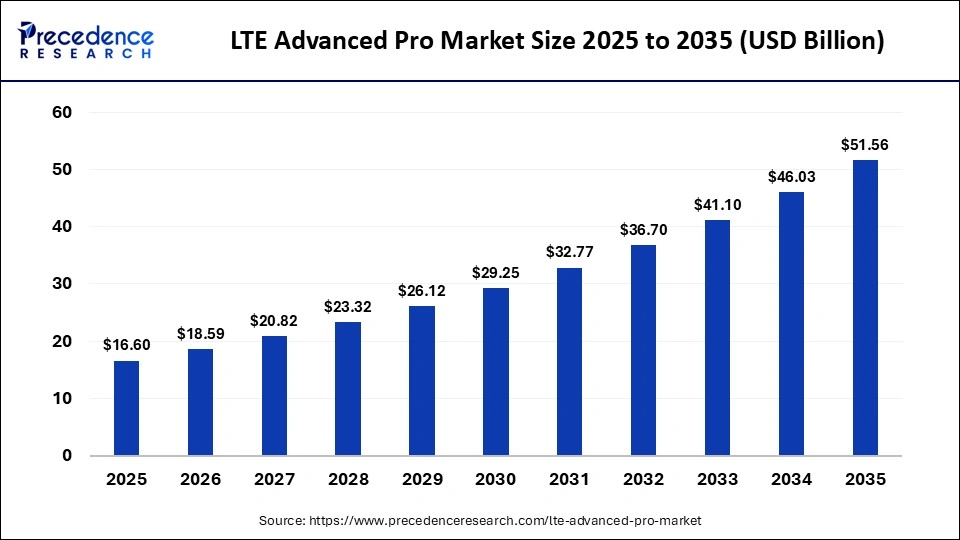
The global LTE advanced pro market size was calculated at USD 16.60 billion in 2025 and is predicted to increase from USD 18.59 billion in 2026 to approximately USD 51.56 billion by 2035, expanding at a CAGR of 12.00% from 2026 to 2035. The market is driven by the growing demand for high-speed, low-latency mobile broadband, enhanced network capacity, and seamless connectivity for IoT, smart devices, and next-generation applications.
Key Takeaways
- North America led the market in 2025.
- Asia Pacific is expected to grow at a significant CAGR during the forecast period.
- By technology, the carrier aggregation segment held the largest share of the market in 2025.
- By technology, the massive MIMO segment is expected to expand with the highest CAGR during the forecast period.
- By application, the mobile broadband segment dominated the market in 2025.
- By application, the machine-to-machine communication segment is expected to grow at the fastest CAGR during the forecast period.
- By service type, the deployment services segment held the largest share of the market in 2025.
- By service type, the managed services segment is expected to grow at the highest CAGR between 2026 and 2035.
- By end-use, the telecommunications segment held the highest share of the market in 2025.
- By end-use, the consumer electronics segment is expected to grow with the highest CAGR during the forecast period.
Market Overview
Long-Term Evolution Advanced Pro (LTE-A Pro) is an iteration of the LTE mobile network standard that provides improved performance metrics and features, such as quicker data transmission speeds, greater network capacity, and expanded coverage areas. LTE-A Pro features improved capabilities for mobile devices like carrier aggregation, higher-order MIMO (multiple-input multiple-output), and optimized network efficiency to deliver a wireless experience at elevated speeds for users across the network.
Software Defined Networking (SDN) and Network Function Virtualization (NFV) are the core technologies behind LTE-A Pro. SDN refers to a way that networks are managed for dynamic configuration, in a programmatic fashion that can improve overall network performance monitoring. The communications infrastructure can reach out from small cells to macro cells, to radio access networks (RAN) equipment, and distributed antenna systems (DAS), serving various end-users, such as retail outlets, transportation services, healthcare facilities, residential areas, industrial operations, commercial enterprises, etc.
The LTE advanced pro market deals with providing 4.5G or pre-5G service around the world. It involves low-latency, high-speed mobile networking technology based on 3GPP Releases 13 and 14. This technology bridges between 4G and 5G by delivering Gigabit speeds (around 3 Gbps) for supporting IoT connectivity, and boosts network efficiency, capacity, and coverage for telecom operators. The surging adoption of IoT devices in the industrial sector, as well as the growing demand for superior network coverage in remote areas, is driving market growth. This market is expected to attain immense traction with the growth of the telecom sector globally.
How is AI Impacting the LTE Advanced Pro Market?
AI plays a critical role in transforming the LTE advanced pro market by automating operations, enhancing network efficiency, and optimizing network performance to handle complex traffic requirements. This technology leverages AI to change from reactive to proactive management, which enables higher data speeds and lower latency. These features are important for Internet of Things (IoT) and vehicular communication (C-V2X) applications. AI algorithms also analyze real-time traffic patterns to reduce bottlenecks, optimize infrastructure, and allocate resources to enhance networking capabilities. AI further enables licensed assisted access (LAA) by analyzing the use of unlicensed spectrum and enabling dynamic configuration of uplink/downlink capacity based on real-time network traffic.
- In March 2026, Nordic Semiconductor launched a new range of ultra-low-power cellular IoT products and technologies. These products are based on edge AI technology to deliver secure LTE connectivity across IoT devices.
LTE Advanced Pro Market Trends
- Partnerships: Numerous smartphone companies are partnering with 3rd party vendors to deliver LTE-based services for enhancing the internet surfing experience.
- Services Launches: Market players are engaged in delivering 4.5 G services in the remote areas to improve scalability and hold their dominant position in the industry.
- Business Expansions: Several LTE providers are constantly expanding their networks in isolated regions to provide superior internet capabilities.
- Investments: Various telecom companies are investing rapidly in deploying advanced LTE technologies to strengthen remote working capabilities.
- Popularity of V2X Network: The popularity of V2X communication has grown significantly in numerous countries, including the U.S., China, Italy, and the UAE, which increases the demand for high-speed internet.
- Rising Smart City Initiatives: The governments of several regions are constantly focusing on launching numerous initiatives to develop smart cities globally.
Market Scope
| Report Coverage | Details |
| Market Size in 2025 | USD 16.60 Billion |
| Market Size in 2026 | USD 18.59 Billion |
| Market Size by 2035 | USD 51.56 Billion |
| Market Growth Rate from 2026 to 2035 | CAGR of 12.00% |
| Dominating Region | North America |
| Fastest Growing Region | Asia Pacific |
| Base Year | 2025 |
| Forecast Period | 2026 to 2035 |
| Segments Covered | Service Type, Technology, Application, End-Use ,and region |
| Regions Covered | North America, Europe, Asia-Pacific, Latin America, and Middle East & Africa |
Segment Insights
Technology Insights
What Made Carrier Aggregation the Leading Segment in the LTE Advanced Pro Market?
The carrier aggregation segment led the market with the largest share in 2025. This is due to its important role in optimizing spectrum utilization and improving network speed. Carrier aggregation helps telecom providers to deliver high-speed data by combining several frequency bands into a single channel. This technology is widely adopted in densely populated areas to support upcoming digital services.
The massive MIMO segment is expected to grow at the highest CAGR during the forecast period, owing to its capability in improving spectral efficiency and enhancing data transmission speed. Massive MIMO uses numerous antennas at base stations to receive and transmit various data streams accordingly, which allows data operators to serve a wide range of population by maintaining superior network performance.
Application Insights
Why Did the Mobile Broadband Segment Dominate the LTE Advanced Pro Market?
The mobile broadband segment dominated the LTE advanced pro market in 2025 due to the surging demand for high-speed mobile data among smartphone users. LTE advanced pro technology delivers superior data speed, enhanced network efficiency, and low latency as compared to LTE bands. Telecom operators have started deploying LTE Advanced Pro to support advanced video streaming and a superior browsing experience.
The machine-to-machine communication segment is expected to expand at the fastest CAGR during the forecast period, owing to the surging popularity of connected devices along with the surging adoption of automated communications among machines. Machine-to-machine communication allows several devices, including meters, vehicles, sensors, and industrial equipment, to exchange data without human intervention. LTE advanced pro network delivers low latency and superior coverage to support large-scale M2M deployments. Several industries, such as transportation, logistics, utilities, and manufacturing, are highly dependent on M2M infrastructure.
Service Type Insights
Why Did the Deployment Services Segment Dominate the LTE Advanced Pro Market?
The deployment services segment dominated the market while holding a major share in 2025, owing to numerous complexities involved in updating LTE networks to support advanced technologies and superior data performance. LTE advanced pro is dependent on various deployment steps, consisting of the installation of an advanced base station, integration of software, and upgradation of antennas. Telecom operators highly rely on deployment services to install, integrate, and optimize network components across the internet infrastructure. Additionally, the increasing deployment of LTE Advanced Pro networks and the need for continuous monitoring, security, and technical support are driving strong demand for managed services.
The managed services segment is expected to grow at the highest CAGR between 2026 and 2035. This is due to the growing focus of the internet providers to efficiently manage network infrastructure by lowering operational costs. Several telecom operators outsource these managed services to third-party operators to maintain superior network operations and deliver superior service quality.
End-Use Insights
What Made Telecommunications the Leading Segment in the LTE Advanced Pro Market?
The telecommunications segment led the market with the highest share in 2025. This is mainly due to the growing deployment of high-quality cellular technologies by telecom companies to deliver a high-quality communication network to mobile phone users globally. LTE advanced pro enables telecom companies to deliver superior data speed with low latency to enjoy hassle-free calling and internet experience. Additionally, investments in network upgrades, spectrum expansion, and deployment of next-generation LTE features make telecommunications the dominant end-user segment driving market growth.
The consumer electronics segment is expected to expand with the highest CAGR during the forecast period, due to the surging adoption of connected devices, which depend on high-speed internet facilities to deliver a seamless experience. LTE advanced pro technology delivers superior upload and download speeds that improve the experience of social media influencers and gamers.
Regional Insights
How Does North America Dominate the LTE Advanced Pro Market?
North America dominated the LTE advanced pro market with the largest share in 2025 due to the presence of a well-established internet infrastructure, coupled with the rapid investment in digital transformation initiatives across the industrial sector. This region boasts numerous market players, such as Qualcomm, Verizon, AT&T, and Intel. These companies are constantly adopting numerous strategies, such as innovations, acquisitions, and partnerships, to hold their prominent position in the industry. The growing adoption of IoT devices by residential users, along with technological advancements in the telecom sector, has played a prominent role in driving the market growth.
U.S. LTE Advanced Pro Market Trends
The U.S. leads the LTE advanced pro market within North America, owing to the rapid adoption of self-driving taxis by the fleet operators, which increases the demand for high-quality internet facilities to enhance their navigation capabilities. The area benefits from substantial investments by telecom operators in network upgrades, spectrum expansion, and deployment of LTE Advanced Pro features to support IoT, smart devices, and enterprise applications. Additionally, supportive regulatory frameworks and the presence of leading technology providers further strengthen the U.S.'s leadership in the market.
Why is Asia Pacific Expanding at a Significant CAGR in the Market?
Asia Pacific is expected to expand with a significant CAGR during the forecast period due to the increase in the number of smartphone users, coupled with the surging use of networking slicing technology by the telecom operators. The rapid adoption of ultra-reliable low-latency communication services by the large enterprises, as well as service launches by the top 4G operators, including ZTE Corporation, Samsung, and Huawei, has contributed to the development of the industry. Moreover, significant investments by the government in strengthening the internet capabilities, along with the modernization of international airports, have driven the market growth. According to the Comsoc.Org, the total number of mobile phone users in China reached 1.8 billion during November 2025.
China LTE Advanced Pro Market Analysis
The market in China is driven by the surging use of high-quality RAN equipment for enhancing 4G capabilities in the remote areas, coupled with the rapid deployment of LTE advanced pro networks in the retail sector. Additionally, the increasing popularity of edge computing solutions, as well as the growing investment in delivering high-quality internet services, has bolstered industrial expansion.
LTE Advanced Pro Market Companies
- Qualcomm (U.S.)
- Huawei (CN)
- Ericsson (SE)
- Cisco (U.S.)
- Intel (U.S.)
- AT&T (U.S.)
- Verizon (U.S.)
- Nokia (FI)
- Samsung (KR)
- ZTE (CN)
Recent Developments
- In March 2026, Nordic Semiconductor launched a new range of advanced LTE-M/NB-IoT service. This connectivity is designed to enhance connectivity across numerous IoT devices.(Source: https://www.nordicsemi.com)
- In December 2025, Ethio Telecom launched a high-speed 4G LTE advanced service. This service is designed to deliver high-speed internet in several towns, such as Nkemt, Sire, Gute, Bako, Ano, Arjo, Nejo, Dembi Dolo, and Gimbi.(Source: https://techafricanews.com)
- In March 2025, Pro-M Zrt launched a public safety mobile broadband network. This network is based on advanced LTE technology designed to cater to consumers across Hungary.(Source: https://www.criticalcommunicationsreview.com)
- In June 2025, Nokia Corporation partnered with e& UAE and MediaTek, Inc. and showcased six component carrier aggregation (6CC) on mid-band spectrum with a successful demonstration. This accomplishment allows for multiple gigabit throughput which enables gigabit LTE-A Pro to coexist and accommodate new 5G designs.
- In February 2025, Ericsson unveiled Massive MIMO and programmable RAN radios to ensure network robustness, as well as new products. These additions enable operators, in a broader evolution of radio technology, to provide more tools to enhance the performance of LTE Advanced Pro.
Segments Covered in the Report
By Service Type
- Deployment Services
- Managed Services
- Consulting Services
By Technology
- Carrier Aggregation
- Massive MIMO
- Network Slicing
- Ultra-Reliable Low-Latency Communication
By Application
- Mobile Broadband
- Machine-to-Machine Communication
- Public Safety
- Fixed Wireless Access
By End-Use
- Consumer Electronics
- Automotive
- Smart Cities
- Telecommunications
By Region
- North America
- Latin America
- Europe
- Asia-pacific
- Middle and East Africa
For inquiries regarding discounts, bulk purchases, or customization requests, please contact us at sales@precedenceresearch.com
Frequently Asked Questions
Tags





Ask For Sample
No cookie-cutter, only authentic analysis – take the 1st step to become a Precedence Research client
 Get a Sample




 sales@precedenceresearch.com
 Schedule a Meeting
