



Materials for Bone Implants Market Size, Companies, Share, Patient Volume, Treatment Adoption Rates, Pricing Analysis, Regulatory Landscape, Competitive Positioning, and Demand Forecast
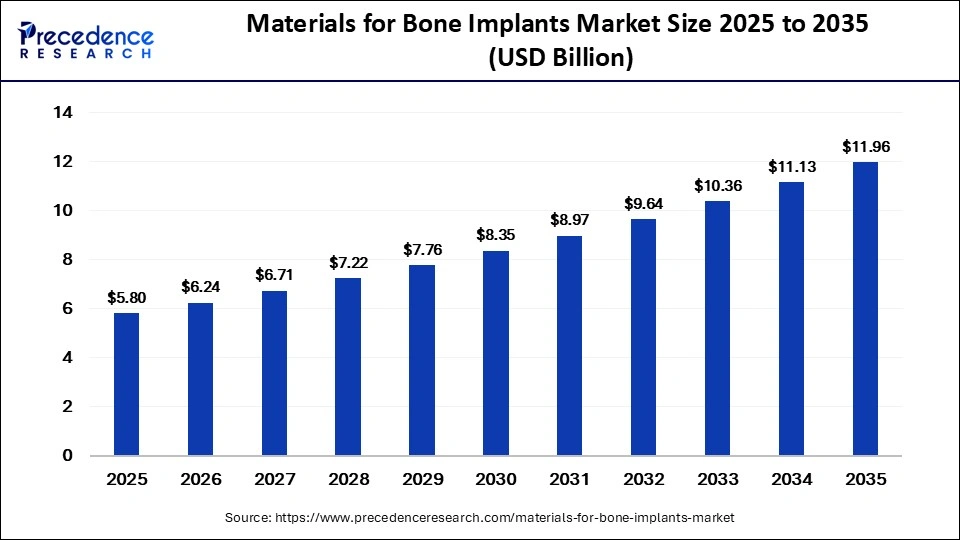
Rohan Patil, a Healthcare Industry Expert, highlights that the materials for bone implants market has reached USD 6.24 billion in 2026 and is on track to reach USD 11.96 billion by 2035, advancing at a CAGR of 7.50%. Key materials for bone implants market companies shaping the market include Stryker Corporation, Zimmer Biomet Holdings, Inc., Medtronic plc, Smith & Nephew plc, while major growth segments span By Material Type, By Implant Type, By End-user.
Source: https://www.precedenceresearch.com/materials-for-bone-implants-market
 Get a Sample
 Table Of Content


What is the Materials for Bone Implants Market Size in 2026?
The global materials for bone implants market size accounted for USD 5.80 billion in 2025 and is predicted to increase from USD 6.24 billion in 2026 to approximately USD 11.96 billion by 2035, expanding at a CAGR of 7.50% from 2026 to 2035. The market is driven by the increasing cases of bone injury and dental problems and advancements in material modification.
Key Takeaways
- North America led the materials for bone implants market in 2025 with a 38% share.
- Asia Pacific is expected to grow at the fastest CAGR of 9% between 2026 and 2035.
- By material type, the titanium & titanium alloys segment led the market with a 35% share in 2025.
- By material type, the polyetheretherketone (PEEK) segment is observed to grow at the fastest CAGR of about 7% in the coming years.
- By implant type, the orthopedic plates & screws segment held the largest revenue share of 30% in 2025.
- By implant type, the dental implants segment is expected to expand at the fastest CAGR of 6.2% during the forecast period.
- By end-user, the hospitals segment held the highest revenue share of 55% in 2025.
- By end-user, the orthopedic & dental clinics segment is expected to grow at the fastest CAGR of 7% in the foreseeable period.
Market Overview
A bone implant is a medical device implanted or grafted into bone for prosthetic, therapeutic, diagnostic, or experimental purposes. The basic requirement for implant material is that the material should be mechanically strong to serve as a substrate for cell attachment and proliferation, and be easily removable/bioabsorbable after the newly generated tissue restores the natural function. In severe cases, bone implants are used to provide mechanical support until new bone has grown and fractures have been repaired.
Impact of Artificial Intelligence on the Materials for Bone Implants Market
Artificial intelligence is transforming the field of bone implant engineering by leveraging immense computational power to analyze intricate biological data, refine treatment strategies, and advance the creation of next-generation regenerative solutions. Additionally, AI can process extensive patient data, such as X-rays, CT scans, and medical histories, to develop personalized implant designs and material recommendations that align precisely with each patient's unique anatomy. This increased level of personalization in bone implant materials can enhance the fit, function, and long-term success of the implants.
Materials for Bone Implants Market Trends
- Increasing Demand for Minimal Invasive and Customized Implant Material: The growing preference for minimally invasive surgical procedures and patient-specific implants is emerging as a major trend in the market. This trend is driving the development of durable, biocompatible, and advanced implant materials that improve surgical outcomes and strengthen the role of orthopedic implants in modern musculoskeletal care.
- Growing Use of Imaging and Preoperative Planning Software: The integration of advanced imaging technologies and preoperative planning software is becoming an important trend in the market. These solutions help surgeons achieve accurate implant positioning, reduce procedural complications, and improve long-term implant functionality, while advanced coatings and biomaterials support faster healing and lower infection risks.
- Rising Adoption of Smart Orthopedic Implants: There is increasing adoption of smart orthopedic implants equipped with sensors and wireless connectivity capabilities. These advanced implants enable real-time monitoring of biomechanical performance and patient recovery, supporting the transition toward personalized and data-driven orthopedic care.
Market Scope
| Report Coverage | Details |
| Market Size in 2025 | USD 5.80 Billion |
| Market Size in 2026 | USD 6.24 Billion |
| Market Size by 2035 | USD 11.96 Billion |
| Market Growth Rate from 2026 to 2035 | CAGR of 7.50% |
| Dominating Region | North America |
| Fastest Growing Region | Asia Pacific |
| Base Year | 2025 |
| Forecast Period | 2026 to 2035 |
| Segments Covered | Material Type, Implant Type, End-User, and Region |
| Regions Covered | North America, Europe, Asia-Pacific, Latin America, and Middle East & Africa |
Market Dynamics
Drivers
Technological Advances
The materials for bone implants market is driven by ongoing advancements in technology and evolving consumer preferences. Innovations in materials for bone implants are being propelled by progress in materials science, bioengineering, and digital technologies. Additionally, factors such as an aging population, rising obesity rates, hip injuries, and dental issues contribute to market growth. Furthermore, the increase in sports-related injuries also supports this expansion.
Restraint
Risks of Infections
A key challenge in the materials for bone implants market is that metal implants are more susceptible to infections and may cause rejection of the implant by the body. Furthermore, these implants can cause an inflammatory reaction at the site of insertion and can also cause fractures in other areas of the bone. The successful integration of bone with metal is low, limiting the regenerative capacity of the bone.
Opportunity
Development of 3D-Printed Ceramics for Personalized Implants
The emerging opportunities in the bone implant market include the development of 3D-printed ceramic implant materials that are similar to natural human bone. These developments assist in personalized bone regeneration, which can result in more effective and accessible treatment for bone defects, thus propelling the market growth.
Segment Insights
Material Insights
The Titanium & Titanium Alloys Dominated the Market With a 34% Share in 2025
The titanium & titanium alloys segment generated approximately USD 2.03 billion in 2025 and is projected to reach nearly USD 3.83 billion by 2035, growing at a CAGR of 6% during the forecast period. The titanium & titanium alloys segment dominated the materials for bone implants market by holding a share of 35% in 2025. This is because titanium is a common metal that is utilized for implantation in orthopedic surgery. Commercially pure titanium and titanium 6Al-4V alloy are the two main types of titanium available in the market. Titanium alloy is a popular material for most total hip femoral stems and most total shoulder arthroplasties. Furthermore, almost all the currently utilized intramedullary rods are made up of titanium alloys.
The stainless steel segment accounted for approximately USD 1.16 billion in 2025 and is projected to reach nearly USD 2.15 billion by 2035, growing at a CAGR of 5.5% during the forecast period. The stainless steel segment held nearly 20% share of the market in 2025. This is because of its abundant availability and the properties of stainless steel in the oxygen-rich body environment, where it does not corrode. Some of the types of stainless steel include 316L stainless steel and martensitic stainless steel. Stainless steel is a common material used in the production of orthopedic plates, screws, sliding hip screws, flexible nails, and rigid intramedullary nails.
Materials for Bone Implants Market Share, By Material Type, 2025-2035 (%)
| Material | 2025 | 2035 | CAGR (%) |
| Titanium & Titanium Alloys | 35.00% | 32.00% | 6.0% |
| Stainless Steel | 20.00% | 18.00% | 5.5% |
| Cobalt-Chromium Alloys | 15.00% | 14.00% | 5.0% |
| Polyetheretherketone (PEEK) | 12.00% | 15.00% | 7.0% |
| Ceramic-based Materials | 10.00% | 12.00% | 6.5% |
| Biodegradable Polymers | 8.00% | 9.00% | 6.8% |
The cobalt chromium alloys segment generated approximately USD 870 million in 2025 and is projected to reach nearly USD 1.67 billion by 2035, growing at a CAGR of 5% during the forecast period. The cobalt chromium alloys segment held approximately 15% market share in 2025, as cobalt-chromium alloy is currently a popular bearing surface in orthopedic surgeries and includes Co Cr Mo Alloy and Co Cr Alloy. They are often used as bearing surfaces in the case of metal on plastic (polyethylene) bearings. Yet, the cobalt chrome particles produced from metal-on-metal wear have been linked to various complications during surgical procedures and are regarded as immunogenic.
The polyetheretherketone (PEEK) segment accounted for approximately USD 696 million in 2025 and is projected to reach nearly USD 1.79 billion by 2035, growing at the fastest CAGR of 7% during the forecast period. This is because PEEK is a high-performance semicrystalline polymer that finds application in finger prosthetics, removable partial denture and fixed partial denture frameworks, and dental implants. It has excellent strength, properties, and elasticity, making it a preferred material in the market.
Implant Insights
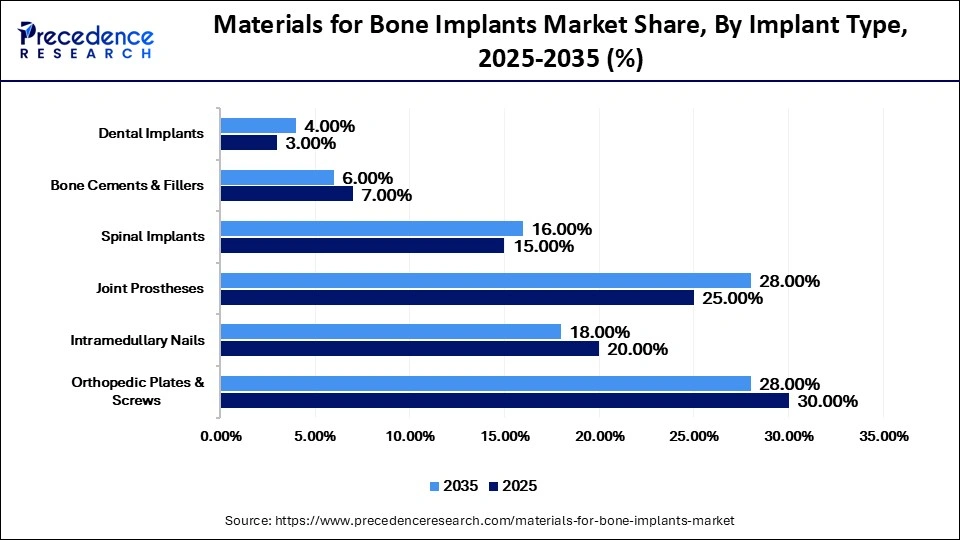
Materials for Bone Implants Market Share, By Implant Type, 2025-2035 (%)
| Implant Type | 2025 | 2035 | CAGR (%) |
| Orthopedic Plates & Screws | 30.00% | 28.00% | 5.5% |
| Intramedullary Nails | 20.00% | 18.00% | 5.0% |
| Joint Prostheses | 25.00% | 28.00% | 6.0% |
| Spinal Implants | 15.00% | 16.00% | 5.8% |
| Bone Cements & Fillers | 7.00% | 6.00% | 4.5% |
| Dental Implants | 3.00% | 4.00% | 6.2% |
The Orthopedic Plates & Screws Segment Held a 30% Market Share in 2025
The orthopedic plates & screws segment generated approximately USD 1.74 billion in 2025 and is projected to reach nearly USD 3.35 billion by 2035, growing at a CAGR of 5.5% during the forecast period. The orthopedic plates & screws segment dominated the materials for bone implants market with a 30% share in 2025. This is because of the widespread use of locking plates, non-locking plates, cortical screws, and cancellous screws. Depending on the anatomical location and the force they must bear, the sizes and thicknesses of the plate and screw components may differ. The reconstruction plates are designed in such a way that they can be easily bent around the complicated anatomical sites. On the other hand, screws help to secure the plates, as well as keep the bony fragments in place.
The intramedullary nails segment accounted for approximately USD 1.16 billion in 2025 and is projected to reach nearly USD 2.15 billion by 2035, growing at a CAGR of 5% during the forecast period. The intramedullary nails segment held around 20% of the market share in 2025. This segment includes both titanium and stainless-steel nails. These nails offer remarkable internal mechanical support and are designed to align with the natural structure of long bones, which helps keep everything in place during the healing process. In addition, their minimally invasive design lowers the risk of infection, a crucial factor in any surgical procedure.
The joint prostheses segment generated approximately USD 1.45 billion in 2025 and is projected to reach nearly USD 3.35 billion by 2035, growing at a CAGR of 6% during the forecast period. This is mainly due to the increasing cases of joint injury. A prosthesis is an artificial body part that replaces a part that is missing or no longer functional. A joint prosthesis is an artificial replacement designed for diarthrodial joints in the body and is commonly used in joint arthroplasty to restore function. This segment mainly includes hip prostheses, knee prostheses, and shoulder prostheses, which are designed to withstand normal loads while providing an efficient range of motion and long-term durability.
The dental implants segment accounted for approximately USD 174 million in 2025 and is projected to reach nearly USD 478 million by 2035, growing at a CAGR of 6.2% during the forecast period. The growth of the segment is attributed to the rising cases of dental problems, such as tooth erosion and impacted teeth. Dental implants provide a natural-looking and natural-feeling replacement for missing teeth that can last for many years. This segment includes endosseous implants and subperiosteal implants. Dental implants provide support for artificial teeth such as crowns, bridges, and dentures, and they offer a decreased risk of caries and endodontic problems in adjacent teeth.
End-User Insights
The Hospitals Segment Led the Market With a 55% Share in 2025
The hospitals segment generated approximately USD 3.19 billion in 2025 and is projected to reach nearly USD 6.22 billion by 2035, growing at a CAGR of 6% during the forecast period. In 2025, the hospitals segment led the materials for bone implants market with the highest share of 55%. This leadership is largely attributable to the enhanced professional autonomy experienced by physicians and specialists within hospital settings, which facilitates the delivery of comprehensive pre- and post-operative care. Moreover, the collaborative nature of multidisciplinary teams within hospitals aids in the effective management of potential complications.
The ambulatory surgical centers (ASCs) segment accounted for approximately USD 1.16 billion in 2025 and is projected to reach nearly USD 2.51 billion by 2035, growing at a CAGR of 6.5% during the forecast period. This is mainly due to the rising demand for specialized and same-day care. ASCs are specialized healthcare facilities providing same-day surgical care, including diagnostic and preventive procedures. They offer physicians considerable operational flexibility, enabling them to schedule procedures conveniently for patients, deploy teams of highly trained and skilled personnel, and ensure the optimal alignment of equipment and supplies with specific techniques. Additionally, these facilities can be tailored to accommodate various medical specialties.
Materials for Bone Implants Market Share, By End-user, 2025-2035 (%)
| End-User | 2025 | 2035 | CAGR (%) |
| Hospitals | 55.00% | 52.00% | 6.0% |
| Ambulatory Surgical Centers | 20.00% | 21.00% | 6.5% |
| Orthopedic & Dental Clinics | 18.00% | 20.00% | 7.0% |
| Research & Academic Institutes | 7.00% | 7.00% | 5.5% |
The orthopedic & dental clinics segment generated approximately USD 1.04 billion in 2025 and is projected to reach nearly USD 2.39 billion by 2035, growing at the fastest CAGR of 7% during the forecast period. The growth of the segment is primarily driven by an increasing demand for specialized surgical interventions within orthopedics, specifically addressing the musculoskeletal system, and for advanced dental care procedures. Routine dental examinations are instrumental in facilitating the early identification of conditions such as dental caries, periodontal disease, and oral malignancies, thereby enabling more efficacious and less invasive therapeutic approaches.
The research & academic institutes segment accounted for approximately USD 406 million in 2025 and is projected to reach nearly USD 837 million by 2035, growing at a CAGR of 5.5% during the forecast period. This is mainly due to the increasing investment in research activities to develop advanced materials for implants. Such institutions are positioned to provide contemporary surgical procedures and incorporate innovative materials developed for surgical applications, frequently offering these services at a comparatively economical cost to patients. Patients receiving surgical treatment within these settings benefit from the specialized expertise and advanced knowledge possessed by the faculty member.
Regional Insights
North America Materials for Bone Implants Market Size and Growth 2026 to 2035
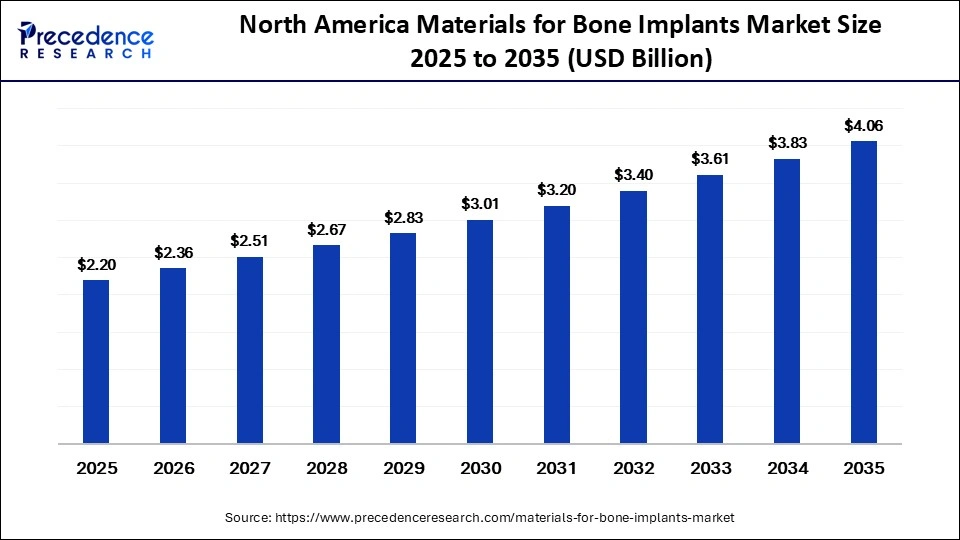
The North America materials for bone implants market size was exhibited at USD 2.20 billion in 2025 and is projected to be worth around USD 4.06 billion by 2035, growing at a CAGR of 6.50% from 2026 to 2035.
What Made North America the Dominant Region in the Market in 2025?
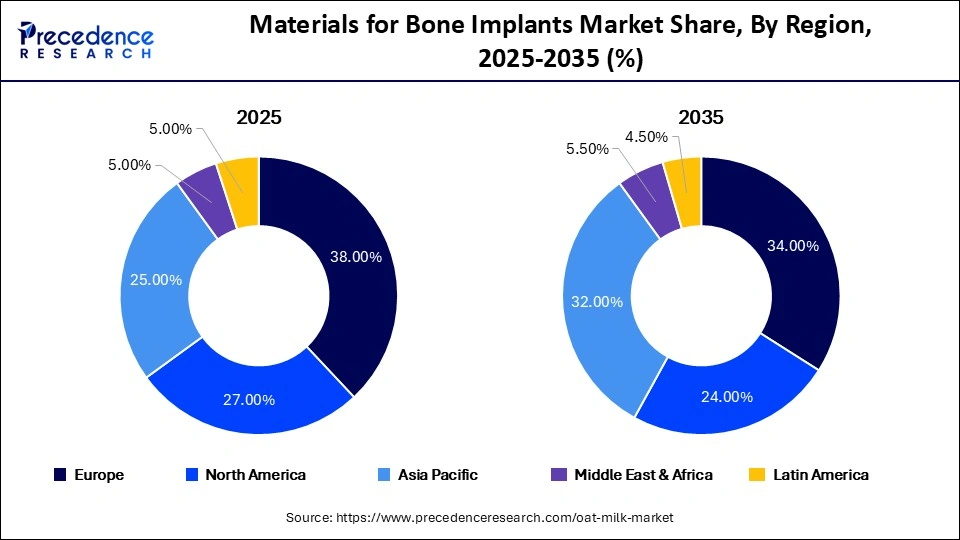
North America dominated the materials for bone implants market while holding a 38% share in 2025. The region's dominance is mainly attributed to an aging population that is more prone to orthopedic and dental issues. High healthcare expenditure, a growing prevalence of orthopedic disorders and dental surgeries, as well as hip injuries, also supported the region's dominance. Moreover, the presence of key market players further reinforces the region's leading position.
U.S. Materials for Bone Implants Market Size and Growth 2026 to 2035
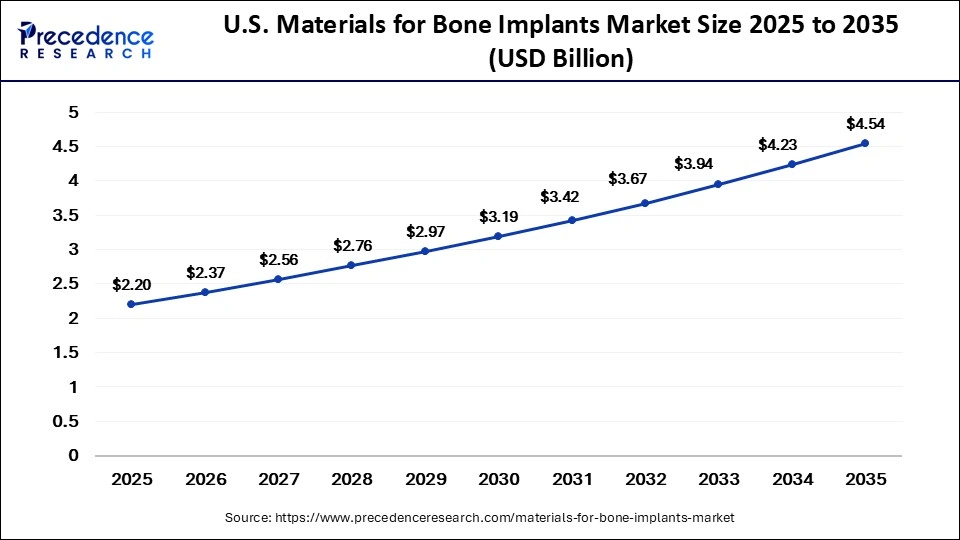
The U.S. materials for bone implants market size was evaluated at USD 2.20 billion in 2025 and is projected to reach around USD 4.54 billion by 2035, growing at a CAGR of 6.75% from 2026 to 2035.
U.S. Market Trends
The U.S. is a major contributor to the North American materials for bone implants market, primarily driven by ongoing advancements in implant design that enhance both the efficacy and longevity of bone implants. Furthermore, a supportive regulatory framework for innovative medical devices contributes to an auspicious environment for market expansion.
Europe: The Second-Largest Market
Europe is considered the second largest market for materials for bone implants, accounting for 27% share in 2025, and is expected to grow at a CAGR of 6% from 2026 to 2035. This growth is supported by the development of biocompatible synthetic bone grafts and an increasing demand for dental bone grafts. There is a high awareness among patients and healthcare providers concerning the benefits of advanced implant designs. The growing number of surgical procedures also contributes to regional market growth.
Germany Market Trends
Germany is leading the European materials for bone implants market, driven by its strong healthcare infrastructure, a growing number of specialty centers, and the adoption of advanced implant materials. Government support for surgical interventions also plays a crucial role in propelling market growth.
Asia Pacific: The Fastest-Growing Region
Asia Pacific held approximately 25% share of the materials for bone implants market in 2025 and is projected to grow at the fastest CAGR of 9% during the forecast period. This growth is driven by a rising prevalence of orthopedic and dental disorders, along with a rapidly aging population. Additionally, strong governmental emphasis on improving access to healthcare is driving the market. Moreover, the rising adoption of advanced materials for implants and a high demand for customized implants support market growth.
China Market Trends
China is leading the Asia Pacific materials for bone implants market, primarily attributable to accelerated urbanization, improved access to healthcare services, and robust domestic manufacturing capabilities that meet the growing demand for reconstructive joint replacements and trauma implants.
How is the Opportunistic Rise of Latin America in the Materials for Bone Implants Market?
Latin America held a 5% share of the market in 2025 and is expected to grow at a 6% CAGR during the projection period. This is mainly due to the increasing prevalence of orthopedic disorders, the rising number of cases of trauma and sports injury, and the growing demand for joint replacement procedures. Improving healthcare infrastructure and increasing investments in advanced orthopedic treatments in countries such as Brazil and Mexico are further supporting market expansion. Additionally, rising awareness regarding minimally invasive surgeries and the adoption of biocompatible and customized implant materials are accelerating regional market growth.
Brazil Market Trends
Brazil is a major contributor to the Latin American market due to its large patient population, increasing number of orthopedic surgeries, and expanding healthcare infrastructure. The country is also witnessing rising investments in advanced medical devices, growing adoption of minimally invasive orthopedic procedures, and increasing demand for biocompatible and customized implant materials, which are driving market growth.
What Drives the Market Within the Middle East & Africa?
The Middle East & Africa (MEA) held a 5% market share in 2025 and is expected to grow at a 7% CAGR in the coming years. The market in the region is mainly driven by the rising prevalence of orthopedic disorders, increasing cases of trauma and road accidents, and growing demand for joint replacement and reconstructive surgeries. Expanding healthcare infrastructure, improving access to advanced orthopedic treatments, and increasing healthcare investments across the region are further supporting market growth.
Saudi Arabia Market Trends
Saudi Arabia leads the Middle East & Africa materials for bone implants market due to its rapidly expanding healthcare infrastructure, increasing number of orthopedic and joint replacement procedures, and strong government investments in healthcare modernization. The country is also witnessing growing adoption of advanced orthopedic technologies, rising demand for minimally invasive surgeries, and increasing prevalence of musculoskeletal disorders, which are collectively driving market growth.
Materials for Bone Implants Market Value Chain Analysis
- R&D
R&D targets key flaws in traditional implants, metal toxicity, stress shielding, poor osseointegration, and reoperation.
Key Players: Zimmer Biomet, Stryker Corporation, DePuy Synthes
- Component Fabrication and Machining
Specialized manufacturing methods are essential to convert advanced biomaterials into precise, patient-specific orthopedic implants and hardware.
Key Players: Tecomet, Paragon Medical, Acrotec Medtech
- Clinical Trials and Regulatory Approvals
Orthopedic implants, as high-risk devices, require rigorous, lengthy, capital-intensive validation of safety, biocompatibility, and efficacy.
Key Players: MCRA, NAMSA, Emergent CRO
- Distribution
This specialized, tightly regulated global network links processing plants with medical device OEMs, distributors, and surgical centers.
Key Players: ACNIS International, ATI, MetalsTek Engineering
- Patient Support and Services
It constitutes the final, patient-facing phase in the overall life cycle of bone implants.
Key Players: Zimmer Biomet, Stryker, DePuy Synthes
Competitive Landscape
The materials for bone implants market is moderately consolidated, with the presence of established medical device manufacturers, biomaterials companies, and emerging orthopedic technology firms competing through innovation and product differentiation. Key players are focusing on strategies such as mergers and acquisitions, strategic collaborations, product launches, and investments in advanced biomaterials, including titanium alloys, ceramics, polymers, and bioresorbable materials, to strengthen their market positions. Companies are also emphasizing the development of customized implants, minimally invasive surgical solutions, and advanced coating technologies to improve implant durability, osseointegration, and patient outcomes.
In the coming years, key players should focus on expanding research and development activities related to smart orthopedic implants, 3D-printed implant materials, and AI-assisted surgical planning technologies to maintain long-term competitiveness. Greater emphasis on biocompatible and sustainable materials, personalized implant solutions, and integration of sensor-enabled monitoring technologies is expected to shape the next phase of market growth. Additionally, companies that strengthen their presence in emerging markets, improve regulatory compliance capabilities, and invest in cost-effective manufacturing processes are likely to gain a competitive advantage over the coming years.
Materials for Bone Implants Market Companies
- Stryker Corporation
- Zimmer Biomet Holdings, Inc.
- Medtronic plc
- Smith & Nephew plc
- DePuy Synthes (Johnson & Johnson)
- Globus Medical, Inc.
- NuVasive, Inc.
- B. Braun Melsungen AG
- Arthrex, Inc.
- LivaNova PLC
- Conmed Corporation
- Invibio Ltd.
- Orthofix Medical Inc.
- Amedica Corporation
- Cook Medical
Recent Developments
- In March 2026, at Georgetown, Styliani Alimperti, an associate professor of biochemistry and molecular and cellular biology in the School of Medicine, began developing 3D‑printed bone grafts made from natural materials to make implant procedures safer and more effective. It is based on natural materials and could significantly improve the safety and effectiveness of implants.(Source: https://www.georgetown.edu)
- In May 2026, a study reported that scientists had developed a new metal implant designed to support healing while slowly degrading inside the body. The implant is a hybrid structure that combines a strong titanium alloy framework with zinc, a metal that gradually dissolves over time. This design allows the implant to provide mechanical support during the healing process while steadily making room for new bones to grow.(Source: https://taltech.ee)
Segment Covered in the Report
By Material Type
- Titanium & Titanium Alloys
- Commercially Pure Titanium
- Titanium 6Al-4V Alloy
- Stainless Steel
- 316L Stainless Steel
- Martensitic Stainless Steel
- Cobalt-Chromium Alloys
- Co-Cr-Mo Alloy
- Co-Cr Alloy
- Polyetheretherketone (PEEK)
- Reinforced PEEK
- Standard PEEK
- Ceramic-based Material
- Alumina
- Zirconia
- Biodegradable Polymer
- Polylactic Acid (PLA)
- Polyglycolic Acid (PGA)
By Implant Type
- Orthopedic Plates & Screws
- Locking Plates
- Non-locking Plates
- Cortical Screws
- Cancellous Screws
- Intramedullary Nail
- Titanium Nails
- Stainless Steel Nails
- Joint Prosthese
- Hip Prostheses
- Knee Prostheses
- Shoulder Prostheses
- Spinal Implants
- Rods
- Screws
- Interbody Cages
- Bone Cements & Fillers
- PMMA Cements
- Calcium Phosphate Cements
- Dental Implants
- Endosseous Implants
- Subperiosteal Implants
By End-user
- Hospitals
- Ambulatory Surgical Centers
- Orthopedic & Dental Clinics
- Research & Academic Institutes
By Region
- North America
- Latin America
- Europe
- Asia-pacific
- Middle and East Africa
For inquiries regarding discounts, bulk purchases, or customization requests, please contact us at sales@precedenceresearch.com
Frequently Asked Questions





Ask For Sample
No cookie-cutter, only authentic analysis – take the 1st step to become a Precedence Research client
 Get a Sample




 sales@precedenceresearch.com
 Schedule a Meeting
