



Medical Supply Delivery Service Market Revenue, Leading Companies, Company Technology / Innovation, Diagnostic Testing Volume, Adoption Rates, Pricing Metrics, Supply Chain Performance, Competitive Positioning, and Industry Trends
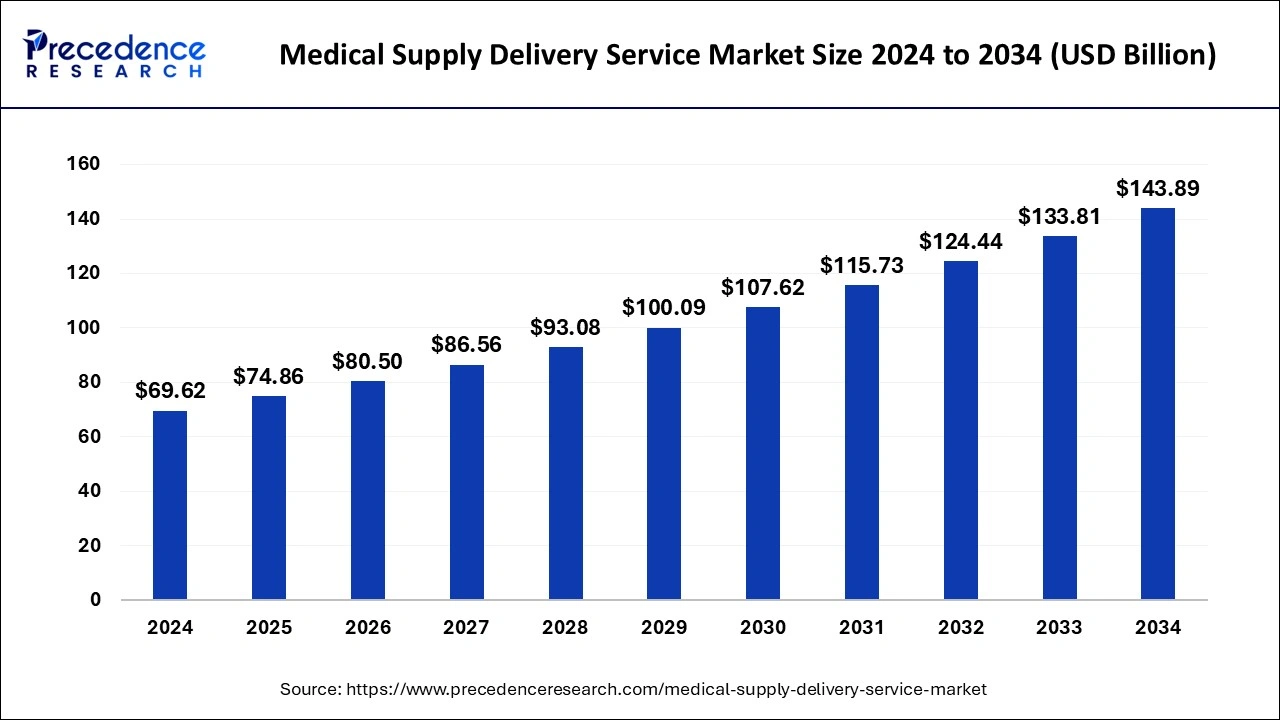
The global Medical Supply Delivery Service Market was valued at USD 74.86 billion in 2026 and is projected to reach approximately USD 143.89 billion by 2035, growing at a CAGR of 7.44% from 2026 to 2035. Market growth is driven by rising surgical procedures, increasing healthcare infrastructure investments, growing demand for timely medical deliveries, and technological advancements in logistics. Asia Pacific dominated the market with a 40.03% share in 2025, while North America is expected to record the fastest growth. Courier delivery led by service mode, medical supplies dominated by application, and pharmacies held the largest end-user share.
Source: https://www.precedenceresearch.com/medical-supply-delivery-service-market
 Get a Sample
 Table Of Content


What is Medical Supply Delivery Service Market Size?
The global medical supply delivery service market size is estimated at USD 74.86 billion in 2026 and is anticipated to reach around USD 143.89 billion by 2035, expanding at a CAGR of 7.44% from 2026 to 2035. The medical supply delivery service market is expanding due to increasing surgical procedures around the world along with increasing adoption of medical courier services expanding market on a global scale.
Market Highlights
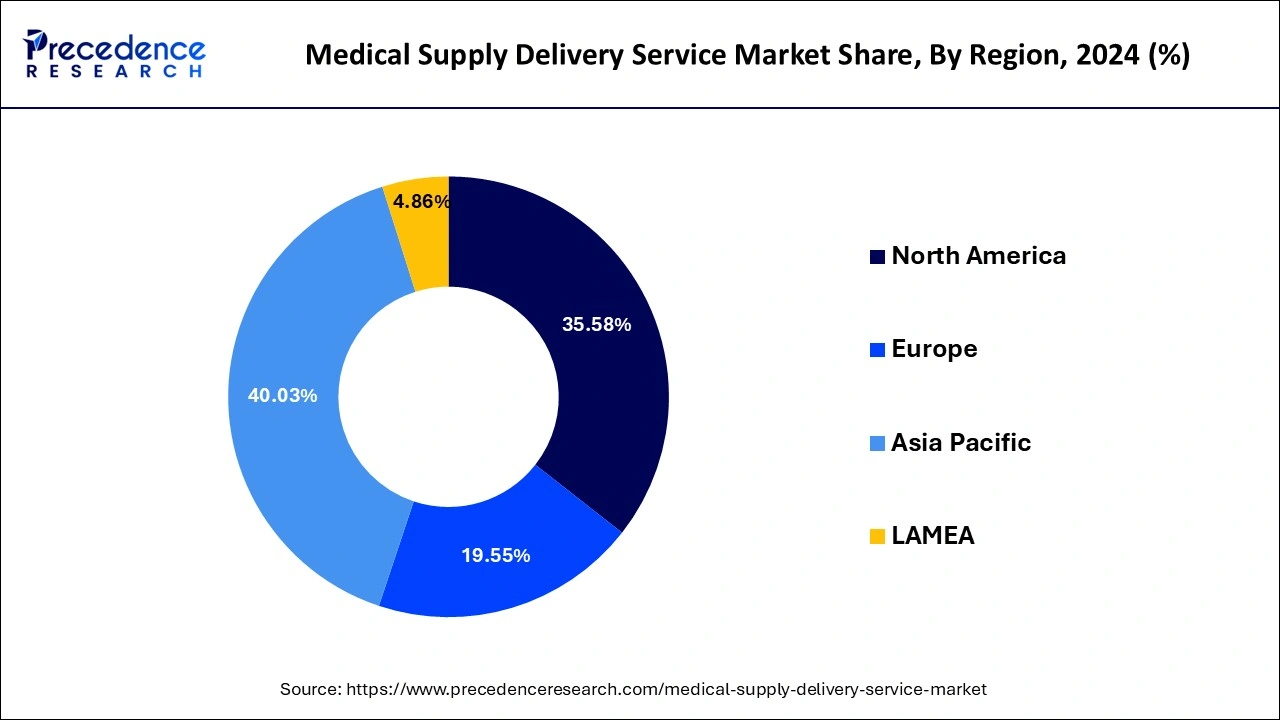
- Asia Pacific dominated the global medical supply delivery service market with the largest market share of 40.03% in 2025.
- North America is projected to expand at the fastest CAGR during the forecast period.
- By service mode, the courier delivery segment contributed the highest market share in 2025.
- By service mode, the drone delivery segment is expected to grow at a significant CAGR from 2026 to 2035
- By application, the medical supplies segment captured the biggest market share in 2025.
- By application, the lab specimens & reports is estimated to be the fastest-growing segment during the forecast period.
- By end user, the pharmacies segment has held the largest market share in 2025.
- By end user, The patients segment is predicted to grow with CAGR during the forecast period.
Artificial intelligence's integration in Medical Supply Delivery Service Market
Artificial intelligence offers the potential to optimize supply chain operations by demand forecasting and inventory management to logistics and delivery.AI models are able to analyze huge datasets and predict the future trends to make informed decisions, thus enhancing the overall efficiency of the supply chains in medical supply delivery service market. AI systems work by using deep reinforcement learning algorithms for optimal supply chain modes in healthcare delivery services. By analyzing historical data, patient trends and external factors, AI driven tools can analyze forecasting demand. Also, AI can streamline logistics by optimizing delivery routes, lowering transportation costs and shortening delivery times.
Moreover, AI can track the real-time data about medical supplies from production process to delivery at expected destination. Powered by AI, sensors and IoT devices are able to potentially track the current status and location of supplies, enabling transparency between consumers and manufacturers.
Medical Supply Delivery Service Market Growth Factors
- Increasing focus on improving healthcare system by ensuring quick and secure transportation of samples and specimens for testing and to minimize cost of logistics for medical supply delivery service.
- Increasing incidence of road accidents where immediate requirement for blood is primary factor driving this market.
- As geriatric population increases along with chronic illness people tend to incline for home health services for convenience.
- Logistics providers are investing in a system which provides delivery of medical supplies for patients on time.
- Many governments are investing to improve healthcare infrastructure and supporting initiatives to improve medical supply chains.
- The convergence of logistics solutions and telehealth services represents a transformative shift in healthcare delivery.
- Rising emphasis on sustainability and eco-friendly practices like use of EVs for delivery of medical necessities.
Market Outlook
How is the Global Healthcare Logistics Market Changing Through Medical Equipment Delivery Services?
- Industry Growth Overview: The growth of the medical logistics market has been driven by increased demand for fast medical logistics, growth of home healthcare, readiness to respond to emergencies, and digitized healthcare systems. These changes have accelerated the growth of medical logistics networks in urban and remote areas around the world.
- Sustainability Trends: Many healthcare logistics providers are introducing electric vehicles, reusable medical packaging, and route optimization software into their operations to reduce emissions, reduce medical waste, and achieve their sustainability goals without compromising on delivery speed.
- Global Expansion: International healthcare outsourcing, cross-border trade of pharmaceuticals, and increased development of hospitals in developing countries are creating a global need for scalable, compliant, and technology-enabled solutions for medical delivery.
- Startup Ecosystem: This market has experienced a surge in start-up activity, particularly related to drone logistics, artificial intelligence-powered dispatch systems, same-day delivery of medicines, and hyperlocal healthcare fulfillment models. Many of these companies are attracting financial investments from venture capital firms specializing in either healthcare or logistics.
Market Scope
| Report Coverage | Details |
| Market Size in 2025 | USD 69.62 Billion |
| Market Size in 2026 | USD 74.86 Billion |
| Market Size by 2035 | USD 143.89 Billion |
| Growth Rate from 2026 to 2035 | CAGR of 7.44% |
| Largest Market | Asia Pacific |
| Base Year | 2025 |
| Forecast Period | 2026 to 2035 |
| Segments Covered | Service Mode, Application, End User, Region |
| Regions Covered | North America, Europe, Asia-Pacific, Latin America, and Middle East & Africa |
Market Dynamics
Driver
Expansion of Urgent Drone Delivery
The major primary driver for the market growth is expanding demand for rapid and time-sensitive emergency logistics, mainly driven by traffic congestion in urban settings and difficult topographies in remote regions. Additionally, automated and on-demand transport of life-saving commodities including blood products and clinical samples, drastically reduces transit times over traditional ground transit.
Restraint
Regulatory Walls and Sky-High Costs
Despite its strong potential, market is constrained by strict, fragmented, and intricate regulatory frameworks governing the transport of temperature-controlled biological items and controlled substances. Furthermore, high operational expenses, payload weight limitations, and restrictive airspace policies for drone deployment further limit global commercial implementation.
Opportunity
Next-Gen Delivery for Remote Health
The major opportunity lies in the rapid expansion of telehealth, home-based healthcare models, and pharmaceutical e-commerce, which creates major expansion opportunities for decentralized medical delivery. Integrating advanced technologies like autonomous unmanned aerial vehicles and AI-driven route planning can effectively connect last-mile gaps for underserved isolated populations.
Segments Insights
Service Mode Insights
The courier delivery segment dominated the global medical supply delivery service market in 2025. The increased demand for the cost-effective transportation and delivery, and the timely delivery of various healthcare materials such as reports, prescription drugs, infusion medicines, lab specimens, and medical equipment has fostered the growth of this segment. Moreover, the increased penetration of the courier delivery mode owing to the higher presence of global and local courier companies across the globe have significantly contributed towards the growth of this segment.
On the other hand, the drone delivery is estimated to be the most opportunistic segment during the forecast period. The rising popularity of drones and growing acceptance of drones in the medical supplies delivery in the developed and developing economies is boosting the demand for the drone delivery services. The development of regulations regarding drones, higher efficiency of the drones, and enhancement of the supply chains are the major factors that are expected to drive the growth f the drone delivery segment in the upcoming future.
Application Insights
Medical supplies segment accounted largest market share and dominated the global medical supply delivery service market in 2025. The rising prevalence of chronic diseases and growing geriatric population is fueling the number of surgical procedures across the healthcare units. The increasing volume of procedures is resulting in the increased demand for the medical supplies that further boosts the demand for the medical supply delivery services. The increased need for the cost-effective, secure, and quick delivery of the various medical supplies has fostered the growth of the medical supplies segment.
The lab specimens & reports is estimated to be the fastest-growing segment during the forecast period. The increased demand for the contact-less and timely deliveries of specimens like blood samples, urine, saliva, and others to the labs, owing to the outbreak of the COVID-19 pandemic in 2020 has fueled the growth of this segment. This trend of contactless delivery of specimens and reports is expected to sustain in the long term and boost the growth of this segment in the foreseeable future.
End User Insights
Based on the end user, the pharmacies segment dominated the market, accounting biggest market share in 2025. The increased demand for the convenient door step delivery of drugs and various medical supplies has boosted the growth of the pharmacies. The customers can eliminate the long queues in the pharmacies and can easily pay using various payment methods. The conveniences associated with the delivery services in the pharmacies has fueled the growth of this segment.
On the other hand, the patients is estimated to be the fastest-growing segment during the forecast period. The growing geriatric population and growing disabilities owing to aging and various diseases, the patients segment is expected to grow at a rapid pace during the forecast period. The increasing demand for the door step delivery of various prescription drugs and medical supplies among the patients is propelling the market growth.
Regional Insights
Why Is Asia Pacific Leading the Medical Supply Delivery Service Market?
Asia Pacific dominated the global medical supply delivery service market with the largest market share of 40.03% in 2025. The rising investments by the government in the improvement of healthcare infrastructure, rising burden of diseases, growing geriatric population, rising number of hospital admissions, and increasing adoption of technological advancements in the logistics are the major factors that are estimated to boost the growth of the market.
Asia Pacific Medical Supply Delivery Service Market Size and Growth 2026 to 2035
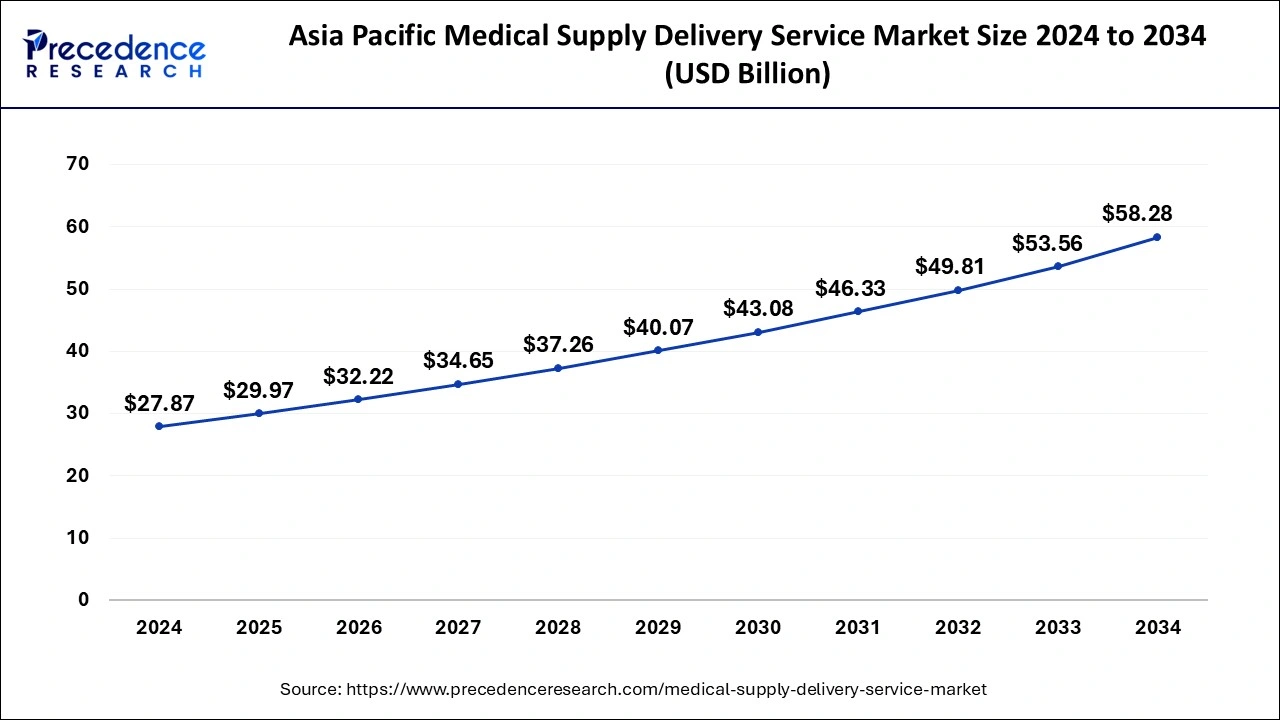
The Asia Pacific medical supply delivery service market size is evaluated at USD 29.97 billion in 2025 and is predicted to be worth around USD 62.35 billion by 2035, rising at a CAGR of 7.6% from 2026 to 2035
India Market Trends
India plays a distinctive role within the region, mainly due to its leveraging aerial medical logistics to solve last-mile delivery limitations across vast rural, tribal, and mountainous terrain. The focus is on public health integration, reducing diagnostic turnaround times, and lowering out-of-pocket pati0000ent expenditures. Spearheaded by the Indian Council of Medical Research (ICMR) i-DRONE initiative and the Ministry of Civil Aviation's Drone Shakti program for domestic manufacturing.
What Is Driving the Growth of the Medical Supply Delivery Services Market in North America?
North America is estimated to be the fastest-growing market during the forecast period. The high healthcare expenditure, increased adoption of advanced technologies in the healthcare sector, rapid growth in the e-commerce, and enhanced logistics services owing to the presence of developed infrastructure are the prominent drivers of the Europe medical supply delivery service market.
U.S. Market Trends
The U.S. plays a dominant role within the region, mainly through the FAA and supply chain resilience. Policies and programs are governed by federal directives like FDA Essential Medicines frameworks and FAA Part 135 drone delivery certifications. Major health systems partner with autonomous logistics providers to execute home prescription deliveries. Leading health systems like Cleveland Clinic launched long-term autonomous prescription drone delivery networks through Zipline to transport medications directly to patients.
Europe: Healthcare Logistics Execution through Regulations and Technology.
Within Europe, delivering supplies for the provision of healthcare through technology and under regulations is supported by strong demand from government-funded healthcare systems and the increasing requirements for maximum compliance standards for: temperature-controlled logistics, same-day fill or flexible delivery from pharmacy, hospital to home (direct release).
Germany Market Trends
Germany plays a distinctive role within the region, mainly due to its innovation in rural and emergency last-mile medical transport using autonomous Unmanned Aerial Vehicles (UAVs) to bypass road congestion. Major initiatives like LieferMichel Project, delivering non-prescription medicines to remote villages, and Greifswald Hospital Trials, which shuttle vital blood products across hospital wings. Federal authorities collaborate with municipalities to establish low-altitude flight corridors for medical deliveries.
Latin America: Logistics as Catalysts to Bridge Access to Healthcare.
In Latin America, innovative delivery solutions are a way to eliminate barriers of physical distance and uneven distribution of access to healthcare. Expansion of healthcare services is being supported by urbanization, establishing private healthcare networks, and an increasing reliance on outside organizations for the delivery of logistics to support healthcare.
Brazil Market Trends
Brazil plays a pioneering role within the region, mainly characterized by its strong focus on its medical supply delivery framework on expanding universal access across geographically vast and challenging terrains through the Unified Health System. ANVISA also sets national guidelines for remote distribution prioritizing temperature control and tracking. Regional pilot programs also involve private drone operators working with public health clinics for improved transport of vaccines and diagnostic samples.
Brazil is leading the region in terms of digitizing healthcare, through the creation of large hospitals and increasing demand for last-mile delivery for pharmaceuticals.
Middle East/Africa: Emergency Health and Telemedicine.
How Are Logistics Investments Supporting Healthcare Delivery in the Middle East and Africa?
In the Middle East and Africa, there continues to be development of resilient supply chains built to support the public health programs, emergency preparedness, and access to healthcare in remote areas. Further, the combination of investment in logistics infrastructure and the establishment of smart delivery systems is increasing the adoption of logistics as a means of supporting public health.
The UAE Market Trends
The UAE is a key contributor within the region, mainly due to it serves as an innovation hub for intra-city medical transport by enforcing rigorous international standards while adopting autonomous aviation to reduce transit times. Policies integrate federal healthcare laws with local smart-city frameworks. Furthermore, facilities like Dubai's Fakeeh University Hospital are known for leveraging collision-avoidance drones to lower delivery times.
Value Chain Analysis of the Medical Supply Delivery Service Market
- Producers and Sellers of Medical Supplies: This portion of the medical supply delivery system comprises manufacturers of pharmaceuticals, diagnostic kits, PPE, surgical instruments, and other consumables.
Key Players: McKesson Corporation, Cardinal Health, and Medline Industries. - Logistics, Cold Chain, Fulfillment Operations: Logistics companies provide warehousing and inventory optimization, as well as cold-chain storage and route planning to facilitate the most efficient last-mile delivery.
Key Players: UPS Healthcare, DHL Supply Chain, and FedEx HealthCare Solutions. - Digital Platforms for Integration into Healthcare Delivery: Digital Platforms are the technology solutions that enable the connections between hospitals, pharmacies, laboratories, and patients using an online automated order processing system, real-time delivery tracking, and documented compliance.
Key players: Zipline, Matternet, and Capsule Technologies.
Medical Supply Delivery Service Market Companies
- DHL
- UPS
- Agility
- LogistiCare Solutions, LLC
- FedEx Corporation
- CEVA Logistics
- The Wing
- International SOS
- Matternet
- Zipline
- Flirtey
- Swoop Aero
Recent Developments
- In February 2024, a leading drone logistics company known as TechEagle announced its partnership with 10 All India institutes of medical sciences which a renowned network of autonomous government medical universities to enhance rapid medical delivery.
- In December 2023, A U.K.-based healthcare logistic company called Apian made a partnership with Zipline which a world largest autonomous instant delivery service to enhance overall healthcare facilities.
Segments Covered in the Report
By Service Mode
- Courier Delivery
- Drone Delivery
By Application
- Drug Supplies
- Medical Supplies
- Lab Specimens & Reports
- Emergency Services
By End User
- Hospitals
- Clinics
- Pharmacies
- Patients
- Laboratories
- Others
By Region
- North America
- Europe
- Asia-Pacific
- Latin America
- Middle East & Africa
For inquiries regarding discounts, bulk purchases, or customization requests, please contact us at sales@precedenceresearch.com
Frequently Asked Questions





Ask For Sample
No cookie-cutter, only authentic analysis – take the 1st step to become a Precedence Research client
 Get a Sample
.webp)



 sales@precedenceresearch.com
 Schedule a Meeting
