



Nano Copper Oxide Market Size, Key Companies, Company Market Share, Production Capacity, Raw Material Pricing, Export & Import Analysis, Manufacturing Cost, Competitive Positioning, and Demand Forecast
Nano Copper Oxide Market (By Type: Powdered, Dispersed; By End User: Electricals and Electronics, Paints and Coatings, Catalysts, Energy Storage, Others) - Global Industry Analysis, Size, Trends, Leading Companies, Regional Outlook, and Forecast 2026 to 2035
Source: https://www.precedenceresearch.com/nano-copper-oxide-market
 Get a Sample
 Table Of Content


What is the Nano Copper Oxide Market Size?
The global nano copper oxide market size is accounted at USD 249.76 billion in 2025 and predicted to increase from USD 300.30 billion in 2026 to approximately USD 1511.58 billion by 2035, expanding at a CAGR of 19.73% from 2026 to 2035. The market is growing because of its use in high-performance electronics, energy storage applications, and antimicrobial coatings. Progress in nanotechnology, artificial intelligence, and eco-friendly manufacturing, combined with funding in renewable energy and semiconductor sectors, drives expansion.

Nano Copper Oxide Market Key Takeaways
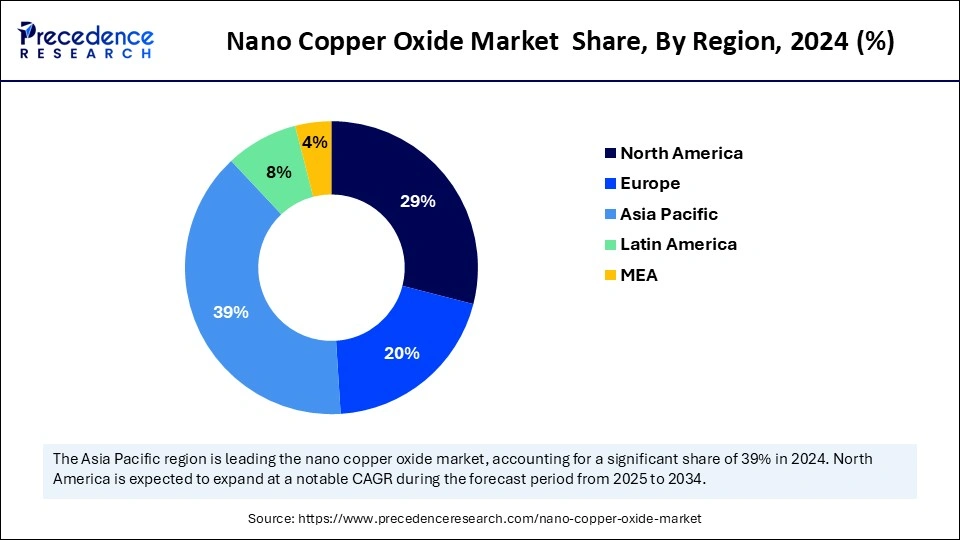
- Asia Pacific dominated the global market with the largest market share of 39% in 2025.
- North America is anticipated to host the fastest-growing market during the forecast period.
- Europe plays a crucial role in the global market.
- By type, the powdered segment contributed the highest market share in 2025.
- By type, the dispersed segment will grow at the fastest CAGR in the upcoming years.
- By end user, the electrical and electronics segment contributed the largest market share in 2025.
- By end user, the energy storage segment is expected to witness the fastest growth during the predicted timeframe.
Artificial Intelligence is Altering the Future of Nanomaterials
Artificial intelligence (AI) is transforming the nano copper oxide market by enhancing manufacturing techniques, refining material characteristics, and speeding up the identification of new uses. AI algorithms examine intricate datasets, minimizing waste and enhancing efficiency. Models in machine learning forecast attributes and automation powered by AI improve quality assurance. AI enables quick screening, research and development, and market prediction by maintaining consistent particle size, purity, and performance traits.
- In March 2025, a study released in Scientific Reports employed machine learning to examine hybrid alumina- copper oxide nanoparticles in Therminol 55 for medium-temperature heat transfer fluids, facilitating precise predictions of nanofluid characteristics.
Why Is Nano Copper Oxide Suddenly Front-Page for Advanced Materials?
Nano copper oxide refers to a category of copper oxide nanoparticles, identified by their reddish-black or brownish colors and offered in the form of powders or dispersions. The global market for nano copper oxide encompasses the manufacturing, distribution, and use of these nanoparticles. The market is witnessing consistent growth owing to its expanding uses in various sectors, mainly propelled by semiconductors, batteries, sensors, and antimicrobial coatings.
These nanoparticles exhibit remarkable optical, catalytic, mechanical, and electrical characteristics, resulting in various applications in catalysts, electronics, coatings, sensors, lubricants, energy storage, and antimicrobial functions. These high-performance nanomaterials, known for their superior surface area, reactivity, conductivity, and affordability compared to alternatives such as nano zinc oxide and nano silver, cater to industries including electronics, energy storage, and healthcare.
Nano Copper Oxide Market Growth Factors
- Increasing demand for electronics: The increasing need for compact and efficient electronics is driving the use of nano copper oxide in semiconductor devices, such as conductive inks, printed circuit boards, batteries, and transparent conductive films for touchscreens and solar cells, spurred by the swift uptake of consumer electronics like smartphones and laptops.
- Growth in the healthcare sector: The healthcare industry is expanding because of the rising utilization of nano copper oxide in antimicrobial coatings, medical textiles, wound dressings, and drug delivery systems, motivated by the demand for infection-proof surfaces in hospitals following the pandemic.
- Government support and environmental Concern: Government support for research and development is facilitating advanced studies on nano copper oxide uses, promoting eco-friendly materials and energy efficient material in sectors such as gas sensing and water purification and endorsing nano copper oxide as a cost-effective, sustainable option.
- Increasing use of renewable sources: The excellent electrochemical characteristics of nano copper oxide position it as an essential element in solar cells and energy storage systems, aiding the expansion of the renewable energy market.
- Prominent in catalysis and chemical sectors: Nano copper oxide is becoming more prominent in catalysis and chemical sectors because of its large surface area and high reactivity, improving reaction efficiency in biofuel generation and wastewater management.
Market Outlook
- Industry outlook: The nano copper oxide market is poised for rapid growth from 2025 to 2034, driven by drivers Application Diversification & OEM Qualification as more OEMs qualify nano CuO for specific uses, demand becomes recurring and higher-value; qualification processes, though lengthy, create durable commercial channels once passed and Synthesis Scale-Up & Cost Reduction Advances in scalable synthesis reduce per-kg costs and enable competitiveness versus micro- or macro-scale alternatives, unlocking volume markets such as textiles and coatings.
- Major investment: investing in pilot-to-commercial nano-reactors and downstream formulation labs to lower scale-up risk and shorten time-to-market for industrial partners and funding supply-chain integration projects, including precursor purification and closed-loop waste management, to ensure cost stability and regulatory compliance for manufacturers.
- Sustainability trend: Sustainability pressures are steering the industry toward greener synthesis routes solvent reduction, aqueous processes, improved worker and environmental exposure controls, and lifecycle transparency for nanomaterial products. Closed-loop processing, solvent reclamation, and energy-efficient reactors are becoming selling points for suppliers seeking regulatory acceptance and buyer trust.
Market Scope
| Report Coverage | Details |
| Market Size by 2035 | USD 1511.58 Million |
| Market Size in 2025 | USD 249.76 Million |
| Market Size in 2026 | USD 207.75 Million |
| Market Growth Rate from 2026 to 2035 | CAGR of 19.73% |
| Dominated Region | Asia Pacific |
| Fastest Growing Market | North America |
| Base Year | 2025 |
| Forecast Period | 2026 to 2035 |
| Segments Covered | Type, End User, and Regions |
| Regions Covered | North America, Europe, Asia-Pacific, Latin America and Middle East & Africa |
Market Dynamics
Drivers
Growing application in the electronics industry
The primary driver in the nano copper oxide market is its growing application in the electronics industry, especially in conductive inks, printed circuit boards, semiconductors, and batteries. Its outstanding electrical conductivity, thermal stability, and potential for miniaturization render it highly beneficial for these purposes. The swift growth of consumer electronics, such as smartphones and laptops, has greatly increased the need for nano copper oxide in this industry.
- In February 2024, scientists at the University of Kerala made noteworthy advancements in a low-temperature technique for manufacturing cupric oxide semiconductors functioning at 60 degrees Celsius, which is much lower than conventional approaches, thereby lowering production costs and infrastructure requirements.
Restraint
Prospective health and environmental hazards
The nano copper oxide market encounters considerable restraints because of prospective health and environmental hazards. These risks encompass toxicity problems, including nausea, vomiting, and lung injury, along with the possible threat to aquatic organisms caused by their bioavailability and high reactivity. These risks hinder broad acceptance and require stringent safety protocols and regulations. The difficulties of toxicity and safe management could result in tighter regulations, further impeding market expansion.
Opportunity
Worldwide shift towards renewable energy solutions
Contributing to the worldwide transition to sustainable energy solutions, nano copper oxide provides significant uses in renewable energy, especially in solar panels and energy storage systems. Its superior electrical conductivity and thermal stability render it a significant element in photovoltaic cells, enhancing energy conversion efficiency.
- In November 2024, the Australian startup SunDrive Solar collaborated with Trina Solar to bring copper-based solar cells to market, substituting conventional silver conductors to tackle silver shortages and lower production expenses, improving the scalability and economic viability of solar energy.
Segment Insights
Type Insights
The powdered segment held a dominant presence in the nano copper oxide market in 2025 because of its adaptability and straightforward use in multiple sectors, such as electronics, energy storage, paints, coatings, and healthcare. Its large surface area improves its catalytic, electrical, and antimicrobial characteristics. Powdered nano copper oxide is economical and suitable for multiple uses, such as catalysis, electronics, and sensors. Moreover, powdered nano copper oxide is more stable and easier to store and transport compared to dispersed versions, which lowers the risk of agglomeration and streamlines handling processes in production.
- In March 2025, researchers at the Indian Institute of Science created a novel technique for producing high-purity nano copper oxide powder, lowering manufacturing costs and enhancing its effectiveness in supercapacitors, underscoring its increasing significance in energy storage.
The dispersed segment will grow at the fastest rate in the upcoming years due to its improved usability and effectiveness in advanced applications. Offered in liquid or colloidal form, it provides improved uniformity, stability, and ease of incorporation. The major elements fueling its expansion consist of enhanced application effectiveness, alignment with modern manufacturing techniques, and simplicity in management. The COVID-19 pandemic has increased the need for antimicrobial coatings, prompting researchers to create innovative techniques for producing high-quality dispersed nano copper oxide.
End User Insights
The electrical and electronics segment dominated the nano copper oxide market with the largest share in 2025 because of its important impact on enhancing the performance of electronic devices. Its superior electrical conductivity, thermal stability, and affordability render it perfect for uses such as conductive inks, energy storage systems, semiconductors, and transparent conductive films. Its nanoscale size allows for smaller components while maintaining functionality, in line with industry trends. The rising demand for consumer electronics, including smartphones, tablets, and wearable gadgets, further amplifies the necessity for advanced materials like nano copper oxide, aiding in improved performance and energy efficiency.
- In February 2024, Recyclekaro and BARC signed an MoU to create high-purity copper oxide nanoparticles from discarded printed circuit boards, adhering to circular economy principles and fostering sustainability in the electronics industry while also addressing Indian electronic waste disposal regulations.
The energy storage segment is expected to witness the fastest growth during the predicted timeframe, driven by the need for innovative and effective solutions. Nano copper oxide plays a vital role in enhancing battery efficiency, integrating renewable energy, facilitating electric vehicle use, and achieving sustainability objectives. It boosts the capacity and efficiency of lithium-ion batteries by facilitating electron transfer and enhancing structural stability, resulting in increased energy densities and extended lifespans. The creation of copper/graphene nanosheets (Cu/GNS) for use as electrode materials has shown remarkable electrical conductivity and power density, leading to electrodes that improve battery efficiency and longevity.
Regional Insights
Asia Pacific Nano Copper Oxide Market Size and Growth 2025 to 2034
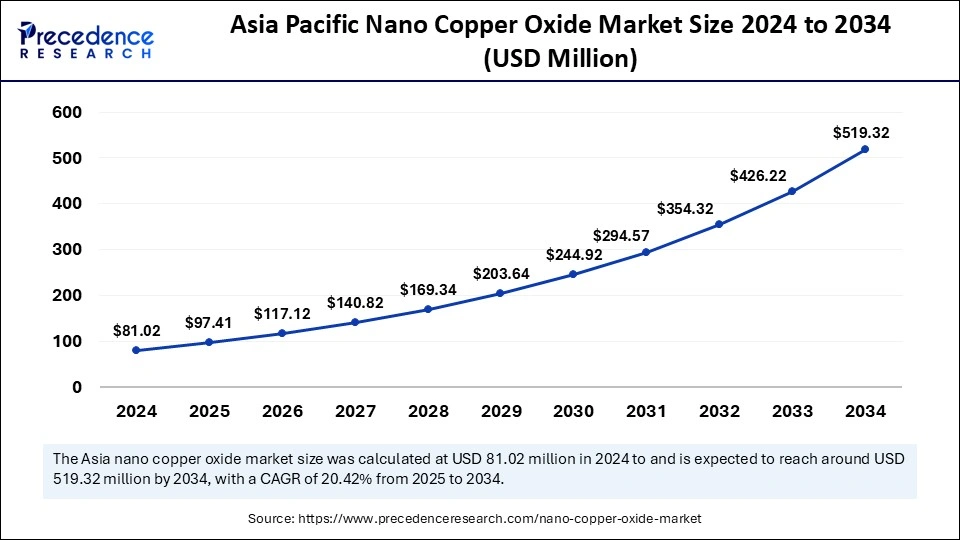
The Asia Pacific nano copper oxide market size is exhibited at USD 97.41 million in 2025 and is projected to be worth around USD 519.32 million by 2034, growing at a CAGR of 20.42% from 2025 to 2034.
Rapid Industrialization in Asia Pacific Drives Up Market
Asia Pacific dominated the nano copper oxide market in 2024, owing to its robust electronics production foundation, swift industrial growth, and government backing for nanotechnology. Nations such as China, Japan, and South Korea are significant users of nano copper oxide in conductive inks, printed circuit boards, and diverse electronic parts. Swift industrial expansion in China and India drives demand in areas such as energy storage, paints, and coatings.
- In December 2024, Indonesia and Canada established a CEPA to bolster economic connections and emphasize mineral management, especially in the nano copper oxide sector, improving resource use and technology sharing.
Industrial Dominance of China Strengthens Market Expansion
China plays a significant role in the leadership of the Asia Pacific nano copper oxide market. Robust manufacturing industry and considerable investment in research and development of China have positioned it as a top producer and consumer of nano copper oxide, especially in electronics and energy sectors. Government programs such as the Made in China 2025 strategy of China created a favorable atmosphere for the production and use of nano copper oxide.
Electronics Revolution of India Boosts Nano Copper Oxide Innovation
India plays a crucial role in the leadership of Asia Pacific in the nano copper oxide market because of its swift industrial growth, increasing attention to electronics and renewable energy, and commitment to innovation. This has established a positive setting for the production and use of nano copper oxide, as researchers focus on enhancing solar cell efficiency with nano copper oxide. This is in line with the renewable energy objectives of India and has resulted in a rise in demand for nano copper oxide in fields such as electronics and energy storage.
Expanding Healthcare and Electronics Sectors in North America Spurs the Market
North America is anticipated to host the fastest-growing nano copper oxide market during the forecast period due to its robust electronics and healthcare industries. The U.S. boasts a robust electronics sector, fueling the need for nano copper oxide in uses such as printed circuit boards, semiconductors, and conductive inks. The healthcare industry takes advantage of the antimicrobial characteristics of nano copper oxide, which are utilized in medical devices and coatings to avert infections.
- In March 2025, Rio Tinto, a leading mining firm, showed a keen interest in increasing investments in U.S. copper initiatives, especially the Resolution Copper Project in Arizona, which could greatly satisfy the copper needs of the country.
U.S. Market Trends
The U.S. leads the nano copper oxide market of North America in growth speed, driven by its advanced technological infrastructure, a growing electronics sector, and supportive government programs. The U.S. boasts a strong technological framework that fosters research and development in nanotechnology, speeding up innovations and market introduction. Moreover, the U.S. emphasizes local mineral production, securing a robust market for nano copper oxide.
- The U.S. government has dedicated more than USD 43 billion to the National Nanotechnology Initiative (NNI), supporting essential research and infrastructure enhancement.
The strong technological infrastructure of the U.S. facilitates extensive research and development efforts, promoting innovations in nanomaterials and broadening applications in the healthcare and electronics fields. The expanding electronics sector and rising incidence of infectious diseases have resulted in the use of nano copper oxide in antimicrobial coatings and biomedical devices, improving infection control strategies in healthcare environments.
Europe: A Prominent Hub for Nano Copper Oxide Advancement
Europe plays a crucial role in the global nano copper oxide market because of its commitment to sustainability, innovative research and development, and increasing demand for high-performance electronics. The focus on sustainable energy and environmental cleanup in the region has resulted in a higher use of nano copper oxide in catalysts, coatings, and energy storage uses. Moreover, strict regulations concerning the application of nanomaterials have propelled research into the safe and effective use of nano copper oxide.
- In November 2023, Europe created self-repairing antibacterial polymer coatings featuring copper oxide nanoparticles, which provide improved effectiveness and resilience, aligning with the focus of Europe on innovative and sustainable approaches.
Europe: Germany Nano Copper Oxide Market Trends
Germany's market is growing steadily due to increasing demand from electronics, coatings, and energy applications. Rising use of nano copper oxide in conductive inks, catalysts, and antimicrobial coatings is supporting broader industrial adoption. The country's strong focus on advanced materials research and its well-established manufacturing base are accelerating commercial deployment. Environmental regulations are also encouraging the shift toward high-efficiency, lower-toxicity nanomaterials in various sectors.
Can Middle East Africa Leap from Raw Minerals to Advanced Nano Materials?
The Middle East & Africa are an emerging region for nano CuO adoption, leveraging mineral feedstock availability in some countries and rapid infrastructure investment in urban hubs. Adoption is currently project-driven, for instance, antimicrobial coatings in healthcare facilities, dust-resistant coatings in arid ports, and speciality catalyst uses in petrochemical units. Many markets are still developing regulatory frameworks for nanomaterials, which slows widespread application but opens opportunities for publicly supported pilot projects. Localisation of production and technology transfer partnerships are the likely path to broader regional uptake.
The UAE Nano Copper Oxide Market Trends
The UAE is positioning itself as a smart-city and advanced-materials testbed, attracting pilot projects for novel coatings and environmental technologies that use nano CuO. Government industry initiatives often back demonstration projects in airports, hospitals, and transport hubs where antimicrobial and anti-soiling properties are attractive. Strategic logistics and free-zone policies facilitate the import of precursor chemicals and the export of finished materials. Over time, the UAE's hub role could catalyse regional distribution and after-sales support networks.
Will Latin America Turn Natural Resources into Nano-Enabled Value?
Latin America's nano CuO market is nascent but promising, particularly where local mining and chemical sectors can feed upstream supply chains for value-added processing. Adoption currently focuses on agricultural fungicides/biocontrol formulations, industrial antimicrobial coatings and localised catalyst needs in refining and chemical plants. Challenges include limited pilot-scale capacity, logistics across large territories, and the need for technical partnerships to ensure product quality. Successful strategies often pair local R&D with toll-manufacturing arrangements to serve regional OEMs and multinational customers.
Brazil Nano Copper Oxide Market Trends
Brazil offers scale opportunities through its large industrial and agricultural economy, where antimicrobial and functional coating markets exist alongside developing electronics and energy-storage sectors. Local research institutes and chemical firms can pilot formulations tailored for hot, humid climates and agricultural deployment patterns. However, supply-chain fragmentation and investment cycles can slow rapid commercialisation without targeted public private programs. Still, Brazil's scale can create a meaningful regional demand base if manufacturing and standardisation capabilities are strengthened.
Nano Copper Oxide Market Value Chain Analysis
- Raw Material Sourcing: Nano copper oxide production begins with high-purity copper salts, copper powders, reductants, stabilizing agents, surfactants, and solvents that enable controlled nanoscale synthesis. Manufacturers prioritise materials with low impurity levels to ensure practical uniformity, consistent reactivity, and better downstream dispersion.
Key players: Aurubis AG, Mitsubishi Materials and Sumitomo Metal Mining. - Retail Sales and Distribution: Once manufactured and formulated, nano copper oxide is distributed through B2B chemical distributors, specialized nanomaterial suppliers and OEM procurement networks and digital chemical marketplaces.
Key players: Sigma-Aldrich and Alfa Aesar
Top Companies in the Nano Copper Oxide Market & Their Offerings:
- Sigma-Aldrich / Millipore: Major global distributor supplying nano CuO in research and small commercial volumes.
- Thermo Fisher Scientific: Provides nano-materials to laboratories, OEMs, and academic researchers worldwide.
- Alfa Aesar: Key seller of nano-grade copper oxide for specialty and R&D applications.
- NanoComposix: Offers formulated nano CuO products with technical support for end-use developers.
- Merck Chemicals Distribution Network: Ensures regulated global distribution of nanomaterials to certified buyers.
Nano Copper Oxide Market Companies
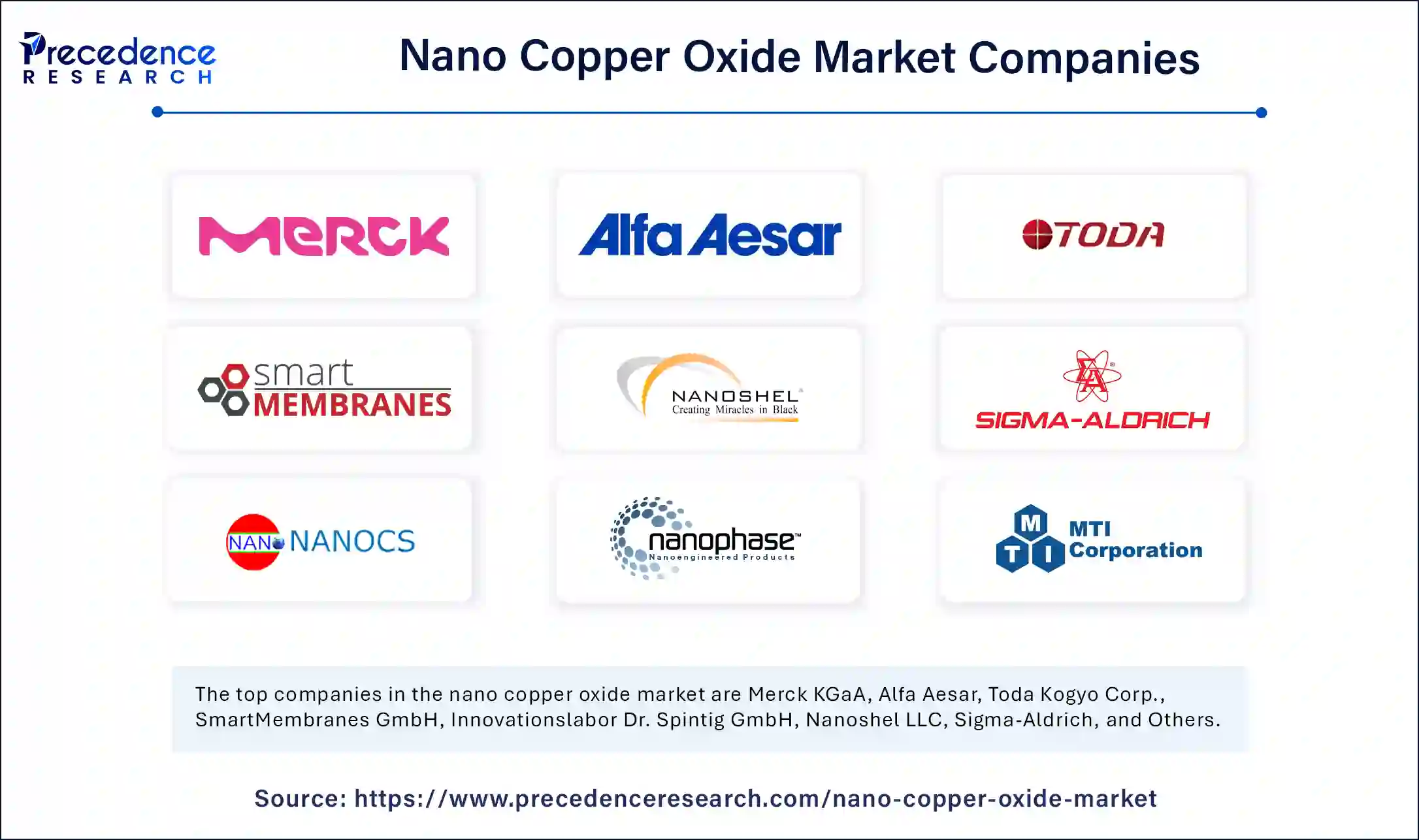
- Merck KGaA
- Alfa Aesar
- Toda Kogyo Corp.
- SmartMembranes GmbH
- Innovationslabor Dr. Spintig GmbH
- Nanoshel LLC
- Sigma-Aldrich
- Nanocs, Inc.
- US Research Nanomaterials, Inc.
- Nanophase Technologies Corporation
- MTI Corporation
Leaders' Announcements
- In February 2024, Recyclekaro and BARC inked a MoU to create high-purity copper oxide nanoparticles from discarded printed circuit boards, focusing on employing advanced technology for diverse industrial uses, emphasizing the significance of sustainable production practices.
Recent Developments
- In March 2025, the U.S. government enacted an executive order to simplify permitting procedures and enhance funding for local mineral initiatives, such as copper, to reduce reliance on foreign sources and bolster domestic industries.
- In May 2024, the Indian Farmers Fertiliser Cooperative (IFFCO) gained approval from the Indian Government for its Nano Zinc Liquid and Nano Copper Liquid products, designed to tackle micronutrient deficiencies in crops.
- In February 2024, a study released in the Biomaterials Science journal revealed that researchers have created quercetin-copper nanoparticles that can efficiently inhibit biofilm formation by Pseudomonas aeruginosa and Staphylococcus aureus, showing low cytotoxicity.
- In September 2023, research released in RSC Advances revealed that scientists created a microwave-assisted biosynthesis technique to generate copper oxide nanoparticles infused with a Pt (II) complex, which demonstrated anticancer effects on human colon cancer cells.
Segments Covered in the Report
By Type
- Powdered
- Dispersed
By End User
- Electricals and Electronics
- Paints and Coatings
- Catalysts
- Energy Storage
- Others
By Region
- North America
- Europe
- South America
- Asia Pacific
- Middle East and Africa
For inquiries regarding discounts, bulk purchases, or customization requests, please contact us at sales@precedenceresearch.com
Frequently Asked Questions
Tags





Ask For Sample
No cookie-cutter, only authentic analysis – take the 1st step to become a Precedence Research client
 Get a Sample




 sales@precedenceresearch.com
 Schedule a Meeting
