



Acid Proof Lining Market Revenue to Attain USD 11.18 Bn by 2035
Published: 15 May 2026
Author: Precedence Research



Acid Proof Lining Market Revenue and Trends 2026 to 2035
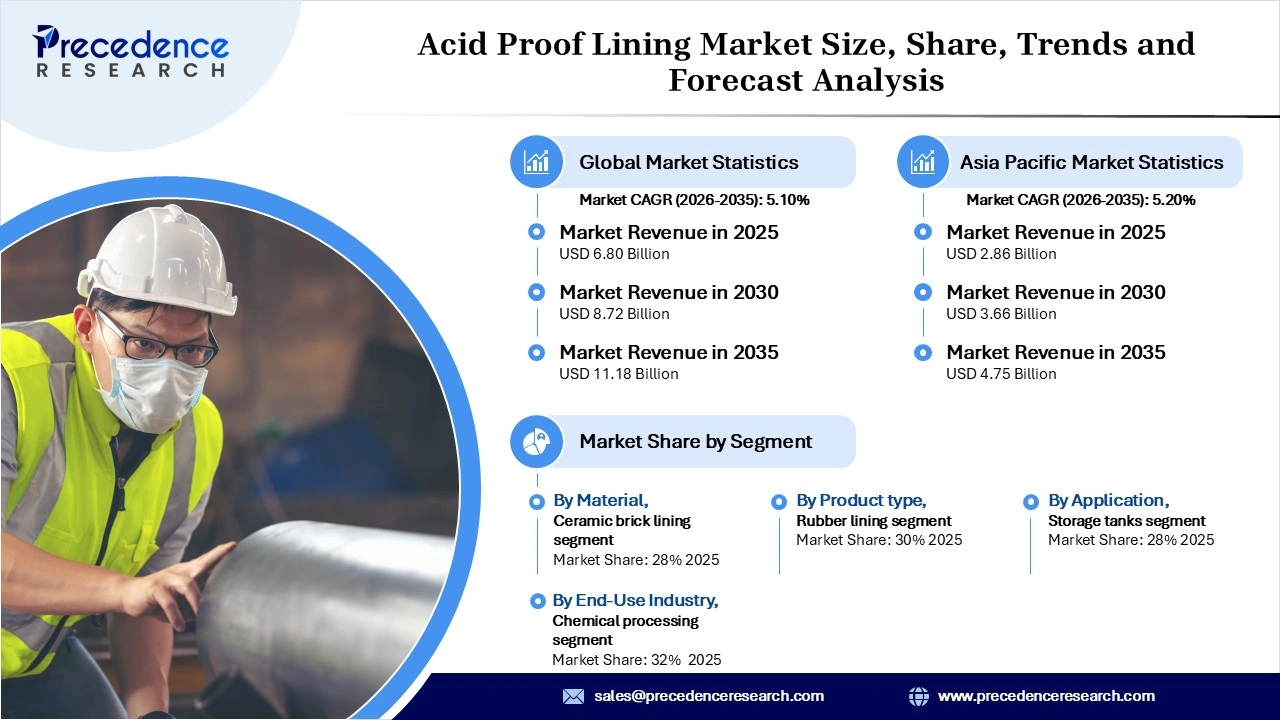
The global acid proof lining market revenue surpassed USD 6.80 billion in 2025 and is predicted to attain around USD 11.18 billion by 2035, growing at a CAGR of 5.10%. The market is driven by the increasing demand to protect industrial machinery like storage tanks, chemical reactors, pipelines, scrubbers, and floor surfaces against corrosive acids, which may cause operational issues, financial losses, legal troubles, and potential danger to the safety of workers.
What are the Major Trends Impacting the Market?
- The Layer That Provides Protection from Acids: The acid proof lining market includes products and services related to the development of an impervious barrier inside the equipment utilized in industrial operations in tanks, reactors, pressure vessels, pipes, scrubbers, sumps, and concrete floors. The purpose of such products is the prevention of damage inflicted by aggressive acidic substances. The products utilized in this market include rubber linings such as natural rubber, neoprene, butyl, and EPDM that can be affixed through vulcanizing or adhesive bonding.
Brick linings have also been adopted that consist of carbon bricks and acid-proof ceramic bricks placed in special chemically resistant mortars used for protecting equipment in cases when it is exposed to abrasives. The market consists of thermoplastic solutions such as Polyvinyl Chloride (PVC), polypropylene, PVDF, and PTFE, as well as combined laminations featuring a thermoplastic layer glued to a fiberglass-reinforced plastic outer shell. The market has been adopted in chemical processing factories, steel mills, fertilizer plants, power plants, mining, the pharmaceutical sector, and wastewater treatment plants. - AI-Driven Laser Surface Treatment for Acid Resistance: The latest trend in the market is the usage of AI-enabled laser treatment technologies for developing superomniphobic surfaces that provide resistance to almost all liquids, including highly corrosive acids, without resorting to any chemicals in spray coating form. Such laser-treated surfaces exhibit resistance against stretching and remain repellent after enduring tens of thousands of stretching cycles due to optimized settings of lasers determined through machine learning models. In 2026, researchers from North Carolina State University developed an AI-driven laser ablation technology for producing superomniphobic surfaces that repel all acids, bases, and solvents for more than 5000 stretching cycles.
- Adoption of HDPE V-Lock Liner System for Acid Pools: The acid proof lining market is benefiting from the adoption of HDPE concrete lining systems that provide multi-layered protection tailored to withstand extremely corrosive environments such as hydrochloric acid storage. This system incorporates a unique anchorage plate that mechanically locks the lining system into the concrete, ensuring that it does not peel off and stops chemicals from going past the barrier under temperature changes and mechanical strain. In 2025, Shandong Ningjin Xinjing Chemical Co. Ltd. reported the successful implementation of its HDPE V-Lock liner system and anchorage plate technology in the manufacturing of hydrochloric acid pools. Laboratory tests confirmed that the material retains 98 percent of its integrity during 1000 consecutive hours of exposure to a 30 percent hydrochloric solution.
- Government Policies for Corrosion Protection: Governments across the world have implemented policies that enforce the installation of impermeable secondary containment systems to ensure no harmful substances escape into the environment. According to such policies, any industrial facility storing hazardous substances must have secondary containment tanks that can hold up to a certain percentage of the total volume stored in those facilities. The policies state that the bases should be sloped to drain hazardous fluids. In 2025, the U.S Environmental Protection Agency enforced Section 40 CFR 264.175 under the Resource Conservation and Recovery Act. This act requires facilities dealing with hazardous wastes, as well as manufacturing facilities handling hazardous chemicals, to install secondary containment systems that are crack-proof and impervious enough to prevent any spills and leaks.
- BASF Decreases Carbon Footprint of Acid Chloride Products by 19%: BASF’s intermediates division transformed its whole acid chlorides and chloroformates product range at the Ludwigshafen site to rely on 100% renewable electricity, achieving a reduction in carbon footprint by an average of 19% in 2025. This modernization initiative has resulted in a 30% increase in production capacity for these compounds, allowing for greater product delivery volumes with reduced emissions from about 25 products.
Market Segmentation Overview
- By material, the ceramic brick lining segment led the acid proof lining market with 28% share in 2025, since it has great resistance to very high temperatures, highly acidic conditions, slurry abrasion, and mechanical impacts, making it ideal for coatings which are regularly exposed to adverse chemical and mechanical conditions.
- By material, the fluoropolymer lining segment is expected to expand at the highest CAGR of 7.2% during the forecast period, due to its high chemical resistance and the ability to resist very aggressive acids, high temperatures, and chronic corrosion.
- By product type, the rubber lining segment dominated the market with 30% share in 2025, owing to strong demand from mining and chemical processing industries, high abrasion and impact resistance properties, increasing use in tanks and pipelines, and a cost-effective corrosion protection solution.
- By product type, the vinyl ester lining segment is expected to grow at the fastest CAGR of 6.2% from 2026 to 2035, because of its high resistance to acids and corrosive chemicals, increasing use in chemical processing plants, rising demand for durable industrial linings, and expansion of wastewater treatment projects.
- By application, the storage tanks segment led the market with 28% share in 2025 and is expected to expand rapidly with a CAGR of 5.8% over the studied period, due to the increasing storage capacities of corrosive industrial chemicals, rising refinery and petrochemical infrastructure investments, growing demand for long-lasting corrosion protection, and expansion of industrial liquid storage facilities.
- By application, the flooring and surface protection segment held the second largest market share of 20% in 2025, owing to the rising industrial safety and durability requirements, growing use in manufacturing plants and warehouses, increasing demand for chemical-resistant flooring systems, and expansion of industrial infrastructure projects.
- By end-use industry, the chemical processing segment dominated the market with 32% share in 2025, because of strong use of corrosive chemicals in industrial operations, increasing investments in chemical manufacturing plants, and the rising need for corrosion-resistant process infrastructure.
- By end-use industry, the fertilizers segment is expected to expand at the highest CAGR of 6% during the forecast period, owing to the increasing global fertilizer production capacity, growing demand for corrosion-resistant storage and process systems, increasing agricultural chemical manufacturing, and expansion of ammonia and phosphate processing facilities.
Regional Analysis
Asia-Pacific held a major revenue share of 42% in the acid proof lining market in 2025, due to well-developed chemical, petrochemical, and fertilizer organizations operating under extreme environmental conditions that call for consistent application of lining systems for increased efficiency and safety. China dominated the market in Asia-Pacific since it has extensive industrial infrastructure, vast chemical production capacity, rapid expansion of refining activities, and a rise in the number of infrastructural projects that necessitate the use of corrosion-resistant lining systems. India is a significant contributor to the market owing to the rapidly growing chemical and process industries and huge investments in oil refinery processes and fertilizers.
North America held the second-largest market share of 24% in 2025, because of its mature base of chemicals, oil and gas, and pharmaceuticals industries, which require superior corrosion resistance, stringent safety and environmental norms, driving the use of superior lining technologies. The U.S led the market in North America due to the presence of large-scale petrochemical plants, superior infrastructure, and constant upgrades and modernization of aging industrial assets through corrosion-resistant lining materials. Canada witnessed notable market growth owing to its significant oil sands production, chemical plants, and the usage of robust lining materials in the face of harsh operating environments.
Acid Proof Lining Market Coverage
| Report Attribute | Key Statistics |
| Market Revenue in 2025 | USD 6.80 Billion |
| Market Revenue by 2035 | USD 11.18 Billion |
| CAGR from 2026 to 2035 | 5.10% |
| Quantitative Units | Revenue in USD million/billion, Volume in units |
| Largest Market | Asia Pacific |
| Base Year | 2025 |
| Regions Covered | North America, Europe, Asia-Pacific, Latin America, and the Middle East & Africa |
Top Companies in the Acid Proof Lining Market
PPG, Sherwin-Williams, AkzoNobel, and Jotun are some of the key players involved in the manufacturing of industrial and protective paints mainly for corrosive protection applications. Hempel, Carboline, Tnemac, and Steuler Group are specialized manufacturers of highly resilient industrial lining and chemical resistant coating products. BASF, Saint Gobain, 3M, and Ashland are diversified material manufacturers who provide chemicals and other materials to the lining and coating industry.
Segments Covered in This Report
By Material
- Ceramic Brick Lining
- Carbon Brick Lining
- Tile Lining
- Thermoplastic Lining
- Fluoropolymer Lining
By Product Type
- Rubber Lining
- Epoxy-based Lining
- Polyurethane Lining
- Vinyl Ester Lining
- Polyester Lining
By Application
- Storage Tanks
- Flooring & Surface Protection
- Process Vessels
- Chimneys & Stacks
- Pipelines & Drains
By End-use Industry
- Chemical Processing
- Power Generation
- Metal & Mining
- Fertilizers
- Oil & Gas
- Water & Wastewater Treatment
By Region
- North America
- Latin America
- Europe
- Asia-pacific
- Middle and East Africa
Get this report to explore global market size, share, CAGR, and trends, featuring detailed segmental analysis and an insightful competitive landscape overview @ https://www.precedenceresearch.com/sample/8412
You can place an order or ask any questions. Please feel free to contact us at sales@precedenceresearch.com |+1 804 441 9344