



AI in Power Grid Management Market Revenue to Attain USD 43.22 Bn by 2035
Published: 06 Jul 2026
Author: Precedence Research



AI in Power Grid Management Market Revenue and Trends 2026 to 2035
The global AI in power grid management market revenue was valued at USD 8.40 billion in 2025 and is expected to attain around USD 43.22 billion by 2035, growing at a CAGR of 17.80% during forecast period. The market is driven by the increasing requirement to upgrade the existing power grid system, improve the efficiency of the power grid by making it more resilient against natural disasters, and enhance load balancing using advanced machine learning algorithms.
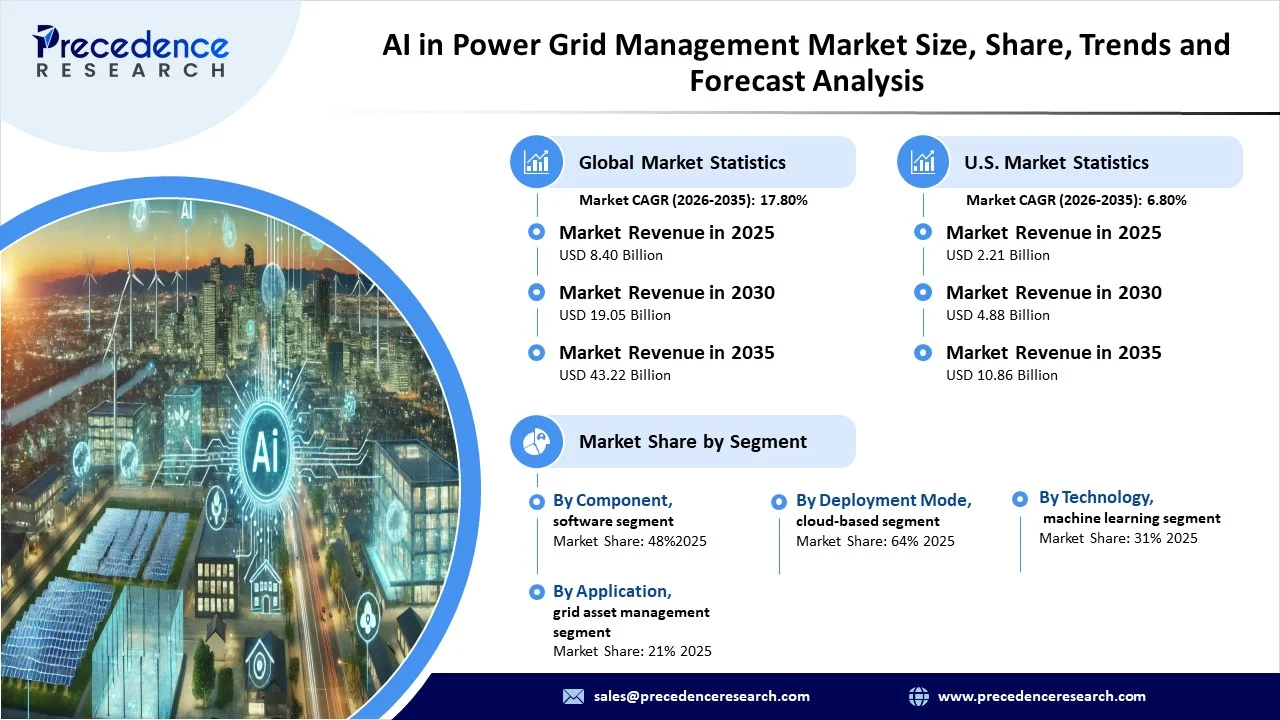
Intelligent Infrastructure: AI-Driven Grid Optimization
The AI in power grid management market consists of AI and machine learning (ML) solutions geared towards improving generation, transmission, distribution, and consumption of electric power within the grid. This market encompasses predictive analytics, anomaly detection, real-time optimization, and energy trading. This market involves software solutions (SCADA integration, simulation using a digital twin approach) and hardware solutions (edge AI solutions, smart sensors).
Specialized algorithms that help with grid stability, renewable energy integration, and outage management are also being adopted. The applications of this market include transmission and distribution network monitoring, DER management, microgrid optimization, and customer-facing demand response systems. This market has been adopted by utility companies, independent system operators (ISOs), renewable energy generators, industrial electricity consumers, and government institutions.
AI Supercomputers as Grid-Responsive Flexible Loads
AI used in the power grid management sector is seeing a new application where AI supercomputers are working as grid-responsive flexible loads, which will change power consumption on a millisecond basis. This solution helps the power grid balance itself during peak times. It is done through the use of predictive controllers, allowing multi-megawatt facilities to adapt to grid violations and frequency deviation in real time. In 2026, scientists unveiled GridPilot, a tri-level predictive controller for AI supercomputers that ensures a trigger-to-target reaction time of 97.2 milliseconds, which is 6.9 times quicker than the 700 ms required by Nordic Fast Frequency Reserve. This open-source system allows multi-megawatt AI and high-performance computing sites to change their power usage very quickly.
Adoption of Agentic AI Platforms for Grid Risk Management
The AI in power grid management market is witnessing rapid adoption of agentic AI platforms designed specifically for utilities to manage grid tasks in real-time. Agentic AI platforms enable the integration of fragmented operational data such as SCADA, AMI, GIS, weather forecasting services, and asset management platforms into a single cognitive layer. This enables identification of potential risks, prioritization of investments in the infrastructure, and improvement of reliability without changing the existing infrastructure. In 2026, Delta Energy launched its new QORTEX platform, which allows transforming fragmented operational data into predictive and actionable intelligence. In times of high wildfire risk, the platform continuously analyzes the forecasted weather conditions, vegetation data, and grid telemetry data to detect risk zones.
Government Programs for AI-Driven Grid Modernization
There is an increasing number of government-led programs that are intended to introduce AI into the process of power grid management in view of the difficulties in renewables’ implementation and the increasing demand for electricity due to AI-based data centers. Such programs include legislative measures, roadmaps, funding for AI studies, and pilot programs. In 2026, the House of Representatives introduced H.R. 7697, the “International AI Energy Grid Modernization Strategy Act,” which seeks to develop an international strategy to conduct research and development of AI technologies to upgrade outdated power grids. The bill highlights the transformative capabilities of AI in the power sector, namely predictive maintenance, real-time monitoring, anomaly detection, and autonomous system recovery.
GridCARE Secures USD 64 Million to Enhance Power Capabilities for AI Data Centers
Grid intelligence firm GridCARE secured USD 64 million in 2026 in a Series A financing round to expand its AI-based technology that allows data centers to leverage their underutilized grid power capabilities. The firm’s technology reduces the time taken to set up interconnections from 6 to 10 years to a few months and has created more than USD 10 billion in economic value for developers of data centers.
Market Segmentation Overview
- By component, the software segment led the AI in power grid management market with a 48% share in 2025 and is expected to expand at the highest CAGR of 19.3% during the forecast period, since it hosts algorithms, machine learning, analytics, and other capabilities that make up the intelligent systems for real-time monitoring, troubleshooting, and self-governing grid systems.
- By component, the hardware segment held the second-largest market share of 27% in 2025 because it delivers the essential physical infrastructure needed for gathering high-frequency data from the power grid and implementing control instructions using AI. This segment forms an integral part of AI grid management, giving lasting benefits through durable and tested products that allow utilities to develop an infrastructure that can handle the transition to renewable sources of energy.
- By deployment mode, the cloud-based segment dominated the market with a 64% share in 2025 and is expected to grow at the fastest CAGR of 20.1% from 2026 to 2035, because it offers the necessary scalability and computing resources to analyze terabytes of sensor and telemetry data in real-time over extensive transmission grids. It allows AI algorithms to keep learning and adapting on the fly without being restricted by expensive and on-premises infrastructure.
- By deployment mode, the on-premises segment held the second-largest market share of 36% in 2025 because it gives utilities full control over grid data, which ensures that they comply with stringent cybersecurity and data sovereignty requirements while not having to depend on any cloud vendors for their crucial infrastructures. This segment is especially favored by regulated utilities and government organizations responsible for critical infrastructure, as it helps them easily integrate it with the SCADA and EMS systems.
- By technology, the machine learning segment led the AI in power grid management market with a 31% share in 2025, since it is the foundation of most AI-enabled applications in grid modernization, enabling the prediction of load and renewable energy generation, real-time fault detection, and power flow and voltage control via optimization techniques. Machine learning’s strength lies in its capability to continually learn from massive data streams ranging from smart meters, PMUs, SCADA, weather sources, and asset condition monitoring sensors.
- By technology, the reinforcement learning segment is expected to expand at the highest CAGR of 21.5% during the forecast period, due to the fact that it supports autonomous and dynamic decision-making in an unpredictable environment of grid operation. This segment is becoming especially relevant in light of the integration of renewable energy sources into electricity networks.
- By application, the grid asset management segment dominated the market with a 21% share in 2025, since it deals with the most expensive problem of utilities, which are aging transformers, transmission lines, and substations. Through AI technology, the prediction of equipment failure, maintenance scheduling, and machinery lifespan optimization is made possible.
- By application, the renewable energy integration segment is expected to grow at the fastest CAGR of 22.4% from 2026 to 2035 because of the sustainability goals of utilities, under which they are trying to achieve decarbonization goals through increased renewable integration. They need to manage several complex issues, including ramp rate control, voltage control, and curtailment reduction, which can be effectively managed using AI technologies.
- By end user, the utilities segment led the market with a 46% share in 2025, due to the fact that they have the primary ownership and operation of the power grids, which entails the direct responsibility for reliability, resilience, and regulatory compliance. This segment is the biggest buyer of AI-based grid management solutions, in order to overcome aging infrastructure and the integration of renewables.
- By end user, the renewable energy developers segment is expected to expand at the highest CAGR of 20.4% during the forecast period, because they are the ones developing solar and wind farms, and the integration of such developments requires AI-based forecasting, optimization, and coordination at the grid edge to help secure interconnection deals, prevent curtailments, and optimize profits.
Regional Analysis
North America dominated the AI in power grid management market with a 35% share in 2025, owing to the presence of one of the most advanced and complicated power grids in the world that is faced with several challenges due to aging infrastructure, integration of renewable energy sources, and climatic conditions, which create a pressing need to use AI technologies to improve the reliability of the grid. The U.S. led the market because of extensive investments in grid modernization and development, the presence of well-developed AI and cloud technology industries, and the availability of venture capital investments for developing grid AI technologies. Canada is a significant contributor to the market due to its government-supported intelligent grid and renewable integration initiatives, emphasis on decarbonization and climate resilience, and its expanding network of AI and clean-technology companies.
Asia-Pacific is expected to grow at the fastest CAGR of 20.6% from 2026 to 2035 because of its rapid energy transition, which involves massive deployment of solar, wind, and storage capacity along with building of grid infrastructure on an unprecedented scale to cater to soaring electricity demand. China dominated the market in Asia-Pacific due to its leading position in terms of global renewable energy deployment, the largest and most complex transmission infrastructure in the world, and significant government backing for AI and smart grid technologies. India witnessed notable market growth owing to large-scale expansion of the national grid, smart meter and sensor deployments, and government backing for digital grid projects and applications using AI for reducing losses, forecasting load, and integrating renewables into the power system.
Europe held the third-largest market share of 26% in 2025, due to its cutting-edge expertise in integrating renewables, the presence of strict sustainability standards, and cross-border grid infrastructures that require complex AI systems to balance intermittent sources of wind and solar power. Germany led the market in Europe owing to its path-breaking energy strategy known as the “Energiewende”, which has resulted in the early implementation of AI for stabilizing the grid and a highly advanced industry base in renewable technology and software. The UK is a significant contributor to the market because of its forward-looking energy policy, advanced ecosystem of AI and technology startups, and its status as one of the global hubs for smart grid innovations.
AI in Power Grid Management Market Coverage
| Report Attribute | Key Statistics |
| Market Revenue in 2025 | USD 8.40 Billion |
| Market Revenue by 2035 | USD 43.22 Billion |
| CAGR from 2026 to 2035 | 17.80% |
| Quantitative Units | Revenue in USD million/billion, Volume in units |
| Largest Market | North America |
| Base Year | 2025 |
| Regions Covered | North America, Europe, Asia-Pacific, Latin America, and the Middle East & Africa |
Top Companies in the AI in Power Grid Management Market
Schneider Electric, Siemens AG, GE Vernova, and Hitachi Energy are some of the key players that offer grid digitalization, automation, and management with the help of AI technology. IBM, Oracle, SAP, and Cisco provide solutions for grid analytics, asset management, and smart grids using AI. Microsoft, NVIDIA, and Google Cloud focus on AI-based grid optimization and energy analytics through cloud platforms. Accenture, Infosys, TCS, and Wipro concentrate on grid management and forecasting services with the help of AI technology.
Segments Covered in This Report
By Component
- Software
- AI Platforms
- Analytics Software
- Grid Optimization Software
- Predictive Maintenance Software
- Hardware
- Edge AI Devices
- Smart Sensors
- Intelligent Controllers
- High-Performance Computing Infrastructure
- Services
- Consulting
- System Integration
- Deployment & Implementation
- Support & Maintenance
- Managed Services
By Deployment Mode
- Cloud-based
- Public Cloud
- Private Cloud
- Hybrid Cloud
- On-premises
By Technology
- Machine Learning (ML)
- Deep Learning
- Natural Language Processing (NLP)
- Computer Vision
- Reinforcement Learning
- Digital Twin
- Generative AI
By Application
- Grid Asset Management
- Asset Health Monitoring
- Predictive Maintenance
- Failure Predictio
- Load Forecasting
- Demand Response Management
- Renewable Energy Integration
- Grid Optimization
- Energy Trading and Market Forecasting
- Outage Detection and Restoration
- Fault Detection and Diagnosis
- Voltage and Frequency Control
- Cybersecurity and Threat Detection
By Grid Type
- Transmission Grid
- Distribution Grid
- Smart Grid
- Microgrid
By Utility Type
- Electric Utilities
- Independent System Operators (ISOs)
- Transmission System Operators (TSOs)
- Distribution System Operators (DSOs)
- Renewable Energy Operators
By End User
- Utilities
- Energy and Power Companies
- Government and Public Utilities
- Industrial Power Consumers
- Commercial Power Consumers
- Renewable Energy Developers
By Organization Size
- Large Enterprises
- Small and Medium Enterprises (SMEs)
By Region
- North America
- Latin America
- Europe
- Asia-pacific
- Middle and East Africa
Get this report to explore global market size, share, CAGR, and trends, featuring detailed segmental analysis and an insightful competitive landscape overview @ https://www.precedenceresearch.com/sample/8534
You can place an order or ask any questions. Please feel free to contact us at sales@precedenceresearch.com |+1 804 441 9344