



Ambient IoT Market Revenue to Attain USD 35,780.00 Mn by 2035
Published: 30 Jun 2026
Author: Precedence Research



Ambient IoT Market Revenue and Trends 2026 to 2035
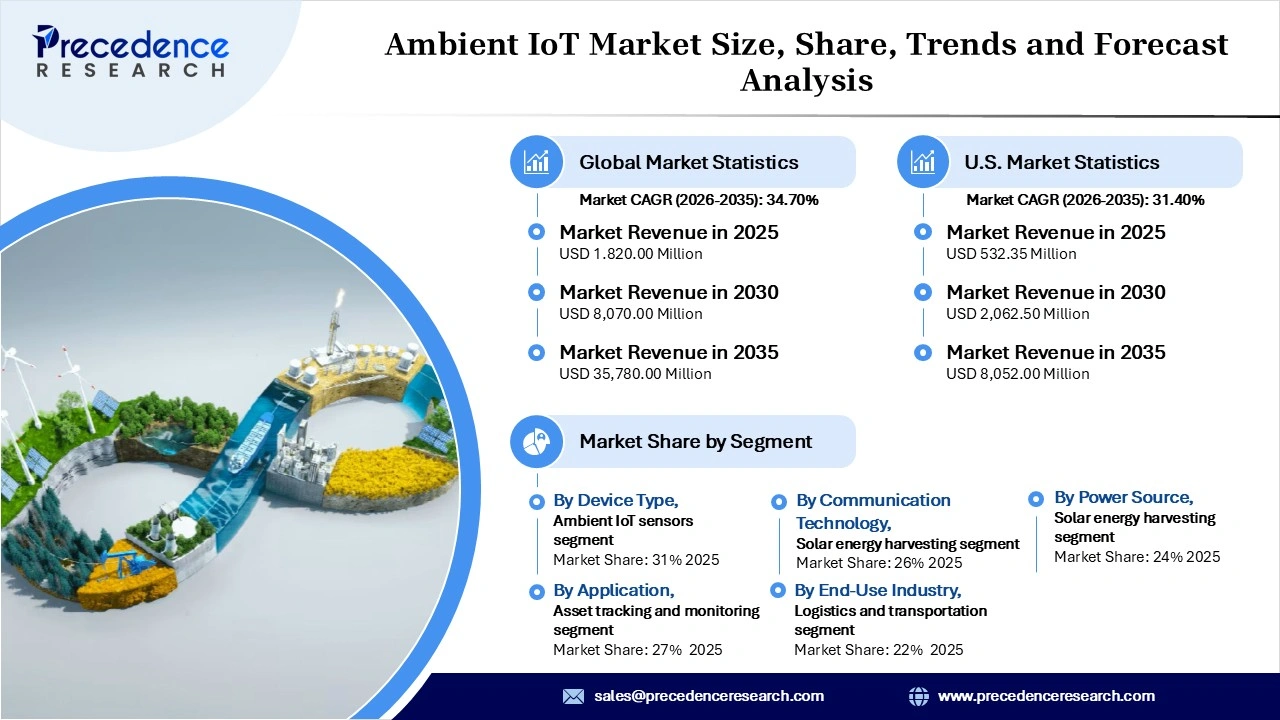
The global ambient IoT market revenue surpassed USD 1,820.00 million in 2025 and is predicted to attain around USD 35,780.00 million by 2035, growing at a CAGR of 34.70%. The market is driven by the convergence of energy harvesting, ultra-low-power wireless technology, and AI edge analytics to provide battery-less, cost-effective, and massively scalable sensor networks for real-time environmental and asset monitoring.
The Invisible Network: Energy-Harvesting Connectivity for the World
The ambient IoT market comprises all technologies, devices, and platforms enabling wireless, batteryless sensing and communication through harvesting energy from the physical environment, including radio frequencies (RF), light, heat, vibrations, and motion. Ambient IoT devices either have no batteries or ultra-long-lasting batteries and work via low-power connectivity methods like Bluetooth Low Energy, Zigbee, LoRaWAN, Wi-Fi HaLow, and ambient backscatter technology.
This market includes sensors, tags, gateways, energy harvesters, and cloud-based analytics software to process the sensor data. The main use cases involve real-time tracking and condition monitoring in logistics, retail, smart buildings, industrial predictive maintenance, patient and asset tracking in healthcare, and cold-chain logistics. This market has been adopted by logistics service providers, retailers, manufacturers, healthcare facilities, and facility managers.
Standardization and Commercialization Speed Up Non-Battery Sensors Rollout
The market is moving towards the scale of infrastructure deployment owing to the introduction of new hardware and communication standards, which help decrease unit costs and increase the range of communication. The next generation of passive energy harvesting sensors and dual-band tags provides real-time visibility of the supply chain and batteryless environment monitoring. In 2026, Wiliot introduced its Gen3 IoT Pixel, which is a dual-band (2.4 GHz and sub-1 GHz) non-battery sensor with an extended range of energizing and reading capabilities and reduced costs to be used in AI-powered supply chain intelligence. The device sends out encrypted BLE signals and uses ambient RF to harvest energy.
Battery-Free Sensor Networks Deployed on Commercial Scale in Retail Supply Chain
The ambient IoT market is transitioning from pilot projects to commercial deployment on a large scale, with battery-free sensors powered by energy harvesting used by leading retailers for real-time supply chain visibility. AI systems turn all the information coming from the continuous stream of sensor data into automatic cycle counting, shipment validation, and monitoring of the conditions. In 2025, Walmart started the implementation of millions of ambient IoT battery-free sensors across its entire U.S. supply chain. The company plans to deploy its solutions at 4,600 sites, among which there will be more than 40 distribution centers. By the end of 2026, Walmart is expected to have 90 million pallets of its inventory covered with sensors providing temperature, location, humidity, and dwell time information for AI analysis.
Avery Dennison to Invest USD 75 Million in Wiliot to Boost Ambient IoT Infrastructure
Avery Dennison plans to invest USD 75 million in Wiliot in 2026, taking a board seat in the company, which will become its preferred global partner for designing and manufacturing inlays. This move will follow after the earlier investments made by Avery Dennison in Wiliot’s Series B round in 2019, worth USD 30 million, and the Series C round in 2021. This collaboration seeks to aid in multi-billion-unit label manufacturing as well as incorporate Wiliot’s tag solutions that require no batteries in Avery Dennison’s atma.io cloud platform.
Market Segmentation Overview
- By device type, the ambient IoT tags segment led the ambient IoT market with 42% share in 2025 and is expected to expand at the highest CAGR of 36.8% during the forecast period, due to the fact that such battery-less, energy-harvesting tags address the extremely high expense and logistical complexity of replacing batteries. This segment facilitates unprecedented large-scale deployment of inexpensive tags on disposable packages, pallets, and high-turnover merchandise.
- By device type, the ambient IoT sensors segment held the second-largest market share of 31% in 2025, since tracking in retail and logistics needs sensors as the underlying hardware that performs the actual task of sensing the temperature, humidity, motion, and location. It acts as a physical link between the physical environment and the cloud-based AI systems.
- By communication technology, the RAIN RFID segment dominated the market with 34% share in 2025 and is expected to grow at the fastest CAGR of 38.1% from 2026 to 2035, because it has low costs of tags per unit, well-developed global standards, and a mature infrastructure. It is the most viable option for high-volume, low-margin uses such as counting inventory in retail stores and warehouse receiving, where mass reading of thousands of objects is needed.
- By communication technology, the Bluetooth low energy (BLE) segment held the second-largest market share of 26% in 2025, owing to the fact that it provides a flexible, inexpensive wireless communication protocol that is readily available on billions of smartphones and existing gateways. It facilitates real-time, uninterrupted data transfer without the need for any specialized readers.
- By power source, the RF energy harvesting segment led the market with 38% share in 2025, and is expected to expand at the highest CAGR of 37.2% during the forecast period, since it powers the most widely used ambient IoT tags, allowing for the possibility of energy harvesting from ambient RF energy sources. This segment does not require any special environmental conditions, such as light and heat.
- By power source, the solar energy harvesting segment held the second-largest market share of 24% in 2025, because it is an established source of energy that is quite dependable. The main advantage of solar harvesting is that it provides a stable energy source that can be used in outdoor logistics, agriculture sensors, and electronic shelves.
- By application, the asset tracking and monitoring segment dominated the ambient IoT market with 27% share in 2025, because it offers solutions to the most widespread and expensive operational problems faced in logistics, retail, and supply chains, such as lost inventory, broken cold chains, mistakes during manual counting, and a lack of real-time visibility. It facilitates battery-free tracking of position, temperature, humidity, and dwell time without needing manual scans and battery replacements.
- By application, the retail inventory management segment is expected to grow at the fastest CAGR of 37.5% from 2026 to 2035, because it helps to curb the high costs of managing out-of-stock, overstock, and manually conducting cycle counts, which allows retailers to get almost perfect visibility on their stock levels using real-time automated methods. It minimizes the risk of shrinkage and improves replenishment and ordering processes.
- By end-use industry, the retail and e-commerce segment led the market with 26% share in 2025, and is expected to expand at the highest CAGR of 37.1% during the forecast period, due to its rapid transaction pace, which makes it prone to problems such as inventory inaccuracy, out-of-stock products, overstock, and shrinkage. This can be solved through continuous and real-time visibility of billions of items in distribution centers, warehouses, and store shelves.
- By end-use industry, the logistics and transportation segment held the second-largest market share of 22% in 2025, since it deals with the movement of large numbers of pallets, boxes, and other goods along a long and intricate chain of distribution where real-time knowledge of location and environmental conditions is essential.
Regional Analysis
North America dominated the ambient IoT market with 39% share in 2025, due to the presence of a high number of large retailers such as Walmart, Amazon, and Target, and logistics companies including UPS and FedEx, which are among the pioneers in adopting ambient IoT solutions. The U.S. led the market in North America because of good venture funding for ambient IoT startups, as well as a well-developed retail and logistics landscape ready to invest in new technologies. Canada is a significant contributor to the market owing to the increasing use of ambient IoT for cold chain logistics and pharmaceuticals, and the presence of government programs fostering innovation and technology adoption in the supply chain.
Asia-Pacific is expected to expand at the highest CAGR of 40.6% during the forecast period, because it is a significant hub of manufacturing and logistics, involving large volumes of products, which require timely visibility, inventory accuracy, and cold chain monitoring to minimize losses and ensure better efficiency. China dominated the market in Asia-Pacific due to its leading position in electronics manufacturing, the presence of the biggest retail and e-commerce market in the world, and strong government support for digital supply chain solutions. India witnessed notable market growth owing to the growing digitization of the retail industry, logistics infrastructure development, and the increasing awareness of small stores about digital solutions to manage inventory and coordinate logistics.
Europe held the second-largest market share of 27% in 2025, due to strong regulatory drivers for supply chain transparency, compliance with the cold chain, and sustainability, and the mature retail and logistics industry, which is already implementing advanced ambient IoT technologies to enhance the efficiency of inventory management. Germany led the market in Europe owing to its robust industrial and logistics infrastructure, a well-developed manufacturing sector that requires real-time visibility and early adoption of ambient IoT in the automotive and pharmaceutical sectors. The UK has a concentrated retail and e-commerce market, early adoption of ambient IoT by retailers for supply chain visibility, and a robust logistics industry acting as a global trading hub for cross-border activities.
Ambient IoT Market Coverage
| Report Attribute | Key Statistics |
| Market Revenue in 2025 | USD 1,820.00 Million |
| Market Revenue by 2035 | USD 35,780.00 Million |
| CAGR from 2026 to 2035 | 34.70% |
| Quantitative Units | Revenue in USD million/billion, Volume in units |
| Largest Market | North America |
| Base Year | 2025 |
| Regions Covered | North America, Europe, Asia-Pacific, Latin America, and the Middle East & Africa |
Top Companies in the Ambient IoT Market
Impinj, Wiliot, and Alien Technology are some of the key players that specialize in battery-powered RAIN RFID and Bluetooth-based sensing technology for item-level tracking and supply chain visibility applications. NXP Semiconductors, Infineon Technologies, STMicroelectronics, and Texas Instruments are suppliers of ultra-low-power microcontrollers, energy harvesting power management integrated circuits (PMICs), and wireless communication silicon devices for ambient IoT nodes. Nordic Semiconductor, EM Microelectronic, and Atmosic Technologies offer low-power Bluetooth system-on-chips (SoCs) and energy harvesting capabilities for battery-less sensor applications. Murata Manufacturing, Sony Semiconductor Solutions, and AMS OSRAM provide RF module solutions and environmental sensing devices.
Segments Covered in the Report
By Device Type
- Ambient IoT Tags
- Ambient IoT Sensors
- Ambient IoT Beacons
- Ambient IoT Gateways
By Communication Technology
- Bluetooth Low Energy (BLE)
- RAIN RFID
- NFC
- Wi-Fi
- LPWAN (LoRa, NB-IoT, LTE-M)
By Power Source
- RF Energy Harvesting
- Solar Energy Harvesting
- Thermal Energy Harvesting
- Piezoelectric Energy Harvesting
- Hybrid Energy Harvesting
By Application
- Asset Tracking and Monitoring
- Supply Chain and Logistics
- Retail Inventory Management
- Smart Buildings
- Industrial Monitoring
- Healthcare Asset Monitoring
By End-use Industry
- Retail and E-commerce
- Logistics and Transportation
- Manufacturing
- Healthcare
- Consumer Electronics
- Automotive
- Others
By Region
- North America
- Latin America
- Europe
- Asia-pacific
- Middle and East Africa
Get this report to explore global market size, share, CAGR, and trends, featuring detailed segmental analysis and an insightful competitive landscape overview @ https://www.precedenceresearch.com/sample/8527
You can place an order or ask any questions. Please feel free to contact us at sales@precedenceresearch.com |+1 804 441 9344