



Ambient IoT Market Trends, Companies, Revenue / Sales Performance, Subscriber Growth, Pricing Strategies, Cloud Adoption, Infrastructure Expansion, Competitive Landscape, and Industry Outlook
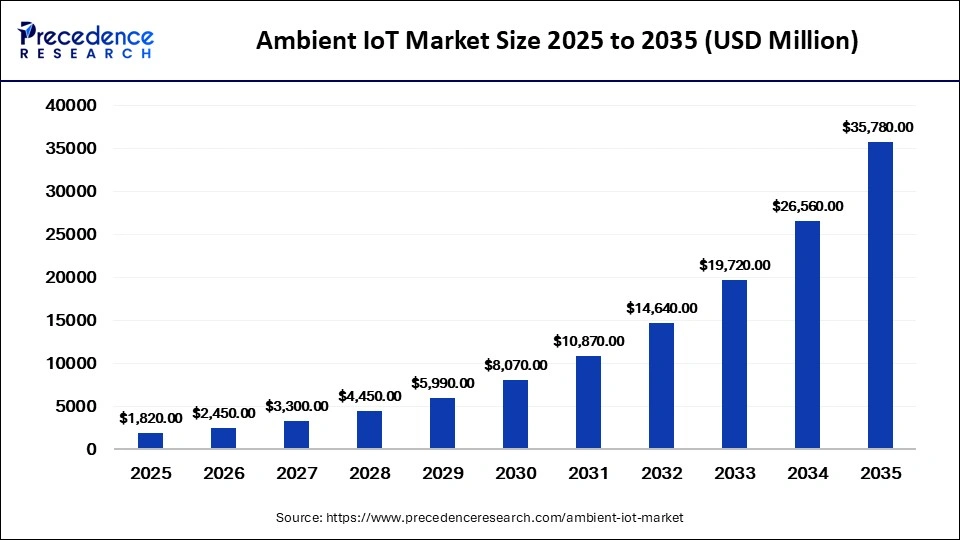
ICT industry specialist Shivani Zoting estimates the ambient IoT market at USD 2,450.00 million in 2026, with continued technology adoption expected to take the market to USD 35,780.00 million by 2035 at a CAGR of 34.70%. Leading ambient IoT market providers such as Impinj, NXP Semiconductors, Infineon Technologies are expanding their capabilities across segments including device type, communication technology, power source, application, end-use industry.
Source: https://www.precedenceresearch.com/ambient-iot-market
 Get a Sample
 Table Of Content


Ambient IoT Market Size and Forecast 2026 to 2035
The global ambient IoT market size accounted for USD 1,820.00 million in 2025 and is predicted to increase from USD 2,450.00 million in 2026 to approximately USD 35,780.00 million by 2035, expanding at a CAGR of 34.70% from 2026 to 2035. The market is driven by the need for battery-less energy harvesting, which removes the financial and environmental costs of traditional batteries.
Key Takeaways
- North America accounted for the highest revenue share of 39% in the ambient IoT market in 2025.
- Asia-Pacific is expected to grow at the fastest CAGR of 40.6% between 2026 and 2035.
- By device type, the ambient IoT tags segment dominated the market with a share of 42% in 2025 and is expected to grow at the fastest CAGR of 36.8% in the coming years.
- By device type, the ambient IoT sensors segment held the second-largest market share of 31% in 2025.
- By communication technology, the RAIN RFID segment dominated the market with a share of 34% in 2025 and is expected to grow at the fastest CAGR of 38.1% in the coming years.
- By communication technology, the bluetooth low energy (BLE) segment held the second-largest market share of 26% in 2025.
- By power source, the RF energy harvesting segment dominated the ambient IoT market with a share of 38% in 2025 and is expected to grow at the fastest CAGR of 37.2% in the coming years.
- By power source, the solar energy harvesting segment held the second-largest market share in 24% in 2025.
- By application, the asset tracking and monitoring segment held the largest market share of 27% in 2025.
- By application, the retail inventory management segment is expected to grow at the fastest 37.5% CAGR between 2026 and 2035.
- By end-use industry, the retail and e-commerce segment accounted for the highest revenue share of 26% in the market in 2025 and is expected to grow at the highest CAGR of 37.1% during the forecast period.
- By end-use industry, the logistics and transportation segment held the second-largest market share of 22% in 2025.
Market Overview
The ambient IoT industry refers to a rapidly growing technological ecosystem centered around battery free, ultra-low-cost, and self-powered sensor devices. Instead of depending on traditional replaceable batteries or wired power, these micro-devices "harvest" energy from their immediate surroundings, like radio waves, light, motion, and temperature. It is mainly driven by the transition toward battery-free, energy-harvesting sensors, which are ultra-cheap, disposable, and capable of transmitting item-level location, temperature, and condition data utilizing existing wireless networks without manual scanning.
Ambient IoT Market Trends
- The technology is transitioning away from traditional batteries toward ultra-sustainable sensors that harvest energy from ambient radio waves (RF), solar power, and Wi-Fi.
- Telecommunications bodies are formally defining ambient IoT specifications, enabling devices to integrate seamlessly with existing cellular infrastructure.
- Ambient IoT is evolving beyond basic data collection to integrate with AI, specifically physical AI and digital twins, to allow real-time tracking and autonomous decision-making.
Market Report Coverage and Key Metrics
| Report Coverage | Details |
| Market Size in 2025 | USD 1,820.00 Million |
| Market Size in 2026 | USD 2,450.00 Million |
| Market Size by 2035 | USD 35,780.00 Million |
| Market Growth Rate from 2026 to 2035 | CAGR of 34.70% |
| Dominating Region | North America |
| Fastest Growing Region | Asia Pacific |
| Base Year | 2025 |
| Forecast Period | 2026 to 2035 |
| Segments Covered | Device Type, Communication Technology, Power Source, Application, End-Use Industry, and Region |
| Regions Covered | North America, Europe, Asia-Pacific, Latin America, and Middle East & Africa |
Market Dynamics
Drivers
Rising Need for Battery-Free Sensing
The rising need for battery-free sensing is a primary driver for the market because it resolves core limitations of traditional IoT: limited device lifespans, prohibitive maintenance costs, and scaling bottlenecks. By eliminating batteries, businesses can deploy massive, maintenance-free sensor networks that were previously unviable. Eliminating batteries significantly decreases the environmental footprint associated with manufacturing and disposing of hazardous battery waste. This directly supports global corporate sustainability and net-zero initiatives.
Restraint
Complex Integration with Legacy Infrastructure
Complex integration with legacy infrastructure restrains the ambient IoT market because older systems lack the modern APIs, digital interfaces, and data protocols needed to process continuous, real-time streams. Retrofitting this outdated hardware demands expensive custom middleware, introduces critical cybersecurity vulnerabilities, and even risks costly operational downtime.
Convergence with Physical AI
Opportunity
The convergence of physical AI and ambient IoT is a major opportunity for market growth because it solves the core challenge of the IoT industry: extracting tangible business value from raw data. Physical AI thus acts as the "brain" that translates the continuous sensory signals into proactive, predictive, and automated physical actions. The synergistic feedback loop enables AI to identify operational patterns in IoT data and direct IoT-enabled devices to act, which in turn generates new data to further refine the AI models.
Market Segmentation Analysis
Device Type Insights
The Ambient IoT Tags Segment Dominated the Market with 42% of Market Share in 2025
The ambient IoT tags segment dominated the ambient IoT market with a share of 42% in 2025 and is expected to grow at the fastest CAGR of 36.8% in the coming years. This is due to increasing retail automation, rising adoption in logistics operations, and falling tag production costs. Stricter supply chain regulations, such as the EU's Digital Product Passport, mandate deep lifecycle tracking. Industries, mainly pharmaceuticals, use these tags for real-time temperature monitoring and supply chain traceability.
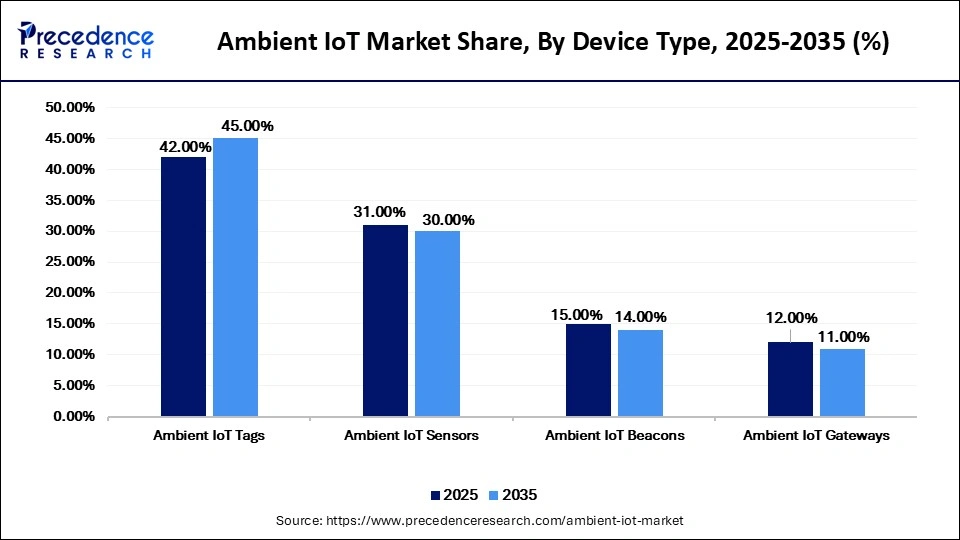
The ambient IoT sensors segment held 31% share of the market in 2025 and is expected to grow at a CAGR of 33.9% during the projection period. This is due to increasing industrial condition monitoring and rising environmental sensing applications. The fusion of Artificial Intelligence (AI) and Machine Learning (ML) transforms raw ambient data into actionable, predictive intelligence. This enables enterprises to deploy sensors that don't just collect data but automate real-time decision-making. Municipalities globally are thus heavily investing in ambient sensors for intelligent traffic systems, smart lighting, waste management, and environmental optimization.
The ambient IoT beacons segment held 15% share of the market in 2025 and is expected to grow at a CAGR of 31.7% during the projection period. This is due to growth in indoor positioning solutions and rising retail customer engagement initiatives. Advancements in miniaturization and micro-power electronics have dramatically slashed the cost of edge nodes, making them inexpensive enough to attach to individual consumer goods, packaging, or clothing. This item-level tracking thus brings mass-scale deployment to industries without breaking the bank.
Communication Technology Insights
The RAIN RFID Segment Led the Market with 34% of Market Share in 2025
The RAIN RFID segment led the ambient IoT market with a share of 34% in 2025 and is expected to grow at the fastest CAGR of 38.1% in the coming years. This is due to the battery-free operation capability, rapid retail inventory digitization, and growing logistics automation. Tech leaders such as Qualcomm are actively integrating RAIN RFID reader capabilities into commercial and enterprise mobile handsets, eliminating the reliance on costly, dedicated scanners.
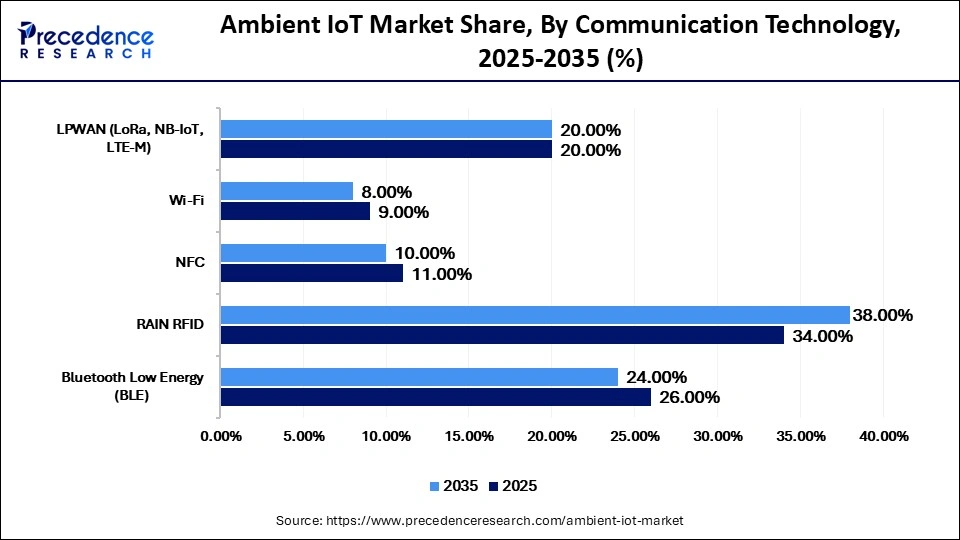
The bluetooth low energy (BLE) segment held 26% share of the market in 2025 and is expected to grow at a CAGR of 30.6% during the projection period. This is due to low-power connectivity, strong smartphone compatibility, and a growing consumer IoT ecosystem. Innovations in energy-harvesting technologies enable BLE tags to harvest ambient radio waves (RF) from routers or smartphones for power. This drastically decreases maintenance, eliminates battery disposal, and lowers the cost of individual tags. The adoption of battery-free ambient IoT by retail giants, like Walmart, deploying tens of millions of tracking tags, has validated the technology and driven economies of scale across the logistics sector.
The LPWAN (LoRa, NB-IoT, LTE-M) segment held 20% share of the market in 2025 and is expected to grow at a CAGR of 35.4% during the projection period. This is due to the expansion of industrial IoT networks and growing smart city deployments. Operating on sub-GHz frequencies, technologies such as LoRaWAN can bypass physical barriers and achieve rural ranges exceeding 15 km. For urban and even underground environments, cellular solutions such as NB-IoT provide enhanced indoor penetration to reach previously unreachable sensors.
Power Source Insights
The RF Energy Harvesting Segment Held the Largest Market Share of 38% in 2025
The RF energy harvesting segment held the largest revenue share of 38% in the ambient IoT market in 2025 and is expected to grow at the fastest CAGR of 37.2% in the coming years. This is due to the expansion of RFID infrastructure and low maintenance requirements. The widespread growth of 5G infrastructure alongside dense Wi-Fi and Bluetooth networks offers a robust web of ambient RF energy to harvest. Industries need dense sensor networks for asset tracking, predictive maintenance, and environmental monitoring. RF-powered ambient IoT easily scales across supply chains without the demand for manual battery checks.
Ambient IoT Market Share, By Power Source , 2025-2035 (%)
| Power Source | 2025 | 2035 | CAGR (%) |
| RF Energy Harvesting | 38.00% | 41.00% | 37.2% |
| Solar Energy Harvesting | 24.00% | 23.00% | 32.1% |
| Thermal Energy Harvesting | 14.00% | 13.00% | 31.6% |
| Piezoelectric Energy Harvesting | 10.00% | 9.00% | 29.8% |
| Hybrid Energy Harvesting | 14.00% | 14.00% | 36.1% |
The solar energy harvesting segment held 24% share of the market in 2025 and is expected to grow at a CAGR of 32.1% during the projection period. It is driven by sustainable IoT deployment, smart building applications, and reduced battery dependency. New technologies, like bifacial solar cells and dye-sensitized solar cells, are designed to capture ambient light efficiently in both indoor environments and outdoor spaces. Organizations are replacing millions of disposable chemical batteries with self-powered modules to lower carbon footprints and thus, prevent electronic waste.
The hybrid energy harvesting segment held 14% share of the market in 2025 and is expected to grow at a CAGR of 36.1% during the projection period. It is driven by deployment in diverse environments and growing advanced IoT applications. Modern Power Management Integrated Circuits (PMICs) enable devices to efficiently capture, merge, and store minuscule amounts of energy from two or more distinct ambient sources simultaneously. Hybrid setups guarantee continuous operation. For instance, when indoor light is low, the device seamlessly switches to harvest energy from radio waves or temperature gradients.
Application Insights
Why Did the Asset Tracking and Monitoring Segment Lead the Ambient IoT Market?
The asset tracking and monitoring segment held a dominant position in the market with a 27% share in 2025, driven by rising enterprise asset visibility needs and the expansion of digital inventory management. Industries, mainly pharmaceuticals and food logistics, face strict regulatory standards, like FSMA compliance, that require continuous temperature and condition logging. Ambient IoT enables automatic, real-time documentation of environmental metrics like temperature and humidity, removing manual logs and minimizing product spoilage.
Ambient IoT Market Share, By Application, 2025-2035 (%)
| Application | 2025 | 2035 | CAGR (%) |
| Asset Tracking & Monitoring | 27.00% | 28.00% | 35.8% |
| Supply Chain & Logistics | 24.00% | 25.00% | 36.9% |
| Retail Inventory Management | 18.00% | 19.00% | 37.5% |
| Smart Buildings | 12.00% | 11.00% | 31.2% |
| Industrial Monitoring | 11.00% | 10.00% | 32.6% |
| Healthcare Asset Monitoring | 8.00% | 7.00% | 33.7% |
The retail inventory management segment held 18% share of the market in 2025 and is expected to grow at the fastest CAGR of 37.5% during the projection period. This is mainly due to smart retail transformation, automated shelf monitoring, and inventory accuracy improvement. Ambient IoT pixels or tags harvest energy from surrounding radio waves, thus making it highly economical to deploy continuous tracking at a massive scale without needing to change batteries.
The supply chain and logistics segment held 24% share of the market in 2025 and is expected to grow at a CAGR of 36.9% during the projection period. This is due to growing global trade activities and demand for operational efficiency. Constant, autonomous updates on location, humidity, and temperature prevent shrinkage, optimize inventory management, and guard the integrity of the cold chain and pharmaceutical goods. Expanding standards for supply chain traceability, mainly in pharmaceutical drug monitoring and preventing food spoilage, have driven the acceptance of autonomous, audit-ready sensor networks.
End-Use Industry Insights
Which End-Use Industry Segment Dominated the Ambient IoT Market?
The retail and e-commerce segment dominated the market with a share of 26% in 2025 and is expected to grow at the fastest CAGR of 37.1% in the coming years. This is due to intelligent inventory visibility and smart shelf monitoring. AI and machine learning (ML) algorithms determine this constant stream of ambient data to deliver real-time demand forecasting, automated restocking, and even hyper-personalized customer engagement.
Ambient IoT Market Share, By End-Use Industry, 2025-2035 (%)
| End-Use Industry | 2025 | 2035 | CAGR (%) |
| Retail & E-commerce | 26.00% | 28.00% | 37.1% |
| Logistics & Transportation | 22.00% | 23.00% | 36.5% |
| Manufacturing | 19.00% | 18.00% | 33.4% |
| Healthcare | 11.00% | 10.00% | 32.6% |
| Consumer Electronics | 10.00% | 10.00% | 34.2% |
| Automotive | 7.00% | 7.00% | 33.1% |
| Others | 5.00% | 4.00% | 31.8% |
The logistics and transportation segment held a 22% share of the market in 2025 and is expected to grow at a CAGR of 36.5% during the projection period. This is due to real-time shipment tracking, cold chain visibility, and warehouse automation. With explosive expansion in online shopping, logistics providers need continuous tracking. Ambient IoT provides end-to-end transparency, alerting managers to dwell times, lost shipments, and delays. Transporting sensitive goods such as pharmaceuticals and perishable foods requires exact environmental controls. Continuous condition monitoring ensures product integrity and assists companies in meeting rigorous government and industry regulations.
The manufacturing segment held a 19% share of the market in 2025 and is expected to grow at a CAGR of 33.4% during the projection period. This is mainly due to smart factory deployment, industrial asset monitoring, and predictive maintenance. Manufacturers require real-time visibility to optimize operations, minimize downtime, and combat global competition. Ambient IoT bridges the gap between the physical factory floor and digital management systems, enabling facilities to integrate systems such as Digital Twins to simulate real-world operations, track resources, and thus, predict equipment failures.
Market Regional Analysis: North America, Europe, Asia-Pacific
U.S. Ambient IoT Market Size and Growth 2026 to 2035
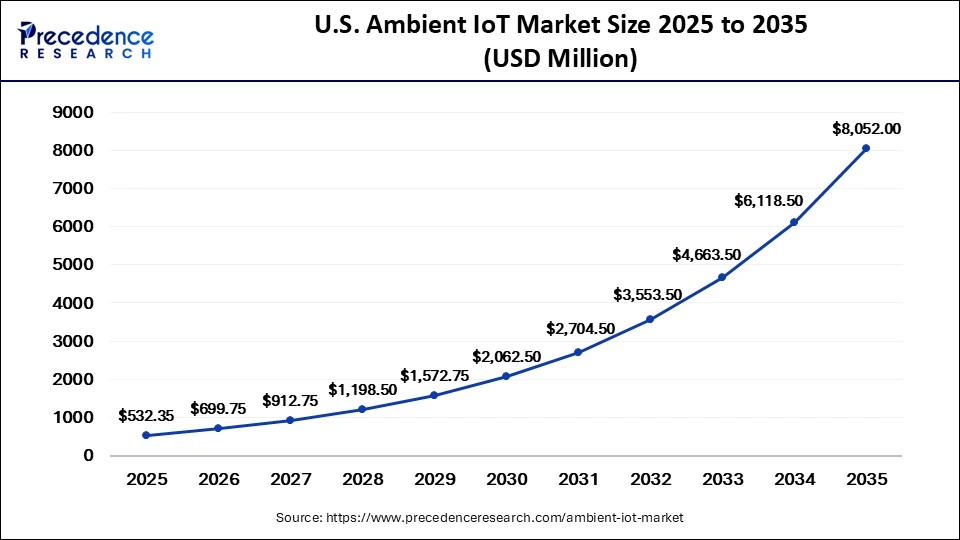
The U.S. Ambient IoT market size was evaluated at USD 532.35 million in 2025 and is projected to reach around USD 8,052.00 million by 2035, growing at a CAGR of 31.40% from 2026 to 2035.
What Led the Global North America Ambient IoT Market Grow in 2025?
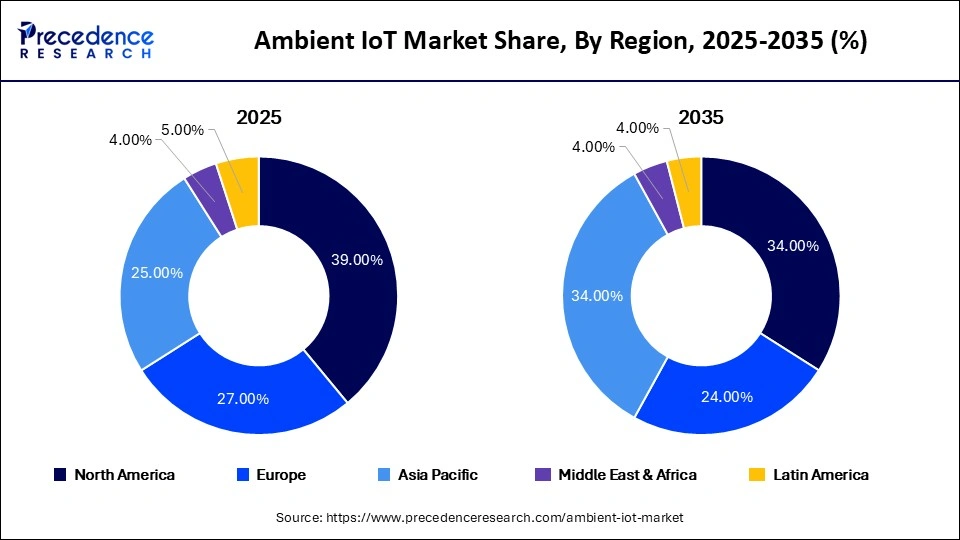
North America held a major market share of 39% in 2025. This is due to the rapid deployment of battery-free IoT solutions, strong retail digitalization initiatives, and high investment in smart supply chains. The widespread rollout of ultra-low latency 5G networks and localized edge computing enables billions of devices to exchange data and process information in real-time without depending on slow, centralized cloud servers.
U.S. Market Analysis
The U.S. market is expanding rapidly due to widespread AI and edge computing advancements, increasing need for consumer smart devices, and federal sustainability initiatives. Industries are leveraging ambient IoT to track assets, enhance supply chains, and enable remote patient monitoring and ambient-assisted living for elderly populations.
Europe: The Second-Largest Market
Europe held the second-largest market share at 27% in 2025 and is expected to grow at a notable CAGR of 32.1% during the projection period, driven mainly by the rising deployment of intelligent asset tracking and strong regulatory support for digital product passports. Consumers and commercial real estate in countries such as Germany, France, and the UK are rapidly adopting smart thermostats and even energy management systems to cut utility costs and hit sustainability goals. The deployment of 5G networks across the EU has offered the high-bandwidth, low-latency connectivity required to integrate vast numbers of sensors in both urban smart cities and rural agricultural areas.
UK Market Analysis
The UK market is driven by battery-free technologies, government digitization strategies, and sustainability initiatives. UK producers are heavily utilizing IoT networks for predictive maintenance and supply chain optimization. Technologies, such as RFID and advanced sensors, allow for real-time asset tracking and operational efficiency.
Asia-Pacific: The Fastest-Growing Region
Asia-Pacific held a 25% share of the ambient IoT market in 2025 and is expected to grow at the fastest CAGR of 40.6% during the projection period, driven by growing retail automation initiatives and increasing semiconductor ecosystem development. Manufacturing and logistics hubs are using smart sensors and AI-driven automation to improve operational efficiency, track cross-border supply chains, and optimize production floors. The rising middle class, combined with increased disposable incomes, is pushing the adoption of smart homes and AI-enabled healthcare monitoring tools.
China Market Analysis
The Chinese market is driven by state-sponsored industrial automation, massive 5G/6G infrastructure deployment, and a growing national push for ultra-low-cost, battery-free sensors. China's widespread 5G infrastructure and advanced mobile carrier platforms enable seamless, nationwide ambient data connectivity and device management.
What Drives the Ambient IoT Market in Latin America?
Latin America held 5% share of the market in 2025 and is expected to grow at a significant CAGR of 32.4% during the projection period, driven by increasing warehouse automation, expansion of logistics infrastructure, and growing demand for asset visibility. The rapid growth of digital commerce in the region, fueled by dominant platforms such as MercadoLibre, requires sophisticated tracking and also ambient solutions to streamline supply chains and optimize customer experiences.
Brazil Market Analysis
The Brazilian market is driven by advancements in low-power self-sustaining devices and increasing demands for real-time data analytics. Sectors such as automotive, electronics, and mining are adopting Industrial IoT (IIoT) to enhance predictive maintenance, resource management, and operational efficiency.
How is the Opportunistic Rise of the Middle East and Africa in the Market?
The Middle East and Africa held a 4% share of the market in 2025 and are expected to grow at a notable CAGR of 33.1% during the projection period, driven by increasing warehouse automation and rising investment in digital infrastructure. The region's dominant oil, gas, and agricultural sectors depend on Ambient IoT for predictive maintenance, asset tracking, and precise resource management.
Saudi Arabia Market Analysis
Saudi Arabia's market is mainly driven by massive government investments tied to Saudi Vision 2030, accelerated digital transformation, and the widespread rollout of high-speed 5G networks.
Market Competitive Landscape: Leading Companies and Strategies
The ambient IoT market is highly competitive, driven by technology providers, semiconductor manufacturers, cloud platform vendors, and connectivity specialists. Major players include Qualcomm, Intel, STMicroelectronics, NXP Semiconductors, Bluetooth SIG, Amazon Web Services (AWS), and Microsoft Azure. Competition centers on ultra-low-power connectivity, energy harvesting, battery-free sensors, edge intelligence, and scalable cloud integration. Firms are investing in strategic partnerships, R&D, and standardization initiatives to expand ambient IoT ecosystems. The growing acceptance of smart buildings, logistics tracking, retail monitoring, and industrial automation is intensifying competition, encouraging continuous innovation and even product differentiation across the value chain.
Ambient IoT Market Companies
- Impinj
- NXP Semiconductors
- Infineon Technologies
- STMicroelectronics
- Texas Instruments
- Nordic Semiconductor
- EM Microelectronic
- Wiliot
- Axzon
- Identiv
- Murata Manufacturing
- Alien Technology
- AMS OSRAM
- Sony Semiconductor Solutions
- Atmosic Technologies
Recent Developments Ambient IoT Market (2025-2026)
- In January 2026, Afero declared a collaboration with Texas Instruments (TI), the largest analog and embedded-processing semiconductor producer in the U.S., to create a seamless and secure IoT platform for smart home products.(Source: https://www.businesswire.com)
- In January 2026, Tageos announced a strategic partnership with Wiliot, an ambient IoT pioneer, to launch a new passive Bluetooth Low Energy (BLE) inlay, the EOS-654 BLE G3. The inlay was developed to support the large-scale deployment of Wiliot's Gen3 IoT Pixel sensor and the Wiliot Intelligence Platform. (Source: https://www.businesswire.com)
Segments Covered in the Report
By Device Type
- Ambient IoT Tags
- Ambient IoT Sensors
- Ambient IoT Beacons
- Ambient IoT Gateways
By Communication Technology
- Bluetooth Low Energy (BLE)
- RAIN RFID
- NFC
- Wi-Fi
- LPWAN (LoRa, NB-IoT, LTE-M)
By Power Source
- RF Energy Harvesting
- Solar Energy Harvesting
- Thermal Energy Harvesting
- Piezoelectric Energy Harvesting
- Hybrid Energy Harvesting
By Application
- Asset Tracking and Monitoring
- Supply Chain and Logistics
- Retail Inventory Management
- Smart Buildings
- Industrial Monitoring
- Healthcare Asset Monitoring
By End-use Industry
- Retail and E-commerce
- Logistics and Transportation
- Manufacturing
- Healthcare
- Consumer Electronics
- Automotive
- Others
By Region
- North America
- Latin America
- Europe
- Asia-pacific
- Middle and East Africa
For inquiries regarding discounts, bulk purchases, or customization requests, please contact us at sales@precedenceresearch.com
Frequently Asked Questions





Ask For Sample
No cookie-cutter, only authentic analysis – take the 1st step to become a Precedence Research client
 Get a Sample




 sales@precedenceresearch.com
 Schedule a Meeting
