



Automation, Digitization and Robotics in Cell and Gene Therapy Manufacturing Market Revenue to Attain USD 5,275.10 Mn by 2035
Published: 23 Apr 2026
Author: Precedence Research



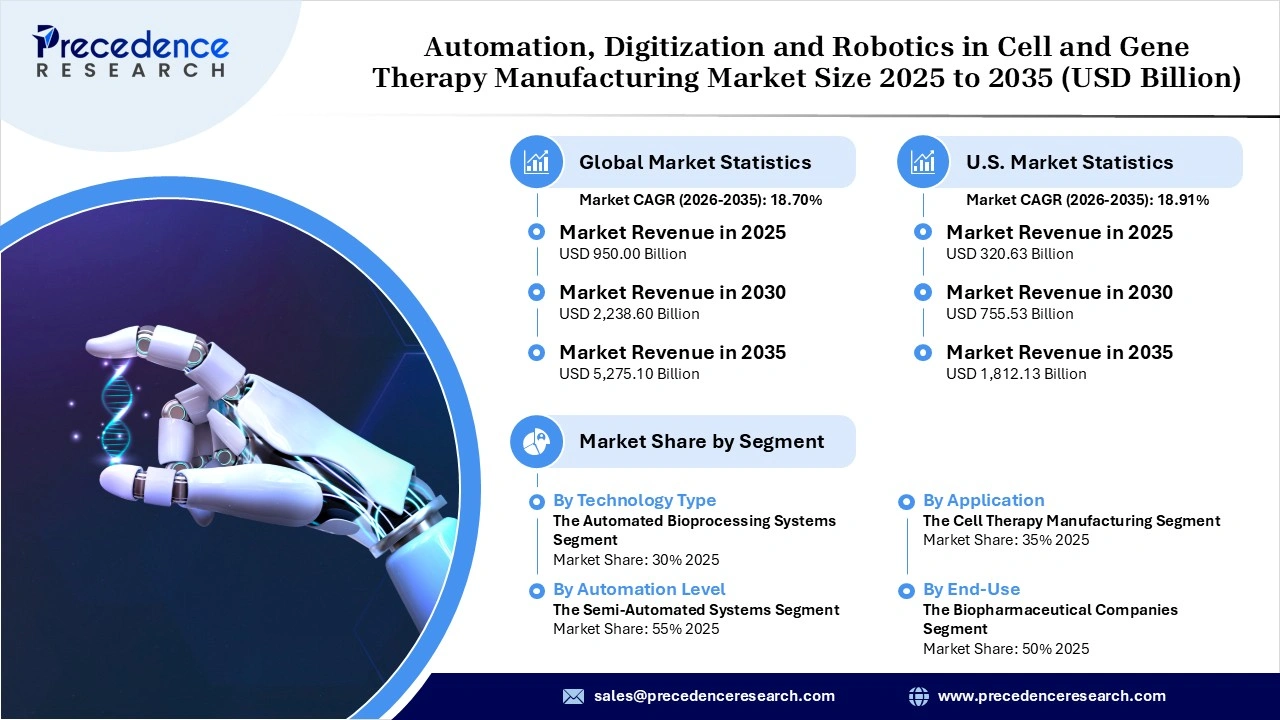
The global automation, digitization and robotics in cell and gene therapy manufacturing market revenue surpassed USD 950.00 million in 2025 and is predicted to attain around USD 5,275.10 million by 2035, growing at a CAGR of 18.70% from 2026 to 2035. The market is driven by the biopharmaceutical industry’s demand for scalable, precise, and cost-efficient production of advanced therapies, along with increasing adoption of AI-enabled manufacturing systems to improve quality, reduce human error, and ensure regulatory compliance.
Market at a Glance
The automation, digitization and robotics in cell and gene therapy manufacturing market refer to the ecosystem of technologies that replace manual, error-prone lab processes with controlled, software-driven production environments. It integrates closed-system bioprocessing, robotic handling, real-time data monitoring, and AI-enabled decision-making to standardize the manufacturing of advanced therapies. The scope spans from early cell isolation to final fill-finish, focusing not only on efficiency but also on consistency, traceability, and the ability to scale therapies that were originally designed for highly individualized treatment.
The scope of automation, digitization, and robotics in cell and gene therapy manufacturing spans the entire production workflow, from upstream cell handling to downstream processing and final product release. It includes both hardware components such as robotic systems and closed bioprocessing units, as well as software solutions like digital twins, Manufacturing Execution Systems (MES), and AI-driven data analytics platforms.
What Drives the Automation, Digitization and Robotics in Cell and Gene Therapy Manufacturing Market?
- Rise in Use of Robotic Cell Handling Systems: The industry is facing a growing challenge of high attrition rates in skilled manufacturing roles, exceeding 25%, which is making human-dependent processes increasingly difficult to sustain. Robotic cell handling systems offer greater consistency and reduce variability in complex, multi-step cell therapy workflows that can involve more than 40 processing stages. This creates a strong opportunity for automation to ensure repeatability while minimizing reliance on scaling human labor.
- Rising Demand for Scalable Cell and Gene Therapies: The rapid growth of therapies like CAR-T and gene editing treatments is increasing the need for scalable manufacturing solutions. Automation and robotics help overcome the limitations of manual, labor-intensive processes and enable consistent production of complex, patient-specific therapies.
How are Government Initiatives Contributing to the Market?
Government initiatives are supporting the automation, digitization and robotics in cell and gene therapy manufacturing market by funding advanced biomanufacturing infrastructure and promoting the adoption of Industry 4.0 technologies in life sciences. Policies that encourage digital health, precision medicine, and biomanufacturing hubs are accelerating the integration of automated systems, robotics, and data-driven platforms in therapy production.
- For instance, in March 2026, CDSCO, ICMR, and DBT have issued the “National Guidelines for Gene Therapy Product Development and Clinical Trials, 2019” to ensure the safe, ethical, and regulatory-compliant development of CRISPR-based and other gene therapies in India. The government is also advancing the precision medicine ecosystem through programs supporting next-generation cell and gene therapies, including gene editing and cell-based approaches.
India’s first-in-human Phase-I gene therapy trial for Hemophilia A, supported by DBT, demonstrated clinically significant outcomes and was published in the New England Journal of Medicine. Additionally, the BioE3 Policy (2024) aims to position India as a global biomanufacturing hub by promoting R&D, pilot-scale manufacturing, and public-private collaboration through DBT and BIRAC support for startups and MSMEs.
Market Segmentation Overview
- By technology type, the automated bioprocessing systems segment dominated the automation, digitization and robotics in cell and gene therapy manufacturing market with a 30% share in 2025. This dominance is driven by manufacturers’ preference for closed-system production, which minimizes contamination risk and improves process reliability. These systems also enhance reproducibility in cell and gene therapy manufacturing, a capability that is difficult to achieve with traditional manual or open-system approaches.
- By technology type, the robotic cell handling & processing systems segment is expected to grow at the fastest CAGR of 20.5% in the market between 2026 and 2035. This growth is driven by the increasing adoption of robotics for precise, sterile, and highly controlled cell manipulation, which improves standardization while reducing human intervention in complex workflows. As a result, these systems are evolving from supportive tools into core components of advanced, automated biomanufacturing environments.
- By automation level, the semi-automated systems segment held a major market share of 55% in 2025 due to their lower cost compared to fully automated systems. These systems offer just enough automation to improve efficiency without forcing a complete overhaul of existing infrastructure.
- By automation level, the fully automated manufacturing platforms segment is expected to grow at a CAGR of 22.5% in the market between 2026 and 2035. This is because of the rapid shift from manual processes to automation to improve manufacturing processes and meet regulatory and compliance requirements.
- By application, the cell therapy manufacturing segment held a share of 35% in the automation, digitization and robotics in cell and gene therapy manufacturing market in 2025, due to the increasing uptake of CAR-T and stem cell therapies. These sophisticated therapies require tightly controlled settings. Therefore, automation has increasingly become important to guarantee uniformity between extremely sensitive patient-specific batches.
- By application, the gene therapy manufacturing segment is expected to expand rapidly with a CAGR of 20% in the coming years, supported by an expanding pipeline of viral vector–based therapies and a steady increase in regulatory approvals. The growing complexity of these therapies is driving demand for automation solutions capable of ensuring precision while maintaining production efficiency, without slowing down manufacturing timelines.
- By end-use, the biopharmaceutical companies segment held a 50% share in the automation, digitization and robotics in cell and gene therapy manufacturing market in 2025, primarily due to their strong investment capacity in advanced therapy manufacturing platforms. Their focus on scalable production is closely linked to the need to transition therapies from clinical development to commercial supply while maintaining strict quality standards.
- By end-use, the contract development and manufacturing organizations segment is expected to grow at the fastest CAGR of 20.5% in the market between 2026 and 2035, as outsourcing of complex biologics manufacturing increases globally. Biopharmaceutical companies are increasingly relying on specialized partners that provide both technical expertise and scalable infrastructure to support efficient and compliant production.
Regional Analysis
North America dominated the automation, digitization and robotics in cell and gene therapy manufacturing market with a market share of 45.0% in 2025, supported by the presence of a large number of biotechnology companies, a well-established manufacturing ecosystem, and a regulatory environment increasingly adapted to advanced therapies rather than constrained by them. The U.S. held the majority of the market share, driven by a strong pipeline of CAR-T and gene therapies and early adoption of automated manufacturing platforms. Canada also contributed through targeted investments in biomanufacturing clusters and translational research, reinforcing the region’s sustained leadership in advanced manufacturing technologies.
Asia Pacific held a market share of 22% in 2025 and is expected to grow at the fastest CAGR of 22.5% in the market during the forecast period, driven by the continuous expansion of biopharmaceutical manufacturing capacity and increasingly proactive government involvement in fostering biotechnology innovation. China is expected to lead regional growth through large-scale infrastructure development and rapid clinical advancement, while Japan focuses on strengthening precision manufacturing capabilities within a highly structured regulatory framework.
Automation, Digitization and Robotics in Cell and Gene Therapy Manufacturing Market Coverage
| Report Attribute | Key Statistics |
| Market Revenue in 2025 | USD 950.00 Million |
| Market Revenue by 2035 | USD 5,275.10 Million |
| CAGR from 2026 to 2035 | 18.70% |
| Quantitative Units | Revenue in USD million/billion, Volume in units |
| Largest Market | North America |
| Base Year | 2025 |
| Regions Covered | North America, Europe, Asia-Pacific, Latin America, and the Middle East & Africa |
Top Companies in the Automation, Digitization and Robotics in Cell and Gene Therapy Manufacturing Market
Companies such as Thermo Fisher Scientific Inc. have been actively integrating automation and digital capabilities across their bioprocessing portfolios. Its recent launch of a closed, automated fill-finish system reflects a clear push to minimize manual intervention and reduce batch variability in sensitive cell-based workflows. Alongside this, Sartorius AG, Danaher Corporation (through Cytiva), Lonza Group AG, and Merck KGaA are shaping the backbone of modern bioprocessing through modular and closed-system platforms. These solutions are designed to make scale-up less of a disruptive leap and more of a controlled, reproducible extension of existing manufacturing processes.
Segments Covered in the Report
By Technology Type
- Automated Bioprocessing Systems (Closed & Modular Systems)
- Robotic Cell Handling & Processing Systems
- Digital Twin & Simulation Platforms
- AI-driven Manufacturing Execution Systems (MES)
- Automated Quality Control & Analytics Systems
By Automation Level
- Semi-automated Systems
- Fully Automated Manufacturing Platforms
By Application
- Cell Therapy Manufacturing (CAR-T, Stem Cell Therapy)
- Gene Therapy Manufacturing (Viral Vectors, Non-viral Systems)
- Process Development & Scale-up
- Quality Control & Release Testing
- Cold Chain & Logistics Automatio
By End-Use
- Biopharmaceutical Companies
- Contract Development and Manufacturing Organizations (CDMOs)
- Research Institutes & Academic Centers
By Deployment Type
- On-premise Automation Systems
- Cloud-based Digital Manufacturing Platforms
- Hybrid Digital-Physical Systems
By Region
- North America
- Latin America
- Europe
- Asia-pacific
- Middle and East Africa
Get this report to explore global market size, share, CAGR, and trends, featuring detailed segmental analysis and an insightful competitive landscape overview @ https://www.precedenceresearch.com/sample/8329
You can place an order or ask any questions. Please feel free to contact us at sales@precedenceresearch.com |+1 804 441 9344