



CNS Clinical Trials Market Revenue to Attain USD 18.49 Bn by 2035
Published: 02 Jul 2026
Author: Precedence Research



CNS Clinical Trials Market Revenue and Trends 2026 to 2035
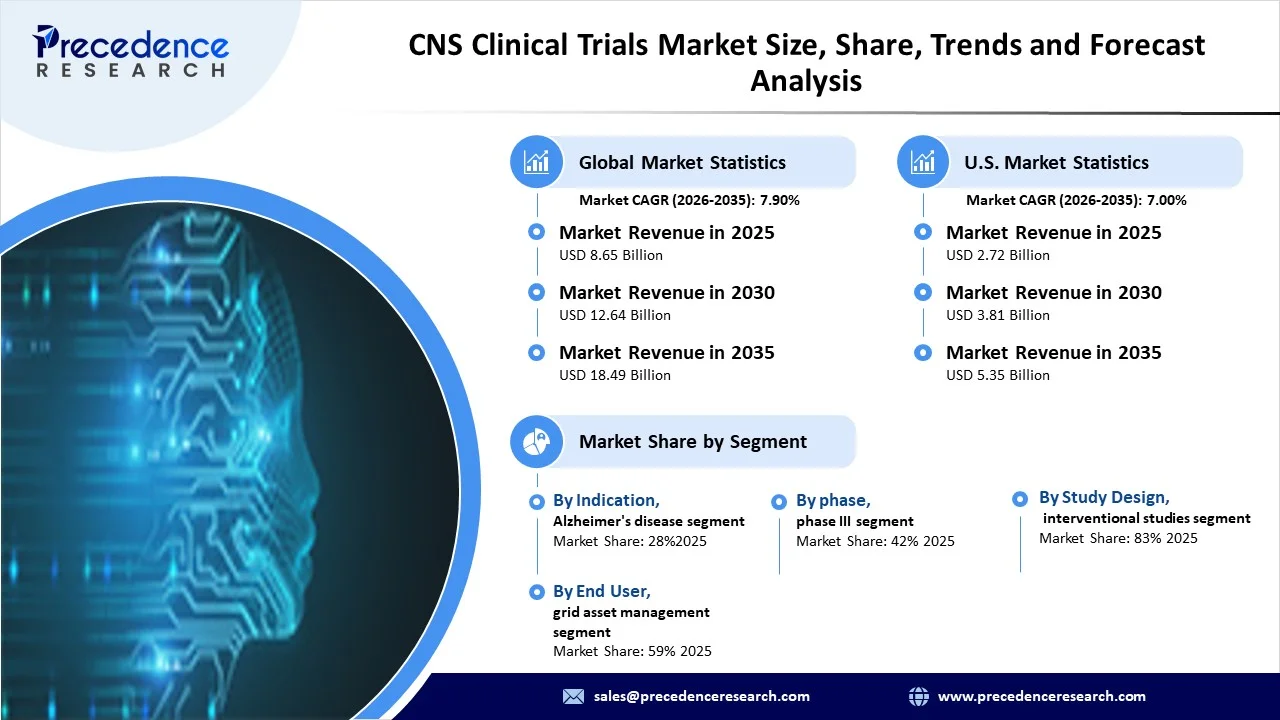
The global CNS clinical trials market revenue reached USD 8.65 billion in 2025 and is predicted to attain around USD 18.49 billion by 2035 with a CAGR of 7.90%. The market is driven by the increasing prevalence of CNS-related disorders such as Alzheimer’s disease, Parkinson’s disease, depression, and schizophrenia across the globe, along with growing impetus on developing therapies that can modify diseases.
Navigating the Challenges of Neurological Drug Development
The CNS clinical trials market comprises all research efforts, services, and technologies associated with the development of new therapies for conditions affecting the central nervous system (CNS). The disorders addressed include Alzheimer’s disease, Parkinson’s disease, multiple sclerosis, epilepsy, depression, schizophrenia, and amyotrophic lateral sclerosis (ALS). It consists of phases 1 to 4 clinical trials that are done by pharmaceutical and biotech companies, contract research organizations (CROs), academic medical centers, and research institutes.
The services provided include recruitment of patients, trial design and management, data monitoring, biostatistics, medical writing, and regulatory consultation. Some of the key focus areas include disease-modifying therapies, cell and gene therapies, and the repurposing of drugs for new CNS conditions. Decentralized and hybrid trial designs have been incorporated, including the use of digital biomarkers, wearables, and telemedicine to enhance the participation and retention of patients.
CNS Drug Discovery Using AI Makes Debut in Human Trials
The market is moving forward through the use of generative AI technology in the development and optimization of drugs with small molecules, which have the capability to cross the blood-brain barrier (BBB). Traditional drug discovery approaches for CNS-related diseases have faced the challenge of a high failure rate and difficulties in attaining BBB penetration. In 2026, Insilico Medicine revealed that it had completed the first-in-human dosing in the phase 1 clinical trial of ISM8969, an orally available and brain-penetrant NLRP3 inhibitor designed using AI, for Parkinson’s disease and other CNS conditions. The trial will involve 80 healthy volunteers as well as 20 patients with obesity who are at risk of developing cardiovascular disorders.
Specialized Service Models to Handle CNS Trial Challenges
The CNS clinical trials market is experiencing increased uptake of specialized service models as contract research organizations (CROs) establish CNS centers that help overcome the challenges encountered in CNS drug development. This development is attributed to the increasing need for specialized knowledge to deal with the high screen failure rate in CNS clinical trials. In 2025, Avance Clinical established its CNS Center of Excellence, following completion of more than 50 clinical trials within the last 5 years. The center is headed by Dr Francesco Bibbiani, who has accumulated over 25 years of experience in CNS clinical development.
National Funding Programs Speed Up CNS Drug Development
Governments across the world are taking initiatives in the form of targeted funding programs and global research partnerships that will speed up the development of new treatments for neurological and psychiatric disorders. These programs offer financial and regulatory support and access to research infrastructure to mitigate risks associated with developing new CNS drugs. In 2025, South Korean CNS drug developer Curebus was chosen to participate in the ‘2025 Global Cluster R&BD Project’ of the Ministry of Science and ICT. The program offers research funding worth up to USD 2.2 million for joint research projects with the Korea Institute of Science and Technology (KIST) and Angelini Pharma from Italy.
USD 12 Million Grant Awarded to UC Irvine for Human Trial for Stem Cell Therapy
UC Irvine was granted USD 11,999,933 by the California Institute for Regenerative Medicine in 2025 for the human clinical trial of neural stem cell treatment of Huntington’s disease. This trial will include 21 participants suffering from early stages of the disease and is estimated to be conducted around mid-2026. The success of this trial would give patients an independent and healthy, prolonged life and save them the cost of long-term care.
Market Segmentation Overview
- By indication, the Alzheimer’s disease segment led the CNS clinical trials market with a 28% share in 2025 and is expected to expand at the highest CAGR of 9.1% during the forecast period because of its significant prevalence across the world, thereby creating an immense need for treatments and hence creating the highest number of clinical trials and research and development investments. The approval of anti-amyloid antibodies has confirmed the disease-modifying strategy and therefore accelerated the flow of new treatments in the pipeline.
- By indication, the Parkinson’s disease segment held the second-largest market share of 14% in 2025, since it involves a clear pathophysiology, which involves a loss of dopamine neurons, and has made it the focus of many disease-modifying treatments and cell therapies. There has been extensive pipeline development for this disease, especially at the early stage, owing to the advancements made in biomarkers, imaging, and digital technologies.
- By phase, the phase III segment dominated the market with a 42% share in 2025, due to the fact that it involves a huge number of patients and conducting the trial for longer durations in order to achieve efficacy and collect safety information. The approval of anti-amyloid antibodies has added more competition among the sponsors and has resulted in an increase in phase 3 trials.
- By phase, the phase II segment is expected to grow at the fastest CAGR of 8.5% from 2026 to 2035, because at this stage, the important “go/no go decision is taken as researchers need to prove their proof-of-concept to get investors and partnerships to avoid risks related to the costly phase III stage. This segment benefits from the increased number of regulatory guidelines since the pandemic made it more acceptable and possible to use the DCTs.
- By study design, the interventional studies segment led the CNS clinical trials market with an 83% share in 2025, owing to the fact that they constitute the bedrock of drug development and approval procedures, taking up a big share of CNS-related clinical trials from phase 1 through phase 3 trials. Clinical trials need controlled administration of investigational drugs and thus create high demand for DCT services.
- By study design, the observational studies segment is expected to expand at the highest CAGR of 8.2% during the forecast period, due to the fact that regulatory authorities have started accepting real-world evidence for drug approval and label expansion. This segment benefits from the emergence of decentralized trial technologies, including wearable devices, mobile applications, and data collection platforms.
- By end user, the pharmaceutical companies segment dominated the market with a 59% share in 2025, because of their position as the main sponsors of drug development efforts in the CNS space, taking on the financial risks and responsibilities for the transition of candidates from the initial preclinical research stage all the way to gaining regulatory approval.
- By end user, the biotechnology companies segment is expected to grow at the fastest CAGR of 9.3% from 2026 to 2035, owing to the fact that they generally have fewer pipelines and are under immense pressure to provide proof-of-concept for their drug or therapy within a short period of time.
- By trial type, the drug trials segment led the market with a 72% share in 2025, since it is the heart of the pharma research and development process, taking up a big share of all CNS clinical trial processes. This segment forms the main method by which regulatory approval and commercialization are attained, making it the most funded and intensive component.
- By trial type, the gene and cell therapy trials segment is expected to expand at the highest CAGR of 12.4% during the forecast period, due to the fact that these types of treatments typically aim at genetically rare disorders, and patient groups suffering from such conditions are scattered around the world. Gene and cell therapy require long-term follow-up, and the high cost and complexity give additional impetus to the sponsors to use DCT models.
Regional Analysis
North America dominated the CNS clinical trials market with a 42% share in 2025 because of the significant presence of prominent pharmaceutical and biotechnology companies, academic medical centers, and considerable government funding for neurological and psychiatric research from the National Institutes of Health (NIH) and other institutions. The U.S. led the market in North America due to significant investments in research and development in the field of CNS drugs, the fast-tracked approval process for neurological drugs at the FDA, and a large and diverse pool of patients. Canada witnessed notable market growth owing to the favorable environment provided by the government for clinical research and the universal healthcare setup that helps enrol patients into the trials.
Asia-Pacific is expected to grow at the fastest CAGR of 10.1% from 2026 to 2035, due to the presence of the world’s largest and aging population, which results in a substantial increase in the number of neurological diseases, such as Alzheimer’s disease, Parkinson’s disease, and stroke, coupled with increased investments in healthcare research and development. China dominated the market in Asia-Pacific owing to its large patient pool, along with large investments made by the government into neuroscience studies and clinical trial reforms that result in faster approval of drugs. India is a significant contributor to the market because of a favourable clinical research environment, a growing network of neurology centers and CROs, and government programs like the BioPharma Shakti that help to increase the trial capabilities in the country.
Europe held the second-largest market share of 27% in 2025, owing to its advanced pharmaceutical and biotechnology industry, sound infrastructure for clinical research and positive regulatory environment, such as the strategic guidance of the European Medicines Agency in CNS drug development. Germany led the market in Europe because of its extensive pharmaceutical industry and its position as the center of clinical research with an advanced healthcare sector, and the significant presence of academic medical centers and government funding of neuroscience research. The UK witnessed notable market growth due to significant government investment in clinical research and an advanced ecosystem for clinical research, and the presence of a large number of clinical trials because of the country’s renowned academic centers for neuroscience research.
CNS Clinical Trials Market Coverage
| Report Attribute | Key Statistics |
| Market Revenue in 2025 | USD 8.65 Billion |
| Market Revenue by 2035 | USD 18.49 Billion |
| CAGR from 2026 to 2035 | 7.90% |
| Quantitative Units | Revenue in USD million/billion, Volume in units |
| Largest Market | North America |
| Base Year | 2025 |
| Regions Covered | North America, Europe, Asia-Pacific, Latin America, and the Middle East & Africa |
Top Companies in the CNS Clinical Trials Market
IQVIA, ICON plc, LabCorp Drug Development, and Syneos Health are some of the key players that provide neuroscience-related CRO services. Parexel, Medpace, and PPD offer comprehensive services for conducting trials on the nervous system, which include recruiting patients, managing sites, and other issues related to regulation. Clinical Trials, PSI CRO, and Premier Research are medium-sized CROs that specialize in conducting clinical trials with complex designs and rare neurological diseases. Novotech, CTI Clinical Trial and Consulting, and KCR are regional providers of CNS trial services.
Segments Covered in This Report
By Indication
- Alzheimer's Disease
- Parkinson's Disease
- Epilepsy
- Multiple Sclerosis
- Stroke
- Depression
- Schizophrenia
- Others
By Phase
- Phase I
- Phase II
- Phase III
- Phase IV
By Study Design
- Interventional Studies
- Observational Studies
By End User
- Pharmaceutical Companies
- Biotechnology Companies
- Academic and Research Institutes
By Trial Type
- Drug Trials
- Biologics Trials
- Gene and Cell Therapy Trials
By Region
- North America
- Latin America
- Europe
- Asia-pacific
- Middle and East Africa
Get this report to explore global market size, share, CAGR, and trends, featuring detailed segmental analysis and an insightful competitive landscape overview @ https://www.precedenceresearch.com/sample/8531
You can place an order or ask any questions. Please feel free to contact us at sales@precedenceresearch.com |+1 804 441 9344