



CNS Clinical Trials Market Size, Companies, Share, Patient Volume, Treatment Adoption Rates, Pricing Analysis, Regulatory Landscape, Competitive Positioning, and Demand Forecast
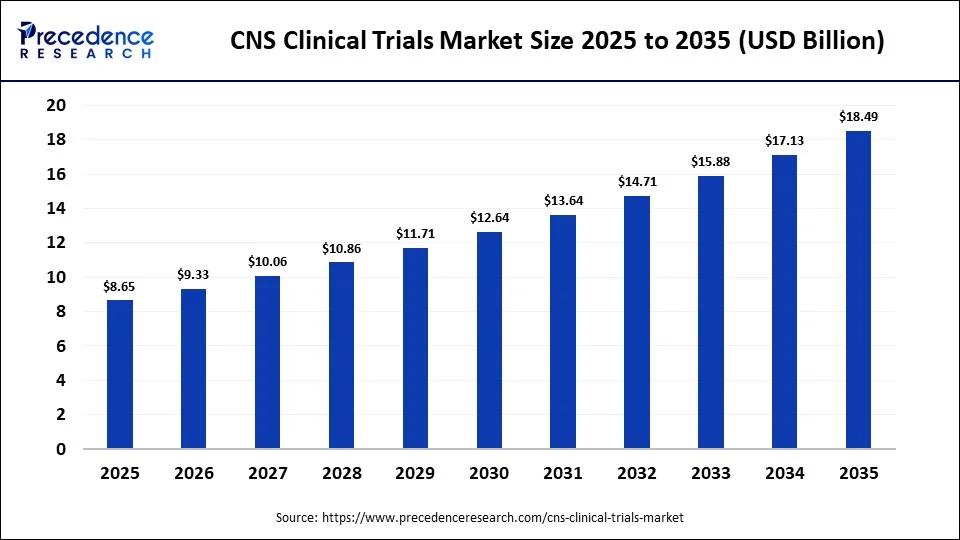
Rohan Patil, a Healthcare Industry Expert, highlights that the CNS clinical trials market has reached USD 9.33 billion in 2026 and is on track to reach USD 18.49 billion by 2035, advancing at a CAGR of 7.90%. Key CNS clinical trials market companies shaping the market include IQVIA, ICON plc, Labcorp Drug Development, Syneos Health, while major growth segments span indication, phase, study design, end user, trial type, region.
Source: https://www.precedenceresearch.com/cns-clinical-trials-market
 Get a Sample
 Table Of Content


CNS Clinical Trials Market Size and Forecast 2026 to 2035
The global CNS clinical trials market size was calculated at USD 8.65 billion in 2025 and is predicted to increase from USD 9.33 billion in 2026 to approximately USD 18.49 billion by 2035, expanding at a CAGR of 7.90% from 2026 to 2035. The market is driven by the rising global prevalence of neurodegenerative diseases, like Alzheimer's, Parkinson's, and Huntington's, combined with an aging global population.
Key Takeaways
- North America accounted for the highest revenue share of 42% in the CNS clinical trials market in 2025.
- Asia-Pacific is expected to grow at the fastest 10.1% CAGR between 2026 and 2035.
- By indication, the Alzheimer's disease segment dominated the market with a share of 28% in 2025 and is expected to grow at the fastest CAGR of 9.1% in the coming years.
- By indication, the Parkinson's disease segment held the second-largest market share of 14% in 2025.
- By phase, the phase III segment held a dominant position in the market with a 42% share in 2025.
- By phase, the phase II segment held a 31% share of the market in 2025 and is expected to grow at the fastest CAGR of 8.5% during the projection period.
- By study design, the interventional studies segment held a dominant position in the CNS clinical trials market with a share of 83% in 2025.
- By study design, the observational studies segment held a 17% share of the market in 2025 and is expected to grow at the fastest CAGR of 8.2% during the projection period.
- By end user, the pharmaceutical companies segment held a dominant position in the market with a 59% share in 2025.
- By end user, the biotechnology companies segment held a 29.00% share of the market in 2025 and is expected to grow at the fastest CAGR of 9.3% during the projection period.
- By trial type, the drug trials segment held the largest market share of 72% in 2025.
- By trial type, the gene and cell therapy trials segment held an 8% share of the market in 2025 and is expected to grow at the fastest CAGR of 12.4% during the projection period.
Market Overview
The CNS clinical trials industry refers to the global healthcare and pharmaceutical sector dedicated to testing and evaluating new drugs, medical devices, or therapies designed to treat diseases of the brain and spinal cord. The main driving force for the market is the surging global prevalence of neurodegenerative and psychiatric disorders. This rising disease burden, coupled with a high need for disease-modifying therapies for conditions such as Alzheimer's, Parkinson's, and multiple sclerosis, is forcing pharmaceutical companies and contract research organizations (CROs) to heavily invest in CNS research.
CNS Clinical Trials Market Trends
- CNS drug developers are increasingly adopting remote and virtual trial formats to overcome the notorious difficulty of patient recruitment and retention in neurology studies.
- There is a heavy reliance on digital health tools alongside wearable sensors for continuous, real-time motor and cognitive tracking. These digital endpoints enable researchers to measure physiological and behavioral changes outside of traditional clinical settings.
- Innovations in biomarkers and brain imaging are allowing more targeted research for notoriously hard-to-treat diseases such as Alzheimer's, Parkinson's, and ALS.
- The pipeline is shifting away from traditional small molecules toward advanced platforms, which include cell and gene therapies, protein degraders, and targeted biologics.
Market Report Coverage and Key Metrics
| Report Coverage | Details |
| Market Size in 2025 | USD 8.65 Billion |
| Market Size in 2026 | USD 9.33 Billion |
| Market Size by 2035 | USD 18.49 Billion |
| Market Growth Rate from 2026 to 2035 | CAGR of 7.90% |
| Dominating Region | North America |
| Fastest Growing Region | Asia Paicfic |
| Base Year | 2025 |
| Forecast Period | 2026 to 2035 |
| Segments Covered | Indication, Phase, Study Design, End User, Trial Type, and Region |
| Regions Covered | North America, Europe, Asia-Pacific, Latin America, and Middle East & Africa |
Market Dynamics
Drivers
High Unmet Medical Need
High unmet medical need is a primary driver in the market because it fuels commercial incentives, drives regulatory incentives, and thus promotes massive scientific investment despite the historically high failure rates of neurodegenerative and psychiatric drug development. Conditions such as Alzheimer's, Parkinson's, ALS, and major depressive disorder impose severe global burdens and affect aging populations globally. The massive patient population translates into blockbuster commercial potential for the first disease-modifying therapies, incentivizing massive industry investments.
Restraint
Stringent Regulatory Pathways
Stringent regulatory pathways restrain the CNS clinical trials market by inflating development costs, extending timelines, and compounding the risks of late-stage failure. Because neurological conditions involve complex biology and the blood-brain barrier, regulators demand highly rigorous safety and efficacy data. Diseases like Parkinson's and schizophrenia have variable progression and heterogeneous patient groups. Regulatory bodies demand massive, diverse, and long-term studies to prove an asset's long-term benefit.
Opportunity
Surging Burden of Neurodegenerative Diseases
The surging burden of neurodegenerative diseases acts as a massive catalyst for the market by driving urgent, high-value need for disease-modifying therapies. With aging global populations and soaring economic healthcare costs, the critical lack of existing cures creates an unprecedented opportunity for pharmaceutical and biotech investment. Investors now recognize CNS therapeutics as a lucrative domain. Major mergers and licensing deals, like J&J's multibillion-dollar acquisition of Intra-Cellular Therapies, highlight the high commercial and even strategic value of successful CNS assets.
Market Segmentation Analysis
Indication Insights
The Alzheimer's Disease Segment Dominated the Market with 28% of Market Share in 2025
The Alzheimer's disease segment dominated the CNS clinical trials market with a share of 28% in 2025 and is expected to grow at the fastest CAGR of 9.1% in the coming years. This is due to increasing disease prevalence, a strong biologics pipeline and high unmet clinical need. The development of blood-based biomarkers and precise PET scans enables trials to enroll patients at earlier, pre-symptomatic stages of the disease when drugs are most effective, drastically enhancing trial success rates.
CNS Clinical Trials Market Share, By Indication, 2025-2035 (%)
| Indication | 2025 | 2035 | CAGR (%) |
| Alzheimer's Disease | 28.00% | 31.00% | 9.1% |
| Parkinson's Disease | 14.00% | 15.00% | 8.3% |
| Epilepsy | 13.00% | 12.00% | 6.8% |
| Multiple Sclerosis | 12.00% | 11.00% | 6.9% |
| Stroke | 10.00% | 9.00% | 6.5% |
| Depression | 11.00% | 11.00% | 7.8% |
| Schizophrenia | 8.00% | 7.00% | 6.7% |
| Others | 4.00% | 4.00% | 7.0% |
The Parkinson's disease segment held a 14% share of the market in 2025 and is expected to grow at a CAGR of 8.3% during the projection period. This is due to rising investment in precision medicine and improved diagnostic capabilities. Innovations like digital health technologies and wearable digital biomarkers enable continuous patient monitoring in real-life settings, streamlining decentralized trial execution.
The epilepsy segment held a 13% share of the market in 2025 and is expected to grow at a CAGR of 6.8% during the projection period. This is due to continued anti-epileptic drug development, growing pediatric trials and increasing refractory epilepsy studies. Research has expanded beyond traditional anticonvulsants into cutting-edge domains such as viral vector gene therapies, stem-cell treatments, and targeted neuromodulation. Increased global awareness and government-backed funding to decrease the social and economic burden of CNS disorders have actively expanded pipeline research.
Phase Insights
Why Did the Phase III Segment Lead the CNS Clinical Trials Market?
The phase III segment led the market with a share of 42% in 2025, driven by a late-stage commercialization focus, large multinational studies and regulatory submission requirements. Advancements in next-generation sequencing, along with liquid biopsies, have enabled more precise patient stratification. By selecting specific genetic or biomarker-defined populations, drug developers are enhancing the efficacy and success rates of highly complex Phase III CNS trials.
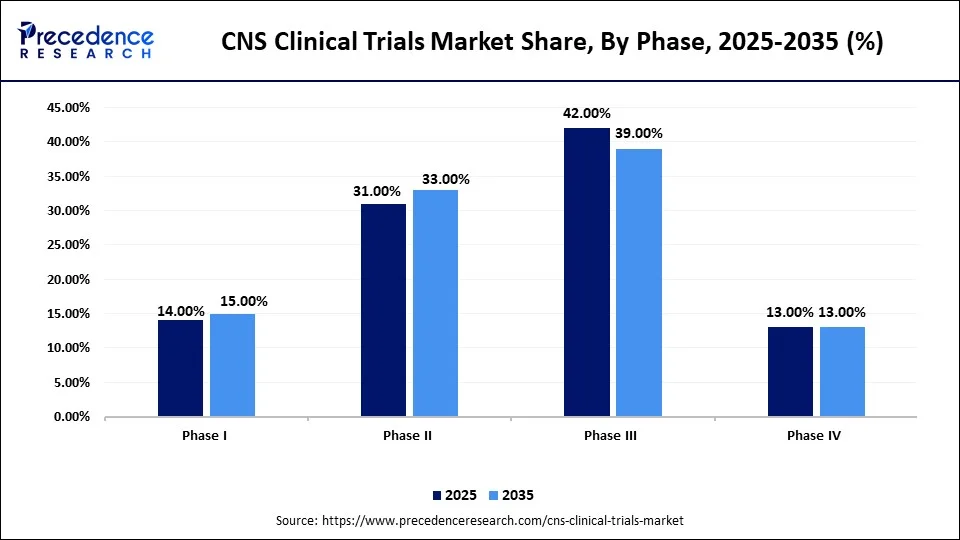
The phase II segment held a 31% share of the market in 2025 and is expected to grow at the fastest CAGR of 8.5% during the projection period. This is mainly due to proof-of-concept studies and increasing precision medicine trials. Complex biological treatments have entered the CNS space, demanding rigorous Phase II testing to determine optimal dosing and preliminary efficacy before moving into massive, expensive Phase III trials. Modern adaptive and decentralized clinical models enable researchers to adjust trial parameters midway through, thus, lifting patient retention rates and preventing costly dropouts during this critical go or no-go phase.
The phase I segment held a 14% share of the market in 2025 and is expected to grow at a CAGR of 8.1% during the projection period. This is due to the expansion of first-in-human CNS assets, increasing biotech innovation, and growing biomarker integration. The adoption of AI and machine learning in drug discovery has dramatically accelerated the identification and validation of new molecular targets in early development.
Study Design Insights
How the Interventional Studies Segment Dominated the CNS Clinical Trials Market?
The interventional studies segment held the largest market share of 83% in 2025, driven by a large drug development pipeline, increasing regulatory approvals, and growing investment in innovative therapies. With a rapidly aging global population, the prevalence of neurodegenerative and psychiatric disorders has drastically increased. The World Health Organization notes that a significant portion of the global population suffers from these complex disorders, necessitating extensive clinical research.
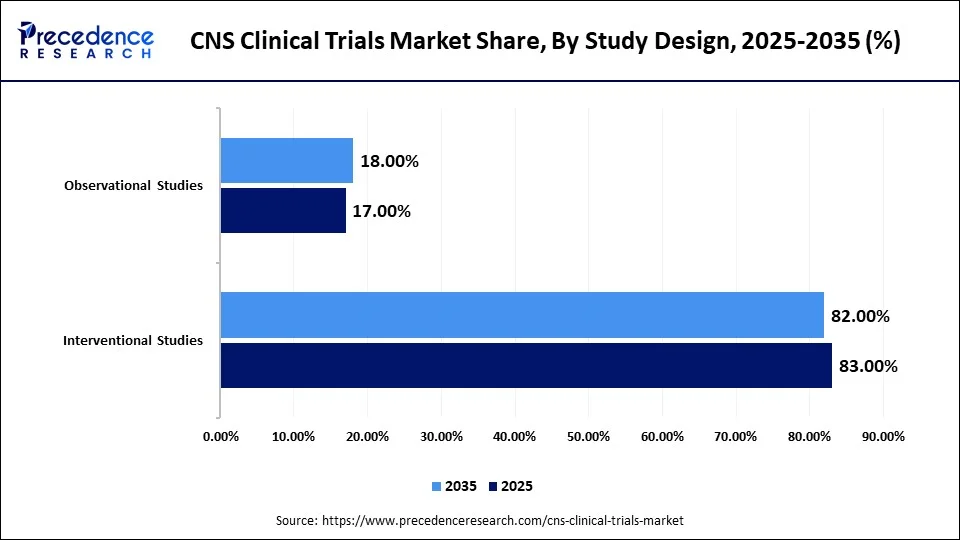
The observational studies segment held a 17% share of the market in 2025 and is expected to grow at the fastest CAGR of 8.2% during the projection period. This is mainly due to growing real-world evidence demand, long-term disease monitoring, and patient registry expansion. Advancements in wearable devices along with mobile health apps have transformed observational research. They enable continuous, real-life tracking of physiological, behavioral, and even cognitive markers, enabling researchers to capture data on diseases such as Alzheimer's and Parkinson's more accurately.
End User Insights
Which End User Segment Dominated the CNS Clinical Trials Market?
The pharmaceutical companies segment held a dominant position in the market, with a 59.00% share in 2025, driven by large CNS drug pipelines, high R&D expenditure, and increasing global trials. A deeper understanding of disease biology and even neuroimmunology has shifted development away from traditional pathways, opening up new mechanisms of action for complex diseases such as multiple sclerosis and Alzheimer's.
CNS Clinical Trials Market Share, By End User, 2025-2035 (%)
| End User | 2025 | 2035 | CAGR (%) |
| Pharmaceutical Companies | 59.00% | 56.00% | 7.5% |
| Biotechnology Companies | 29.00% | 33.00% | 9.3% |
| Academic & Research Institutes | 12.00% | 11.00% | 6.8% |
The biotechnology companies segment held a 29% share of the market in 2025 and is expected to grow at the fastest CAGR of 9.3% during the projection period. This is mainly due to growing venture capital funding and the expansion of innovative CNS therapies. The adoption of digital biomarkers and continuous, remote patient monitoring devices enables trials to capture real-life data, reducing the reliance on traditional clinical trial sites.
The academic and research institutes segment held a 12% share of the market in 2025 and is expected to grow at a CAGR of 6.8% during the projection period. This is due to government-funded neuroscience programs, investigator-initiated studies, and translational medicine research. Federal grants, non-profit foundations, and heavy financial backing for neuroscience have dramatically expanded the number of investigator-initiated studies and even early-stage CNS drug evaluations hosted at academic centers.
Trial Type Insights
Why Did the Drug Trials Segment Lead the CNS Clinical Trials Market?
The drug trials segment held a dominant position in the market with a 72% share in 2025, driven by the high prevalence of CNS disorders, continuous innovation in neurology and regulatory support. Scientists have a better understanding of the underlying neuroimmunology and neurodegeneration. Innovations in biomarker research and next-generation sequencing are paving the way for targeted and personalized therapies that yield better trial success.
CNS Clinical Trials Market Share, By Trial Type, 2025-2035 (%)
| Trial Type | 2025 | 2035 | CAGR (%) |
| Drug Trials | 72.00% | 67.00% | 7.3% |
| Biologics Trials | 20.00% | 23.00% | 9.2% |
| Gene & Cell Therapy Trials | 8.00% | 10.00% | 12.4% |
The gene and cell therapy trials segment held an 8% share of the market in 2025 and is expected to grow at the fastest CAGR of 12.4% during the projection period. This is mainly due to growing gene-editing technologies, increasing rare CNS disorder focus and rising regenerative medicine research. Regulatory bodies globally offer expedited pathways, such as Regenerative Medicine Advanced Therapy (RMAT) and even orphan drug designations, for rare and debilitating CNS disorders. This lowers barriers and accelerates timelines for trial progression.
The biologics trials segment held a 20% share of the market in 2025 and is expected to grow at a CAGR of 9.2% during the projection period. This is due to increasing neuroimmunology research and precision therapeutics adoption. The use of next-generation sequencing and genomic databases enables researchers to stratify patients by genetic risk, resulting in highly targeted, efficient biologic and even gene therapy trials.
Market Regional Analysis: North America, Europe, Asia-Pacific
U.S. CNS Clinical Trials Market Size and Growth 2026 to 2035
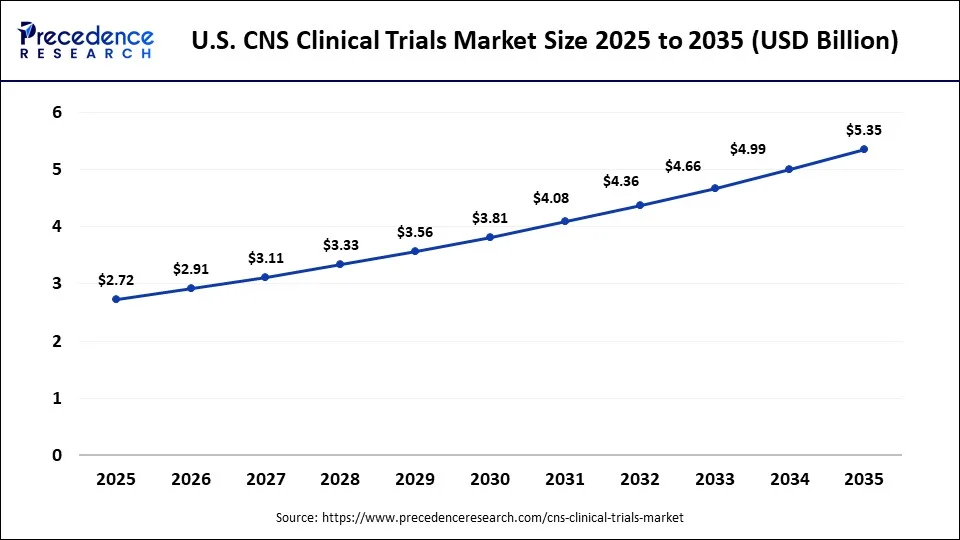
The U.S. CNS clinical trials market size was evaluated at USD 2.72 billion in 2025 and is projected to reach around USD 5.35 billion by 2035, growing at a CAGR of 7.00% from 2026 to 2035.
Which Factors Drive the CNS Clinical Trials Market in North America?
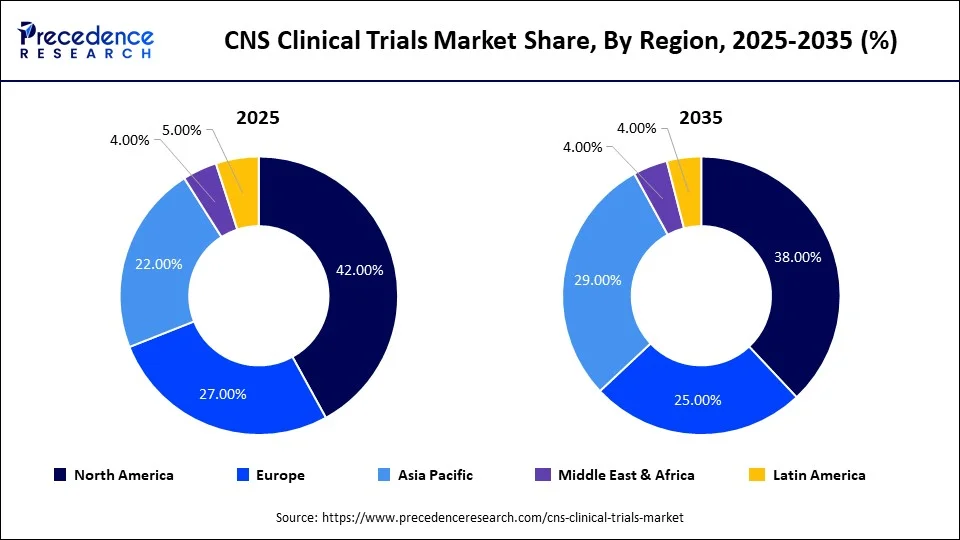
North America held a major market share of 42% in 2025. This is due to the high concentration of CNS drug developers, a large patient pool for neurological disorders, and strong NIH and private R&D funding. Precision medicine, genetic profiling, and digital health technologies (DHT) have significantly enhanced trial targeting and patient monitoring, leading to better trial designs.
U.S. Market Analysis
The U.S. market has experienced rapid growth due to an aging population, rising mental health concerns, and massive R&D investments. The shift toward precision medicine, disease-modifying therapies, and AI-driven trial designs has unlocked new treatments for complex conditions such as Alzheimer's and Parkinson's.
Europe: The Second-Largest Market
Europe held the second-largest market share of 27% in 2025 and is expected to grow at a notable CAGR of 7.2% during the projection period, driven mainly by the growing CNS pipeline across EU countries and well-established trial networks. The implementation of the EU Clinical Trials Regulation (CTR) has harmonized and even accelerated study start-ups across member states, making Europe a highly attractive centre for complex neuroscience trials.
UK Market Analysis
The UK's market is driven by MHRA regulatory reforms that cut trial approval times in half, extensive NHS research infrastructure, and a massive surge in R&D funding for neurodegenerative diseases and personalized medicine.
Asia-Pacific: The Fastest-Growing Region
Asia-Pacific held a 22% share of the market in 2025 and is expected to grow at the fastest CAGR of 10.1% during the projection period, driven by increasing pharmaceutical outsourcing and government support for clinical research. Substantial investments in clinical research networks and advanced digital health tools, for example, decentralized trials and wearable tracking, have bolstered the region's research infrastructure, enabling rapid adoption of personalized medicine.
China Market Analysis
The Chinese market has experienced rapid growth. A massive, treatment-naive patient population mainly drives this, streamlined regulatory reforms prioritizing innovative therapies, and rising R&D investments by both domestic biotechs and even global pharmaceutical companies.
What Drives the CNS Clinical Trials Market in Latin America?
Latin America held a 5% share of the market in 2025 and is expected to grow at a significant CAGR of 7.8% during the projection period, driven by expanding CRO presence, improving healthcare infrastructure, and increasing prevalence of CNS disorders. Latin America boasts a large, highly urbanized, and genetically diverse population, which is vital for determining the safety and efficacy of new CNS drugs. This mitigates the patient recruitment crisis, frequently seen in developed nations.
Brazil Market Analysis
Brazil's market is driven by its massive, ethnically diverse patient population, standardized regulatory frameworks contributed by ANVISA, and high disease prevalence. These factors provide global pharmaceutical sponsors with rapid patient recruitment and high-quality, globally accepted data at a cost-effective rate.
How is the Opportunistic Rise of the Middle East and Africa in the CNS Clinical Trials Market?
The Middle East and Africa held a 4% share of the market in 2025 and are expected to grow at a notable CAGR of 7.5% during the projection period, driven by the expansion of multinational clinical trials, growing neurological disease burden and increasing regulatory harmonization. There is an escalating prevalence of neurological and psychiatric conditions across the globe. Developing new, personalized treatments for these complex indications has spurred global R&D investments, increasing the need for international investigative sites.
Saudi Arabia Market Analysis
The Saudi Arabian market is mainly driven by Vision 2030 healthcare reforms, accelerated SFDA approvals, and a surge in neurological diseases. Advanced clinical trial management systems are being rapidly adopted to manage multi-center neurological studies securely and efficiently.
Market Competitive Landscape: Leading Companies and Strategies
The CNS clinical trials market is highly competitive, with major global contract research organizations (CROs), specialized neuroscience-focused CROs, and technology-enabled service providers competing on therapeutic expertise, regulatory knowledge, patient recruitment capabilities, and global site networks. Leading players include IQVIA, ICON plc, Parexel, Fortrea, Medpace, and Thermo Fisher Scientific.
Competition is driven by decentralized trial capabilities, AI-enabled patient recruitment, biomarker integration, and real-world evidence platforms to address recruitment challenges and enhance trial efficiency. Strategic collaborations with pharmaceutical firms, academic research centers, and digital health providers, along with growth into Asia-Pacific, are key strategies to strengthen market presence and even accelerate CNS drug development.
CNS Clinical Trials Market Companies
- IQVIA
- ICON plc
- Labcorp Drug Development
- Syneos Health
- Parexel
- Medpace
- PPD
- Worldwide Clinical Trials
- PSI CRO
- Premier Research
- Novotech
- CTI Clinical Trial and Consulting
- KCR
- CMIC Holdings
- Ergomed
Recent Developments CNS Clinical Trials Market (2025-2026)
- In May 2026, Labcorp declared a collaboration with the Alliance for Clinical Trials in Oncology to advance a national, multicenter clinical trial for patients newly diagnosed with colorectal cancer (CRC).(Source: https://ir.labcorp.com)
- In February 2026, Zelluna declared a clinical partnership with Medpace, a leading global Contract Research Organization (CRO), to fund the first clinical trial of ZI-MA4-1 (ZIMA-101), Zelluna's lead product candidate.(Source: https://www.globenewswire.com)
Segments Covered in the Report
By Indication
- Alzheimer's Disease
- Parkinson's Disease
- Epilepsy
- Multiple Sclerosis
- Stroke
- Depression
- Schizophrenia
- Others
By Phase
- Phase I
- Phase II
- Phase III
- Phase IV
By Study Design
- Interventional Studies
- Observational Studies
By End User
- Pharmaceutical Companies
- Biotechnology Companies
- Academic and Research Institutes
By Trial Type
- Drug Trials
- Biologics Trials
- Gene and Cell Therapy Trials
By Region
- North America
- Latin America
- Europe
- Asia-pacific
- Middle and East Africa
For inquiries regarding discounts, bulk purchases, or customization requests, please contact us at sales@precedenceresearch.com
Frequently Asked Questions





Ask For Sample
No cookie-cutter, only authentic analysis – take the 1st step to become a Precedence Research client
 Get a Sample




 sales@precedenceresearch.com
 Schedule a Meeting
