



Data Center Battery Market Revenue to Attain USD 18.01 Bn by 2035
Published: 07 Jul 2026
Author: Precedence Research



Data Center Battery Market Revenue and Trends 2026 to 2035
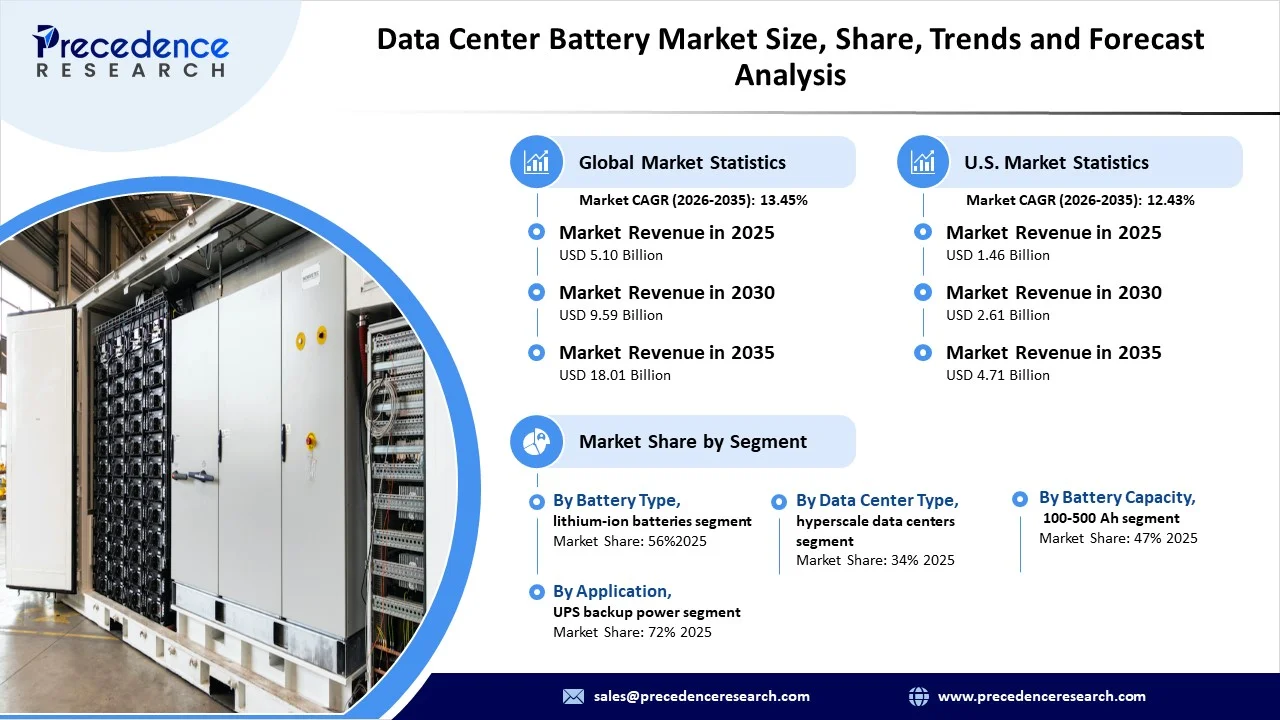
The global data center battery market revenue was valued at USD 5.10 billion in 2025 and is expected to attain around USD 18.01 billion by 2035, growing at a CAGR of 13.45% during forecast period. The market is driven by the necessity of having dependable and constant sources of power backup in case of any outage in the grid to safeguard applications of AI, cloud, and enterprises, and the incorporation of battery energy storage systems with on-site renewable energy sources.
The Foundation of Reserve Power
The data center battery market consists of the production, distribution, installation, and maintenance of Battery Energy Storage Systems (BESS) designed for delivering backup power and bridging power in case of any disturbances in the grid. This market encompasses conventional Valve Regulated Lead Acid (VRLA) batteries, modern Li-ion variants such as LFP/NMC, and innovative options like nickel-zinc and sodium-ion batteries.
The scope of this market comprises both centralized UPS-based solutions and distributed battery systems designed for AI-powered solutions. Typical use cases are UPS infrastructure, large grid-scale energy storage to provide ancillary services, and integration with on-site renewables for peak shaving and demand response. This market has been adopted by hyperscale cloud service companies, colocation facility providers, enterprises, and edge computing centers.
Rapid Power Backup of AI Clusters Using High-Rate LFP Cells
Data center battery technology is evolving to a large extent with the development of high-rate lithium iron phosphate (LFP) cylindrical batteries that are capable of responding to the variations in power in AI workloads. This is largely because such batteries have ultra-low internal resistance, providing stable voltage when dealing with millisecond-level power fluctuations and sudden GPU load spikes. CBAK Energy announced the release of its 26650HP V2.0 (40C) and 26650PFS2 V2.0 (38C) high-rate LFP cylindrical batteries. The batteries have very low internal resistance and can pulse discharge up to approximately 100C.
Deployment of Energy Storage in Computing Centers as Directed by the Governments
Governments across the globe have launched national policies designed to improve the energy security of their data centers, promote renewable energy use, and improve the stability of electric grids. Such directives also include tax subsidies, storage quotas, and building programs that prompt data farms to install battery energy storage systems (BESS). In 2025, the National Development and Reform Commission and the National Energy Administration of China launched the Action Plan for Large-Scale Development of New Energy Storage (2025-2027). This action plan specifies the usage of “computing infrastructure” as one of the key applications for new energy storage, promoting the implementation of energy storage systems in computing facilities.
ZincFive Generates Revenue of USD 66.9 Million in 2025
In 2025, zinc-nickel battery manufacturer ZincFive announced a business combination with Spark I Acquisition Corp. at a pre-money valuation of USD 600 million. The firm disclosed its 2025 revenue, which increased almost 2 times compared to 2024 and was recorded to be approximately USD 66.9 million. The firm also noted that it has a commercial backlog of USD 81 million, while having installed almost 2 gigawatts of power system installations worldwide by the end of 2025.
Market Segmentation Overview
- By battery type, the lithium-ion batteries segment led the data center battery market with a 56% share in 2025, owing to their high energy density and fast discharge rate, which helps computation facilities to provide uniform power delivery, which is critical for sensitive high-power AI equipment. This segment benefits from the decreasing prices of lithium-ion batteries, especially LFP and NMC, along with their long duration of operation before their efficiency starts to decrease.
- By battery type, the sodium-ion batteries segment is expected to expand at the highest CAGR of 21% during the forecast period, due to the availability of abundant, cost-effective materials, as sodium is far more available and less expensive compared to lithium and cobalt. Another key factor is that this segment facilitates great thermal stability and reduced risk of fire, both being important requirements for high-capacity deployment for significant duration backup and utility-scale energy storage facilities.
- By data center type, the hyperscale data centers segment dominated the market with a 35% share in 2025 and is expected to grow at the fastest CAGR of 17% in 2025, since they host the biggest and densest data centers in terms of power consumption, where the premise is in the order of hundreds of megawatts of IT load. This results in a need for an uninterrupted power supply to millions of servers and protection from any instabilities of the grid system.
- By data center type, the colocation data centers segment held the second-largest market share of 29% in 2025 because it has been adopted by a wide range of enterprises and cloud clients with different power density and availability needs, necessitating a need for battery backup in a huge number of racks for service-scale agreement fulfilment.
- By battery capacity, the 100-500 Ah segment led the market with a 47% share in 2025 because it provides an ideal combination of runtime and space efficiency, which makes it the standard choice for rack-mounted BBU as well as smaller UPS module sizes that can be used in any data center configuration. Another key feature of this segment is that it provides enough runtime to allow switching on the generator and not overprovisioning the battery array.
- By battery capacity, the above 500 Ah segment is expected to expand at the highest CAGR of 16.8% during the forecast period, owing to the increasing energy requirements of AI and HPC clusters that are driving the need for data farms to invest in rack-based BBUs with large capacity batteries. Heavy-duty batteries provide extended run time and the capacity to supply high amounts of power during surges in GPU processing and the startup of generators.
- By application, the UPS backup power segment dominated the data center battery market with a 72% share in 2025, since it is the most critical requirement for the functioning of any computing facility, protecting important IT infrastructure during power failures and outages, electrical disturbances, and generator startup lag.
- By application, the renewable energy integration segment is expected to grow at the fastest CAGR of 20.1% from 2026 to 2035, due to the pressure on hyperscale and colocation data centers to reduce their carbon footprint and provide renewable energy. Batteries for renewable energy integration also offer frequency regulation and other grid services besides the main purpose of regulating power supply.
- By end user, the cloud service providers segment led the market with a 31% share in 2025 and is expected to expand at the highest CAGR of 16.5% during the forecast period because they run massive data centers that need to have dependable sources of backup power supply. The growth and investments made in the infrastructure by the players in this segment pushed up the demand for batteries significantly.
- By end user, the telecom companies segment held the second-largest market share of 14% in 2025, since its network operations require an uninterrupted electricity supply to keep up with seamless connectivity. The requirement for a consistent power supply is growing due to increasing demands for mobile coverage and widespread consumption of data.
Regional Analysis
North America dominated the data center battery market with a 38% share in 2025 because of its extensive hyperscale and enterprise data center network, in addition to early and extensive usage of cloud computing, resulting in high demand for dependable battery backup systems. The U.S. led the market in North America owing to the significant presence of key cloud providers, constant investment in digital infrastructure, and emphasis on data center efficiency. Canada is a significant contributor to the market due to the growing investments in data centers, affordable and reliable power, and its naturally cool climate conditions, which aid the efficient operations of data centers.
Asia-Pacific is expected to grow at the fastest CAGR of 16.3% from 2026 to 2035 because of fast-paced digitalization, high internet proliferation rate, and the rapid uptake of cloud computing, all of which contribute to the massive growth of computing facilities infrastructure. China dominated the market in Asia-Pacific owing to significant investments in hyperscale data centers, government backing for modernizing digital infrastructure, and the significant presence of indigenous cloud service vendors that keep expanding their capacities. India witnessed notable market growth due to the fast-paced development of its digital economy, growing data usage, government support, and investment by both global and local companies in the development of data center infrastructure.
Europe held the third-largest market share of 24% in 2025 because of its well-developed computing center industry, high importance of regulation of data security and sustainability goals, and constant need for dependable power systems in enterprises, colocation, and cloud-based data centers. Germany led the market in Europe due to the presence of a robust industrial and digital infrastructure and continued investment in high-capacity data centres with significant research impetus on making the operations energy efficient. The UK is a significant contributor to the market owing to its well-established cloud computing sector, high data traffic, and consistent growth in the colocation and hyperscale data center infrastructure.
Data Center Battery Market Coverage
| Report Attribute | Key Statistics |
| Market Revenue in 2025 | USD 5.10 Billion |
| Market Revenue by 2035 | USD 18.01 Billion |
| CAGR from 2026 to 2035 | 13.45% |
| Quantitative Units | Revenue in USD million/billion, Volume in units |
| Largest Market | North America |
| Base Year | 2025 |
| Regions Covered | North America, Europe, Asia-Pacific, Latin America, and the Middle East & Africa |
Top Companies in the Data Center Battery Market
EnerSys, LG Energy Solution, Samsung SDI, and Panasonic are some of the key players that provide integrated backup battery solutions and UPSs for computing facilities. CATL, BYD, EVE Energy, and CALB are prominent manufacturers of batteries for data center energy storage systems. Exide Technologies, Saft, C&D Technologies, and East Penn offer lead-acid and lithium-ion battery solutions.
Segments Covered in This Report
By Battery Type
- Lithium-ion Batteries
- Lithium Iron Phosphate (LFP)
- Lithium Nickel Manganese Cobalt Oxide (NMC)
- Other Lithium-ion Chemistries
- Lead-acid Batteries
- Valve-Regulated Lead-Acid (VRLA)
- Absorbent Glass Mat (AGM)
- Gel Batteries
- Flooded Lead-acid Batteries
- Nickel-based Batteries
- Nickel-Cadmium (Ni-Cd)
- Nickel-Metal Hydride (NiMH)
- Sodium-ion Batteries
- Flow Batteries
- Other Battery Technologies
By Data Center Tier
- Tier I
- Tier II
- Tier III
- Tier IV
By Data Center Type
- Enterprise Data Centers
- Colocation Data Centers
- Hyperscale Data Centers
- Edge Data Centers
- Modular Data Centers
By Battery Capacity
- Below 100 Ah
- 100-500 Ah
- Above 500 Ah
By UPS Configuration
- Centralized UPS
- Distributed UPS
- Modular UPS
By Application
- UPS Backup Power
- Energy Storage Systems (ESS)
- Peak Load Management
- Renewable Energy Integration
- Emergency Power Support
By Installation Type
- New Installations
- Replacement and Retrofit
By End User
- Cloud Service Providers
- Telecom Companies
- BFSI
- Government and Defense
- Healthcare
- Manufacturing
- IT and ITES
- Retail and E-commerce
- Energy and Utilities
- Others
By Distribution Channel
- Direct Sales
- System Integrators
- Value-Added Resellers (VARs)
- Electrical Equipment Distributors
By Region
- North America
- Latin America
- Europe
- Asia-pacific
- Middle and East Africa
Get this report to explore global market size, share, CAGR, and trends, featuring detailed segmental analysis and an insightful competitive landscape overview @ https://www.precedenceresearch.com/sample/8537
You can place an order or ask any questions. Please feel free to contact us at sales@precedenceresearch.com |+1 804 441 9344