



Data Center Battery Market Trends, Companies, Revenue / Sales Performance, Subscriber Growth, Pricing Strategies, Cloud Adoption, Infrastructure Expansion, Competitive Landscape, and Industry Outlook
Data Center Battery Market (By Battery Type: Lithium-ion Batteries, Lead-acid Batteries, Nickel-based Batteries, Sodium-ion Batteries, Flow Batteries, Other Battery Technologies; By Data Center Tier: Tier I, Tier II, Tier III, Tier IV; By Data Center Type: Enterprise Data Centers, Colocation Data Centers, Hyperscale Data Centers, Edge Data Centers, Modular Data Centers; By Battery Capacity: Below 100 Ah, 100-500 Ah, Above 500 Ah; By UPS Configuration: Centralized UPS, Distributed UPS, Modular UPS; By Application: UPS Backup Power, Peak Load Management, Renewable Energy Integration, Emergency Power Support; By Installation Type: New Installations, Replacement and Retrofit; By End User: Cloud Service Providers, Healthcare, Manufacturing, IT and ITES, Retail and E-commerce, Others; By Distribution Channel: Direct Sales, System Integrators, Electrical Equipment Distributors) - Global Industry Analysis, Size, Trends, Leading Companies, Regional Outlook, and Forecast 2026 to 2035
Source: https://www.precedenceresearch.com/data-center-battery-market
 Get a Sample
 Table Of Content


Data Center Battery Market Size and Forecast 2026 to 2035
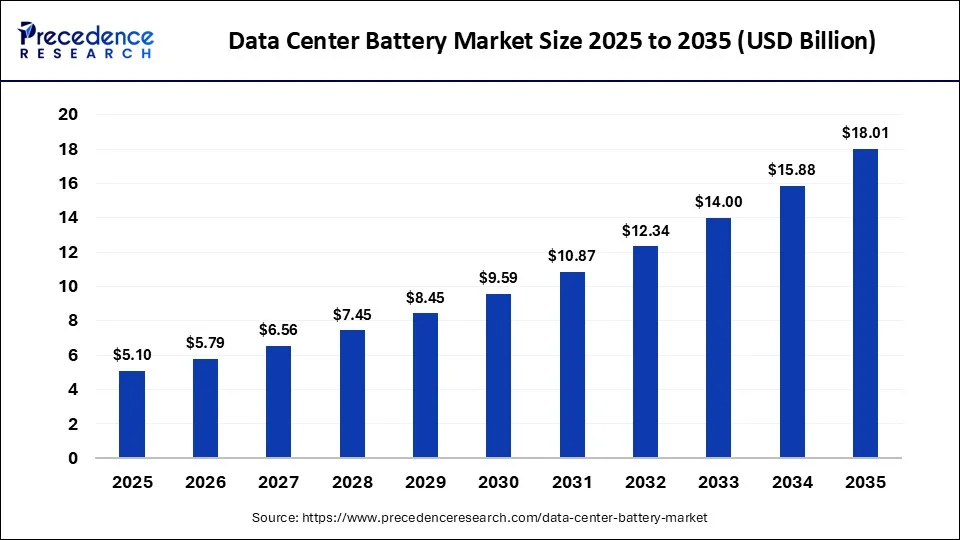
The global data center battery market size accounted for USD 5.10 billion in 2025 and is predicted to increase from USD 5.79 billion in 2026 to approximately USD 18.01 billion by 2035, expanding at a CAGR of 13.45% from 2026 to 2035. The market is driven by the increase in high-density AI and cloud computing workloads, which cause rapid power spikes and demand robust, scalable battery energy storage systems to prevent multi-million dollar outages.
Key Takeaways
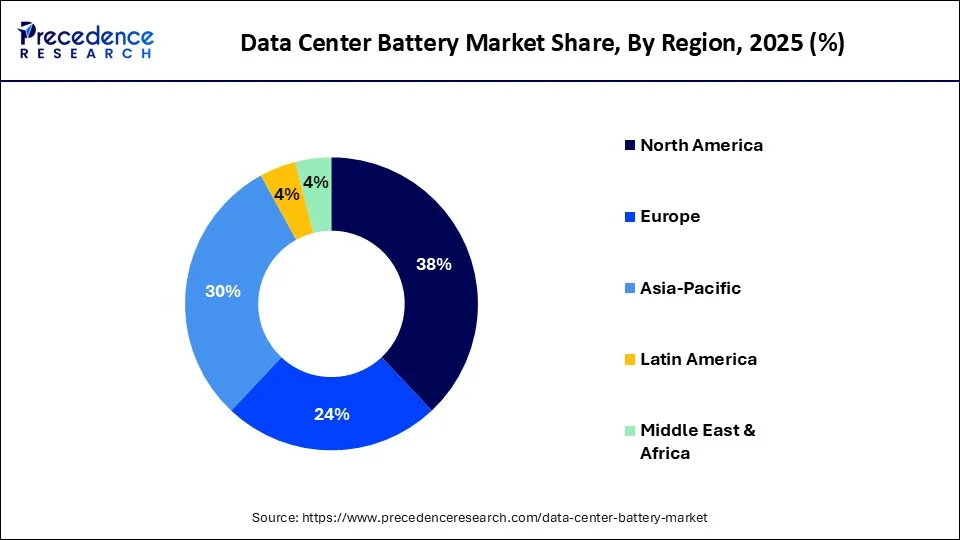
- North America led the data center battery market by holding a major share of 38% in 2025.
- Asia-Pacific held a 30% share of the market in 2025 and is expected to grow at the fastest CAGR of 16.3% during the projection period.
- By battery type, the lithium-ion batteries segment held a dominant position in the market with a 56% share in 2025.
- By battery type, the sodium-ion batteries segment held a 2% share of the market in 2025 and is expected to grow at the fastest CAGR of 21% during the projection period.
- By data center type, the hyperscale data centers segment dominated the market with a share of 34% in 2025 and is expected to grow at the fastest CAGR of 17% in the coming years.
- By data center type, the colocation data centers segment held the second-largest market share of 29% in 2025.
- By battery capacity, the 100-500 Ah segment held a dominant position in the data center battery market with a 47% share in 2025.
- By battery capacity, the above 500 Ah segment held a 35% share of the market in 2025 and is expected to grow at the fastest CAGR of 16.8% during the projection period.
- By application, the UPS backup power segment dominated the market with a 72% share in 2025.
- By application, the renewable energy integration segment held a 5% share of the market in 2025 and is expected to grow at the fastest CAGR of 20.1% during the projection period.
- By end user, the cloud service providers segment dominated the market with a share of 31% in 2025 and is expected to grow at the fastest CAGR of 16.5% in the coming years.
- By end user, the telecom companies segment held the second-largest market share of 14% in 2025.
Market Overview
The data center battery industry encompasses the equipment, software, and services utilized to offer continuous, uninterrupted power to digital infrastructure. It involves uninterruptible power supply (UPS) units along with battery energy storage systems (BESS) programmed to prevent data loss during grid outages and to balance heavy energy needs and AI workloads. The explosive expansion of artificial intelligence (AI) workloads, along with high-density computing, is the main driver of the market.
Data Center Battery Market Trends
- Operators are changing away from traditional Valve-Regulated Lead-Acid (VRLA) batteries. Lithium-ion solutions are increasingly preferred for hyperscale and AI-focused sites as they provide 60-70% less weight and even a lifespan of up to 15 years.
- High-performance AI computing creates fast, sub-second power spikes. Advanced energy storage and intelligent Battery Management Systems (BMS) are now needed to manage these volatile compute loads while meeting strict thermal and safety constraints.
- Batteries are revolutionizing from simple backup supplies into active grid components. Operators are utilizing BESS to store renewable energy, perform "peak shaving" to minimize electricity costs, and even manage grid connection delays by offering off-grid flexibility.
Market Report Coverage and Key Metrics
| Report Coverage | Details |
| Market Size in 2025 | USD 5.10 Billion |
| Market Size in 2026 | USD 5.79 Billion |
| Market Size by 2035 | USD 18.01 Billion |
| Market Growth Rate from 2026 to 2035 | CAGR of 13.45% |
| Dominating Region | North America |
| Fastest Growing Region | Asia Paicfic |
| Base Year | 2025 |
| Forecast Period | 2026 to 2035 |
| Segments Covered | Battery Type, Data Center Tier, Data Center Type, Battery Capacity, Battery Capacity, Application, Installation Type, End User, Distribution Channel, and Region |
| Regions Covered | North America, Europe, Asia-Pacific, Latin America, and Middle East & Africa |
Market Dynamics
Drivers
Explosive Growth of Hyperscale Infrastructure and AI Workloads
The explosive growth of hyperscale infrastructure and AI workloads is the main driver for the market, as AI requires continuous, high-density power. Batteries act as a vital shock absorber and backup, smoothing out extreme power spikes along with grid volatility to prevent downtime for delicate servers. As utilities struggle to meet need, AI data center batteries can now actively store energy during off-peak hours and discharge it during high-demand peaks, enabling them to function as active participants in grid need-response programs.
Restraint
Supply Chain Uncertainties
Supply chain uncertainties act as a major restraint in the data center battery market by creating component shortages, driving up procurement costs, and delaying critical construction timelines. This imbalance, spurred by increasing AI power demands, significantly restricts the rapid deployment of essential backup power and energy storage infrastructure. Developers usually face extended lead times for the delivery of battery units, semiconductors, and even specialized electrical gear. These delays leave operators scrambling to synchronize battery systems with data center buildout schedules.
Opportunity
Rise of AI Data Center Energy Buffers
AI data centers draw immense and volatile power. Batteries act as essential energy buffers as standard grids cannot manage rapid GPU power spikes or long interconnection delays. This creates a vast market for energy storage manufacturers to stabilize compute loads, prevent grid blackouts, and even unlock immediate off-grid deployment. Batteries are evolving from simple, short-term backups into active grid tools. Moreover, oversized data center batteries can now peak shave to avoid costly grid charges, store intermittent renewable energy, and even participate in utility programs by dispatching excess power back to the grid during high-demand hours.
Market Segmentation Analysis
Battery Type Insights
Why Did the Lithium-ion Batteries Segment Lead the Data Center Battery Market?
The lithium-ion batteries segment dominated the market with a 56% share in 2025, driven by rapid adoption due to longer lifecycle, lower footprint, and AI-ready hyperscale deployments. Lithium-ion systems perform reliably across a wider temperature range compared to VRLA batteries. This reduces the demand for precise, energy-draining cooling units dedicated to battery rooms.
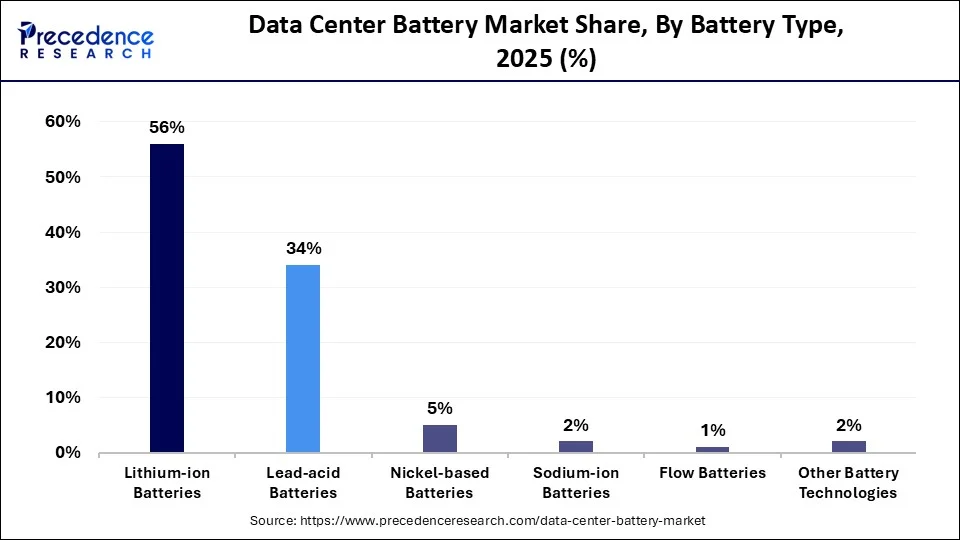
The sodium-ion batteries segment held a 2% share of the market in 2025 and is expected to grow at the fastest CAGR of 21% during the projection period. This is mainly due to the emerging low-cost option with improving commercialization. Sodium-ion cells have extremely low internal resistance and even inherently stable molecular structures, making them nonflammable and virtually removing the risk of catastrophic thermal runaway.
The lead-acid batteries segment held a 34% share of the market in 2025 and is expected to grow at a CAGR of 7.8% during the projection period. This is due to the continued use in legacy facilities because of lower upfront costs. Data centers demand massive energy arrays in the megawatt range. Lead-acid batteries provide a significantly lower upfront capital investment compared to modern lithium-ion (Li-ion) solutions. Moreover, lead-acid batteries excel at delivering high currents instantly, which perfectly matches the instantaneous burst required to bridge the gap between grid failure and generator engagement.
Data Center Type Insights
Which Data Center Type Segment Dominated the Data Center Battery Market?
The hyperscale data centers segment dominated the market with a share of 34% in 2025 and is expected to grow at the fastest CAGR of 17% in the coming years. This is due to AI cloud expansion and mega campus investments. Because hyperscale facilities demand gigawatt-level campus power, waiting for standard utility growth can take years. Co-locating massive battery arrays at the data center enables developers to draw a steady, manageable trickle of power from the grid while depending on batteries to meet the sudden peaks in demand.
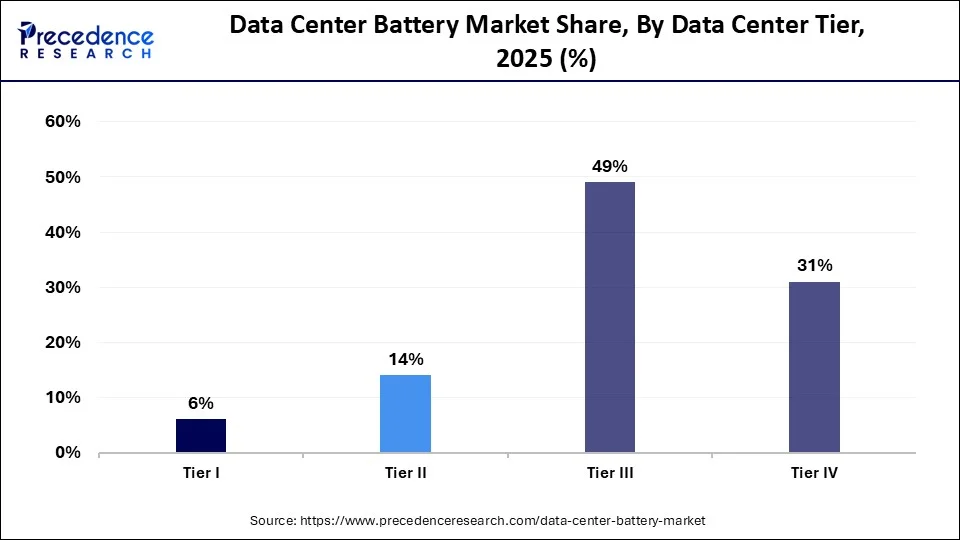
The colocation data centers segment held a 29% share of the market in 2025 and is expected to grow at a CAGR of 13.2% during the projection period. This is due to the rising outsourcing of IT infrastructure. Batteries offer the immediate, uninterrupted power supply (UPS) required to keep equipment online during micro-outages or to bridge the gap as backup diesel generators spin up. Facilities utilize co-located storage to avoid costly utility demand charges and discharging batteries during peak local grid demand.
The enterprise data centers segment held a 24% share of the market in 2025 and is expected to grow at a CAGR of 9.1% during the projection period. This is due to the gradual migration toward colocation and cloud services. Enterprise facilities must run continuously. Batteries offer immediate, zero-downtime backup power during grid failures or voltage fluctuations, bridging the critical seconds demanded for backup diesel generators to start.
Battery Capacity Insights
Why Did the 100-500 Ah Segment Lead the Data Center Battery Market?
The 100-500 Ah segment held a dominant position in the market with a 47% share in 2025, driven by standard UPS installations. In a facility-scale outage, batteries are primarily utilized to keep operations running for 5 to 15 minutes while vast emergency generators spin up. A 100-500 Ah configuration offers the exact high-rate discharge demanded for these short windows without wasting space on excess storage.
Data Center Battery Market Share, By Battery Capacity, 2025 (%)
| Battery Capacity | 2025 | 2035 | CAGR (%) |
| Below 100 Ah | 18 | 14 | 8.90% |
| 100–500 Ah | 47 | 42 | 12.60% |
| Above 500 Ah | 35 | 44 | 16.80% |
The above 500 Ah segment held a 35% share of the market in 2025 and is expected to grow at the fastest CAGR of 16.8% during the projection period. This is mainly due to increasing deployment in hyperscale campuses. Computing loads, mainly during AI tasks or GPU startups, demand instant, large power surges. Lead-acid cells comfortably manage these high discharge rates to prevent sudden voltage drops. Moreover, data centers prioritize predictability. With over a century of proven use in critical standby applications, lead-acid systems are now trusted for seamless emergency handovers while backup generators start.
The below 100 Ah segment held an 18% share of the market in 2025 and is expected to grow at a CAGR of 8.9% during the projection period. This is due to small edge and enterprise facilities. Smaller blocks make installation, maintenance, and replacement much easier for personnel. Further, data center modules can be connected in parallel to easily scale capacity as the facility's server load rises.
Application Insights
How the UPS Backup Power Segment Dominated the Data Center Battery Market?
The UPS backup power segment held the largest market share of 72% in 2025, driven by core battery applications across all facilities. Utility grids can now take anywhere from a few seconds to a few minutes to switch to backup generators. UPS batteries, thus, act as an immediate bridge to power servers during this delay. The grid is prone to voltage sags, spikes, and surges. A UPS constantly conditions the power, ensuring that sensitive IT hardware receives stable, clean, and even reliable voltage at all times.
Data Center Battery Market Share, By Application, 2025 (%)
| Application | 2025 | 2035 | CAGR (%) |
| UPS Backup Power | 72 | 64 | 11.80% |
| Energy Storage Systems (ESS) | 11 | 16 | 18.40% |
| Peak Load Management | 6 | 8 | 17.30% |
| Renewable Energy Integration | 5 | 8 | 20.10% |
| Emergency Power Support | 6 | 4 | 9.50% |
The renewable energy integration segment held a 5% share of the market in 2025 and is expected to grow at the fastest CAGR of 20.1% during the projection period. This is mainly because renewable sources are naturally variable. Batteries integrated with renewables can offer essential services back to the power grid, like frequency regulation, allowing data centers to earn revenue or utility credits.
The energy storage systems (ESS) segment held an 11% share of the market in 2025 and is expected to grow at a CAGR of 18.4% during the projection period. This is due to grid support and energy optimization initiatives. Modern data centers with high-density GPU clusters experience rapid, intense power spikes. ESS supplies this dynamic need while maintaining a highly stable voltage and frequency, which is important to protect sensitive hardware.
End User Insights
Which End User Segment Led the Data Center Battery Market?
The cloud service providers segment led the market with a share of 31% in 2025 and is expected to sustain its dominance with a CAGR of 16.5% in the coming years. This is due to massive investments in AI cloud infrastructure. Cloud service providers must guarantee high availability as cloud infrastructure is worldwide distributed and supports mission-critical applications; hyperscale providers utilize millions of advanced lithium-ion battery cells to bridge gaps between grid power outages and even the activation of standby generators.
Data Center Battery Market Share, By End User, 2025 (%)
| End User | 2025 | 2035 | CAGR (%) |
| Cloud Service Providers | 31 | 37 | 16.50% |
| Telecom Companies | 14 | 12 | 10.20% |
| BFSI | 12 | 10 | 9.80% |
| Government & Defense | 8 | 7 | 10.50% |
| Healthcare | 7 | 7 | 12.00% |
| Manufacturing | 6 | 6 | 12.50% |
| IT & ITES | 13 | 12 | 13.10% |
| Retail & E-commerce | 5 | 5 | 14.80% |
| Energy & Utilities | 2 | 3 | 16.20% |
| Others | 2 | 1 | 9.00% |
The telecom companies segment held a 14% share of the market in 2025 and is expected to grow at a CAGR of 10.2% during the projection period. This is due to the physical lines between telecom infrastructure and data centers increasingly blurring. With the growth of 5G, edge computing, and AI, telecom firms are transforming local switching stations and telecom hubs into localized, edge data centers. Further, this means the battery architecture needed to power and cool these facilities, usually in weak-grid areas, is identical to utility-scale data center requirements.
The IT & ITES segment held a 13% share of the market in 2025 and is expected to grow at a CAGR of 13.1% during the projection period. This is due to the enterprise digital transformation. IT & ITES operations manage sensitive data, cloud computing, and even global financial transactions. Even a millisecond of power disruption can now result in data corruption, downtime, and huge financial losses. Battery systems serve as the vital bridge, instantly supplying power during grid outages while backup generators start up.
Market Regional Analysis: North America, Europe, Asia-Pacific
Which Factors Drive the Data Center Battery Market in North America?
North America held a major market share of 38% in 2025. This is due to the AI infrastructure and hyperscale investments driving demand. Hyperscale data centers, along with AI training workloads, create intense power need spikes that regional U.S. and Canadian power grids were not programmed to handle. Batteries assist in bridging this energy gap. Moreover, battery Energy Storage Systems (BESS) store energy during low-demand periods and even discharge it instantaneously during peak times, enabling operators to avoid massive transmission surcharges.
U.S. Data Center Battery Market Size and Growth 2026 to 2035
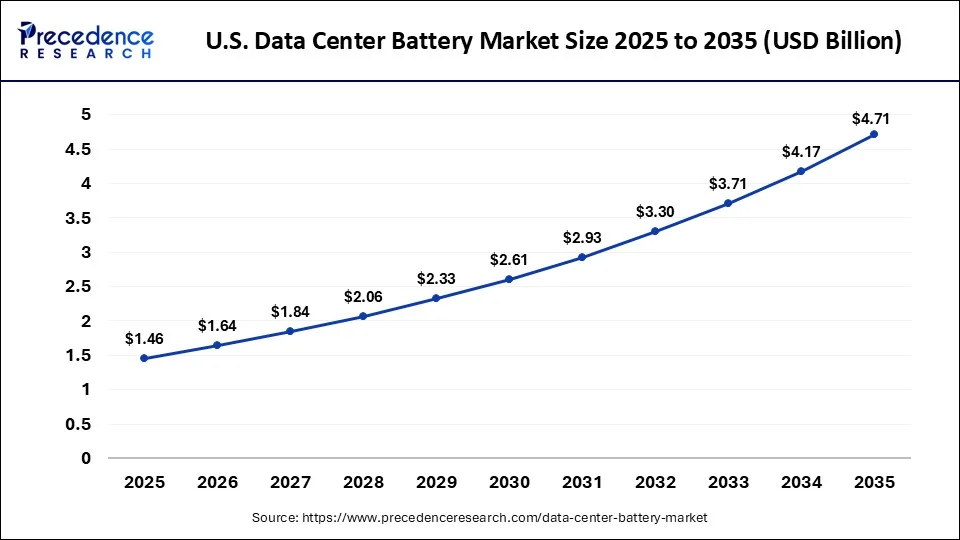
The U.S. data center battery market size was evaluated at USD 1.46 billion in 2025 and is projected to reach around USD 4.71 billion by 2035, growing at a CAGR of 12.43% from 2026 to 2035.
U.S. Market Analysis
Data center batteries (UPS and BESS) are popular in the U.S. to guarantee uninterrupted operations during power outages, offset the huge energy demands of AI and cloud computing, and stabilize local power grids. They prevent millions in downtime losses, bypass grid bottlenecks, and even replace polluting diesel generators.
Europe: The Second-Largest Market
Europe held the second-largest market share of 24% in 2025 and is expected to grow at a notable CAGR of 12% during the projection period, driven mainly by sustainability regulations and battery upgrades. Europe's strict carbon-neutral targets have forced data centers to explore green energy. Advanced Battery Energy Storage Systems (BESS) are famous for replacing diesel generators, replacing traditional systems, and also protecting mission-critical IT infrastructure without carbon emissions.
UK Market Analysis
With soaring energy requirements from cloud computing and AI in the UK, these large-scale energy storage systems prevent costly downtime while actively stabilizing the national grid by balancing renewable power fluctuations. The UK depends heavily on intermittent renewables such as wind and solar. Data center batteries store excess green energy when generation is high and release it when generation drops, assisting the UK in meeting its net-zero emission targets.
Asia-Pacific: The Fastest-Growing Region
Asia-Pacific held a 30% share of the data center battery market in 2025 and is expected to grow at the fastest CAGR of 16.3% during the projection period, driven by rapid data center construction in China, India, Southeast Asia, and Japan. The explosive expansion of Artificial Intelligence (AI) and high-density workloads demands massive power and uninterrupted operations. Advanced batteries prevent catastrophic data loss and even financial damage during grid outages.
China Market Analysis
Data center batteries are significant in China to stabilize power grids against massive energy spikes from AI infrastructure and fund strict renewable energy mandates for new computing hubs. China controls a massive majority of the world's battery manufacturing capacity and also material processing.
What Drives the Data Center Battery Market in Latin America?
Latin America held a 4% share of the market in 2025 and is expected to grow at a significant CAGR of 12.6% during the projection period, driven by increasing cloud infrastructure deployment. Operators are changing from legacy lead-acid systems to highly efficient lithium-ion setups, which take up less space and provide better performance and longer lifespans for high-density AI servers.
Brazil Market Analysis
The Brazilian market is driven by unprecedented energy needs from hyperscale cloud and AI facilities. They are mainly located in the Sao Paulo metro centre to solve grid bottlenecks, stabilize renewable energy intermittency, and ensure 24/7 continuous operations.
Will the Middle East and Africa Grow in the Data Center Battery Market?
The Middle East and Africa held a 4% share of the market in 2025 and are expected to grow at a notable CAGR of 13% during the projection period, driven by smart city and digital economy investments. High ambient temperatures in the Middle East require heavy cooling systems. Batteries act as vital buffers to stabilize power delivery during sudden spikes in energy demand.
Saudi Arabia Market Analysis
The Saudi Arabian market is growing because they ensure uninterrupted uptime during grid fluctuations, funds the transition to 24/7 green energy, and offsets the inherent intermittency of powering mega data campuses with solar, along with wind in the desert.
Market Competitive Landscape: Leading Companies and Strategies
The data center battery market is highly competitive, driven by the rising need for uninterrupted power supply, hyperscale data centers, and AI workloads. Leading firms such as EnerSys, Vertiv, Schneider Electric, Leoch International, Eaton, and Exide Technologies compete via advanced lithium-ion and VRLA battery technologies, improved energy density, and intelligent battery management systems. Firms are investing in sustainable energy storage, modular UPS solutions, and even strategic partnerships with cloud service providers and colocation operators. Innovation, reliability, global service capabilities, lifecycle performance, and cost optimization remain the primary competitive factors shaping market leadership.
Data Center Battery Market Companies
- Vertiv Holdings Co
- Eaton Corporation
- Schneider Electric
- LG Energy Solution
- Samsung SDI
- Saft Groupe S.A. (TotalEnergies)
- Panasonic Holdings Corporation
- Natron Energy
Recent Developments Data Center Battery Market (2025-2026)
- In April 2026, Eaton declared an investment of over $30 million to raise U.S. production of its medium-voltage switchgear, the equipment utilized to protect, control, and isolate electrical equipment in data centers, utility, and industrial power generation and distribution systems.(Source: https://www.eaton.com)
- In March 2026, Vertiv declared four new or expanding manufacturing facilities in the Americas, growing the firm's production capacity for infrastructure solutions, power management, and integrated cabinets.(Source: https://www.vertiv.com)
Segments Covered in the Report
By Battery Type
- Lithium-ion Batteries
- Lithium Iron Phosphate (LFP)
- Lithium Nickel Manganese Cobalt Oxide (NMC)
- Other Lithium-ion Chemistries
- Lead-acid Batteries
- Valve-Regulated Lead-Acid (VRLA)
- Absorbent Glass Mat (AGM)
- Gel Batteries
- Flooded Lead-acid Batteries
- Nickel-based Batteries
- Nickel-Cadmium (Ni-Cd)
- Nickel-Metal Hydride (NiMH)
- Sodium-ion Batteries
- Flow Batteries
- Other Battery Technologies
By Data Center Tier
- Tier I
- Tier II
- Tier III
- Tier IV
By Data Center Type
- Enterprise Data Centers
- Colocation Data Centers
- Hyperscale Data Centers
- Edge Data Centers
- Modular Data Centers
By Battery Capacity
- Below 100 Ah
- 100-500 Ah
- Above 500 Ah
By UPS Configuration
- Centralized UPS
- Distributed UPS
- Modular UPS
By Application
- UPS Backup Power
- Energy Storage Systems (ESS)
- Peak Load Management
- Renewable Energy Integration
- Emergency Power Support
By Installation Type
- New Installations
- Replacement and Retrofit
By End User
- Cloud Service Providers
- Telecom Companies
- BFSI
- Government and Defense
- Healthcare
- Manufacturing
- IT and ITES
- Retail and E-commerce
- Energy and Utilities
- Others
By Distribution Channel
- Direct Sales
- System Integrators
- Value-Added Resellers (VARs)
- Electrical Equipment Distributors
By Region
- North America
- Latin America
- Europe
- Asia-pacific
- Middle and East Africa
For inquiries regarding discounts, bulk purchases, or customization requests, please contact us at sales@precedenceresearch.com
Frequently Asked Questions





Ask For Sample
No cookie-cutter, only authentic analysis – take the 1st step to become a Precedence Research client
 Get a Sample




 sales@precedenceresearch.com
 Schedule a Meeting
