



Desalting Buffer Exchange Market Revenue to Attain USD 2.99 Bn by 2035
Published: 07 Apr 2026
Author: Precedence Research



Desalting Buffer Exchange Market Revenue and Trends 2026 to 2035
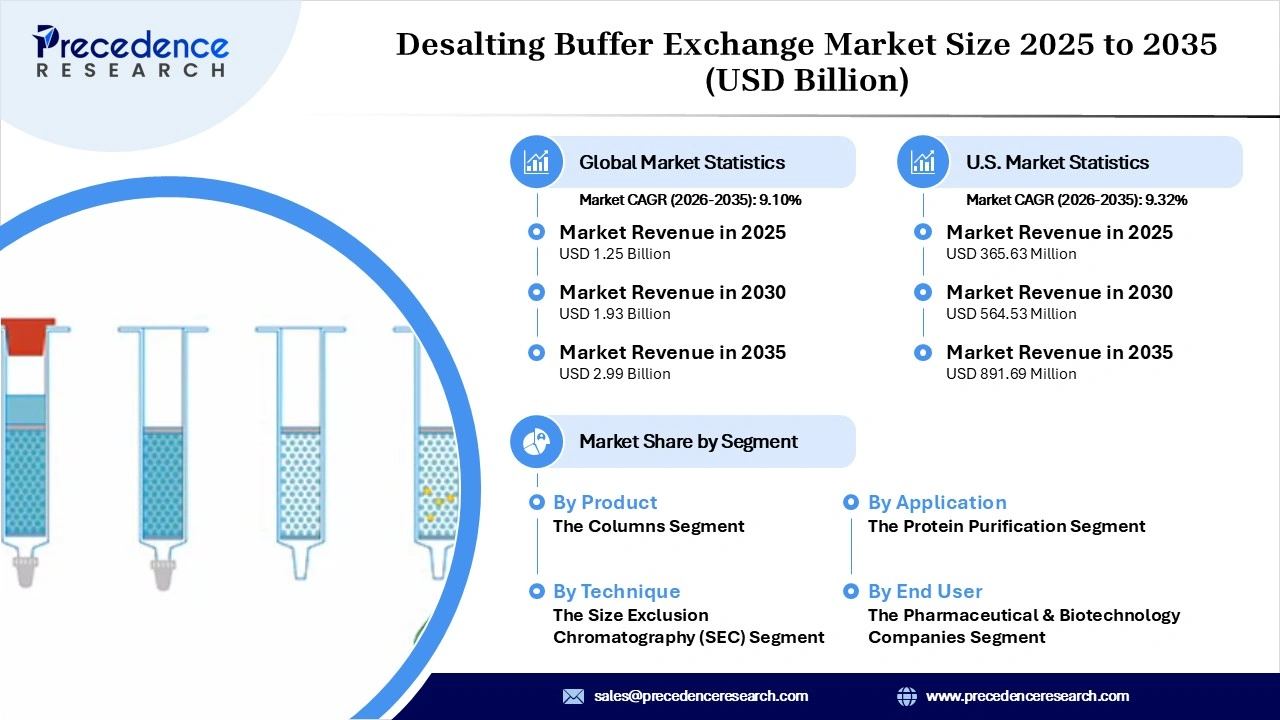
The desalting buffer exchange market revenue surpassed USD 1.25 billion in 2025 and is predicted to attain around USD 2.99 billion by 2035 with a CAGR of 9.10% during the forecast period. The desalting buffer exchange market is driven by the growing demand for efficient protein purification and stabilization in biologics manufacturing and proteomics research. Key applications include monoclonal antibody and recombinant protein production, where maintaining consistent quality and process reproducibility is critical.
Market at a Glance
The desalting buffer exchange market involves technology for desalting and buffer exchange at the same time. It includes various techniques like desalting columns, ultrafiltration, and dialysis. These techniques find applications in protein purification, sample preparation, and biopharmaceutical manufacturing. The market is driven by an increased need for high-purity bioactive molecules and downstream process development.
What are the Future Opportunities in the Market?
Future prospects in the desalting buffer exchange market are tied to its critical role in biomolecule purification, ensuring proteins perform optimally by removing salts and impurities. Additionally, it supports downstream processes like electrophoresis and chromatography, and is essential in processing proteins, DNA, and conjugates by eliminating nucleotides, reagents, and buffers.
The rising demand for high‑purity biologics, such as monoclonal antibodies, vaccines, and recombinant proteins, creates opportunities in the market. As biologics production scales up and bioprocessing workflows require efficient impurity removal, opportunities lie in high‑throughput buffer exchange systems that reduce processing time and ensure compliance with stringent purity standards. Furthermore, integration of desalting technologies with automated and continuous biomanufacturing platforms presents significant potential for cost savings and faster development timelines, especially in emerging markets with expanding biotechnology infrastructure.
Global Biologics Processing and Research Expansion Trends Supporting Desalting Buffer Exchange Demand
- According to the Biotechnology Innovation Organization, over 1,516 biologic drug candidates were in active clinical development globally in 2024-2025, with monoclonal antibodies dominating, all requiring intensive buffer exchange during purification.
- According to studies indexed in PubMed, downstream processing in monoclonal antibody manufacturing accounts for up to 80% of total production costs, emphasizing the critical role of desalting and buffer exchange in purification workflows.
- Sartorius AG reports that single-use filtration and fluid management systems are utilized in more than 70% of buffer exchange operations in modern biologics manufacturing (2024-2025), driven by contamination control and flexibility.
- According to the European Federation of Pharmaceutical Industries and Associations, global health industries invested approximately €258 billion in R&D in 2023-2024, accounting for over 20% of total global business R&D spending, highlighting strong funding for biologics and protein research.
- The International Federation of Pharmaceutical Manufacturers and Associations reports that the top 50 pharmaceutical companies collectively invested around USD 167 billion in R&D, with continued growth observed through 2024-2025, largely driven by biologics and advanced therapies.
- The U.S. Food and Drug Administration reported that 135 biosimilar development programs were active under its Biosimilar Biological Product Development (BPD) program as of 2025, indicating a robust and expanding biosimilars pipeline.
Market Segmentation Overview
By Product
The columns segment led the desalting buffer exchange market with a 48% share in 2025. The dominance of the segment is attributed to the widespread use of columns in rapid desalting and buffer exchange, ease of use, high reproducibility, compatibility with lab workflows, and rising demand in protein purification.
On the other hand, the kits & reagents segment is expected to grow at the highest CAGR from 2026 to 2035. The growth of this segment is driven by the rising preference for ready-to-use solutions, time efficiency, reduced manual errors, and growing research activities.
By Technique
The size exclusion chromatography(SEC) segment dominated the market with 46% share in 2025. This is de to its ability to provide high accuracy and resolution, ensuring precise separation of biomolecules while minimizing sample loss. Its widespread adoption in protein purification workflows, particularly in the biopharmaceutical and research sectors, has further solidified its role as a preferred technique for critical applications requiring reliability and reproducibility.
The ultrafiltration segment is expected to expand at the fastest rate during the forecast period, driven by its ability to handle larger sample volumes efficiently and its scalability for both laboratory and industrial processes. Ultrafiltration offers rapid processing times, high recovery rates, and suitability for concentration and purification of proteins, antibodies, and other biomolecules, making it increasingly attractive for bioprocessing workflows.
By Application
The protein purification segment led the market with 50% share in 2025 because it is a critical step in biologics production, antibody isolation, and proteomics research, where high purity and stability of proteins are essential. Its dominance is also driven by the widespread adoption of recombinant proteins and monoclonal antibodies in pharmaceuticals, making efficient and reliable desalting and buffer exchange processes indispensable for downstream workflows.
The drug development segment is expected to grow at the highest CAGR from 2026 to 2035. This is mainly due to the rapid expansion of biologics, biosimilars, and vaccine pipelines, which require efficient desalting and buffer exchange processes for formulation, purification, and stability testing.
By End User
The pharmaceutical & biotechnology companies segment dominated the desalting buffer exchange market in 2025. This is because of their essential role in large-scale biopharmaceutical production, where high-throughput, reproducible, and GMP-compliant processes are critical.
The contract research organizations(CROs) segment is expected to expand at the fastest rate during the forecast period. This is because companies increasingly outsource early-stage research and biologics development to leverage specialized expertise, reduce upfront costs, and accelerate project timelines.
Regional Insights
North America Dominated the Market in 2025
North America dominated the desalting buffer exchange market in 2025 with a 39% share, driven by its well-established biopharmaceutical industry, advanced research infrastructure, and substantial R&D investments. The presence of leading companies and strong adoption of high-throughput, GMP-compliant purification processes further reinforces the region’s market leadership.
Asia Pacific is Expected to Expand at the Fastest Rate
Asia Pacific is projected to grow at the fastest CAGR from 2026 to 2035, fueled by the rapid expansion of biopharmaceutical manufacturing, increasing research activities, and strong government-backed initiatives. Additionally, the region’s cost-effective production capabilities and growing investments in biotechnology infrastructure are driving widespread adoption of desalting buffer exchange technologies.
Desalting Buffer Exchange Market Coverage
| Report Attribute | Key Statistics |
| Market Revenue in 2025 | USD 1.25 Billion |
| Market Revenue by 2035 | USD 2.99 Billion |
| CAGR from 2026 to 2035 | 9.10% |
| Quantitative Units | Revenue in USD million/billion, Volume in units |
| Largest Market | North America |
| Base Year | 2025 |
| Regions Covered | North America, Europe, Asia-Pacific, Latin America, and the Middle East & Africa |
Top Companies in the Market
Major companies in the market include Thermo Fisher Scientific Inc, Merck KGaA, Bio-Rad Laboratories Inc, Cytiva, Sartorius AG, Agilent Technologies Inc, Avantor Inc, Promega Corporation, Takara Bio Inc, and QIAGEN NV. These companies are driving market growth by developing advanced desalting and buffer exchange technologies, expanding high-throughput and GMP-compliant solutions, and supporting large-scale biopharmaceutical production and research applications.
Segments Covered in the Report
By Product
- Column
- Spin Columns
- Gravity Columns
- Prepacked Columns
- Membrane Filters
- Ultrafiltration Membranes
- Dialysis Membranes
- Kits & Reagent
- Buffer Exchange Kits
- Desalting Reagents
By Technique
- Size Exclusion Chromatography
- Dialysis
- Ultrafiltration
- Precipitation Methods
By Application
- Protein Purification
- Recombinant Proteins
- Antibody Purification
- Nucleic Acid Purification
- DNA/RNA Cleanup
- Drug Development
- Biologics Development
- Vaccine Development
- Others
- Diagnostic
- Proteomics Research
By End User
- Pharmaceutical & Biotechnology Companies
- Biopharma Manufacturers
- Vaccine Producers
- Academic & Research Institutes
- Universities
- Research Labs
- Contract Research Organizations
By Region
- North America
- South America
- Europe
- Asia Pacific
- MEA
Get this report to explore global market size, share, CAGR, and trends, featuring detailed segmental analysis and an insightful competitive landscape overview @ https://www.precedenceresearch.com/sample/8276
You can place an order or ask any questions, please feel free to contact us at sales@precedenceresearch.com |+1 804 441 9344