



Hematopoietic Stem Cell Transplantation Market Revenue to Attain USD 24.32 Bn by 2035
Published: 20 May 2026
Author: Precedence Research



Hematopoietic Stem Cell Transplantation Market Revenue and Trends 2026 to 2035
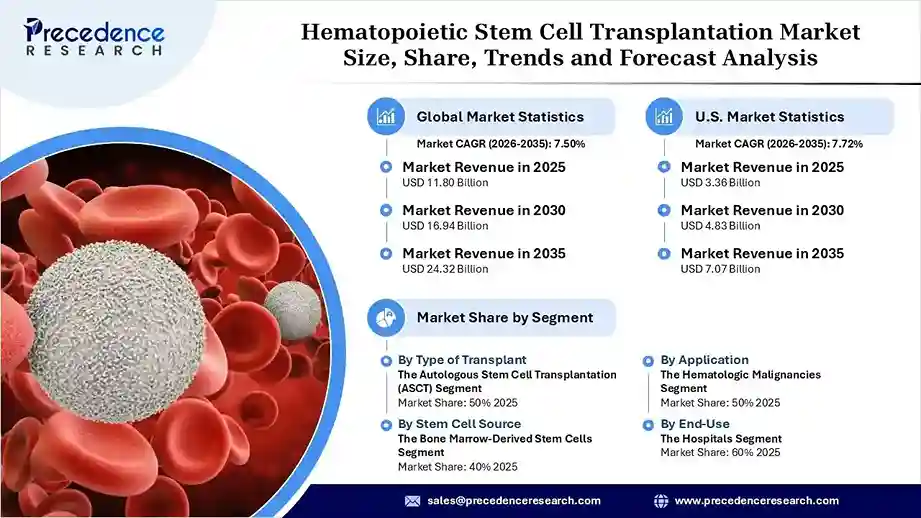
The global hematopoietic stem cell transplantation market revenue surpassed USD 11.80 billion in 2025 and is predicted to attain around USD 24.32 billion by 2035, growing at a CAGR of 7.50%. The market is gaining strong momentum as rising cases of leukemia, lymphoma, and genetic blood disorders meet advancing transplant success rates, broader donor availability, and growing demand for curative therapies over long-term disease management.
Market at a Glance
The hematopoietic stem cell transplantation market is a worldwide strategy to transplant affected or diseased marrow into healthy (bone marrow) cells, which will then replace lost/wasted bone marrow with healthy stem cells that can rebuild normal blood and immune functions. It includes autologous (self-donated) and allogeneic (donor-based) transplants, matching donor services, umbilical cord blood banking technologies, conditioning programs before a transplant is performed, processing techniques for these cells, specialized hospital facilities that provide transplants, and post-transplant care.
The most significant sources of demand are uses in the treatment of leukemia, lymphoma, myeloma, inherited blood anomalies, and blood cancers. The sector includes transplant operations themselves; networks that support donor registries; systems designed for the collection of stem cells; laboratory processes for the preparation; drugs used during the conditioning phase; supportive measures in their care in connection to procedures; and services for long-term health monitoring.
Market Forecast for the Hematopoietic Stem Cell Transplantation Market
- Demand for Earlier Referrals: NMDP noted that 8,879 lives were impacted in 2025, the highest in its history. Improved survival rates, safer conditioning regimens, and stronger post-transplant care are prompting physicians to refer eligible patients earlier rather than as a last resort.
- Rare Genetic Disease Treatment: The World Health Organization states that over 1.5 million patients have undergone hematopoietic stem cell transplant globally, with increasing use beyond cancer into sickle cell anemia and thalassemia. This shift widens the addressable market from oncology to lifelong inherited disorders.
Growing Global Patient Base in Stem Cell Transplantation
- By the end of April 2026, the EBMT Registry had registered 815,912 patients, illustrating the ongoing growth of the global population receiving treatment through hematopoietic stem cell transplantation.
- From this volume, 932,914 transplants were added to the registry, indicating that both repeated procedures and the increased adoption of treatments are generating new growth in the market.
- For instance, the registry recorded 18,559 CAR-T therapies, implying that the transplant centers have evolved increasingly into multi-therapy systems for advanced cellular medicine.
- 8,531 immunosuppressive treatments were observed, indicating concurrent treatment needs to treat post-transplant care and marrow failure.
- Finally, there were 83 gene therapies registered, a small but important number, reflecting a space of potential for curative treatments for blood disorders.
- EBMT now spans 7,700+ members across 84 countries, underlining the widening international infrastructure supporting HSCT procedures and research.
Market Segmentation Overview
- By type of transplant, the autologous stem cell transplantation (ASCT) segment accounted for a considerable revenue share of 50% in the hematopoietic stem cell transplantation market in 2025, because it is widely adopted in hematologic malignancies such as lymphoma. Rising use of ASCT in selected non-malignant blood disorders, along with growing numbers of cancer survivors, supported strong procedural demand.
- By type of transplant, the allogeneic stem cell transplantation (AlloSCT) segment is expected to grow at the fastest CAGR of 7.8% in the market between 2026 and 2035, due to rising demand in hematologic cancers requiring allogeneic stem cell therapy and an increasing number of unrelated donor stem cell transplants. Expansion of stem cell registries, stronger donor networks, and increasing incidence of leukemia and myeloma are likely to accelerate segment growth.
- By stem cell source, the bone marrow-derived stem cells segment held a major revenue share of 40% in the market in 2025, as they remained the long-standing clinical benchmark for several hematologic malignancies. They have proven successful in autologous and allogeneic transplants and are common to hospitals with great engraftment success over time.
- By stem cell source, the umbilical cord blood stem cells segment is steadily growing with a CAGR of 7.8% in the market between 2026 and 2035, because of the emerging use of umbilical cord blood as an alternative source of blood for transplantation, which has contributed to this trend. There were some contributing factors for this uptake, such as the growth of cord blood banks and donor registries, improvement in transplant success rates, and potentially a large contribution in managing genetic disorders in addition to hematological malignancies.
- By application, the hematologic malignancies segment accounted for a considerable revenue share of 50% in the hematopoietic stem cell transplantation market in 2025, due to high demand for stem cell transplants in leukemia, lymphoma, and myeloma. Better survival outcomes for blood cancer patients due to stem cell therapies, and increased focus on post-transplant therapy and relapse prevention after therapy, helped maintain this segment’s leading revenue contribution.
- By application, the autoimmune diseases segment is expected to expand rapidly in the market with a CAGR of 8% in the coming years, due to expanding research in lupus, rheumatoid arthritis, and related conditions. Rising acceptance of stem cell therapy as a last-resort treatment and the broader promise of regenerative medicine using stem cells are expected to fuel momentum.
- By end-use, the hospitals segment accounted for a considerable revenue share of 60% in the market in 2025, because of strong demand for specialized care in transplant centers capable of managing complex procedures. Increasing numbers of hospitals offering stem cell transplantation, along with high volumes of procedures and comprehensive healthcare coverage, reinforced their market leadership.
- By end-use, the research institutes segment is expected to grow at the fastest CAGR of 8.5% in the market between 2026 and 2035, due to expanding research activities in stem cell biology and regenerative medicine. Greater collaboration with pharmaceutical companies, industries, and academic research; rising clinical trial activity, and increasing government support for translational research are likely to strengthen this segment.
Regional Analysis
North America dominated the global hematopoietic stem cell transplantation market with a market share of 38% in 2025, as it possessed a mature healthcare infrastructure, an advanced transplant center, and rapid uptake of next-generation stem cell processing technologies. Hematologic cancers and genetic disorders are on the rise. In this area, the United States has had the upper hand with the high volume of transplants and innovative capacity, while Canada has been contributing to growth in publicly funded specialized care networks and increasingly high donor registries.
Asia-Pacific holds a market share of 20% in 2025 and is expected to grow at the fastest CAGR of 9.2% in the market during the forecast period, due to the rapid expansion of health infrastructure in China, India, and Japan. We see an increase in both hematologic malignancies and genetic conditions, as well as new transplant centers that are springboard treatment options being added to a range of different locations, thanks to the influx of transplants and new research institutions. And on top of this, governments are spending more on medical innovation. China’s growth is largely anticipated to result from greater spending on hospitals. India should also see some success from cheaper and more affordable treatments and the growth of tertiary oncology centers.
Hematopoietic Stem Cell Transplantation Market Coverage
| Report Attribute | Key Statistics |
| Market Revenue in 2025 | USD 11.80 Billion |
| Market Revenue by 2035 | USD 24.32 Billion |
| CAGR from 2026 to 2035 | 7.50% |
| Quantitative Units | Revenue in USD million/billion, Volume in units |
| Largest Market | North America |
| Base Year | 2025 |
| Regions Covered | North America, Europe, Asia-Pacific, Latin America, and the Middle East & Africa |
Top Companies in the Hematopoietic Stem Cell Transplantation Market
Novartis and its subsidiary Sandoz have long been influential in oncology treatments, therapies for graft-versus-host disease, and advanced cell therapy systems. Gilead Sciences solidified this environment with its cellular oncology offerings, and Celgene (a subsidiary of Bristol Myers Squibb) expanded its reach to hematology and associated transplant therapies. Biologics, plasma sciences, and medical products used in transplantation settings made significant contributions by Takeda Pharmaceutical Company, Amgen, and Baxter International. As far as technology is concerned, Thermo Fisher Scientific, Bio-Rad Laboratories, and Miltenyi Biotec all play crucial roles by providing essential tools such as cell separation systems, flow cytometry instruments, cryopreservation solutions, and research-grade reagents that are vital for transplant processes.
Segments Covered in the Report
By Type of Transplant
- Autologous Stem Cell Transplantation (ASCT)
- Allogeneic Stem Cell Transplantation (AlloSCT)
- Syngeneic Stem Cell Transplantation
By Stem Cell Source
- Bone Marrow-derived Stem Cells
- Peripheral Blood Stem Cells
- Umbilical Cord Blood Stem Cells
By Conditioning Regimen
- Myeloablative Conditioning
- Non-myeloablative Conditioning
- Reduced Intensity Conditioning
By Application
- Hematologic Malignancies
- Non-malignant Hematological Disorders
- Autoimmune Diseases
- Genetic Disorders
By End-Use
- Hospitals
- Specialized Hematopoietic Transplant Centers
- Research Institutes
- Homecare
By Region
- North America
- Latin America
- Europe
- Asia-pacific
- Middle and East Africa
Get this report to explore global market size, share, CAGR, and trends, featuring detailed segmental analysis and an insightful competitive landscape overview @ https://www.precedenceresearch.com/sample/8421
You can place an order or ask any questions. Please feel free to contact us at sales@precedenceresearch.com |+1 804 441 9344