



Neuroinflammation Market Revenue to Attain USD 23.81 Bn by 2035
Published: 29 May 2026
Author: Precedence Research



Neuroinflammation Market Revenue and Trends 2026 to 2035
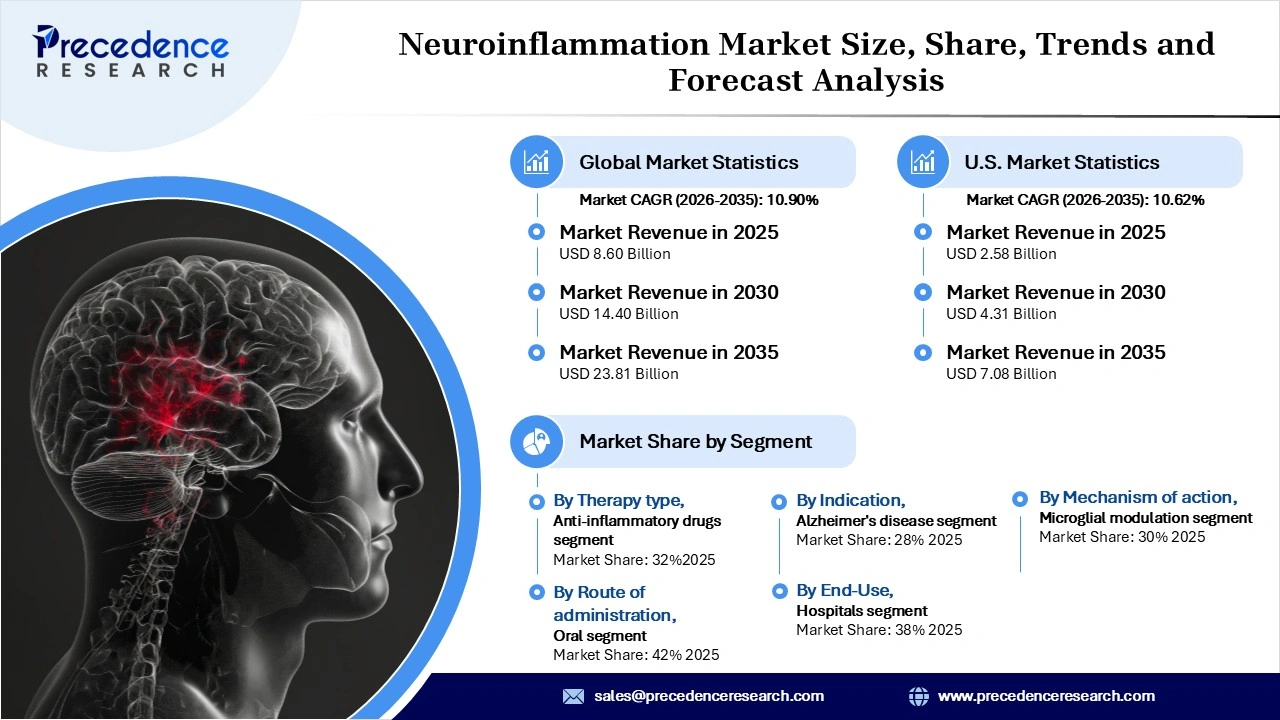
The global neuroinflammation market revenue was valued at USD 8.60 billion in 2025 and is expected to attain around USD 23.81 billion by 2035, growing at a CAGR of 10.90% during forecast period. With the rising number of Alzheimer’s, Parkinson’s, multiple sclerosis, and other neurological conditions, the neuroinflammation sector is booming. This surge in prevalence is fueling the surge in treatments and diagnostics targeting inflammation, which has been identified as one of the leading factors responsible for damaging the brain.
Market at a Glance
The neuroinflammation market encompasses therapies, diagnostic tools, biomarkers, and research technologies designed to detect, study, and manage inflammatory processes within the brain and spinal cord. It deals with disorders like Alzheimer’s disease, Parkinson’s disease, multiple sclerosis, traumatic brain injuries, as well as some psychiatric conditions in which immune responses disrupt nerve health. From pharmaceutical developments, laboratory investigations, imaging technologies, and clinical care models to the slow advancement of disease and improving neurological outcomes, the market is now a mainstream presence in the industry itself.
Diversified within the neuroinflammation space of drug discovery, biomarkers, brain imaging approaches, targeted therapies for immune modulation, and the rest of the central nervous system, the field is broad. It encompasses neurodegenerative diseases, autoimmune pathologies, trauma-inflicted conditions, and psychiatric disorders; it promises growth opportunities via early diagnostic progress, personalized medicine trends, and novel therapeutics for the CNS.
Market Forecast for the Neuroinflammation Market
- Need for Device-Based Neuroimmune Modulation : Drug therapy is no longer the only route. In April 2026, SetPoint Medical initiated patient enrollment for a pilot study using an FDA-cleared investigational neuroimmune modulation device for relapsing-remitting MS. The device aims to promote remyelination through immune signaling pathways.
- Growing Aging Populations: The Alzheimer’s association estimates millions of people continue to live with dementia worldwide, reinforcing long-term demand for therapies that can control inflammatory damage tied to neurodegeneration.
Roche Clinical Progress Highlights Growth Potential in the Neuroinflammation Market
- In February 2026, Roche revealed that fenebrutinib is the first experimental treatment in over ten years to slow down disability progression in primary progressive multiple sclerosis (PPMS), signifying a resurgence in commercial interest for developing neuroinflammatory treatments.
- The drug showed a 12% reduction in risk of disability progression versus Ocrevus, indicating that next-generation neuroimmune therapies are beginning to outperform existing standards of care in chronic CNS inflammation disorders.
- Additional trial data showed a 26% lower risk of worsening upper-limb function, reinforcing the demand for therapies that preserve patient independence and long-term neurological function.
- The Phase III FENtrepid study enrolled 985 adult patients, reflecting the scale of investment now flowing into neuroinflammatory disease trials and late-stage CNS drug programs.
- Roche stated regulatory filings were planned after additional readouts in 2026, suggesting near-term commercialization opportunities that could widen the neuroinflammation market across relapsing and progressive multiple sclerosis segments.
Market Segmentation Overview
- By therapy type, the anti-inflammatory drugs segment accounted for a considerable revenue share of 32.0% in the neuroinflammation market in 2025, as conventional therapies remained widely prescribed across CNS disorders. Their established cost-effective positioning supported stronger demand. The growing use of cytokine-targeting medicines further strengthened this segment’s leadership in hospitals and specialty neurology care.
- By therapy type, the cell and gene therapies segment is expected to grow at the fastest CAGR of 20.8% in the market between 2026 and 2035, due to rapid advancements in regenerative neurology therapies. Expanding interest in gene editing, stem cell approaches, and targeted repair mechanisms is drawing fresh capital. Precision medicine strategies are also likely to accelerate adoption over the coming years.
- By indication, the Alzheimer’s disease segment held a major revenue share of 28.0% in the market in 2025, as strong evidence connected neuroinflammation with Alzheimer’s progression. Rising urgency for disease-modifying therapies and rising investments in neurodegenerative drug development, and strong patient prevalence also kept Alzheimer’s at the center of commercial and clinical attention.
- By indication, the autism spectrum disorders segment is steadily growing with a CAGR of 15.0% in the market between 2026 and 2035, as research increasingly explores links between immune dysfunction and autism. Interest in neuroimmune modulation therapies is widening, while pediatric neuroscience initiatives and early-intervention programs are likely to create new commercial pathways.
- By mechanism of action, the microglial modulation segment dominated the neuroinflammation market with a 30.0% market share in 2025 and is expected to maintain its leading position with a CAGR of 14.5% in the coming years, due to the rising development of targeted neuroimmune therapies. A strong scientific focus on regulating CNS immune-cell activity encouraged investment in targeted therapies. Growing evidence connecting microglia with neurodegeneration helped this mechanism secure a leading strategic position.
- By route of administration, the oral segment accounted for a considerable revenue share of 42.0% in the market in 2025, as patients and physicians favored convenient administration methods. Rising use of chronic maintenance therapies, better compliance, and easier dosing schedules supported widespread use. Rising development of oral neuroprotective medicines also helped this segment maintain a commercially attractive lead.
- By route of administration, the intrathecal segment is expected to expand rapidly in the market with a CAGR of 16.2% in the coming years, as advanced CNS-targeted therapies require direct access to the spinal fluid and brain environment. Increasing development of gene, RNA-based neurological treatment, and precision neurological treatments is likely to drive stronger demand for this specialized route.
- By end-use, the hospitals segment accounted for a considerable revenue share of 38.0% in the market in 2025, as they handled high patient inflow for neurological disorders. Expanding use of biologics and infusion therapies, alongside broader availability of specialized neurology departments, reinforced their primary revenue contribution.
- By end-use, the pharmaceutical and biotechnology segment is expected to grow at the fastest CAGR of 16.8% in the market between 2026 and 2035, as investments in CNS pipelines continue to rise. Expanding clinical trials for neuroinflammation therapies, combined with licensing deals, partnerships, and platform acquisitions, are likely to intensify innovation-led market expansion.
Regional Analysis
North America dominated the global neuroinflammation market with a market share of 40.0% in 2025, as the region benefited from sustained investments in neurodegenerative disease therapeutics, especially for Alzheimer’s disease, multiple sclerosis, and Parkinson’s disease pipelines. The increasing prevalence of CNS inflammatory disorders kept treatment demand elevated. Strong adoption of biologics, monoclonal antibodies, and advanced neurological therapies further supported revenue concentration. For this territory, the lead was given by the US, a participant in robust clinical trials and with a significant pharmaceutical industry footprint, as part of the greater regional effort, Canada had provided a contribution by strengthening their neuroscience research networks as well as publicly funded specialized care systems for neurology patients.
Asia-Pacific held a market share of 20.0% in 2025 and is expected to grow at the fastest CAGR of 14.8% in the market during the forecast period, as China, Japan, and South Korea face rapidly aging populations vulnerable to dementia and chronic neurological inflammation. Increasing healthcare expenditures have helped expand access to diagnostics and biologics as well as other specialty neurology services across this sector. Emerging biotechnology ecosystems, together with university-based research on neuroinflammation, are also emerging and providing additional, more lucrative avenues. China is anticipated to develop very well as domestic biotech-driven funding supports projects for growth, and strong patient demographics provide substantial potential for innovation in domestic biotech.
Neuroinflammation Market Coverage
| Report Attribute | Key Statistics |
| Market Revenue in 2025 | USD 8.60 Billion |
| Market Revenue by 2035 | USD 23.81 Billion |
| CAGR from 2026 to 2035 | 10.90% |
| Quantitative Units | Revenue in USD million/billion, Volume in units |
| Largest Market | North America |
| Base Year | 2025 |
| Regions Covered | North America, Europe, Asia-Pacific, Latin America, and the Middle East & Africa |
Top Companies in the Neuroinflammation Market
This growth of key players, including Pfizer Inc. and Eli Lilly and Company, is now particularly relevant due to their long-standing research focus in inflammation research and neurodegenerative drug development, especially in areas including the immune processes with a broad overlap with dementia mechanisms, such as immune pathways. They have both an important position within inflammation and neurodegeneration drug development, where immune pathways interact with dementia.
AbbVie Inc. and Sanofi S.A. similarly emerge as major players; Sanofi is especially proactive in advancing BTK inhibitors for neuroimmune diseases. Johnson & Johnson maintains its market position through large neuroscience research capabilities, supplemented by sweeping global commercialization efforts. At the same time, both Merck & Co., Inc. and Bristol Myers Squibb have advanced immunology knowledge for potential new CNS inflammation therapeutics, and UCB Pharma is emerging from its commercial roots in neurology.
Segments Covered in the Report
By Therapy Type
- Anti-inflammatory Drugs
- NSAIDs
- Corticosteroids
- Cytokine Inhibitors
- Monoclonal Antibodies
- Small Molecule Therapies
- Cell & Gene Therapies
- Immunomodulators
By Indication
- Alzheimer's Disease
- Parkinson's Disease
- Multiple Sclerosis
- Amyotrophic Lateral Sclerosis (ALS)
- Traumatic Brain Injury (TBI)
- Stroke
- Autism Spectrum Disorders
- Other Neurodegenerative Disorders
By Mechanism of Action
- Microglial Modulation
- Cytokine Suppression
- Oxidative Stress Reduction
- Blood-Brain Barrier Protection
- Neuroprotection Enhancement
By Route of Administration
- Oral
- Intravenous (IV)
- Subcutaneous
- Intrathecal
By End-use
- Hospitals
- Specialty Neurology Clinics
- Academic & Research Institutes
- Pharmaceutical & Biotechnology Companies
By Region
- North America
- Latin America
- Europe
- Asia-pacific
- Middle and East Africa
Get this report to explore global market size, share, CAGR, and trends, featuring detailed segmental analysis and an insightful competitive landscape overview @ https://www.precedenceresearch.com/sample/8435
You can place an order or ask any questions. Please feel free to contact us at sales@precedenceresearch.com |+1 804 441 9344