



Neuropharmacology Market Revenue to Attain USD 311.78 Bn by 2035
Published: 18 Jun 2026
Author: Precedence Research



Neuropharmacology Market Revenue and Trends 2026 to 2035
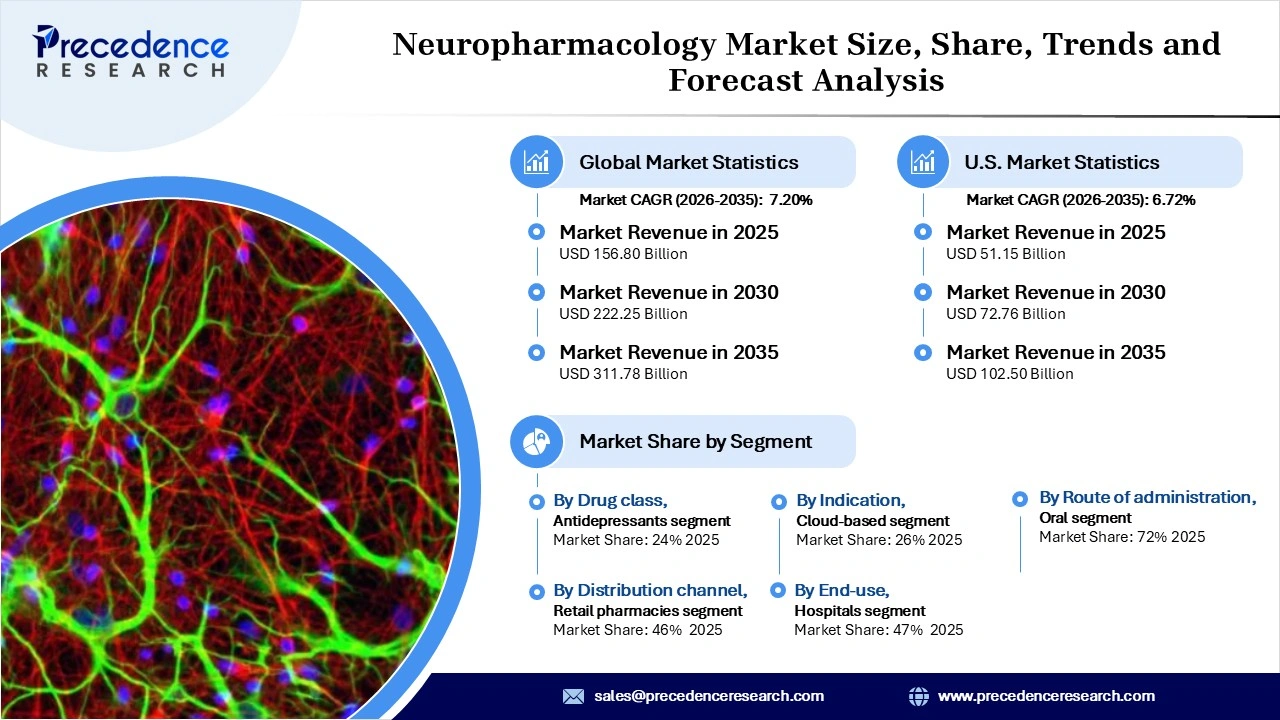
The global neuropharmacology market revenue surpassed USD 156.80 billion in 2025 and is predicted to attain around USD 311.78 billion by 2035, growing at a CAGR of 7.20%. The market is driven by the increasing worldwide occurrence of neurological and psychiatric conditions, as well as new developments in drugs targeted at specific diseases, such as drugs targeted at the central nervous system.
Targeting the Nervous System: Medications for Brain and Nerve Diseases
The neuropharmacology market entails the development and commercialization of drugs used to modulate the physiological function of the brain and nervous system in order to treat neurological and psychiatric conditions. These drugs can be classified under small-molecule compounds, biopharmaceuticals, gene therapy drugs, and RNA-based treatments. These medications are designed to target diseases like Alzheimer’s, Parkinson’s, epilepsy, multiple sclerosis, depression, schizophrenia, anxiety, chronic pain, and substance abuse disorders.
The market encompasses the entire life cycle of the drugs being offered, ranging from target identification to clinical testing, regulatory approval, and postmarketing surveillance. The technologies utilized in the market involve blood-brain barrier (BBB)-penetrating drugs, neuromodulators used to introduce medications to nerve tissues, and neuroimaging techniques used to identify biomarkers among patients. This market has been adopted by pharmaceutical firms, academic research institutes, contract research organizations, and hospital pharmacies.
Novel Oral Medications to Manage Agitation in Alzheimers Disease
The market is moving from the use of traditional antipsychotics to the use of agents targeting glutamate and sigma-1 receptors for the management of neuropsychiatric disturbances, including agitation in dementia. This therapeutic strategy seeks to relieve agitation symptoms without the severe side effects observed with conventional antipsychotic agents. Auvelity (dextromethorphan-bupropion) received FDA approval in 2026 for the treatment of agitation associated with Alzheimer’s disease dementia. Auvelity achieved a 72.5% reduction in relapse hazard.
Novel Neuropsychiatric Medications Reach Late-Stage Clinical Trials
The neuropharmacology market witnesses a growing focus on innovative neuropharmacology mechanisms targeting beyond the conventional dopamine and serotonin receptors in light of the rising prevalence of resistant psychiatric disorders. Approval from regulatory authorities on Phase 3 programs and recruitment of a large number of patients into worldwide clinical trials show high levels of confidence in upcoming drugs. In 2025, Newron Pharmaceuticals successfully got approval from regulatory bodies regarding their pivotal Phase 3 ENIGMA-TRS program aimed at treating resistant schizophrenia using evenamide as an add-on medication.
Governments Toughen Prescription Requirements for High-Profile Neurological Drugs
Regulatory bodies around the globe have decided to classify several neuro-active drugs currently being prescribed frequently into more stringent prescription categories. The rationale behind such restrictions is to control increasing drug abuse, illegal drug trafficking, and the strict regulation of neurological medications. In 2026, the Union Health Ministry in India issued a notification regarding Pregabalin, an active neurological drug that is used to treat conditions such as epilepsy, nerve pain, and generalized anxiety disorder. This regulation is intended to make sure that Pregabalin is sold with a prescription written by a qualified doctor, and pharmacies need to keep records of prescriptions and sales separately.
Aspen Neuroscience Secures USD 115 Million Series C for Parkinson’s iPSC Treatment
In 2025, Aspen Neuroscience announced that it had raised USD 115 million in Series C funding for the development of its autologous treatment for moderate to advanced Parkinson’s disease using induced pluripotent stem cells (iPSCs). This round of funding comes on the heels of the company raising more than USD 340 million thus far, including a USD 8 million award from the California Institute for Regenerative Medicine.
Market Segmentation Overview
- By drug class, the antidepressants segment led the neuropharmacology market with 24% share in 2025, because it is targeted to alleviate depression, which affects more than 280 million individuals across the globe, forming the largest pool of patients amongst all psychiatric disorders and fueling consistent demand for generics and new formulations. Major depressive disorders last for a significant amount of time and needs continuous treatment.
- By drug class, the Alzheimer’s disease drugs segment is expected to expand at the highest CAGR of 10.5% during the forecast period, since the prevalence of Alzheimer’s disease is increasing due to rapid aging of the global population and the regulatory approval of disease-modifying therapies. These novel drugs help to slow down the mental deterioration of patients with the help of new-age techniques like amyloid antibodies.
- By indication, the depression segment dominated the market with 26% share in 2025, because it is the most common mental disorder globally, thus creating a continuous demand for its treatment. There are various drugs belonging to different classes of medications for its treatment, such as SSRIs, SNRIs, atypical antidepressants, and rapid onset agents.
- By indication, the Alzheimer’s disease segment is expected to grow at the fastest CAGR of 10.4% from 2026 to 2035, since disease-modifying drugs are being increasingly used to retard the progression of dementia. The increase in the geriatric population is increasing the need for effective medications.
- By route of administration, the oral segment led the market with 72% share in 2025, because it provides convenience, allowing self-administration without having to go to clinics, hence increasing patient compliance and reducing healthcare expenditures. Oral administration is widely preferred by both patients and physicians in the case of neurological and psychiatric disorders when therapy requires long-term administration.
- By route of administration, the injectable segment is expected to expand at the fastest CAGR of 9% during the forecast period, due to the development of novel disease-modifying treatments like lecanemab and donanemab, which require intravenous or subcutaneous injection.
- By distribution channel, the hospital pharmacies segment dominated the neuropharmacology market with 42% share in 2025, since novel drugs used to treat neurological diseases need special storage, professional handling, and monitoring. Hospitals prescribe most drugs used during sudden neurological conditions like stroke and status epilepticus.
- By distribution channel, the online pharmacies segment is expected to grow at the fastest CAGR of 11.2% from 2026 to 2035, because of their convenience, confidentiality, and low cost compared to hospital and retail pharmacies for patients dealing with chronic disorders of the brain and nervous system.
- By end-user, the hospitals segment led the market with 47% share in 2025, due to the fact that hospitals represent the main venues where the administration of complicated therapies in neurological diseases, such as intravenous drip therapy, intrathecal injection therapy, and controlled drugs. Hospitals have the medical and multi-disciplinary capabilities to treat acute neurological events like stroke and seizures.
- By end-user, the specialty neurology clinics segment is expected to expand at the highest CAGR of 8.4% during the forecast period, since they provide specialized treatment over extended periods of time for diseases like Alzheimer’s, Parkinson’s, and multiple sclerosis. With an increasing number of disease-modifying treatments in the form of pills and injections, patients can be treated in specialty neurology clinics rather than hospitals.
Regional Analysis
North America led the neuropharmacology market with 41% share in 2025, due to high investment in pharmaceutical research and development, a well-established approval process (FDA), and significant prevalence of neurological and psychiatric conditions such as Alzheimer’s and depression. The U.S. dominated the market in North America because of its robust biotechnology sector, significant investments from the National Institutes of Health (NIH) in brain research, and the swift introduction of innovative drugs such as anti-amyloid antibodies for Alzheimer’s disease. Canada witnessed notable market growth owing to its free public healthcare system, which facilitates widespread drug access for patients, along with the presence of strong academic networks in neuroscience.
Asia-Pacific is expected to expand at the highest CAGR of 9.1% during the forecast period, because it has the world’s biggest and fastest aging population, which increases the incidence of age-associated neuropsychiatric conditions like Alzheimer’s disease, Parkinson’s disease, and stroke, thus creating a significant need for neurological drugs. China led the market in Asia-Pacific due to its large patient base, heavy governmental spending on neuroscience research and drug development, and efficient regulatory approval pipeline for new central nervous system (CNS) drugs. India is a significant contributor to the market owing to a significant number of patients suffering from epilepsy, depression, and chronic pain, the burgeoning generics and specialty medicines pharmaceutical industry, and increased healthcare spending.
Europe held the second-largest market share of 27% in 2025, since it has a mature pharmaceutical industry, good public healthcare facilities, and a high prevalence of neurological diseases, due to which CNS drug development projects receive significant encouragement from regulatory bodies such as the EMA. Germany dominated the market in Europe due to its sophisticated research and development facilities and extensive use of advanced neuropharmacology in the treatment of dementia and multiple sclerosis. France and the UK witnessed notable market growth because of the presence of robust neuroscience research networks, significant governmental investments in brain science, and the use of new disease-modifying agents.
Neuropharmacology Market Coverage
| Report Attribute | Key Statistics |
| Market Revenue in 2025 | USD 156.80 Billion |
| Market Revenue by 2035 | USD 311.78 Billion |
| CAGR from 2026 to 2035 | 7.20% |
| Quantitative Units | Revenue in USD million/billion, Volume in units |
| Largest Market | North America |
| Base Year | 2025 |
| Regions Covered | North America, Europe, Asia-Pacific, Latin America, and the Middle East & Africa |
Top Companies in the Neuropharmacology Market
Pfizer, Eli Lilly and Company, Johnson and Johnson, and AbbVie are some of the key players that manufacture drugs for depression, migraine, Alzheimer’s disease, and Parkinson’s disease. Novartis, Roche, Merck and Co., and Bristol Myers Squibb provide drugs for multiple sclerosis, Alzheimer’s disease, and neuroimmunological conditions. Novartis provides Kesimpta for the treatment of relapsing multiple sclerosis, and Roche offers Ocrevus for relapsing multiple sclerosis as well as primary progressive multiple sclerosis. Otsuka Pharmaceutical, Lundbeck, and Teva Pharmaceutical Industries manufacture drugs for various neurological disorders. Otsuka focuses on bipolar disorder and schizophrenia, and Lundbeck focuses on depression and Alzheimer’s disease. Teva Pharmaceutical Industries manufactures drugs for migraine and Huntington’s disease.
The market is moving towards the development of disease-modifying drugs for Alzheimer’s disease, Parkinson’s disease, and other neurological disorders, rather than just symptom management using antidepressants and antipsychotics. Biogen, Roche, Eisai, and Eli Lilly are at the forefront in developing anti-amyloid antibodies.
Segments Covered in This Report
By Drug Class
- Antidepressants
- Antipsychotics
- Antiepileptics
- Anti-Parkinson Drugs
- Alzheimer's Disease Drugs
- CNS Stimulants
- Others
By Indication
- Depression
- Schizophrenia
- Epilepsy
- Parkinson's Disease
- Alzheimer's Disease
- Attention Deficit Hyperactivity Disorder (ADHD)
- Others
By Route of Administration
- Oral
- Injectable
- Transdermal
- Others
By Distribution Channel
- Hospital Pharmacies
- Retail Pharmacies
- Online Pharmacies
By End User
- Hospitals
- Specialty Neurology Clinics
- Ambulatory Care Centers
- Homecare Settings
By Region
- North America
- Latin America
- Europe
- Asia-pacific
- Middle and East Africa
Get this report to explore global market size, share, CAGR, and trends, featuring detailed segmental analysis and an insightful competitive landscape overview @ https://www.precedenceresearch.com/sample/8493
You can place an order or ask any questions. Please feel free to contact us at sales@precedenceresearch.com |+1 804 441 9344