



Parkinsons Disease Biomarkers Market Revenue to Attain USD 4.88 Bn by 2035
Published: 22 May 2026
Author: Precedence Research



Parkinsons Disease Biomarkers Market Revenue and Trends 2026 to 2035
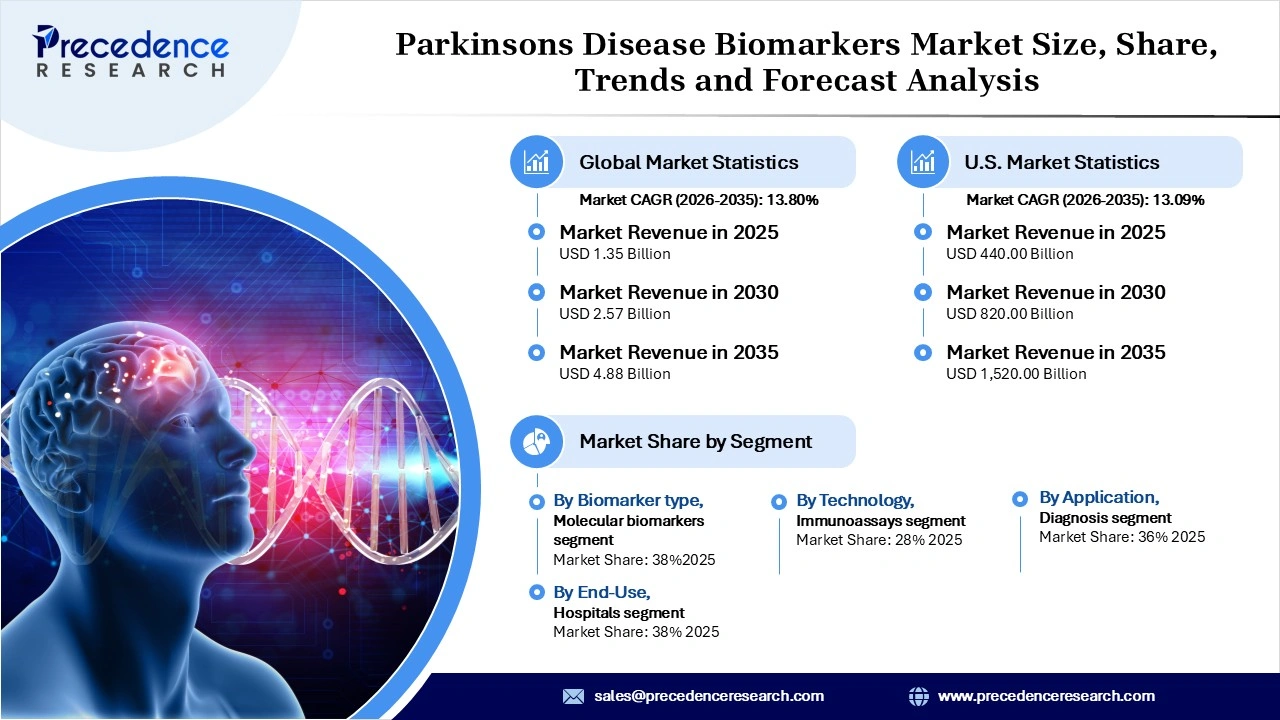
The global Parkinsons disease biomarkers market revenue reached USD 1.35 billion in 2025 and is predicted to attain around USD 4.88 billion by 2035 with a CAGR of 13.80%. The market is driven by the increasing demand for an early diagnosis to identify Parkinson’s disease before the neurons start to get affected, and the increase in the number of clinical trials that require the use of biomarkers.
Tracing Biological Signs for Neurological Conditions
The Parkinson’s disease biomarkers market comprises biological markers that can be used to diagnose Parkinson’s disease, track its development, and differentiate it from other neurological disorders. This market includes biomarkers from cerebrospinal fluid, such as alpha-synuclein and neurofilament light chain, genetic biomarkers from blood samples, including LRRK2 and GBA mutations, and imaging markers, including DaT-SPECT scans.
This market has been adopted in diagnostic labs, neurology departments at hospitals, and pharmaceutical companies involved in the trials for disease-modifying drugs that require early-stage patients whose pathology is established. Regulatory oversight comprises the FDA Biomarker Qualification Program, CLIA certification, and CE-IVD designation. Many new biomarkers are being investigated due to gaps in diagnostics in early disease detection.
Smartwatch Algorithms for Monitoring Parkinson’s Disease
The latest trend in the market is towards the usage of wearable technology, such as smartwatches, that collect sensor data and monitor motor symptoms in real-time on an ongoing basis. Such smartwatches use deep learning algorithms that allow for the assessment of rest tremor and heart rate variability, giving quantifiable, objective progression markers that don’t rely on patient trips to a clinic. In 2026, the scientists in the Personalized Parkinson Project have created algorithms (ParaDigMa) that detect digital biomarkers in raw data collected by a smartwatch, based on two years of constant recording for 620 individuals with Parkinson’s disease.
Integration of Biomarkers in Clinical Development Programs
Pharmaceutical companies are increasingly leveraging biomarkers in blood as part of therapeutic development programs through patient stratification, pharmacodynamics, and even as surrogate endpoints in clinical trials. Pharmaceutical firms are employing phosphorylated Rab10 as a pharmacodynamic marker in trials related to their LRRK2 inhibitors for Parkinson’s disease. In 2025, Lunai Bioworks identified three distinct subgroups of Parkinson’s disease based on its integration of proteomic information obtained from over 650 patients through more than 4,500 proteomic markers over several years.
Government Initiatives to Boost Parkinson’s Disease Biomarker Research
Governments and non-profit organizations across the world have initiated substantial funding programs and collaborative efforts among public and private sectors to hasten the identification and verification of Parkinson’s disease biomarkers. Such biomarkers are vital for early diagnosis and disease-modification treatments. In 2025, the National Research Council of Canada, through its Industrial Research Assistance Program, provided a contribution agreement amounting to USD 21,500 to PragmaClin Research Inc., located in St. John’s, Newfoundland and Labrador. This fund helped the empirical data gathering process in the automation of Parkinson’s disease assessment using the PRIMS (PragmaClin Intelligent Motor System).
Annovis Bio Uses NeuroRPM’s AI-Based Wearable Biomarkers
In 2026, Annovis Bio collaborated with NeuroRPM to employ its FDA-approved AI-based wearable platform that uses an Apple Watch to passively capture movement data in its ongoing 36-month Parkinson’s trial involving around 500 patients. This platform enables continuous assessment of bradykinesia, tremors, and dyskinesia as digital biomarkers in the real world, in addition to its skin biopsy test for alpha-synuclein with more than 90% sensitivity and specificity.
Market Segmentation Overview
- By biomarker type, the molecular biomarkers segment led the Parkinson’s disease biomarkers market with 38% share in 2025, due to increasing emphasis on alpha-synuclein-based diagnostics, growing research on disease-specific protein biomarkers, rapid adoption of techniques that aid in early Parkinson’s detection, and active investments in biomarker validation studies.
- By biomarker type, the genetic biomarkers segment is expected to expand at the highest CAGR of 15% during the forecast period, because of growing usage of genetic testing for hereditary Parkinson’s disease, increasing usage of sequencing techniques in neurology, and rising demand for predictive diagnostics.
- By technology, the immunoassays segment dominated the market with 28% share in 2025, owing to its extensive use in protein biomarker detection, increasing laboratory automation in neurological diagnostics, and rising adoption of sensitive assay technologies.
- By technology, the AI-based biomarker analysis segment is expected to grow at the fastest CAGR of 22% from 2026 to 2035, due to increasing integration of AI in neurological imaging analysis, rising use of predictive analytics for disease detection, and growing investments in digital neurology tools.
- By application, the early diagnosis segment led the Parkinson’s disease biomarkers market with 36% share in 2025, and is expected to expand at the highest CAGR of 16.5% during the forecast period, owing to growing focus on detecting Parkinson’s disease before motor symptoms worsen, rapid development of early-stage biomarker techniques, and increasing demand for preventive neurological treatments.
- By application, the disease progression monitoring segment held the second-largest market share of 28% in 2025, because of the rapid adoption of biomarkers for therapy monitoring, the growing need for disease tracking tools, and the expansion of personalized treatment management
- By end-use, the hospitals segment dominated the market with 38% share in 2025, owing to its robust patient inflow for neurological diagnostics, rising availability of advanced neuroimaging tools, and increasing demand for integrated Parkinson’s diagnostic treatments.
- By end-use, the diagnostic laboratories segment is expected to grow at the fastest CAGR of 15.5% from 2026 to 2035, due to growing demand for biomarker and molecular diagnostic testing, rising laboratory automation and efficiency, and rapid adoption of blood-based biomarker assays.
Regional Analysis
North America led the Parkinson’s disease biomarkers market with 43% share in 2025, owing to the significant presence of prominent pharmaceutical firms undertaking phase 3 clinical trials to test disease-modifying therapies, and highly efficient qualification processes for biomarkers via the FDA. The U.S. dominated the market in North America due to consistent research funding through the National Institute of Health (NIH) and the Michael J. Fox Foundation, and the development of novel biomarker assays through the biotechnology clusters in the country. Canada witnessed notable market growth because of its well-developed public funding system for Parkinson’s disease research at the Canadian Institutes of Health Research, and the presence of networked academic research facilities across multiple provinces.
Asia-Pacific is expected to expand at the highest CAGR of 17.2% during the forecast period, owing to the presence of the world’s largest and aging population, high levels of investments in healthcare, and significant research initiatives to identify biomarkers for neurodegenerative diseases. China led the market in Asia-Pacific due to the active involvement of the National Natural Science Foundation of China in the development of stem cell treatment of Parkinson’s disease, and the presence of advanced clinical researchers in the country. India is a significant contributor to the market because of its extensive biomarker research, such as the “1000-PD Cohort” study conducted for early onset vs late onset Parkinson’s disease, recruiting 1000 participants, and the ATPARK longitudinal study on atypical Parkinsonism financed by the Pratiksha Trust.
Parkinson’s Disease Biomarkers Market Coverage
| Report Attribute | Key Statistics |
| Market Revenue in 2025 | USD 1.35 Billion |
| Market Revenue by 2035 | USD 4.88 Billion |
| CAGR from 2026 to 2035 | 13.80% |
| Quantitative Units | Revenue in USD million/billion, Volume in units |
| Largest Market | North America |
| Base Year | 2025 |
| Regions Covered | North America, Europe, Asia-Pacific, Latin America, and the Middle East & Africa |
Top Companies in the Parkinson’s Disease Biomarkers Market
F. Hoffmann-La Roche Ltd, Bio-Rad Laboratories, Thermo Fisher Scientific, Abbott Laboratories, Quanterix, Siemens Healthineers, GE HealthCare, PerkinElmer, Sysmex Corporation, and Proteome Sciences are some of the key players that are currently working on immunoassays, mass spectrometry assays, and digital ELISA assays. Biogen Inc., Pfizer Inc., and Novartis AG make use of biomarkers in their efforts to develop drugs for Parkinson’s disease.
Segments Covered in This Report
By Biomarker Type
- Molecular Biomarkers
- Alpha-synuclein
- DJ-1 Protein
- Tau Protein
- Neurofilament Light Chain (NfL)
- Imaging Biomarkers
- PET Imaging
- MRI Biomarkers
- SPECT Imaging
- Genetic Biomarkers
- LRRK2 Mutation
- GBA Mutation
- SNCA Gene
- Biochemical Biomarkers
- Cerebrospinal Fluid (CSF) Biomarkers
- Blood-based Biomarkers
- Salivary Biomarkers
By Technology
- Immunoassays
- Molecular Diagnostics
- Proteomics
- Genomics
- Neuroimaging Technologies
- AI-based Biomarker Analysis
By Application
- Early Diagnosis
- Disease Progression Monitoring
- Drug Discovery & Development
- Personalized Medicine
- Clinical Research
By End-use
- Hospitals
- Diagnostic Laboratories
- Academic & Research Institutes
- Specialty Neurology Clinics
- Pharmaceutical & Biotechnology Companies
By Region
- North America
- Latin America
- Europe
- Asia-pacific
- Middle and East Africa
Get this report to explore global market size, share, CAGR, and trends, featuring detailed segmental analysis and an insightful competitive landscape overview @ https://www.precedenceresearch.com/sample/8424
You can place an order or ask any questions. Please feel free to contact us at sales@precedenceresearch.com |+1 804 441 9344