



Pharmaceutical Quality Management Software Market Revenue to Attain USD 8.03 Bn by 2035
Published: 16 Dec 2025
Author: Precedence Research



Pharmaceutical Quality Management Software Market Revenue and Trends 2026 to 2035
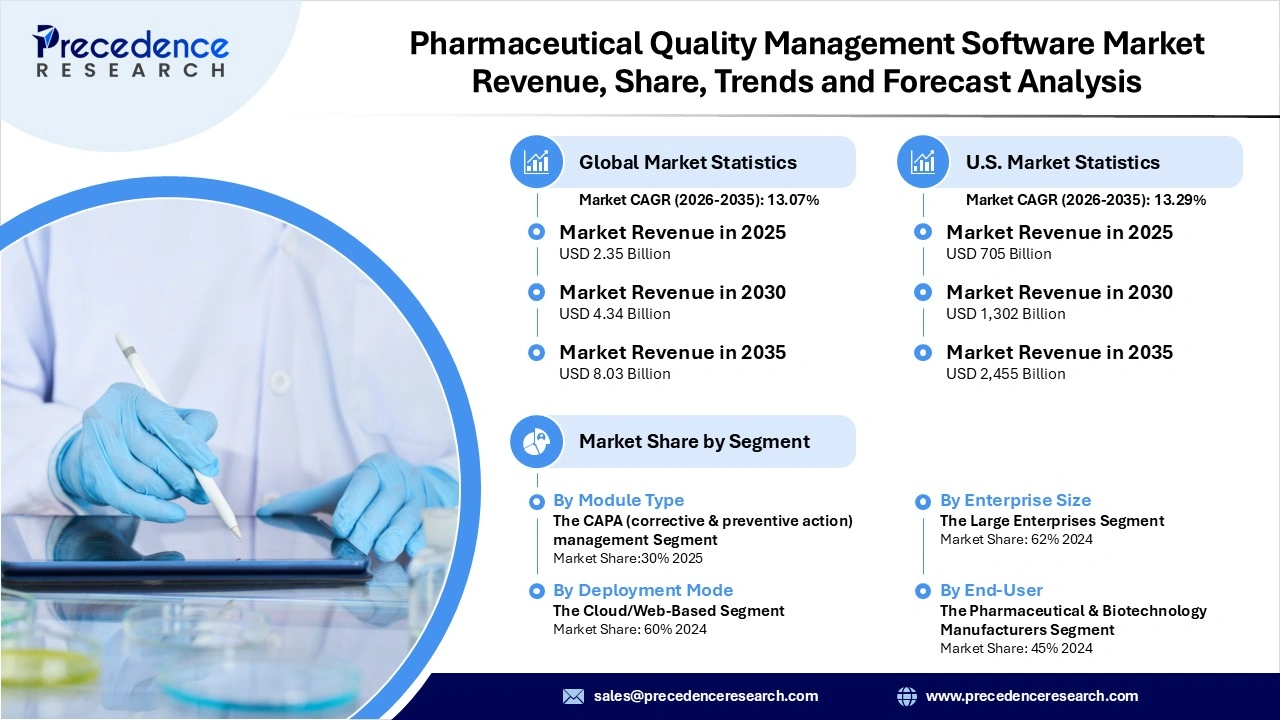
The global pharmaceutical quality management software market revenue reached USD 2.35 billion in 2025 and is predicted to attain around USD 8.03 billion by 2035 with a CAGR of 13.07%. The market is witnessing a significant shift due to increased drug complexity and demand, as well as high operational efficiency and regulatory compliance for safety, propelling it globally.
What are the Key Driving Factors in the Pharmaceutical Quality Management Software Market?
The pharmaceutical quality management software market is driven by the growing need to maintain consistent product quality and to comply with strict regulatory requirements governing drug development, approval, and commercialization. Pharmaceutical companies must document every stage of the product lifecycle, from early formulation and clinical trial material production to large-scale manufacturing and post-market surveillance.
Regulatory authorities such as the U.S. Food and Drug Administration and the European Medicines Agency require extensive documentation, validation records, deviation tracking, and corrective and preventive action reporting before approving new drug launches. Quality management software enables companies to centralize these processes, reduce manual errors, and ensure audit readiness at all times.
Adoption of quality management software in the pharmaceutical sector continues to deepen as companies seek to streamline internal audits, document control, change management, and enforcement of standard operating procedures. These platforms support electronic batch records, training compliance, supplier qualification, and risk management, which are essential for maintaining operational consistency across multiple manufacturing sites.
Leading pharmaceutical and biotechnology firms increasingly deploy globally standardized quality systems to support cross-border operations and regulatory inspections. At the same time, sustained investment in research and development for complex biologics, cell therapies, and personalized medicines further increases the need for robust, compliant digital quality infrastructures.
Segments Insights
- By Solution/Module Type, The CAPA- corrective & prevention action segment led the market in 2025 due to significant factors like growing focus on risk mitigation, product quality, and stringent safety regulations.
- By Deployment Type, The cloud/web-based segment dominated the global pharmaceutical quality management software market due to unmatched benefits, such as high scalability and cost-effective offerings that eliminate the need for costly hardware. It is highly beneficial for SMEs.
- By Enterprise Size, Large enterprises held the largest market share in 2025, owing to their massive production and complex operations, which require scalable quality management software to comply with mandatory regulations set by the pharmaceutical sector authorities.
- By End User/Application Sector, The pharmaceutical and biotech manufacturers segment held the largest market share in 2025 due to the expansion of the pharmaceutical and biotech sectors and the need to streamline administrative processes while maintaining quality compliance.
Regional Insights
North America held the largest market share in 2025, supported by its strong pharmaceutical and biotechnology base and a mature infrastructure for advanced drug research and development. The region hosts a high concentration of innovative drug developers, contract manufacturing organizations, and clinical research institutions, all of which operate under stringent quality-control and documentation requirements. Frequent regulatory inspections, strong enforcement of current good manufacturing practices, and continuous new product development necessitate advanced quality management software to manage audits, deviations, and validation workflows. The widespread adoption of digital quality systems across large enterprises and mid-sized biotech firms continues to fuel sustained regional growth.
Asia Pacific is projected to grow at the fastest CAGR during the foreseeable period, driven by its emergence as a major hub for pharmaceutical and biotechnology manufacturing. Countries such as India, China, South Korea, and Singapore are expanding generic drug production, biosimilar manufacturing, and active pharmaceutical ingredient supply to address rising chronic disease burdens across both domestic and export markets. Increasing regulatory scrutiny from international agencies requires manufacturers in the region to align quality practices with global standards, accelerating adoption of pharmaceutical quality management software. Growth is further supported by the expansion of contract development and manufacturing organizations and the increasing number of facilities seeking regulatory approvals for exports to North America and Europe.
Pharmaceutical Quality Management Software Market Coverage
| Report Attribute | Key Statistics |
| Market Revenue in 2025 | USD 2.35 Billion |
| Market Revenue by 2035 | USD 8.03 Billion |
| CAGR from 2026 to 2035 | 13.07% |
| Quantitative Units | Revenue in USD million/billion, Volume in units |
| Largest Market | North America |
| Base Year | 2025 |
| Regions Covered | North America, Europe, Asia-Pacific, Latin America, and the Middle East & Africa |
Recent Development
- In February 2025, Yokogawa Electric crop., introduces a new model of quality management system called OpreX, which is a cloud-based system for operational risk management.(Source: https://www.yokogawa.com)
Get this report to explore global market size, share, CAGR, and trends, featuring detailed segmental analysis and an insightful competitive landscape overview @ https://www.precedenceresearch.com/sample/7202
You can place an order or ask any questions, please feel free to contact us at sales@precedenceresearch.com |+1 804 441 9344