



Product Design and Development Services Market Trends, Companies, Revenue / Sales Performance, Subscriber Growth, Pricing Strategies, Cloud Adoption, Infrastructure Expansion, Competitive Landscape, and Industry Outlook
Product Design and Development Services Market (By Service Type: Industrial Design Services, Mechanical Product Engineering Services; By Design Stage: Concept Development and Ideation, Feasibility Analysis and Engineering Studies, Detailed Product Design and Engineering; By Technology Integration: AI-Assisted Design and Generative Design, IoT-Enabled Product Design; By End-Use Industry: Automotive and Transportation, Consumer Electronics) - Global Industry Analysis, Size, Trends, Leading Companies, Regional Outlook, and Forecast 2026 to 2035
Source: https://www.precedenceresearch.com/product-design-and-development-services-market
 Get a Sample
 Table Of Content


What is Product Design and Development Services Market Size in 2026?
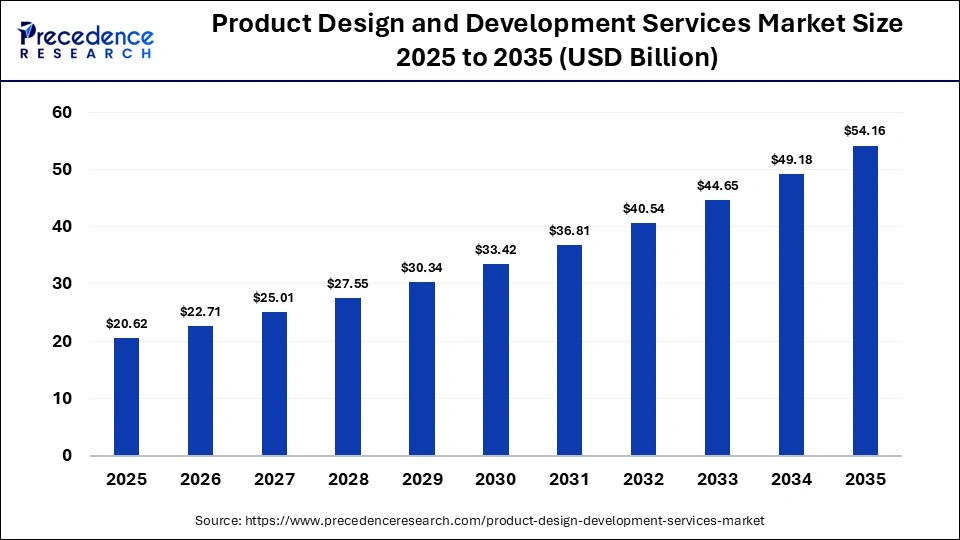
The global product design and development services market size was calculated at USD 20.62 billion in 2025 and is predicted to increase from USD 22.71 billion in 2026 to approximately USD 54.16 billion by 2035, expanding at a CAGR of 10.14% from 2026 to 2035. The market includes engineering, design, prototyping, and testing services used to create and commercialize new products across multiple industries. The market is experiencing robust growth, driven by the growing use of 3D printing, the increasing need for personalized products, and technological advancements.
Key Takeaways
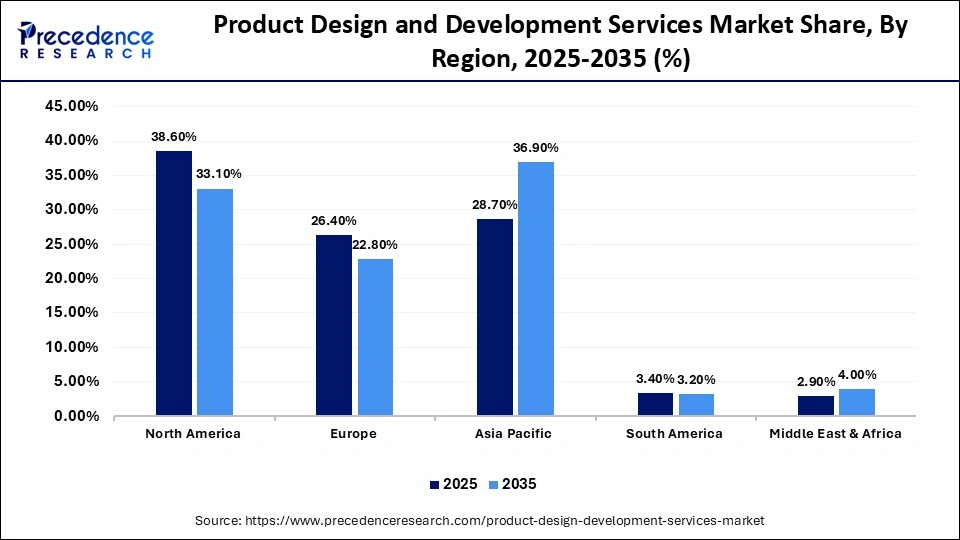
- North America held a dominant position in the market with a share of 38.60% in 2025.
- Asia-Pacific is expected to grow at the fastest CAGR in the market between 2026 and 2035.
- By service type, the mechanical product engineering services segment held a major revenue share of 26.70% in the product design and development services market in 2025.
- By service type, the software and digital product design services segment is expected to expand rapidly in the market with a CAGR of 11.40% in the coming years.
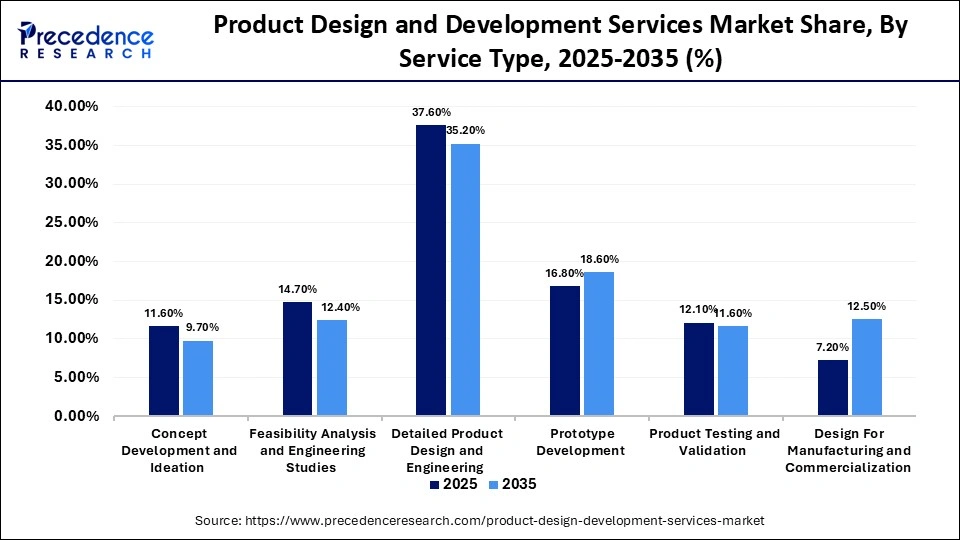
- By design stage, the detailed product design and engineering segment accounted for the highest revenue share of 37.60% in the market in 2025.
- By design stage, the design for manufacturing and commercialization segment is expected to gain the highest market share with a CAGR of 12.60% between 2026 and 2035.
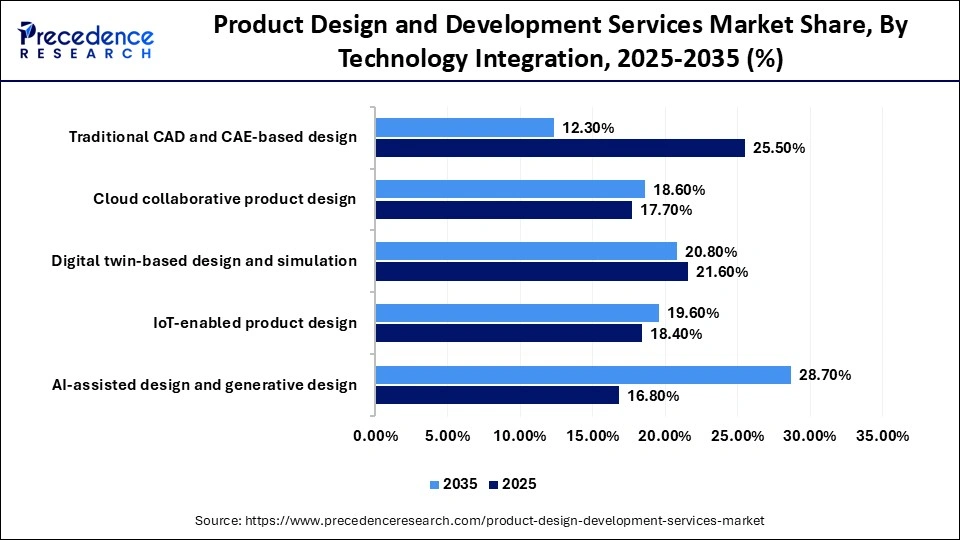
- By technology integration, the traditional CAD and CAE-based design segment dominated the global market with a share of 25.50% in 2025.
- By technology integration, the AI-assisted design and generative design segment is expected to witness the fastest growth in the market with a CAGR of 16.60% over the forecast period.
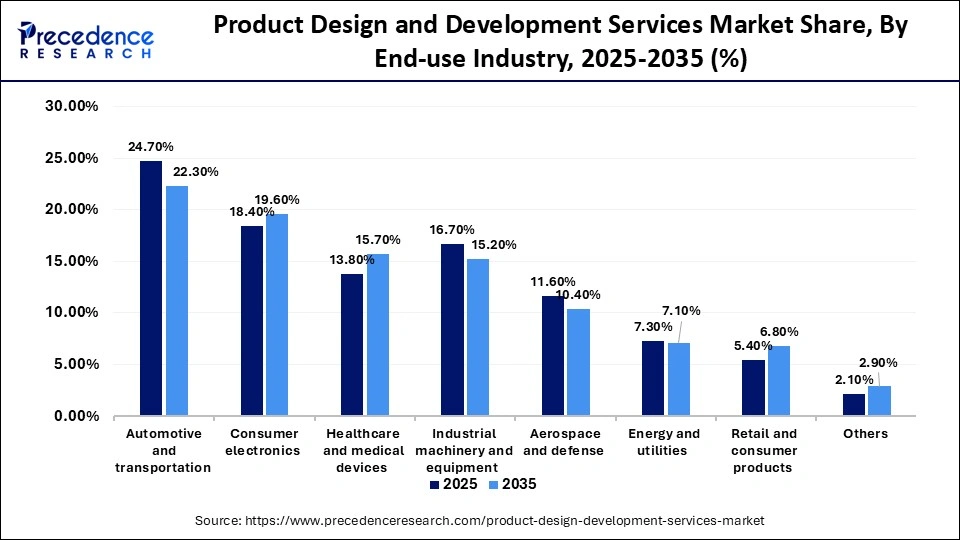
- By end-use industry, the automotive and transportation segment held the largest revenue share of 24.70% in the market in 2025.
- By end-use industry, the retail and consumer products segment is expected to grow at the fastest CAGR of 11.20% in the market between 2026 and 2035.
What is the Product Design and Development Services Market?
The product design and development services industry encompasses comprehensive solutions, from concept to manufacturing, for innovative products in the healthcare, electronics, and automotive sectors. The need for faster delivery, the complexity of software-driven devices, and the integration of advanced technologies like AI and machine learning (ML) are increasing demand in the market. These services connect conceptualization and manufacturing, encompassing research, UI/UX design, engineering, prototyping, and testing to ensure sustainable profit. Industrial design is used in successful product development, combining creativity with technical expertise to generate functional and attractive products.
Using industrial design, companies transform ideas into user-centric solutions to stand out in the market. Additionally, industrial design considers usability, everyday integration, and the ability to solve real-world problems. Early incorporation of industrial design provides companies with a competitive edge to meet user needs and exceed market expectations. These services merge innovative design with robust engineering to enhance user experience, optimize workflows, and increase operational efficiency. A strong design system is crucial for consistency and efficiency throughout the product lifecycle, providing guidelines and resources for a cohesive product appearance.
What is the Role of AI in the Product Design and Development Services Market?
Artificial Intelligence (AI) is a game-changer in the market, shifting the industry from the old-fashioned, linear methods to automated, data-driven approaches. AI algorithms, such as generative design, quickly produce many design options based on a product's weight, material, and cost, helping designers find optimized and lightweight structures. Also, tools for predictive modeling, such as Autodesk Fusion 360, predict a designer's goals while providing instant feedback, and automate routine tasks like 3D modeling and CAD, boosting productivity.
AI also analyzes large datasets from social media, customer feedback, and support requests and identifies user issues, assesses sentiment, and spots new trends, aiding product teams to generate user-centered products. In the area of physical products, AI examines sensor data to predict failures, improve performance, and schedule maintenance, which enhances reliability. AI also reduces manual work in tasks such as code generation, documentation, bug detection, and quality control, which allows engineers to focus on more strategic responsibilities.
What are the Trends in the Product Design and Development Services Market?
- User-Centric Design and Focus
User-centric design (UCD) plays a vital role in product development by ensuring that products meet user needs directly, increasing adoption, and lowering the chances of failure. UCD also improves customer satisfaction, strengthens brand loyalty, and offers a lasting competitive edge in markets. UCD helps validate concepts early on, avoiding expensive redesigns, and also creates intuitive interfaces to boost user satisfaction, increase customer retention, and encourage brand advocacy. Spotting usability problems during the design stage helps cut down on customer support and maintenance expenses. Furthermore, UCD leverages user feedback and behavior analytics to inform design decisions, making sure that the product adapts to real-world needs instead of relying on assumptions. - Integration of Agile Methodologies
Agile prioritizes customer satisfaction by consistently delivering value and creating products that cater to the customer. It also allows any changes to requirements at any stage of the project. These changes can improve customer satisfaction and gain a competitive advantage. Agile also aims to shorten the time between planning and delivering value by reducing the amount of documentation needed beforehand. With continuous testing, it ensures that bugs are identified early on, resulting in a high-quality final product. - Rapid Prototyping and 3D Printing
3D printing for rapid prototyping offers significant benefits in product development. It reduces the time to market by allowing designers to transition directly from digital designs to physical prototypes. Furthermore, 3D printing fosters functional models that simulate the final product's behavior, thorough testing to uncover design flaws before mass production. Additionally, it eliminates the need for tooling, which results in significant cost savings. These prototypes are very important for evaluating a product's efficiency, usability, and performance.
Market Scope
| Report Coverage | Details |
| Market Size in 2025 | USD 20.62 Billion |
| Market Size in 2026 | USD 22.71 Billion |
| Market Size by 2035 | USD 54.16 Billion |
| Market Growth Rate from 2026 to 2035 | CAGR of 10.14% |
| Dominating Region | North America |
| Fastest Growing Region | Asia Pacific |
| Base Year | 2025 |
| Forecast Period | 2026 to 2035 |
| Segments Covered | Service Type, Design Stage, Technology Integration, End-use Industry, and region |
| Regions Covered | North America, Europe, Asia-Pacific, Latin America, and Middle East & Africa |
Segmental Insights
Service Type Insights
Which Service Type Segment Dominated the Product Design and Development Services Market?
The mechanical product engineering services segment held a dominant position in the market with a share of 26.70% in 2025. These services provide essential materials and framework for a product's intended functions. Thus, integrating mechanical and industrial manufacturing processes is advantageous for creating products that embody strength and efficiency. They are vital for creating the physical, structural, and functional foundations of products across major industries. This leadership is further driven by the need for high-quality, affordable, and rapid product development, especially in the manufacturing and automotive sectors, which are the main sources of demand.
The software and digital product design services segment is expected to show the fastest growth with a CAGR of 11.40% over the forecast period, as they provide a competitive edge, accelerating time to market, and driving revenue growth in a digital-focused economy. Good digital product design combines functionality with visual attractiveness, making sure products are not just good-looking but also easy to use and understand. This approach leads to better user engagement and retention.
Additionally, a data-driven design strategy ensures that products meet market demands and stay ahead of industry trends. In today's market, having a strong digital presence provides a significant competitive advantage. It aligns with and supports business goals by enhancing customer engagement, boosting sales, and improving user experience.
Design Stage Insights
Which Design Stage Dominated the Product Design and Development Services Market?
The detailed product design and engineering segment registered its dominance over the global market with a share of 37.60% in 2025, as it is crucial in developing advanced, technology-driven products, which require specialized skills. The design embodies the product's essence, engaging audiences and enhancing market value. Excellent design, appealing aesthetics, user-friendliness, and clear limitations show products as premium. Also, creativity and innovation in product design, aligned with current trends, are essential for success. Unique designs differentiate products, boosting sales and ROI. By optimizing material use, reducing production costs, and minimizing waste, designers ensure quality while making products stand out.
The design for manufacturing and commercialization segment is expected to witness the fastest growth in the market with a CAGR of 12.60% over the forecast period. The Design for Manufacturing (DFM) is essential for enhancing product design and ensuring efficient and cost-effective production. It also considers factors like material choice, production methods, tolerances, and volumes. By applying DFM principles, designers reduce costs while maintaining product quality and reliability. The key principles include simplifying designs, standardizing components, and reviewing the entire manufacturing process from concept to assembly.
Technology Integration Insights
Which Technology Integration Segment Dominated the Product Design and Development Services Market?
The traditional CAD and CAE-based design segment contributed the biggest revenue share of 25.50% in the market in 2025, as it accelerates cycles, reduces prototyping costs, and enhances design accuracy. CAD allows designers to quickly experiment with ideas and easily save their work, making design changes simpler than with physical models. This reduces errors and facilitates 3D modeling, including improving efficiency and precision.
CAE tools help engineers predict product performance under real-world conditions like stress and heat, ensuring safety and functionality. By integrating CAD and CAE, prototypes are tested virtually, minimizing the need for physical models, saving materials, and lowering costs, which is vital for small and medium-sized businesses.
The AI-assisted design and generative design segment is expected to grow with the highest CAGR of 16.60% in the market during the studied years, as they are key drivers in product design and development, enhancing innovation, reducing development times, and promoting sustainability. Generative design accelerates and improves traditional engineering, allowing engineers to focus on optimization and customization while using eco-friendly materials. Additionally, it explores a wider range of possibilities, creating many solutions considering functionality, manufacturability, and cost, offering a more flexible approach to solving design problems.
End-use Industry Insights
Why Did the Automotive and Transportation Segment Dominate the Market?
The automotive and transportation segment accounted for the highest revenue share of 24.70% in the product design and development services market in 2025, fueled by the rapid shift to electric vehicles (EVs), self-driving technology, and connected systems. The car development process involves various interconnected systems and functions and is multidisciplinary, requiring input from different fields to assess design and operational issues.
Also, as testing physical prototypes is both time-intensive and expensive, automation and virtual testing are used to cut down the number of physical prototypes needed. Brands are heavily investing in user experience, functionality, and sustainability to stand out in the market, requiring product design to create high-quality and unique products, crucial for capturing attention.
The retail and consumer products segment is expected to witness the fastest growth in the market with a CAGR of 11.20% over the forecast period, driven by retail and consumer products, shaped by intense competition, quick shifts in consumer trends, and the need for constant innovation to increase sales. Consumer goods face ongoing pressure to provide new and improved products, making fast design iterations, prototyping, and material choices essential for ongoing competitiveness.
Retailers are also investing heavily in digital technologies like AI and smart solutions to enhance user experience and create intelligent, connected products. The shift from mass-produced items to personalized, niche products demands tailored design services to adapt to evolving consumer preferences.
Regional Insights
North America Product Design and Development Services Market Size and Growth 2026 to 2035
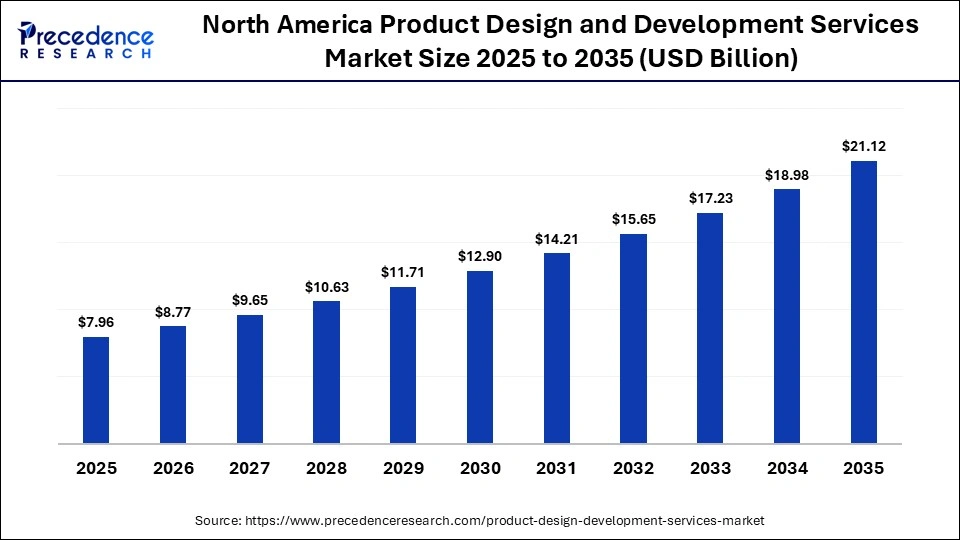
The North America product design and development services market size is estimated at USD 7.96 billion in 2025 and is projected to reach approximately USD 21.12 billion by 2035, with a 10.25% CAGR from 2026 to 2035.
Which Factors Drive the Product Design and Development Services Market in North America?
North America held a major market share of 38.60% in 2025, driven by digitalization and the need for creative visual communication strategies. The increase in startups, along with established companies moving into digital areas, boosts opportunities for specialized design firms. Market players are looking for partnerships and expanding their services to include new areas like augmented reality (AR), virtual reality (VR), and sustainable design practices. Additionally, government programs aimed at fostering innovation and technology adoption create a supportive environment for market expansion.
U.S. Product Design and Development Services Market Size and Growth 2026 to 2035
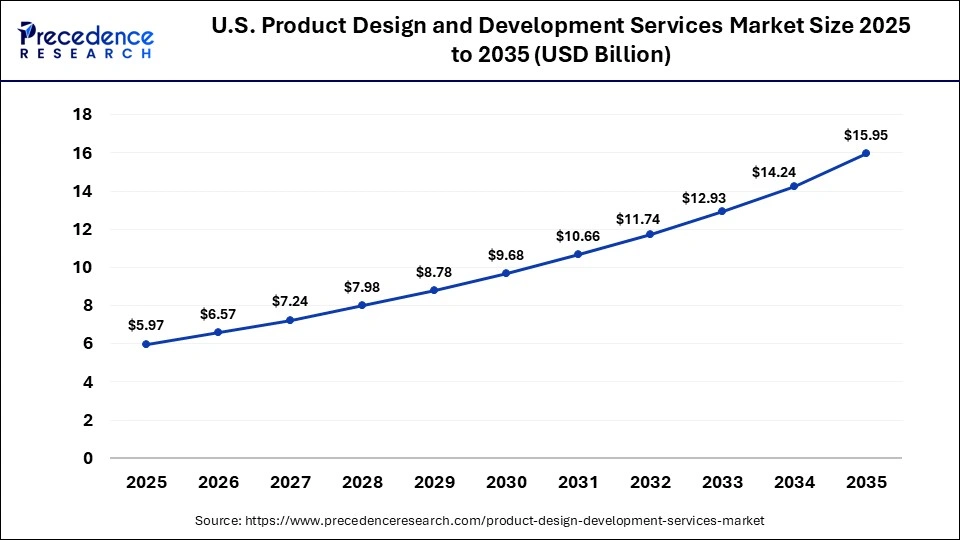
The U.S. product design and development services market size is calculated at USD 5.97 billion in 2025 and is expected to reach nearly USD 15.95 billion in 2035, accelerating at a strong CAGR of 10.33% between 2026 to 2035.
U.S. Market Trends
The rising use of AI in design processes opens avenues for greater efficiency and creativity, offering promising chances for growth and diversification in this vibrant industry. The increased emphasis on sustainable practices is increasing demand for eco-friendly industrial and product design, thus generating new opportunities for market participants. Also, modern manufacturing methods like 3D Printing and rapid prototyping allow for quick changes and visual representation of industrial and product designs, thus reducing development time. Furthermore, cloud-based collaboration platforms support smooth remote teamwork, manage versions, and provide real-time feedback, which improves project workflows.
How is Asia-Pacific Growing in the Product Design and Development Services Market?
Asia-Pacific is expected to experience the fastest growth during the predicted timeframe. The region is rapidly emerging as a leader in digital innovation, with design playing a crucial role. Businesses across various industries are leveraging user-centered design to create experiences that are visually appealing, efficient, and impactful.
As the hub of global consumer growth and innovation, the region's diverse cultures and regulatory systems necessitate a sophisticated approach. Also, global innovators are embracing a flexible, localized, and strategically responsive framework. Recent trends indicate a shift towards hyper-localization, AI-driven consumer insights, and agile methodologies as key success factors.
China Market Trends
Outsourcing product design to China is a popular choice that not only saves money but also grants access to a wide range of resources and skills, giving businesses a competitive edge. Chinese manufacturers produce high-quality products at lower costs due to factors like cheaper labor and efficient supply chains. This strategy cuts overhead costs and increases profits while ensuring product quality.
Working with them provides access to advanced technologies such as 3D printing and robotics, along with creative and technical expertise in design. This helps speed up product launch times, helping businesses stay ahead of competitors and quickly adapt to market trends. Thus, China is influencing the product design and development services.
Product Design and Development Services Market Value Chain Analysis
- R&D
It includes market research, consumer behavior analysis, competitor analysis, user needs, and the identification of technology trends.
Key Players - Mackenzie and Co., IDEO - Prototyping and Testing
It includes prototyping of the product's preliminary version for testing its functionality, ergonomics, usability, and other performance metrics and feedback loops.
Key Players - UL Labs, Proto Labs, Materialize - Production And Manufacturing
It includes designing a product for manufacturing and its actual production on a large scale. It also involves raw material sourcing, managing labor, product quality, and production line setup.
Key Players - Foxconn, Jabil, Flex - Distribution and Logistics
It includes packaging and distribution of the product to retailers, warehouses, and customers in a timely manner.
Key Players - UPS, FedEx, DHL, Amazon - Marketing and Sales
It includes marketing the product, promoting its features, and attracting buyers by advertising and social media campaigns.
Key Players - Nielsen, Ogilvy, Google Ads
Top Companies in the Product Design and Development Services Market
- Accenture
- Capgemini Engineering
- Tata Technologies
- HCLTech
- Wipro Engineering Edge
- Cognizant Engineering Services
- Altran Technologies
- Infosys Engineering Services
- Quest Global
- Luxoft
- Cyient
- Alten Group
- Bertrandt
- EPAM Systems
- Tech Mahindra Engineering Services
Recent Developments in the Product Design and Development Services Market
- In March 2026, Rabbit Product Design launched new electronic design consulting services for entrepreneurs and businesses aiming to create innovative wearable technology. Their offerings include comprehensive product consulting, from prototyping to go-to-market strategies, assisting inventors, startups, and established companies in developing wearable devices in a competitive market. (Source - https://markets.financialcontent.com)
- In May 2025, Accenture announced its plan to acquire Yumemi, a top digital services provider in Japan. This acquisition is expected to boost Accenture's ability to design and implement products for clients efficiently and at scale, while also enhancing ongoing support through user insights from newly launched products. (Source -https://newsroom.accenture.com)
Segments Covered in the Report
By Service Type
- Industrial Design Services
- Mechanical Product Engineering Services
- Electronics and Embedded System Design Services
- Software and Digital Product Design Services
- Prototyping and Rapid Manufacturing Services
- Product Testing and Validation Services
- Product Redesign and Lifecycle Engineering Services
By Design Stage
- Concept Development and Ideation
- Feasibility Analysis and Engineering Studies
- Detailed Product Design and Engineering
- Prototype Development
- Product Testing and Validation
- Design For Manufacturing and Commercialization
By Technology Integration
- AI-Assisted Design and Generative Design
- IoT-Enabled Product Design
- Digital Twin-Based Design and Simulation
- Cloud Collaborative Product Design
- Traditional CAD and CAE-Based Design
By End-Use Industry
- Automotive and Transportation
- Consumer Electronics
- Healthcare and Medical Devices
- Industrial Machinery and Equipment
- Aerospace and Defense
- Energy and Utilities
- Retail and Consumer Products
- Others
By Region
- North America
- Latin America
- Europe
- Asia-pacific
- Middle and East Africa
For inquiries regarding discounts, bulk purchases, or customization requests, please contact us at sales@precedenceresearch.com
Frequently Asked Questions





Ask For Sample
No cookie-cutter, only authentic analysis – take the 1st step to become a Precedence Research client
 Get a Sample




 sales@precedenceresearch.com
 Schedule a Meeting
