



U.S. Cell Therapy Manufacturing Market Size, Share, Trends, Companies, and Forecast 2026-2035
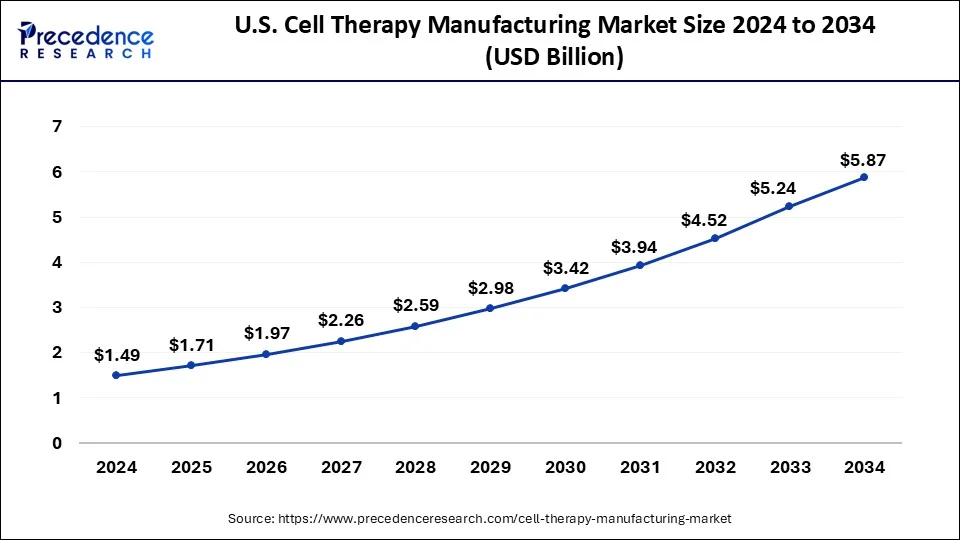
Deepa Pandey, a Healthcare Industry Expert, highlights that the U.S. cell therapy manufacturing market has reached USD 1.97 billion in 2026 and is on track to reach USD 6.56 billion by 2035, advancing at a CAGR of 14.39%. Key U.S. cell therapy manufacturing market companies shaping the market include Merck KGaA, Thermo Fisher Scientific, Catalent, Inc., while major growth segments span By Therapy Type, By Technology Type, By Source, By Application.
Source: https://www.precedenceresearch.com/us-cell-therapy-manufacturing-market
 Get a Sample
 Table Of Content


U.S. Cell Therapy Manufacturing Market Size and Forecast 2026 to 2035
The U.S. cell therapy manufacturing market size is predicted to increase from USD 1.97 billion in 2026 to approximately USD 6.56 billion by 2035, expanding at a CAGR of 14.39% from 2026 to 2035. The market is driven by increasing clinical development and commercialization of cell-based therapies, rising investments in biopharmaceutical manufacturing infrastructure, and growing demand for scalable, automated production technologies.
Key Takeaways
- By therapy type, the autologous cell therapy segment dominated the market in 2026.
- By therapy type, the allogenic cell therapy segment is expected to grow at the fastest rate during the forecast period.
- By technology type, the somatic cell technology segment held the largest share of the market in 2026.
- By technology type, the 3D technology segment is anticipated to grow at the fastest rate during the forecast period.
- By source, the IPSC (induced pluripotent stem cell) segment dominated the market in 2026.
- By source, the bone marrow segment held the second largest share of the market in 2026.
- By application, the oncology segment held the largest revenue share of the market in 2026.
- By application, the neurological segment is projected to expand at the fastest rate during the forecast period.
- By end user, the pharmaceutical & biotechnology companies segment held the dominant position in the market in 2026.
- By end user, the academic & research institutes segment is expected to grow with the highest CAGR during the forecast period.
Market Overview
The U.S. cell therapy manufacturing market is experiencing significant growth, driven by the growing prevalence of oncological disorders. There is a growing focus of biotechnology companies in developing novel technologies for manufacturing cell therapies. Increasing investments in new production facilities to enhance cell therapy manufacturing capabilities also drive the market. Additionally, the government is launching several policies to strengthen the biotech sector, which is contributing to industrial growth.
What is the Impact of AI on the U.S. Cell Therapy Manufacturing Market?
Artificial intelligence is positively impacting the U.S. cell therapy manufacturing industry. Firstly, AI platforms can analyze live-cell imaging and bioreactor data to monitor cell health and phenotypes in real-time. Secondly, AI helps to predict how stem cells will differentiate before the manufacturing process is completed. Thirdly, AI is deployed by cell therapy companies to enhance automated process development and supply-chain optimization.
- In May 2026, Nucleus Biologics launched the NB-Lux AI. NB-Lux AI is an advanced digital platform designed to improve cell therapy manufacturing in the U.S. region.
Market Dynamics
Drivers
Growing Prevalence of Cancers
The rising cases of breast cancer and prostate cancer in the U.S. have increased the demand for advanced therapies. To combat cancer-related issues, genetic engineering companies have started manufacturing cell therapies to provide high-quality treatment. Thus, the growing adoption of cell therapies for the treatment of cancer is boosting the market growth.
- According to the Cancer Statistics Center, around 2,114,850 new cancer cases and 626,140 cancer deaths are expected to occur in the U.S. during 2026.
Restraint
Complexity in Manufacturing and Regulatory Hurdles
The production method of cell therapy is highly complex due to the compatibility issues and scarcity of a skilled workforce. The U.S. Food and Drug Administration has mandated strict regulations for approving cell therapies, which in turn restrains the market expansion.
Opportunity
Next-Gen Gene Editing Tools and Technological Advancements
Several gene editing tools, such as CRISPR-Cas9, TALENs, and ZFNs, are gaining significant popularity due to their wider application in cell therapy production. Cell therapy companies are integrating ML and generative AI to enhance their production capabilities. Thus, the surging use of next-gen gene editing tools, as well as technological advancements in cell therapy manufacturing, are expected to create opportunities in the coming years.
Why is the U.S. Government Investing in the Cell Therapy Manufacturing Industry?
The U.S. government is rapidly investing in cell therapy manufacturing to secure domestic supply chains, enhance patient access to life-saving personalized medicines, and boost economic growth. By investing in this critical sector, the government focuses on tackling high production costs, lowering the dependency on foreign therapies, and creating job opportunities. For instance, in February 2026, the government of Pennsylvania invested around US$41.5 million. This investment was made to build a next-generation cell therapy manufacturing unit in Montgomery County.
Market Segmentation Analysis
Therapy Type Insights
The Autologous Cell Therapy Segment Dominated the Market in 2026
The autologous cell therapy segment dominated the U.S. cell therapy manufacturing market in 2026. This is because autologous cell therapy uses specific cells to repair or replace diseased tissues. This therapy provides numerous advantages, such as zero risk of graft-versus-host disease, protection against disease transmission, superior targeted integration, and a simple route of administration.
The allogenic cell therapy segment is anticipated to grow at the fastest rate during the forecast period. This is due to the growing use of allogeneic cell therapy for replacing or repairing damaged cells, treating blood cancers, and modulating the immune system. The top biopharma brands, such as Johnson&Johnson and Novartis, are making significant investments in developing high-quality allogenic cell therapies.
Technology Type Insights
What Made Somatic Cell Technology the Dominant Segment in the Market?
The somatic cell technology segment dominated the U.S. cell therapy manufacturing market in 2026, as this technology allows scientists to transform mature body cells back into a flexible one. Somatic cell technology enhances cell therapy manufacturing by enabling the production of patient-specific treatments, reducing the risk of immune rejection, and bypassing the ethical concerns of embryonic stem cells.
The 3D technology segment is anticipated to expand at the fastest rate during the forecast period. This is because 3D technology enhances the growth, delivery, and efficacy of therapeutic cells by copying the body's natural environment. The genetic engineering brands are rapidly integrating 3D technology for developing advanced therapies.
Source Insights
The IPSC Segment Held the Largest Market Share in 2026
The IPSC (induced pluripotent stem cell) segment led the U.S. cell therapy manufacturing market by holding the largest share in 2026. This is because IPSCs are widely adopted by pharma companies to enhance disease modeling, improve drug testing, and produce cell therapies. This cellular source allows the production of allogeneic therapies on a large commercial scale.
The bone marrow segment held the second-largest share of the market in 2026 and is expecetd to grow at a significant rate. This is due to the surging adoption of bone marrow therapy to treat a wide range of blood cancers. Additionally, numerous research institutes are investing rapidly in studying the efficacy of bone marrow-based therapies in rare disease treatment.
Application Insights
The Oncology Segment Led the Market in 2026
The oncology segment dominated the U.S. cell therapy manufacturing market in 2026. This is owing to the increasing prevalence of leukemia and lymphoma among men, along with the significant investment by the government in strengthening the cancer treatment infrastructure. In addition, the genetic engineering companies have started using next-gen gene tools to develop cell therapies for the treatment of cancer.
The neurological segment is expected to expand at the fastest rate during the forecast period. This is due to the surging adoption of cell therapies for treating numerous types of neurological disorders, including Parkinson's Disease and Multiple Sclerosis (MS). The biotech companies are investing rapidly in developing allogenic cell therapy to treat nerve disorders.
End-User Insights
The Pharmaceutical & Biotechnology Companies Segment Dominated the Market in 2026
The pharmaceutical and biotechnology companies segment held the largest share of the market in 2026. This is owing to the increasing focus of biotech companies on deploying advanced technologies such as AI and ML to enhance the production of cell therapy. Additionally, the pharma brands are collaborating with CDMO providers to develop cell therapies for treating cardiovascular disorders.
The academic and research institutes segment is expected to rise with the highest CAGR during the forecast period. This is due to the growing adoption of cell therapies by biotech research centers to check their efficacy in treating patients. The government is investing rapidly to establish new academic centers to study cell therapies.
Country-Level Analysis
- California: California leads the U.S. cell therapy manufacturing market due to its large concentration of biotechnology companies, advanced manufacturing facilities, and strong investment in cell and gene therapy research. The state also hosts numerous clinical trials and innovation hubs that support commercial-scale production.
- Massachusetts: Massachusetts is a major center for cell therapy manufacturing, driven by the presence of leading biopharmaceutical companies, research institutions, and specialized manufacturing facilities. Strong collaboration between academia and industry continues to accelerate process development and commercialization.
U.S. Cell Therapy Manufacturing Market Value Chain Analysis
- R&D
The research and development (R&D) of cell manufacturing is a complex process that involves the conversion of living cells into targeted medical treatments.
Key Companies: Bristol Myers Squibb (BMS), Johnson & Johnson, and Allogene Therapeutics.
- Clinical Trials and Regulatory Approvals
Cell therapy development undergoes preclinical research followed by three clinical trial phases, including safety evaluation, dosing, and efficacy.
Key Companies: Fate Therapeutics, Iovance Biotherapeutics, and Abeona Therapeutics.
- Distribution to Hospitals, Pharmacies
Cell therapy is distributed through a well-organised supply chain that involves cold-chain logistics and cryogenic shipping.
Key Companies: Cryoport Systems, Mercury Business Services, and QuickSTAT.
Market Competitive Landscape: Leading Companies and Strategies
The U.S. cell therapy market is highly fragmented due to the presence of well-established brands along with the proliferation of new startups. Top companies in the market include Merck KGaA, Thermo Fisher Scientific, Catalent, Inc, Bristol-Myers Squibb Company, and Gilead Sciences, Inc. These companies are constantly engaged in developing advanced cell therapies and adopting various strategies, including product launches and business expansions, to strengthen their position in the market.
- In May 2026, Thermo Fisher Scientific launched the Gibco CTS DynaXS single-use bioreactor. This new bioreactor was designed to enhance cell therapy manufacturing activities across the U.S.
U.S. Cell Therapy Manufacturing Market Companies
- Merck KGaA
- Thermo Fisher Scientific
- Catalent, Inc
- Bio-Techne
- Novartis AG
- Bristol-Myers Squibb Company
- Gilead Sciences, Inc.
- Cytiva
- Lonza
- The Discovery Labs
Recent Developments U.S. Cell Therapy Manufacturing Market (2025-2026)
- In May 2026, FUJIFILM Cellular Dynamics invested US$200 million. This investment was made to open a manufacturing unit to expand cell manufacturing capacity across the U.S.(Source: https://biopharmaapac.com)
- In May 2026, Andelyn Biosciences launched the LVV Curator platform. This platform was designed to enhance the production of cell therapies for U.S. consumers.(Source: https://manufacturingchemist.com/)
- In February 2026, Johnson & Johnson announced to invest around US$1 billion. Through this investment, this company will open a new cell therapy manufacturing facility in Montgomery County, Pennsylvania, U.S.(Source: https://www.jnj.com)
Segments Covered in the Report
By Therapy Type
- Allogenic Cell Therapy
- Autologous Cell Therapy
By Technology Type
- Somatic Cell Technology
- Cell Immortalization Technology
- Viral Vector Technology
- Genome Editing Technology
- Cell Plasticity Technology
- 3D Technology
By Source
- IPSC (Induced Pluripotent Stem Cell)
- Bone Marrow
- Umbilical Cord
- Adipose Tissues
- Neural Stem
By Application
- Musculoskeletal
- Cardiovascular
- Gastrointestinal
- Neurological
- Oncology
- Dermatology
- Others
For inquiries regarding discounts, bulk purchases, or customization requests, please contact us at sales@precedenceresearch.com
Frequently Asked Questions





Ask For Sample
No cookie-cutter, only authentic analysis – take the 1st step to become a Precedence Research client
 Get a Sample
.webp)



 sales@precedenceresearch.com
 Schedule a Meeting
