



Virtual Critical Care Solutions Market Size, Companies, Share, Patient Volume, Treatment Adoption Rates, Pricing Analysis, Regulatory Landscape, Competitive Positioning, and Demand Forecast
Virtual Critical Care Solutions Market (By Offering: Hardware, Software, Services; By Technology: Machine Learning, Context Aware Computing, Natural Language Processing, Computer Vision, Speech Recognition, Querying Method; By Application: Health Monitoring, Digital Consultation, Virtual Nurses Precision Medicines, Drug Creation, Healthcare System Analysis, Medication Management, Others) - Global Industry Analysis, Size, Trends, Leading Companies, Regional Outlook, and Forecast 2026 to 2035
Source: https://www.precedenceresearch.com/virtual-critical-care-solutions-market
 Get a Sample
 Table Of Content


What is the Virtual Critical Care Solutions Market Size in 2026?
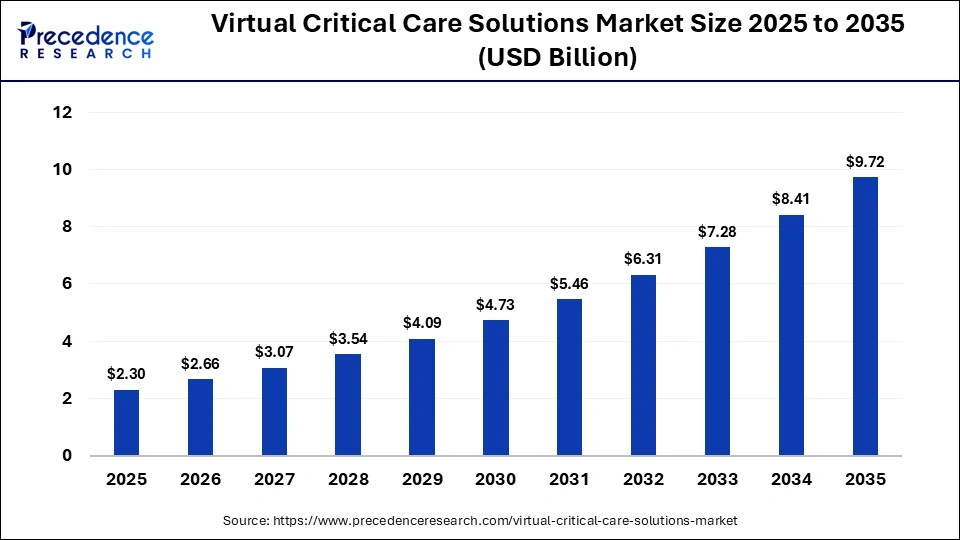
The global virtual critical care solutions market size was calculated at USD 2.30 billion in 2025 and is predicted to increase from USD 2.66 billion in 2026 to approximately USD 9.72 billion by 2035, expanding at a CAGR of 15.50% from 2026 to 2035. The market is growing as healthcare systems pursue scalable solutions to address intensivist shortages and the increasing number of ICU admissions. The factors that contribute to growth include the rising use of telehealth, the value of continuous patient monitoring, the pressure to cut costs, and the need to improve the outcomes of critical care in remote and underserved localities.
Key Takeaways
- North America dominated the global virtual critical care solutions market in 2025.
- Asia-Pacific is expected to grow at the fastest CAGR in the market during the forecast period.
- By offering, the hardware segment held a dominant position in the market in 2025.
- By offering, the software segment is expected to grow at the fastest CAGR in the market between 2026 and 2035.
- By technology, the machine learning segment led the global market in 2025.
- By technology, the computer vision segment is expected to grow with the highest CAGR in the market during the studied years.
- By application, the health monitoring segment dominated the global market in 2025.
- By application, the digital consultation segment is expected to expand rapidly in the market in the coming years.
What is the Virtual Critical Care Solutions Market?
Virtual critical care allows caregivers and intensivists to operate remotely and supervise patients with serious illnesses through digital means. Hospitals use centralized command centers that are fitted with hi-tech monitoring dashboards and audiovisual systems. The model improves clinical decision-making, decreases mortality, and maximizes resource utilization in the ICU. The growth of the market worldwide is increasing with the rise in medical digitalization and reimbursement. The growing demand for telemedicine and remote monitoring, along with the rising geriatric population, fosters market growth.
What is the Role of AI in the Virtual Critical Care Solutions Market?
Predictive analytics and real-time clinical decision support are changing virtual critical care with the use of artificial intelligence (AI). The analysis of patient vitals, laboratory findings, and past data is done by AI algorithms that indicate potential worsening. Machine learning (ML) models can be used to help clinicians in the prediction of sepsis, ventilation, or risk stratification. AI-based integration enhances workflow and assists in data-based treatment planning in tele-ICU settings.
Virtual Critical Care Solutions Market Trends
- AI/ML Incorporation: Healthcare operators are integrating AI applications into virtual ICU systems to improve early warning systems. Predictive analytics can improve the speed of response and save more lives. ML models can optimize treatment guidelines through actual evidence.
- Expansion of Tele-ICU Models: The implementation of hub-and-spoke tele-ICU networks by hospitals is becoming a common practice to expand the coverage of specialist care. There are centralized monitoring centers in which several facilities are monitored.
- Wearables and Remote Patient Monitoring: High-tech biosensors and wearable gadgets allow transmission of patient data in real-time. Vital signs monitoring, when continuous, will increase early identification of complications. The combination with cloud-based dashboards assists in proactive interventions.
- Digital Change and Interoperability: Interoperability with electronic health records (EHRs) and hospital information systems is gaining a lot of importance. Interop platforms are guaranteed to enable secure data transfer between departments.
- Hybrid Care Model: Healthcare systems are integrating physical ICU with telemedicine. Hybrid models enhance the flexibility of staffing and clinical coverage. Physical presence of teams with remote specialists is used in making tough decisions together.
- Concentrate on Post-ICU Rehabilitation: Virtual services are expanding the services beyond the acute care to help patients recover after the ICU. Tele-rehabilitation monitoring enhances the outcome of patients in the long-term. Online follow-up interventions decrease readmissions.
Market Scope
| Report Coverage | Details |
| Market Size in 2025 | USD 2.30 Billion |
| Market Size in 2026 | USD 2.66 Billion |
| Market Size by 2035 | USD 9.72 Billion |
| Market Growth Rate from 2026 to 2035 | CAGR of 15.50% |
| Dominating Region | North America |
| Fastest Growing Region | Asia Pacific |
| Base Year | 2025 |
| Forecast Period | 2026 to 2035 |
| Segments Covered | Offering, Technology, Application, and Region |
| Regions Covered | North America, Europe, Asia-Pacific, Latin America, and Middle East & Africa |
Segmental Insights
Offering Insights
Which Offering Segment Dominated the Virtual Critical Care Solutions Market?
The hardware segment dominated the market in 2025 because physical infrastructure is critical in remote patient management. Hardware consists of high-resolution cameras, vital signs monitors, and telemetry devices, servers, and integrated ICU command centres, which facilitate real-time tracking. To promote the efficiency of critical care, hospitals persist in investing in modern bedside equipment and centralized monitoring centres.
The surge in the use of tele-ICU models has led to an increased need for powerful networking equipment and a listening and viewing system to facilitate smooth connections. Moreover, medical professionals are considering the use of secure and dependable hardware devices to reduce downtime to the lowest possible level and deliver continuous care to patients.
The software segment is expected to be the fastest-growing segment in the forecast period, driven by rising demand for smart analytics and remote care organization frameworks. SDA tele-ICU software allows real-time data display, predictive alerts, and automatic clinical decision support. Cloud-based solutions are becoming popular due to their scalable implementation and the possibility of integrating them with electronic health records (EHRs).
The use of AI-driven monitoring tools and workflow optimization systems is becoming more rapid with continued developments. In addition, SaaS and subscription-based models are lowering the initial expenditures, thereby motivating smaller health care organizations to adopt virtual critical care solutions.
Technology Insights
What Made the Machine Learning Segment Dominate in the Market?
The machine learning segment held a dominant revenue share of the virtual critical care solutions market in 2025, driven by a process of a great amount of patient data in real time.
Algorithms are used to identify initial signs of clinical deterioration, sepsis, respiratory failure, and other severe diseases. ML-driven predictive analytics addresses the problem of patient outcomes by facilitating the active implementation of interventions.
To minimize ICU mortality and improve resource allocation, hospitals use tools that are based on ML. Further evolution of the accuracy of data and the integration with multi-parameter monitoring devices augment the segment's growth.
The computer vision segment is expected to show the fastest growth over the forecast period, which can be used to improve the efficiency of clinical workflow. Voice-enabled systems also enable the physician to record patient information without the use of hands, as this saves on the administrative load. Solutions enhance the speed of responding to an emergency since patient records can be accessed quickly on command. It is integrated with virtual assistants that are also AI-based, so that information can be found in real time and clinical advice provided. Growing interest in clinician productivity and burnout-prevention is contributing to the growing demand for speech-enabled virtual care solutions.
Application Insights
How the Health Monitoring Segment Led the Virtual Critical Care Solutions Market?
The health monitoring segment led the market in 2025 because continuous patient monitoring is at the core of the operations of the ICUs. Remote monitoring systems monitor vital signs, oxygen levels, heartbeat rhythms, and neurological conditions. Early warning systems incorporated in monitoring systems can be used to eliminate complications and minimize stays in the ICU. Hospitals are also drawn to centralized models of monitoring that enable ICUs to monitor multiple patients at a time. Increasing focus on patient safety, quality measures, and outcomes fosters the segment's growth.
The digital consultation segment is expected to gain the highest market share between 2026 and 2035, as the number of people using telemedicine in critical care centers is increasing. Through virtual consultations, intensivists can assist rural and understaffed hospitals without necessarily being present. This strategy will increase access to specialized care and decision-making in emergencies. High penetration of broadband and safe telehealth is increasing the pace of implementation. Secondly, remote expert consultation models are being acknowledged by healthcare systems due to their high scalability and cost-efficiency.
Regional Insights
Why North America Dominated the Virtual Critical Care Solutions Market?
North America held a major revenue share of the market in 2025 because of the developed healthcare facilities and good implementation of tele-ICU programs. The area has the advantage of high health spending and the rapid adoption of digital health technologies. To overcome the shortage of intensivists, hospitals are adopting centralized monitoring centers.
Favorable regulatory environments and reimbursement policies are another factor that increases market growth at a greater rate. There is also a high level of the presence of major healthcare IT providers, which leads to technological improvements. The regional leadership is supported by continuous innovation of AI-powered clinical decision support systems.
Country-Level Analysis
The U.S. leads the market in North America, owing to the need to streamline patient outcomes and minimize operational costs. Predictive analytics and AI are taking place in the workflow of critical care at academic medical centers. Virtual care is also being expanded in Canada, especially in remote and rural areas, to enhance accessibility.
In hospital systems areas, digital transformation is promoted through public health initiatives. Transnational partnerships and studies also enhance the region's healthcare ecosystem. All in all, technological maturity and strategic investments strengthen North America's dominance in the market.
Why is Asia-Pacific the Fastest-Growing Region in the Virtual Critical Care Solutions Market?
Asia-Pacific is expected to witness the fastest growth during the predicted timeframe because of the increasing healthcare structures and digitalization. The high rate of urbanization and rising numbers of ICU admissions are leading to the need for scalable monitoring systems. Telehealth is an area where governments in the region are making investments to enhance access to healthcare in rural areas.
The increasing awareness of AI-based clinical support tools is also leading to their adoption. Emerging economies are especially drawn to the cost-effective cloud-based solutions. An increase in involvement in the private sector also hastens the implementation of technology.
Country-Level Analysis
China is being seen through mass modernization and the implementation of AI-based monitoring of hospitals, and through their integration. India is developing tele-ICU networks to overcome the shortage of specialists in the tier-2 and tier-3 cities. Japan pays attention to high-tech robotics and AI implementation in the critical care environment to cope with the aging population.
Southeast Asian countries are slowly embracing remote monitoring technologies by engaging in public-private collaborations. Regional expansion should also be backed by the increased smartphone penetration and the availability of broadband connectivity. All these trends make Asia-Pacific the most vibrant growth market in the world.
Will Europe Grow in the Virtual Critical Care Solutions Market?
Europe is expected to experience notable growth in the market in the coming years, as healthcare systems increasingly adopt digital health technologies to improve critical care outcomes. Rising demand for tele-ICU services, combined with strong government support for healthcare organizations, is accelerating implementation across the region. Many European countries are modernizing hospital infrastructure to support remote monitoring and consultation, driven in part by a shortage of intensivists and critical care specialists.
Moreover, the trend in favor of value-based care and cost control is increasing the interest in virtual care solutions that improve efficiency without deteriorating the quality. The adoption of the latest technologies, including AI-powered analytics and interoperable services, contributes to further uptake. The investment in regulatory frameworks and data security practices encourages healthcare providers to increase the scale of virtual critical care initiatives.
Country-Level Analysis
Germany supports healthcare facilities in rural areas and relieves the workload of ICUs in major urban centers. Another initiative in the development of virtual critical care in the UK is based on NHS-aligned digital programs, which designate the importance of standardized remote monitoring and remote clinical collaboration. France is developing cloud-based solutions and AI analytics in the critical care operations to enhance the prompt identification of patient complications.
Countries such as Sweden and Denmark, among the Scandinavian countries, are also capitalizing on high broadband penetration and well-established e-health ecosystems to increase remote consultation services. Spain and Italy are slowly stepping up to meet the needs of a post-pandemic requirement of flexible critical care capacity. In these nations, a harmonized data standard is one of the facilitators of further development of the European market and cross-institutional cooperation.
Virtual Critical Care Solutions Market Value Chain Analysis
Virtual Critical Care Solutions Market Companies
- Nvidia Corporation
- IBM Corporation
- AiCure
- iCarbonX
- Cyrcadia Health Inc.
- Atomwise, Inc.
- Pathway Genomics Corporation
- Zebra Medical Vision Ltd.
- Sophia Genetics
- Apixio Inc.
- Microsoft
Recent Developments
- In January 2026, Vsee Health teamed up with DocBox to introduce an augmented intelligence virtual care platform that integrates telehealth capabilities with real-time clinical data systems. The solution enables continuous data monitoring, supports remote critical care management, streamlines billing processes, and delivers AI-powered insights to enhance hospital efficiency and patient outcomes globally. (source: https://www.morningstar.com)
- In February 2026, Maverick simulator solutions unveiled SIDDH, which is a high-fidelity critical care simulator to train medical professionals on complex situations in the ICU. The new simulator improves clinical skills and the application of patients' conditions, and emergency response to help improve competency and preparedness for critical care.(source: https://health.economictimes.indiatimes.com)
Segments Covered in the Report
By Offering
- Hardware
- Software
- Services
By Technology
- Machine Learning
- Context Aware Computing
- Natural Language Processing
- Computer Vision
- Speech Recognition
- Querying Method
By Application
- Health Monitoring
- Digital Consultation
- Virtual Nurses
- Precision Medicines
- Drug Creation
- Healthcare System Analysis
- Medication Management
- Others
By Region
- North America
- Europe
- Asia-Pacific
- Latin America
- Middle East & Africa
For inquiries regarding discounts, bulk purchases, or customization requests, please contact us at sales@precedenceresearch.com
Frequently Asked Questions





Ask For Sample
No cookie-cutter, only authentic analysis – take the 1st step to become a Precedence Research client
 Get a Sample
.webp)



 sales@precedenceresearch.com
 Schedule a Meeting
