



AI In Economic Analytics Market Trends, Companies, Revenue / Sales Performance, Subscriber Growth, Pricing Strategies, Cloud Adoption, Infrastructure Expansion, Competitive Landscape, and Industry Outlook
AI In Economic Analytics Market (By Component: Solutions, Services; By Application: Macroeconomic forecasting, Financial Analytics, Trade and Investment Analytics, Labor Market Analytics, Others; By End-User: Government and Public Institutions, Financial Institutions, Corporates and Enterprises, Research and Academia, International Organizations) - Global Industry Analysis, Size, Trends, Leading Companies, Regional Outlook, and Forecast 2026 to 2035
Source: https://www.precedenceresearch.com/ai-in-economic-analytics-market
 Get a Sample
 Table Of Content


What is the AI In Economic Analytics Market Size in 2026?
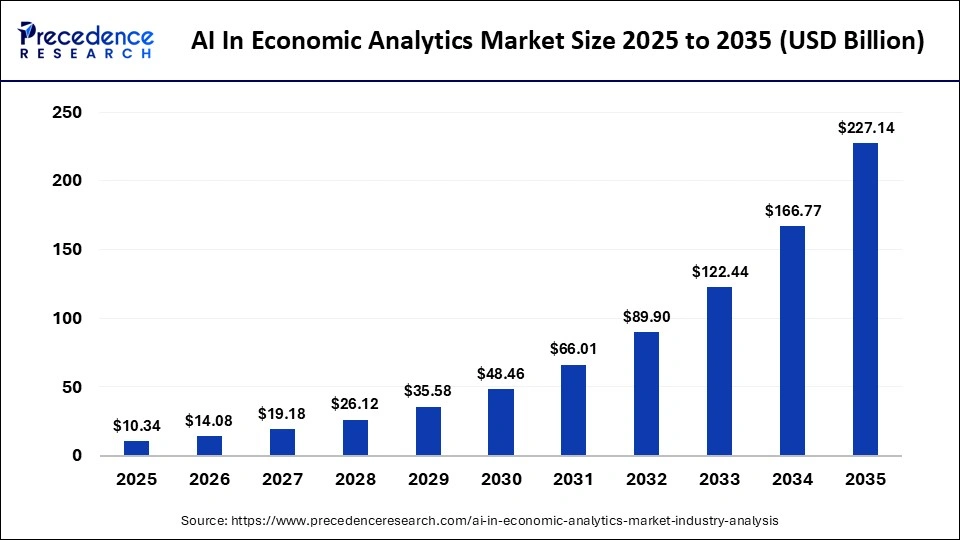
The global AI in economic analytics market size was calculated at USD 10.34 billion in 2025 and is predicted to increase from USD 14.08 billion in 2026 to approximately USD 227.14 billion by 2035, expanding at a CAGR of 36.20% from 2026 to 2035. The market is rapidly growing due to the expansion of digital data across sectors, which has created a surge in demand for AI-powered tools. AI adoption is driven by the desire to automate complex processes, minimize errors, and improve productivity, which helps firms reduce costs. The emergence of advanced technology is enabling more sophisticated narrative reporting and forecasting.
Key Takeaways
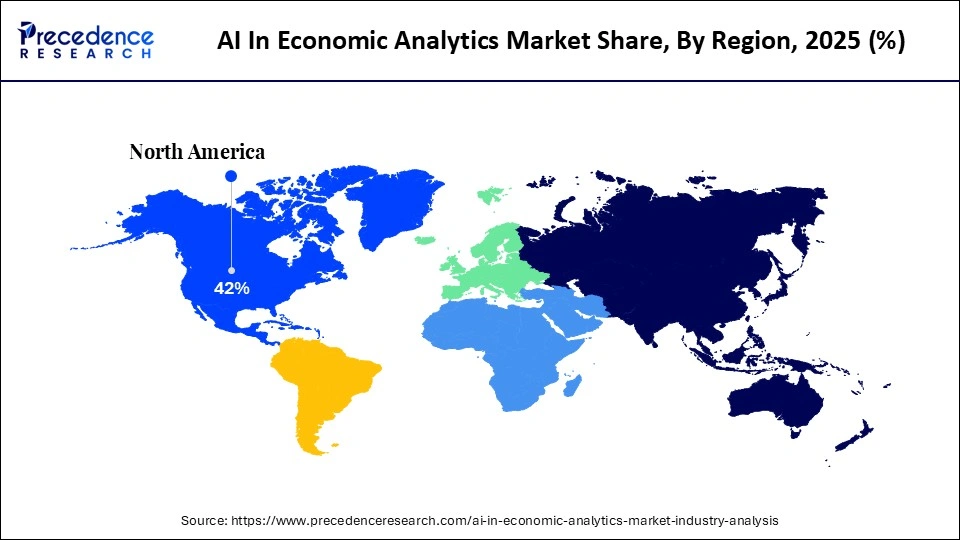
- North America dominated the market with the the largest market share of 42% in 2025.
- Asia-Pacific is expected to grow at the fastest CAGR during the foreseeable period.
- By component, the solutions segment held the largest market share in 2025.
- By component, the services segment is expected to grow at the fastest CAGR during the forecast period.
- By application, the macroeconomic forecasting segment held the largest market share in 2025.
- By application, the financial analytics segment is expected to grow at the fastest CAGR between 2026 and 2035.
- By end-user, the financial institutions segment held the largest market share in 2025.
- By end user, the corporate and enterprises segment is expected to grow at the fastest CAGR during the foreseeable period.
What is the Role of AI in Economic Analytics?
The AI in economic analytics market comprises an integration of advanced computational technologies, specifically machine learning, deep learning, and natural language processing, to manage and interpret vast, complex datasets that traditional econometric methods often struggle to process. It serves as a transformative toolset used to uncover hidden patterns, automate decision-making, and improve the precision of economic modelling.
The key applications span financial portfolio optimization, fraud detection, macroeconomic forecasting, and supply chain management. Growth factors driving this adoption include the exponential increase in available big data, improved computing power, and strategic investments by governments and enterprises to secure competitive advantages.
AI In Economic Analytics Market Trends
- AI is moving from passive analysis to agentic AI, where autonomous agents independently plan, execute, and verify entire analytical workflows with minimal human oversight.
- The proliferation of generative AI and large language models is transforming how unstructured data, such as financial reports, news articles, and social media feeds, is processed to deliver narrative summaries and predictive insights.
- The shift towards batch processing to real-time analytics allows for nowcasting, predicting the present state of the economy instantly, rather than waiting for lagged official data.
- As AI adoption increases, particularly in finance and government, the need for transparency is critical. Explainable AI (XAI) is becoming mandatory to make AI-driven decisions transparent and auditable, combating the black-box nature of deep learning to ensure trust, safety, and compliance.
- Data-centric AI and synthetic data for research prioritizes high-quality data over just model complexity, the use of synthetic data to protect privacy while allowing for robust testing and innovation in economic modeling.
Market Scope
| Report Coverage | Details |
| Market Size in 2025 | USD 10.34 Billion |
| Market Size in 2026 | USD 14.08 Billion |
| Market Size by 2035 | USD 227.14 Billion |
| Market Growth Rate from 2026 to 2035 | CAGR of 36.20% |
| Dominating Region | North America |
| Fastest Growing Region | Asia Pacific |
| Base Year | 2025 |
| Forecast Period | 2026 to 2035 |
| Segments Covered | Component, Application, End-User, and region |
| Regions Covered | North America, Europe, Asia-Pacific, Latin America, and Middle East & Africa |
Segmental Insights
Component Insights
Why Did the Solutions Segment Lead the AI In Economic Analytics Market?
The solutions segment led the market by holding the largest share in 2025. This is because the trend towards static modeling to dynamic, real-time intelligence, combining advanced predictive accuracy with operational efficiency and democratized data access, markets. While AI empowers faster and more complex decision-making, its future success depends on balancing these technical capabilities with transparency and ethical governance.
The services segment is expected to show the fastest growth over the forecast period, due to an increasing dependence on bridging the gap between sophisticated technology and organizational readiness. The shift towards AI-as-a-service and customized GenAI models allows firms to bypass internal experience shortages and legacy infrastructure hurdles. Long-term viability requires a focused effort on resolving data governance and regulatory challenges through strategic partnerships.
Application Insights
Which Application Segment Dominated the AI In Economic Analytics Market?
The macroeconomic forecasting segment held a dominant position in the market in 2025. This is because integrating unstructured, real-time data, these tools provide the superior accuracy needed to navigate modern market volatility and complex risk landscapes. The evaluations from descriptive reporting to prescriptive decision-making allow both governments and enterprises to anticipate disruptions rather than merely reacting to them. The synergy between high data availability and advanced machine learning creates a powerful strategic framework for optimized, data-driven economic policy and business strategy.
The financial analytics segment is expected to gain the highest market share between 2026 and 2035 by replacing manual, time-consuming processes with high-speed, automated intelligence. The integration of advanced technologies, such as ML and NLP, enables institutions to convert complex, multidimensional data into actionable insights while simultaneously strengthening risk management and regulatory compliance. The adoption of these tools represents a shift towards a more resilient, data-centric framework for financial and economic decision-making.
End-User Insights
How the Financial Institutions Segment Dominated the AI in Economic Analytics Market?
The financial institutions segment contributed the biggest market share in 2025, due to access to high-quality, digitalized datasets and the high-stakes nature of its real-time operations. By integrating advanced machine learning into quantitative trading and risk management, institutions achieve significant gains, including a reduction in fraud and lower operational costs. The shift toward predictive, AI-driven insights has made conventional econometric models obsolete for modern, high-speed financial decision-making.
The corporates and enterprises segment is expected to witness the fastest growth in the market over the forecast period, due to the increasing integration of generative AI and leveraging cloud-based accessibility. Enterprises are successfully moving from experimental stages to full-scale development across supply chains and financial planning. These tools allow businesses to process datasets that traditional models simply cannot process. The competitive pressure intensifies, and investing in these advanced analytical "moats" has become a critical requirement for long-term market leadership and sustainability.
Regional Analysis
North America AI In Economic Analytics Market Size and Growth 2026 to 2035
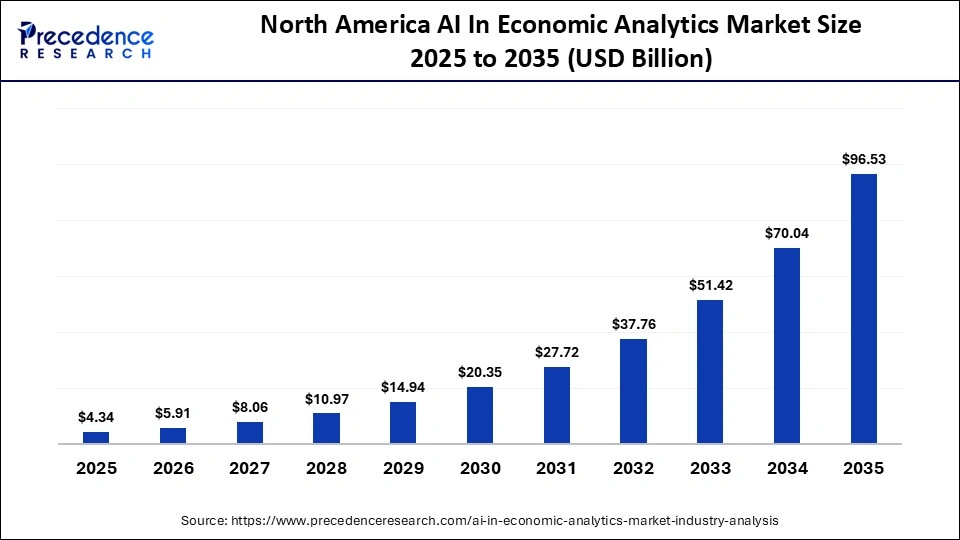
The North America AI in economic analytics market size is estimated at USD 4.34 billion in 2025 and is projected to reach approximately USD 96.53 billion by 2035, with a 36.37% CAGR from 2026 to 2035.
What Made North America the Dominant Region in the AI In Economic Analytics Market?
North America registered its dominance in the market by holding the largest share in 2025. This is mainly due to a world-class technological infrastructure and a concentrated ecosystem of hyperscalers, such as AWS and Microsoft. The robust venture capital environment and premier academic institution that continuously funnels elite R&D talent into Silicon Valley and beyond. Early and aggressive adoption across high-stakes sectors like finance and healthcare has allowed firms to move rapidly from experimentation to large-scale, data-driven implementation.
There is a massive proliferation of IoT and digital data, ensuring a constant supply of the "fuel" necessary for sophisticated machine learning models to thrive. Ultimately, this synergy of capital, infrastructure, and expertise creates a self-sustaining cycle of innovation that keeps the region at the global forefront of economic intelligence.
U.S. AI In Economic Analytics Market Size and Growth 2026 to 2035
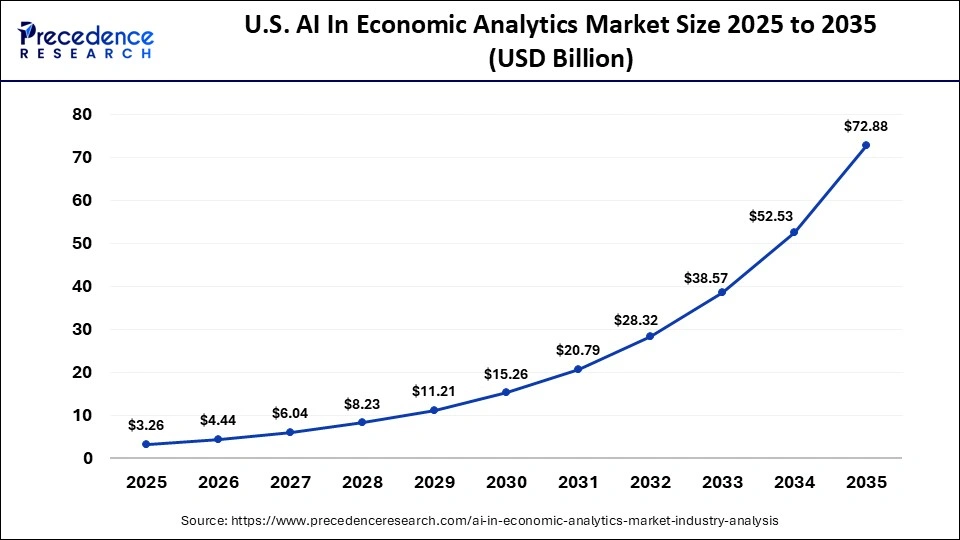
The U.S. AI in economic analytics market size is calculated at USD 3.26 billion in 2025 and is expected to reach nearly USD 72.88 billion in 2035, accelerating at a strong CAGR of 36.44% between 2026 and 2035.
U.S. Market Analysis
The market in the U.S. is growing due to the private investment that significantly outpaces global competitors. The dramatic reduction in AI inference costs has democratized access to high-level predictive modeling, allowing firms to shift from traditional analytics to real-time, sentiment-driven economic forecasting. The ability to balance these rapid productivity gains against the risks of "AI debt" will define the next era of American economic leadership.
Why is Asia-Pacific Rapidly Expanding in the AI in Economic Analytics Market?
Asia-Pacific is expected to experience the fastest growth during the predicted timeframe, due to the widespread adoption of super-apps and digital payment systems, providing the critical volume of data necessary to train sophisticated economic and financial models at scale. The regions are rapidly closing the infrastructure gap through massive investment in 5G and cloud computing. The combination of a tech-savvy demographic and robust technological innovation ensures that APAC will remain the world's fastest-growing market for AI-driven economic analytics.
China Market Analysis
In China, the market is evolving due to leveraging open-source dominance and integrating AI into smart cities and supply chains. The nation is successfully offsetting hardware constraints to achieve significant productivity gains. The intense domestic "war" among AI labs is accelerating the transition from foundational research to practical economic self-reliance and global technology export. This focus on "AI+" integration across manufacturing and logistics positions China as a primary architect of the next generation of global digital infrastructure.
Why is Europe Experiencing a Notable Growth in the AI in Economic Analytics Market?
Europe is expected to grow at a notable CAGR in the foreseeable future, as the region prioritizes digital sovereignty and high-value industrial applications, resulting in a boost in labor productivity. With world-class research output and a focused adoption of machine learning in manufacturing and finance, the region is successfully bridging the gap between theoretical innovation and economic output. The strategic focus on generative AI for social and policy functions ensures that European AI development is deeply integrated with its regulatory and economic values.
Germany Market Analysis
Germany is a global leader in the field of AI, particularly with regard to self-learning systems and machine learning. Germany's manufacturing and automotive sectors are driving transition by integrating generative AI and predictive analytics, a shift towards cloud infrastructure, and key technologies are driving the market growth. More than 70% of German companies seek to invest in AI for faster data analytics, process automation, new products, and business models.
Will Latin America Grow in the AI in Economic Analytics Market?
Latin America is considered to be a significantly growing area, due to a critical push to reverse stagnant productivity levels through high-impact applications in manufacturing, finance, and healthcare. By investing in localized solutions like LATAM-GPT, the region is ensuring that economic analytics are tailored to unique cultural and linguistic nuances rather than relying solely on foreign models. The leadership shown by the region in infrastructure and R&D positions the region as a highly reactive and rapidly maturing market for predictive economic intelligence.
Which Factors Drive the AI in Economic Analytics Market in the Middle East and Africa?
The Middle East and Africa are expected to grow at a considerable CAGR in the upcoming period, driven by a shift that is a cornerstone of economic diversification, with aggressive national AI strategies, an economic diversification ecosystem powered by massive investment in cloud and high-performance computing. By integrating AI into logistics, energy, and smart city projects, these nations are effectively managing vast datasets to optimize urban and industrial operations.
AI In Economic Analytics Market Companies
- Accenture PLC
- Amazon Web Services Inc.
- AlphaSense Inc.
- Bloomberg LP
- Economic AI
- DataRobot Inc.
- Ernst and Young Global Ltd.
- H2O.ai Inc.
- Google LLC
- International Business Machines Corp.
- London Stock Exchange Group plc
- KPMG International Ltd.
- Microsoft Corp.
Recent Developments
- In February 2026, researchers at the City University of Hong Kong developed a data-driven machine learning model for financial asset pricing that uses AI to enhance predictive accuracy and interpretability of portfolio construction. The “P-Trees” model enables investors to make better-informed decisions by simplifying complex market data.(Source: https://www.asiaresearchnews.com)
- In January 2026, Naver and the Bank of Korea developed BOKI (Bank of Korea Intelligence), a dedicated generative AI service specialized for finance and the economy. Bank of Korea aims that this tool will transform work culture, raise the level of Korea's financial and economic analysis, and serve as a foundation for strengthening competitiveness across the nation.(Source: https://biz.chosun.com)
- In June 2025, Bloomberg announced the launch of its Document Search & Analysis solution to empower investment professionals and corporate decision makers to ask questions and follow up using everyday language. The solution enables investors to transform their work, maximize productivity, and unlock insights for unique ideas. (Source: https://www.prnewswire.com)
Segments Covered in the Report
By Component
- Solutions
- Services
By Application
- Macroeconomic forecasting
- Financial Analytics
- Trade and Investment Analytics
- Labor Market Analytics
- Others
By End-User
- Government and Public Institutions
- Financial Institutions
- Corporates and Enterprises
- Research and Academia
- International Organizations
By Region
- North America
- Asia Pacific
- Europe
- Latin America
- Middle East & Africa
For inquiries regarding discounts, bulk purchases, or customization requests, please contact us at sales@precedenceresearch.com
Frequently Asked Questions





Ask For Sample
No cookie-cutter, only authentic analysis – take the 1st step to become a Precedence Research client
 Get a Sample




 sales@precedenceresearch.com
 Schedule a Meeting
