



Biopharma Analytics Market Size, Companies, Share, Patient Volume, Treatment Adoption Rates, Pricing Analysis, Regulatory Landscape, Competitive Positioning, and Demand Forecast
Biopharma Analytics Market (By Analytics Type: Descriptive Analytics, Predictive Analytics, Cognitive/AI-Driven Analytics; By Application: Drug Discovery & Preclinical Analytics, Commercial & Market Access Analytics, Pharmacovigilance & Safety Analytics, Real-World Evidence Analytics; By Solution Type: Software Platforms, Services, Data Integration & Infrastructure; By Deployment Mode: On-Premises, Cloud-Based, Hybrid; By Data Source: Clinical Data, Manufacturing & Batch Data, Commercial & Sales Data; By Technology: Big Data Analytics, Edge & Cloud Analytics; By End-User: Biopharmaceutical Companies, Research Institutes & Academia; By Organization Size: Large Enterprises, Small & Emerging Biotech; By Distribution Channel: Direct Enterprise Sales, Cloud Marketplaces, Consulting & Advisory Partners) - Global Industry Analysis, Size, Trends, Leading Companies, Regional Outlook, and Forecast 2026 to 2035
Source: https://www.precedenceresearch.com/biopharma-analytics-market
 Get a Sample
 Table Of Content

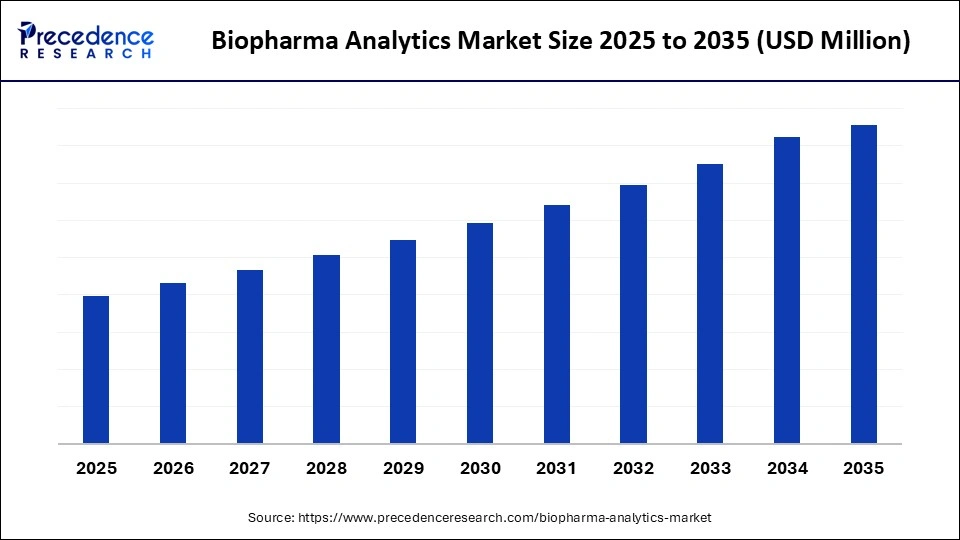
What is the Biopharma Analytics Market Size?
The global biopharma analytics market focuses on advanced data analytics solutions that support drug development, clinical trials, and commercialization. The biopharma analytics market is growing because pharmaceutical and biotechnology companies are increasingly using advanced data analytics to improve drug discovery efficiency, optimize clinical trial design, meet stricter regulatory reporting requirements, and reduce development timelines and costs.
Market Highlights
- North America dominated the market with the largest share in 2025.
- Asia Pacific is set to be the fastest-growing region in the market for biopharma analytics in the forecasted period between 2026 and 2035.
- By analytics type, the descriptive analytics segments led the market with the largest share in 2025.
- By analytics type, the predictive and cognitive analytics are expected to grow at the highest CAGR from 2026 to 2035.
- By application, the clinical trials & study optimization segment led the market in 2025.
- By application, the drug discovery analytics segment is set to be the fastest-growing in the biopharma analytics market with the highest CAGR from 2026 to 2035.
- By solution type, the software platform segment led the market during 2025.
- By solution type, the managed analytics services segment is set to grow at the highest CAGR in the market between 2026 and 2035.
- By deployment mode, the on-premise setups segment led the market in 2025.
- By deployment mode, the cloud-based analytics segment is set to be the fastest-growing from 2026 to 2035.
- By data source, the clinical data segment dominated the biopharma analytics market during 2025.
- By data source, the omics data segment is expected to expand at the fastest rate from 2026 to 2035.
- By technology, the big data analytics segment dominated the market in 2025.
- By technology, the AI & Machine Learning segment is expected to see the highest CAGR from 2026 to 2035.
- By end-user, the biopharmaceutical companies segment led the market in 2025.
- By end-user, the biotechnology firms segment is set to be the fastest-growing during the period between 2026 and 2035.
What is Biopharma Analytics Market?
The global biopharma analytics market covers analytics platforms, AI/ML systems, data integration tools, visualization software, and managed analytics services used across biopharmaceutical R&D, preclinical studies, clinical development, manufacturing, quality control, supply chain, regulatory operations, pharmacovigilance, and commercial strategy.
Biopharma analytics enables faster decision-making, predictive modelling, optimized trial designs, real-time operational insights, enhanced biologics manufacturing efficiency, and improved patient outcomes through data-driven processes. Growth is driven by the rapid expansion of biologics and advanced therapies, complex multi-omics datasets, demand for digital transformation, and increasing reliance on predictive and prescriptive analytics across the biopharma value chain.
What is the Significance of AI in the Biopharma Analytics Market?
Artificial Intelligence (AI) helps in transforming the biopharma analytics industry by converting massive, complex biological and clinical datasets into actionable insights. Additionally, the deployment of AI in the biopharma sector enhances the drug discovery process, optimizing clinical trials, streamlining manufacturing procedures, and lowering the overall production costs of drugs.
- In April 2026, IntegriChain launched a new conversational AI assistant platform. This AI assistant platform is designed to enhance the capabilities of biopharma manufacturing. (Source: https://www.prnewswire.com)
Market Trends
- Rising Use of Advanced Analytics in Drug Discovery and Preclinical Research: Biopharma companies are increasingly deploying predictive modeling, multivariate analysis, and AI-enabled analytics to identify viable drug targets, optimize lead compounds, and reduce early-stage attrition rates.
- Expansion of Analytics Across Clinical Trial Design and Management: Analytics platforms are being used to improve patient recruitment, site selection, protocol optimization, and real-time monitoring, helping sponsors reduce trial duration, control costs, and improve data quality.
- Growing Adoption of Real-World Evidence (RWE) and Real-World Data (RWD): Increasing regulatory acceptance of RWE is driving demand for analytics solutions that can process electronic health records, claims data, genomics, and registries to support regulatory submissions and post-market surveillance.
- Integration of AI and Machine Learning for Manufacturing and Quality Analytics: Biopharma manufacturers are applying advanced analytics to process monitoring, deviation detection, predictive maintenance, and batch release optimization to strengthen compliance with GMP requirements and improve yield consistency.
- Rising Demand for Cloud-Based and Scalable Analytics Platforms: Cloud-native biopharma analytics solutions are gaining traction due to their ability to support large, complex datasets, enable cross-functional collaboration, and reduce infrastructure costs while maintaining data security and compliance.
- Increased Focus on Personalized Medicine and Biomarker Analytics: Growth in precision medicine is accelerating adoption of analytics tools that integrate genomics, proteomics, and clinical data to support biomarker discovery, patient stratification, and targeted therapy development.
Market Scope
| Report Coverage | Details |
| Dominating Region | North America |
| Fastest Growing Region | Asia Pacific |
| Base Year | 2025 |
| Forecast Period | 2026 to 2035 |
| Segments Covered | Analytics Type, Application, Solution Type, Deployment Mode, Data Source, Technology, End-User, Organization Size, Distribution Channel, and Region |
| Regions Covered | North America, Europe, Asia-Pacific, Latin America, and Middle East & Africa |
Market Dynamics
Driver
Government Initiatives for Strengthening the Biopharma Sector
The governments of several countries, such as India, the U.S., China, and Germany, are launching a wide range of policies, such as innovations and collaborations, to develop the drug manufacturing sector. Additionally, numerous governments are making significant investments to deploy advanced technologies in the biopharma industry. Thus, the above-mentioned strategies are driving the market growth.
- In March 2026, the Indian Government launched the Biopharma SHAKTI Scheme. This scheme was launched to enhance the production of drugs across this nation. (Source: https://www.drishtiias.com/daily-updates/daily-news-analysis/biopharma-shakti-scheme)
Restraint
Stringent Regulatory Framework
Numerous strict regulations by public organizations to commercialize several drugs have lowered sales output in different regions, thereby causing negative impacts on the industry.
Opportunity
Surging Adoption of Digital Twins for Smart Manufacturing of Drugs
Pharma companies are constantly adopting digital twins to increase the production output of medicines. Thus, the technological advancements in digital twins are anticipated to create significant opportunities for the market players of biopharma analytics in the upcoming years.
Segment Insights
Analytics Type Insights
Why is Descriptive Analytics leading the Biopharma Analytics Market?
The descriptive analytics is dominating the biopharma analytics because it offers the necessary visibility of past performance, patient patterns, and operational efficiencies. The organizations are using descriptive dashboards heavily to understand trial timelines, recruitment trends, and safety signals. Its modesty and trustworthiness are what make it the ground layer on which all advanced analytics are built. Most groups still consider their digital transformation as a way of stabilizing their descriptive insights workflow first. The common use of EDC systems, LIMS platforms, and trial monitoring tools is supporting its dominance. Consequently, descriptive analytics remains the main instrument of data-driven decision-making in life sciences.
Predictive and cognitive analytics are growing rapidly as enterprises look for more foresight into drug efficacy, patient response, and clinical risk patterns. These instruments facilitate the prediction of trial delays, the establishment of the most suitable patient cohorts, and the prediction of therapeutic success to a greater extent. AI-driven cognitive engines are allowing quicker processing of unstructured data such as clinical notes and imaging files. The escalating demand for the shortening of development cycles is leading organizations to smarter forecasting systems. With the maturity of ML models, the trust in predictive insights is getting higher among R&D teams. Hence, the transition makes predictive and cognitive analytics the fastest-growing category in the analytics spectrum.
Application Insights
Why is Clinical Trials & Study Optimization leading the Biopharma Analytics Market?
The clinical trials & study optimization are dominating the Biopharma Analytics market and are leading the application space, as they are the main source of massive volumes of both structured and unstructured data that require continuous analytics support. Sponsors employ analytics to monitor recruitment, detect anomalies, and ensure protocol compliance. Real-time dashboards are instrumental in patient safety, as they alert the occurrence of adverse events early. Trial optimization tools, in turn, also lower the operational costs by allowing the more efficient use of resources. As regulatory pressures become stronger, companies are increasingly relying on analytics to keep up with the quality of the trials. This is what makes clinical trial analytics the core application in the market.
Drug discovery analytics is expanding at the fastest CAGR due to AI and machine learning that are speeding up target identification and molecule screening. Presently, companies resort to algorithms to traverse vast chemical spaces at an unimaginable speed. Additionally, preclinical analytics is helping the mechanistic modeling, toxicity prediction, and in vitro/in vivo correlation assessment processes. The necessity to lower the failure rate of early-stage R&D is what is causing the huge investments in this area. As the datasets from omics and high-throughput screening grow, analytics is becoming a must-have. That is why drug discovery and preclinical analytics is the fastest-growing application segment.
Solution Type Insights
Why is Software Platforms leading the Biopharma Analytics Market?
Software platforms are the leading segment in the market because they act as the central environment where enterprises bring together data, perform analytics, and manage workflows. These platforms provide the R&D teams with scalability, regulatory compliance, and a single source of truth. The companies opt for stable, customizable software that can handle multiple study types and datasets. The ability to add AI modules, visualization dashboards, and statistical engines enhances their usefulness. When data gets more complicated, powerful platforms become even more necessary. That, therefore, keeps software platforms as the dominant solution type.
Managed analytics services are set to be the fastest-growing in the market as organizations want to hire outside experts to deal with complex data integration, model building, and reporting tasks. Quite a few biotech companies are without in-house data science teams, and they rely on managed services for quick insights. Such services are also about continuous monitoring, model tuning, and provision of regulatory-compliant analytics outputs. Besides, outsourcing reduces the operational burden, and the pace of R&D is thus accelerated.
Deployment Mode Insights
Why is On-Premise leading the Biopharma Analytics Market?
On-premise setups are leading mainly due to their ability to provide increased data security, which is very important for sensitive clinical and genomic data. The big pharma companies are more comfortable with having local control over the infrastructure and regulatory compliance. Without the dependence on internet connection, on-premise installations can also assure steady performance. It is largely because many of the old analytics systems were designed for on-premise that the transition is not very fast. For the most important functions, people still prefer stable in-house servers. Hence, despite the development of the cloud, on-premise deployment is still in a dominant position.
Cloud-based analytics is the fastest-growing in the market because organizations are willing to move into environments that offer them flexibility, scalability, and collaboration possibilities. Thanks to cloud systems, data sharing becomes easy between global R&D teams and trial sites. They facilitate AI workloads that demand a lot of computational power. The cloud providers do not only take the load off the IT department by offering security and compliance frameworks but also by enabling easy upgrades. Given the growth of remote research and digital trials, the cloud seems to be the natural workflow for the future. So, cloud deployment is enjoying considerable, sustained growth.
Data Source Insights
Why is Clinical Data leading the Biopharma Analytics Market?
Clinical data is dominating the biopharma analytics market due to analytics usage, as it is the main evidence that regulatory submissions and patient safety require. The amount of data coming from the trials is so huge that they must be continuously cleaned, monitored, and interpreted. The regulatory agencies impose the necessity of top-quality analytics around efficacy and safety endpoints. For the clinical teams, analytics is a must if they want to keep track of the deviations and be compliant in real time. Also, the integration of wearables and digital biomarkers into the clinical datasets makes them even more central. This helps to keep clinical data at the core of most analytics systems.
Omics data is the quickest to develop in that genomic, transcriptomic, proteomic, and metabolomic datasets are the building blocks of precision medicine. These datasets require highly advanced computational models to be able to understand the complex biological relationships. The use of AI and ML is speeding up the process of finding biomarkers and therapeutic targets. The way omics data is progressing is also the reason why the cost of sequencing and multi-omics profiling is going down and the number of adoptions is increasing all over the research programs. The demand for personalized therapy is largely dependent on the availability of omics-based insights. That is why omics data is the fastest-expanding analytics category.
Technology Insights
Why is Big Data Analytics leading the Biopharma Analytics Market?
Big data analytics is dominating the biopharma analytics market because of the grand scale of life sciences datasets, which include EHRs and multi-site clinical trials. These are the tools that can deal with huge, diverse datasets with high speed and great reliability. The big data frameworks are deeply interwoven with the enterprise workflows. Organizations use them for their routine reporting and operational intelligence. Their stability and maturity are what give them an advantage over newer technologies. This makes big data analytics the technological foundation that is still dominant.
AI & Machine Learning is the fastest-growing in the biopharma analytics market, due to predictive insights that conventional systems cannot provide. Using machine learning models, one can find the hidden patterns of clinical outcomes, molecular properties, and biological pathways. Many companies are now implementing AI to lower the rate of trials that end in failure and increase the success rate of new discoveries. Apart from this, the mentioned technologies are also helpful in the automation of such tasks that are usually labor-intensive, e.g., data curation, anomaly detection, etc. Almost in every stage of the R&D pipeline, as an outcome of growing trust in AI, adoption is happening. The rapid growth of AI/ML is the most significant factor behind this hype.
End-User Insights
Why is Biopharmaceutical Companies foremost in the Biopharma Analytics Market?
The biopharmaceutical companies are dominating the biopharma analytics market, due mainly to the representatives in the field of analytics, as they are the ones who conduct most trials and must deal with the largest datasets. To carry these out efficiently, they need advanced analytics, e.g., to submit documents for drug approval, monitor drug safety, and conduct trials all over the world. Large internal teams and budgets facilitate the process of getting on board. At the same time, those companies also integrate analytics through the different stages of the lifecycle, from discovery through development to commercialization. With several pipeline assets, analytics becomes a strategic necessity. This is especially influential on biotech firms, which makes them the dominant end users.
The biotechnology firms are the fastest-growing in the biopharma analytics market, driving an acceleration of less resource-intensive and more diligent development pipelines. There are several biotechs that decide on analytics use to make up for the shortage of people at the internal level as well as inadequate infrastructure. AI-powered insights provide them with a better way of target selection, trial design optimization, and risk management. As the early-stage biotechs are looking into precision and specialty therapies increasingly, analytics turns out to be the main decision-making tool. Moreover, apart from the facilitation of implementation through external partnerships, the use of cloud-based tools offers even more straightforward adoption. Hence, biotechnology is an industry with the fastest-growing number of users.
Organization Size Insights
Why is Large Enterprises leading the Biopharma Analytics Market?
The large enterprises are dominating the biopharma analytics market because of having well-built analytics structures, being experienced in regulatory issues, and having multi-skilled data teams. What essentially makes their continuous analytical needs so hard to meet is the fact that their extensive pipelines go through numerous different stages. They do so by investing in enterprise-grade platforms that easily integrate with their outdated systems. The huge trials carried out on a large scale result in massive datasets, and for this reason, sophisticated analytics become necessary. Being equipped with enough economic resources allows them to go for long-term investments in both AI and big data capabilities. That is why large enterprises still hold the dominant position. Small & Emerging Biotech.
Small and emerging biotechs top the list of the most rapid adopters of analytics, as they are very much reliant on digital tools to be in the competition with the bigger players in the field. most of them embrace cloud-native systems that enable a fast rollout without the need for heavy infrastructure. AI-powered platforms are the means through which these companies fast-track their assets with fewer resources. As startups turn their attention to niche therapeutic areas, analytics becomes a vital factor that differentiates one from another.
Distribution Channel Insights
Why is Direct Enterprise Sales leading the Biopharma Analytics Market?
The direct enterprise sales leading the biopharma analytics market are on top of the game, as large pharmaceutical companies tend to opt for direct partnerships when it comes to security, customization, and long-term support. Usually, enterprise buyers need tailored integrations as well as implementations compliant with regulations. It is through these direct relationships that the resolution of problems occurs at a faster pace and there is dedicated account management. Most of the legacy contracts were created through direct sales models; thus, the continuity gets strengthened. Apart from that, these channels are also better aligned with enterprise procurement structures. So, the direct sales are still the main distribution pathway.
The cloud marketplace is the fastest-growing in the biopharma analytics market, driven are expanding, companies are becoming inclined towards these as portable and instantly available-to-use analytics tools without the need for stiff procurement cycles. They are provided with the opportunity to implement AI modules, data visualization tools, and workflow engines instantly. What is more, for the sake of flexibility and lower upfront costs, a majority of smaller biotechs would subscribe to marketplaces rather than other alternatives. The vendors endure the benefit in terms of the extended reach and simplified subscription models. The advent of cloud-native R&D environments is catalyzing marketplace adoption. As a result, cloud marketplaces are the fastest-growing channel.
Regional Insights
Why Does North America Continue to Dominate the Biopharma Analytics Market?
North America is dominating the biopharma analytics market due to its heavy concentration of biotech innovators and state-of-the-art clinical research facilities. North America is still the leading center of cell and gene therapy. The area is like a big money tree where investors are always willing to put their money into the next generation of therapies. Besides, regulatory pathways are more visible and easier, thus allowing fast transitions from trials to approvals. North American producers have also mastered the skill of viral vectors, cell processing, and analytical testing, giving them a considerable advantage over the rest of the world. Patient access programs, as well as rising clinical adoption, help to consolidate leadership locally. In general, North America is the mainstay that determines the worldwide direction of advanced therapies.
U.S. Biopharma Analytics Market
The U.S. is in the driver's seat with most of the shares, this being mainly due to its crowded biotech corridors and incomparable R&D capabilities. American academic institutions are constantly the leaders when it comes to the foundational breakthroughs in gene editing, cell engineering, and vector innovation. The US clinical trial ecosystem is enormous, thus making rapid patient recruitment and efficient validation of emerging therapies possible. Various manufacturing expansions, that is, from modular facilities to large-scale vector plants, are meeting supply demands. Although reimbursement frameworks are still in transition, they are gradually getting used to one-time curative treatments.
How Is Asia Pacific the Fastest-Growing Biopharma Analytics Market?
Asia Pacific region is establishing itself as the fastest developing area, mainly due to the increased healthcare investments, improved biotech capabilities, and strong governmental support. The adoption of cell and gene therapies in the region is going at an accelerated pace as the demand for precision medicine rises in the major population hubs. Biotech companies within the region are widening clinical pipelines and facilitating their own manufacturing to be less dependent on the Western side. Several countries have embraced the building of GMP facilities that are specialized in cell expansion, viral vectors, and regenerative medicine.
China Biopharma Analytics Market
China is very resolute in building up its advanced therapy community by means of strong government backing, increasing biotech investments, and speedy GMP facility construction. Japan keeps on being a major player, especially in regenerative medicine, as the country is characterized by regulatory flexibility that enables quicker market entry for innovative therapies. South Korea is reinforcing its position via strong academic-industry collaborations and a rising startup ecosystem. What all three countries share is that they are upgrading their manufacturing capabilities, from vector production to allogeneic cell therapy platforms.
What are the Advancements in the Biopharma Analytics Market in Europe?
Europe is expected to witness significant growth in the market. This growth is because the region benefits from a strong regulatory environment that encourages innovation and collaboration among stakeholders. Increasing investments in healthcare technology and a growing emphasis on patient-centric approaches are also gaining traction, further driving the demand for analytics solutions. Additionally, the rise of digital health initiatives is expected to further boost market growth in the coming years. Countries such as Germany, France, and the UK are leading players.
Germany Market Trends
The country's market landscape is characterized by a mix of established firms and emerging startups, all competing for the highest market share. As pharmaceutical companies increasingly adopt data analytics to improve operational efficiency and patient outcomes, the region is poised for continued expansion in this sector.
What are the Key Trends in the Biopharma Analytics Market in Latin America?
Latin America is expected to witness a substantial amount of growth in the region, driven by increasing healthcare expenditure and a growing emphasis on data-driven decision-making. Government initiatives aimed at enhancing healthcare infrastructure and digital transformation are also gaining traction, thus contributing to market growth and creating a favorable environment for biopharma analytics adoption. Countries like Brazil and Mexico are leading players in the region.
Brazil Market Trends
Medical analytics companies in the region are expanding their presence in the region, offering tailored solutions to meet the unique needs of healthcare providers. As the demand for improved patient outcomes and operational efficiency rises, the market is poised for significant growth.
How is the Middle East and Africa Region Growing in the Biopharma Analytics Market?
The Middle East and Africa region is expected to grow significantly in the upcoming years, driven by increasing investments in healthcare infrastructure and a growing focus on data analytics. Government initiatives aimed at enhancing healthcare services and digital transformation are key drivers of the growth and are helping in fostering a fertile environment for biopharma analytics adoption. Countries like Saudi Arabia, South Africa, and the UAE are leading players.
Saudi Arabia Market Trends
Healthcare analytics software companies in the region are increasingly focusing on developing analytics solutions tailored to the unique challenges faced by healthcare providers in the region. As healthcare organizations prioritize data-driven decision-making, the demand for biopharma analytics is expected to rise even further.
Biopharma Analytics Market Value Chain Analysis
- Raw Material Sourcing
Sourcing raw materials for biopharma analytics entails recognizing, assessing, and acquiring top-quality raw materials while handling supply chain risks, ensuring adherence to regulations, and reducing variability between lots.
Key players: Canaan Partners, Lumira Ventures - R&D
R&D is essential for developing new therapies, improving patient outcomes, and leveraging analytics to drive informed decision-making within the biopharmaceutical industry.
Key players: Russian Venture Company
Who are the Major Players in the Global Biopharma Analytics Market?
The major players in the biopharma analytics market include IQVIA, Saama Technologies, Clarivate, Axtria, Indegene, SAS (Life Sciences), ZS Associates, Real Chemistry, Parexel, ICON plc, Medidata Solutions, ArisGlobal, Labcorp (Covance), Trinity Life Sciences, TAKE Solutions, and SCIO Health Analytics.
Recent Developments
- In May 2026, Agilent Technologies partnered with Veeda Lifesciences. This partnership was done to enhance regulatory aligned analytical and bioanalytical workflows for supporting biopharma development in different parts of the world. (Source: https://veedalifesciences.com)
- In April 2026, Lantern Pharma launched Zeta.ai. Zeta.ai is a comprehensive multi-agentic AI platform designed for accelerating drug discovery of cancers.(Source: https://www.businesswire.com)
- In April 2026, AWS launched the Amazon Bio Discovery. Amazon Bio Discovery is an AI-based drug development platform designed for scientists to enhance the design and testing of novel drugs. (Source: https://www.aboutamazon.com/news/aws/aws-amazon-bio-discovery-ai-drug-research)
- In February 2026, Within3 launched the Dataverse. Dataverse is an advanced intelligence platform designed for the biopharma companies globally.
(Source: https://finance.yahoo.com) - In December 2025, Amazon Web Services (AWS) revealed a range of enhancements during re:Invent 2025 that are anticipated to impact how hospitals, diagnostic companies, pharmaceutical firms, and research organizations utilize cloud-based solutions for imaging, genomics, and clinical data processing. To kick off this broader transition, AWS Chief Executive Officer Matt Garman stated: Two years ago, individuals were developing AI applications. Now, individuals are creating applications that incorporate AI.
Segments Covered in the report
By Analytics Type
- Descriptive Analytics
- Predictive Analytics
- Prescriptive Analytics
- Cognitive/AI-Driven Analytics
By Application
- Drug Discovery & Preclinical Analytics
- Clinical Trials & Study Optimization
- Manufacturing & Bioprocess Analytics
- Quality Control & Compliance Analytics
- Supply Chain & Operations Analytics
- Commercial & Market Access Analytics
- Pharmacovigilance & Safety Analytics
- Real-World Evidence (RWE) Analytics
By Solution Type
- Software Platforms (Analytics/BI Tools)
- Services (Consulting, Managed Analytics)
- Data Integration & Infrastructure (Cloud, Warehousing)
By Deployment Mode
- On-Premises
- Cloud-Based
- Hybrid
By Data Source
- Clinical Data (EHR, EMR, CTMS)
- Omics Data (Genomics, Proteomics, Metabolomics)
- Real-World Data (RWD)
- Manufacturing & Batch Data
- Commercial & Sales Data
By Technology
- Big Data Analytics
- Artificial Intelligence & Machine Learning
- Natural Language Processing (NLP)
- Data Visualization & BI Tools
- Edge & Cloud Analytics
By End-User
- Biopharmaceutical Companies
- Biotechnology Firms
- Contract Research Organizations (CROs)
- CDMOs/Biomanufacturing Partners
- Research Institutes & Academia
By Organization Size
- Large Enterprises
- Medium Enterprises
- Small & Emerging Biotech
By Distribution Channel
- Direct Enterprise Sales
- Technology Integrators
- Cloud Marketplaces
- Consulting & Advisory Partners
By Region
- North America
- Europe
- Asia-Pacific
- Latin America
- Middle East & Africa
For inquiries regarding discounts, bulk purchases, or customization requests, please contact us at sales@precedenceresearch.com
Frequently Asked Questions





Ask For Sample
No cookie-cutter, only authentic analysis – take the 1st step to become a Precedence Research client
 Get a Sample




 sales@precedenceresearch.com
 Schedule a Meeting
