



Chemical Hydrogen Market Size, Companies, Share, Production Capacity, Raw Material Pricing, Export & Import Analysis, Manufacturing Cost, Competitive Positioning, and Demand Forecast
Chemical Hydrogen Market (By Production Type: Grey Hydrogen, Blue Hydrogen, Green Hydrogen; By Application: Ammonia Production, Methanol Production, Petroleum Refining, Others; By End-Use: Chemical Processing, Energy Storage, Transportation) - Global Industry Analysis, Size, Trends, Leading Companies, Regional Outlook, and Forecast 2026 to 2035
Source: https://www.precedenceresearch.com/chemical-hydrogen-market
 Get a Sample
 Table Of Content


What is Chemical Hydrogen Market Size in 2026?
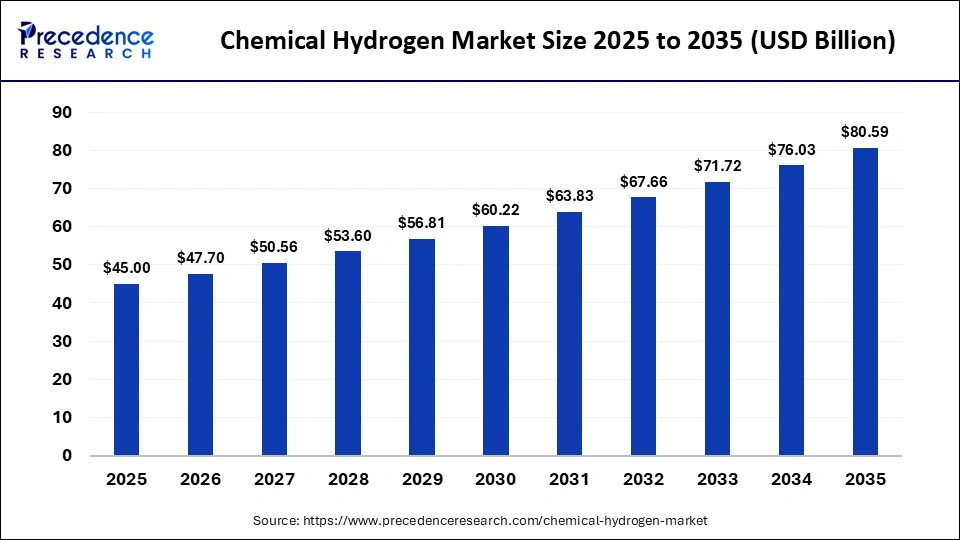
The global chemical hydrogen market size was calculated at USD 45.00 billion in 2025 and is predicted to increase from USD 47.70 billion in 2026 to approximately USD 80.59 billion by 2035, expanding at a CAGR of 6.00% from 2026 to 2035. This market is rapidly expanding as industries increase the production and use of hydrogen for clean energy, chemical synthesis, and decarbonization initiatives across sectors like refining, fertilizers, and industrial chemicals.
Key Takeaways
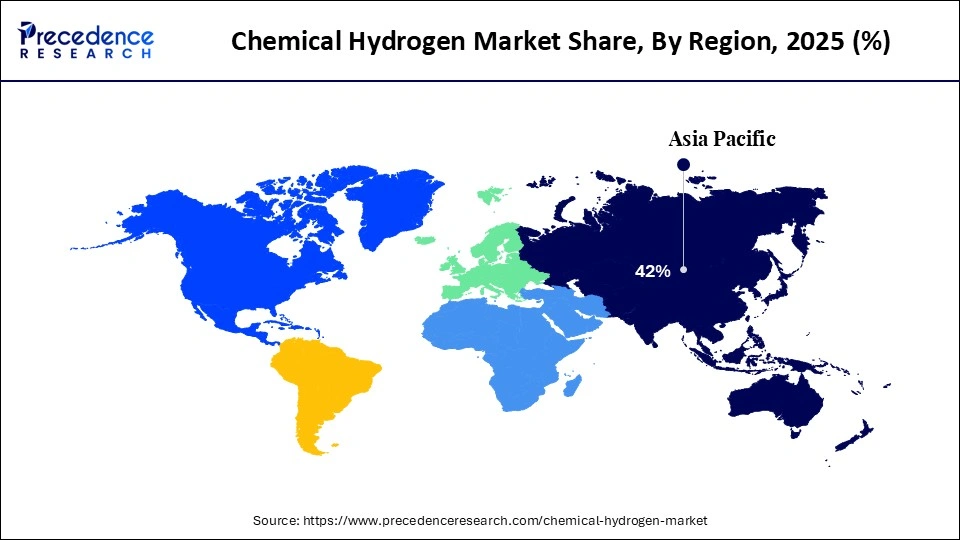
- Asia Pacific dominated the market with a major share of 42% in 2025.
- North America is expected to grow at the fastest CAGR of 6.5% between 2026 and 2035.
- By production type, the grey hydrogen segment held the biggest market share of 68% in 2025.
- By production type, the blue hydrogen segment is expected to expand at a robust CAGR of 5.2% between 2026 and 2035.
- By application, the ammonia production segment contributed to the highest market share of 42% in 2025.
- By application, the methanol production segment is expected to grow at a strong CAGR of 5.4% between 2026 and 2035.
- By end use, the chemical processing segment held the highest market share of 78% in 2025.
- By end use, the energy storage segment is expected to expand at a CAGR of 5.6% from 2026 to 2035.
What Drives the Growth of the Market?
The chemical hydrogen market is expanding steadily because of its vital role in the production of methanol and ammonia, emerging clean energy applications, and petroleum refining. Increasing fertilizer use, growing demand for low-sulfur fuels, and growing attention to decarbonization are the main growth factors. The market outlook is also being strengthened by investments in green and blue hydrogen production technologies as industries shift to more sustainable and clean energy sources.
How is Artificial Intelligence Transforming the Chemical Hydrogen Market?
Artificial intelligence is transforming the market through cost reduction, increased operational effectiveness, and production process optimization. Monitoring systems with AI capabilities improve electrolyzer performance, predict equipment failures, and allow for real-time process control. Additionally, energy management is enhanced and integration with renewable power sources is supported by advanced data analytics. Large-scale commercialization and sustainable hydrogen production are being accelerated by artificial intelligence as digital technologies grow.
Chemical Hydrogen Market Trends
- Growing investments in renewable-powered electrolysis are accelerating the adoption of green hydrogen across industries.
- The integration of carbon capture technologies in hydrogen production is gaining traction to reduce emissions.
- Stricter fuel regulations are increasing hydrogen consumption for desulfurization processes in refineries.
- Rising fertilizer demand is driving the use of hydrogen in ammonia manufacturing.
- Governments and private players are investing in storage, transport, and pipeline networks to support hydrogen distribution.
- Heavy industries are increasingly adopting hydrogen to reduce their carbon footprints.
- Improvements in efficiency and cost reductions of electrolyzer systems are supporting scalable hydrogen production.
- Energy companies are forming collaborations and making investments to expand hydrogen production capacity.
Future Market Outlook
- Large-Scale Green Hydrogen Plants: Expanding renewable energy projects create strong opportunities for clean hydrogen production.
- Hydrogen Export Markets: Countries investing in hydrogen hubs can tap into global export demand.
- Integration with Renewable Energy: Surplus solar and wind power can be utilized for hydrogen generation.
- Hydrogen for Power Generation: Blending hydrogen in gas turbines offers new energy transition opportunities.
- Transportation Fuel Applications: Fuel cell vehicles and heavy transport sectors present long-term growth potential.
- Carbon Capture & Storage (CCS) Expansion: Blue hydrogen projects linked with CCS provide investment opportunities.
- Hydrogen Storage Technologies: Advanced storage solutions such as liquid hydrogen and solid carriers are emerging.
- Industrial Hydrogen Hubs: Cluster-based hydrogen ecosystems can drive regional economic growth.
Government Initiatives Supporting the Chemical Hydrogen Market
|
Government Initiatives |
Country |
Key Support for the Hydrogen Market |
|
Hydrogen Strategy |
European Union |
Promotes green hydrogen production, infrastructure development, and investment incentives for decarbonization. |
|
Hydrogen Energy Earthshot |
United States |
Aims to reduce clean hydrogen costs and accelerate large-scale production and adoption. |
|
National Hydrogen Mission |
India |
Supports domestic green hydrogen production and builds hydrogen infrastructure to reduce fossil fuel dependence. |
|
Made in China 2025 |
China |
Encourages advanced hydrogen technologies and strengthens domestic manufacturing capabilities. |
|
Net Zero Strategy |
United Kingdom |
Promotes hydrogen as a key clean energy source to achieve long-term carbon neutrality goals. |
How is the Chemical Hydrogen Market Staying Resilient?
The market for chemical hydrogen remains robust by lowering risk through the use of various production techniques, including grey, blue, and green hydrogen. Additionally, to comply with environmental regulations, businesses are implementing cleaner procedures and advancements in technology. Growing industrial demand, government assistance, and stable supply contracts all contribute to steady growth. Constant expenditure on safety measures and infrastructure reinforces market stability even more. Additionally, the growing global focus on green and blue hydrogen for sustainable energy solutions sustains long-term market growth and resilience.
Market Scope
| Report Coverage | Details |
| Market Size in 2025 | USD 45.00 Billion |
| Market Size in 2026 | USD 47.70 Billion |
| Market Size by 2035 | USD 80.59 Billion |
| Market Growth Rate from 2026 to 2035 | CAGR of 6.00% |
| Dominating Region | Asia Pacific |
| Fastest Growing Region | North America |
| Base Year | 2025 |
| Forecast Period | 2026 to 2035 |
| Segments Covered | Production Type, Application , End Use, and region |
| Regions Covered | North America, Europe, Asia-Pacific, Latin America, and Middle East & Africa |
Segment Insights
Production Type Insights
What Made Grey Hydrogen the Dominant Segment in the Chemical Hydrogen Market?
The grey hydrogen segment dominated the market with the largest share of 68% in 2025. This is because it is produced from natural gas through established, cost-effective steam methane reforming (SMR) processes. Its lower production cost compared to green and blue hydrogen makes it widely used in refineries, ammonia production, and other industrial applications. Grey hydrogen is still used in large-scale industrial applications because of its steady supply and cheaper startup costs. It is the favored choice for many manufacturers due to its well-established technology and broad accessibility.
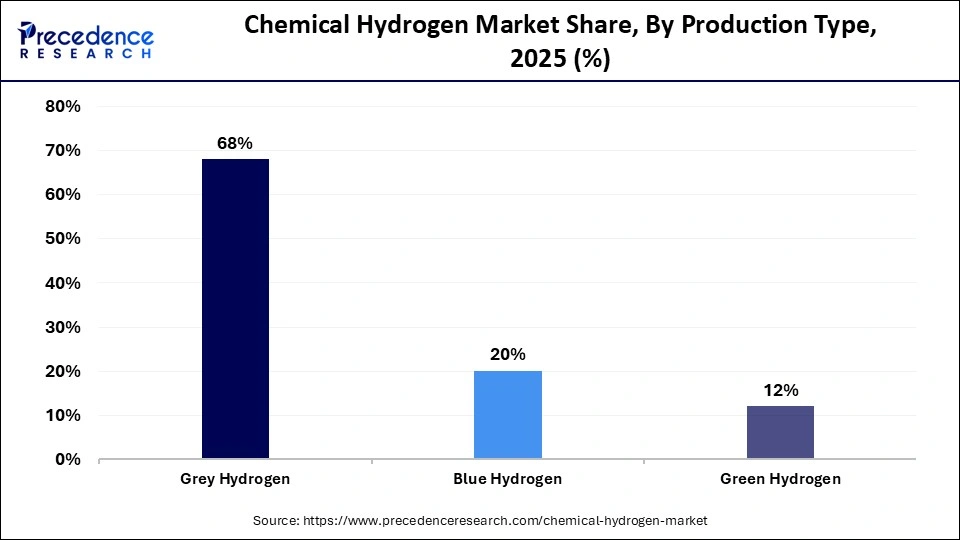
The blue hydrogen segment is expected to grow at the fastest CAGR of 5.2% in the coming years because low-carbon hydrogen solutions are in high demand. It combines the cost-effectiveness of conventional hydrogen production with carbon capture and storage (CCS) technologies, significantly reducing greenhouse gas emissions. Investment in cleaner hydrogen alternatives is driven by growing environmental regulations and sustainability objectives. Blue hydrogen projects are being funded by governments and energy companies to help achieve energy transition objectives. Additionally, as industries aim to transition toward greener alternatives without the higher costs of green hydrogen, blue hydrogen is emerging as a strategic bridge solution, fueling its rapid growth.
Application Insights
Why Did the Ammonia Production Segment Dominate the Chemical Hydrogen Market?
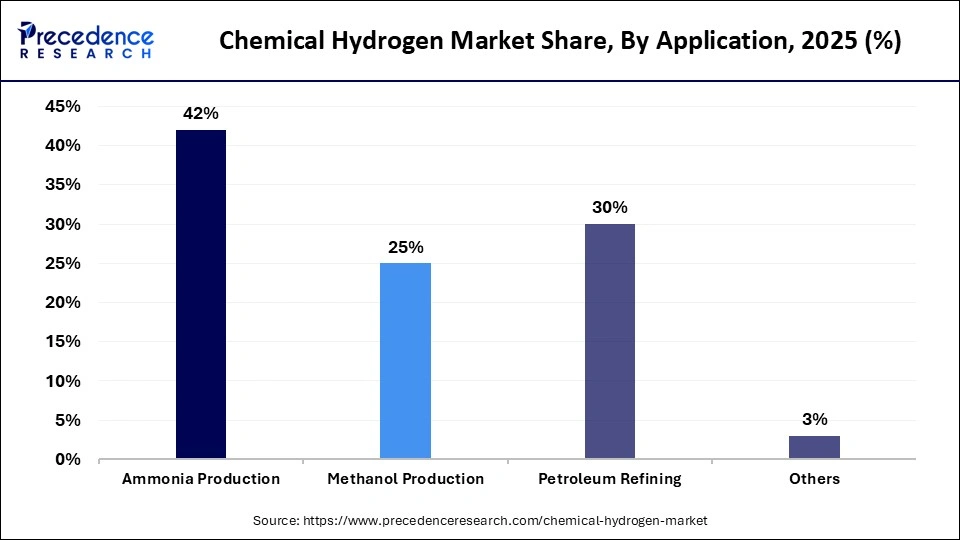
The ammonia production segment dominated the market with a 42% share in 2025 because the production of ammonia depends heavily on hydrogen. The ongoing use of hydrogen in this application is supported by the strong worldwide demand for agricultural productivity. A steady supply of hydrogen is essential to fertilizer manufacturing companies. Global food production demands are growing, which increases demand for ammonia-based fertilizers.
The methanol production segment is expected to grow at the fastest CAGR of 5.4% CAGR in the coming years because hydrogen is a critical feedstock for synthesizing methanol, which is widely used in chemicals, fuels, and industrial applications. Increasing demand for methanol as a clean fuel additive and as a raw material in formaldehyde, acetic acid, and plastics production is driving hydrogen consumption. Additionally, stricter environmental regulations are encouraging the use of hydrogen-based methanol production to reduce carbon emissions, further boosting growth in this segment.
End Use Insights
What Made Chemical Processing the Leading Segment in the Chemical Hydrogen Market?
The chemical processing segment led the market with a 78% market share in 2025 because hydrogen is frequently utilized as a primary feedstock in petrochemical production. Its strong market position is supported by the high industrial reliance on hydrogen for efficient production. Its dominance is also a result of established infrastructure. Constant demand from chemical plants and refineries keeps consumption levels steady
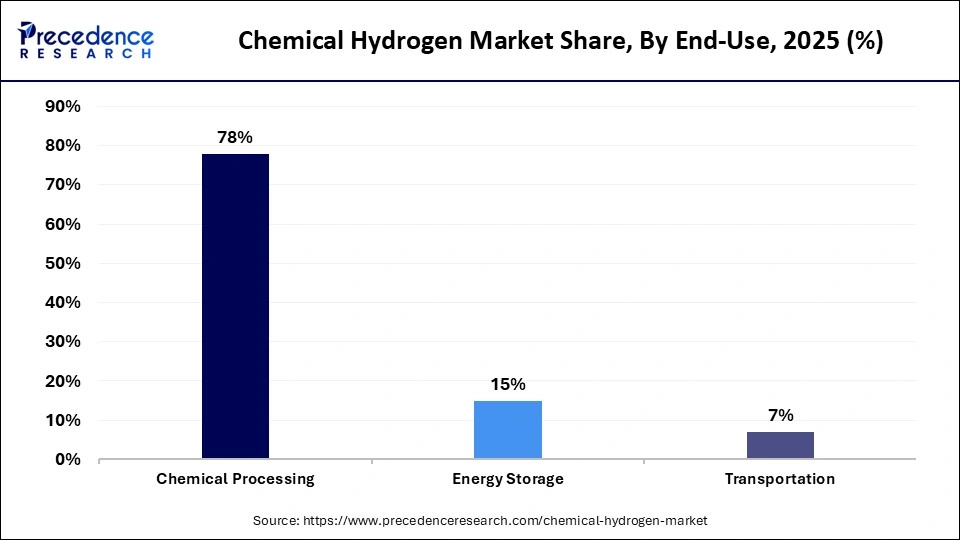
The energy storage segment is expected to grow at the fastest CAGR of 5.6% CAGR in the coming years because the use of hydrogen as a clean energy storage solution is growing. The need for effective storage systems is driven by the growing integration of renewable energy. Long term energy management and grid stability are supported by hydrogen-based storage. Growth of this segment is being aided by rising investments in renewable energy and decarbonization programs.
Regional Insights
Asia Pacific Chemical Hydrogen Market Size and Growth 2026 to 2035
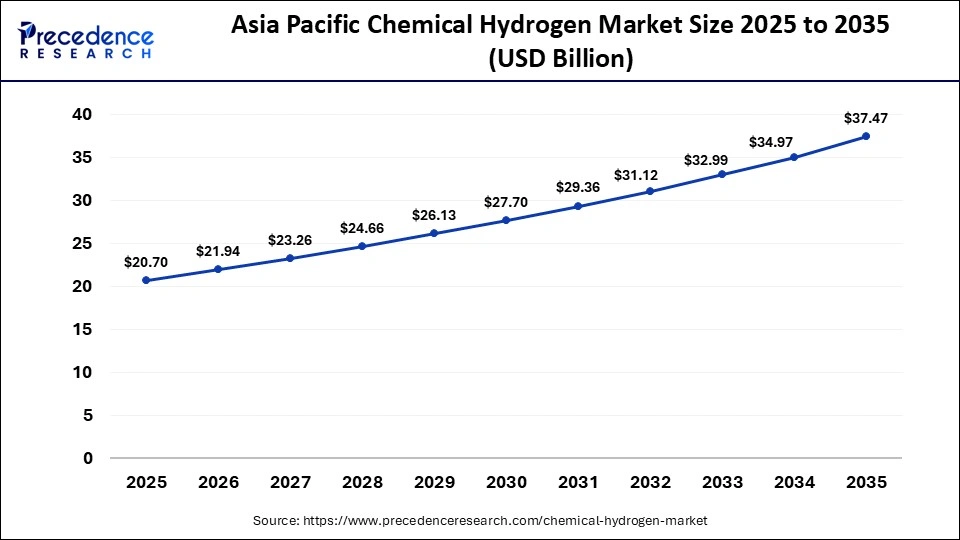
The Asia Pacific chemical hydrogen market size is estimated at USD 20.70 billion in 2025 and is projected to reach approximately USD 37.47 billion by 2035, with a 6.11% CAGR from 2026 to 2035.
How is the Opportunistic Rise of Asia Pacific in the Market?
Asia Pacific is expected to grow at the fastest CAGR of 6.5% CAGR in the coming years due to the rapid industrialization and the growing need for hydrogen in the energy and chemical industries. Market expansion is accelerated by rising investments in green hydrogen and renewable energy projects. Regional market growth is further strengthened by increasing manufacturing activities and government support. The adoption of hydrogen is growing across the region due to rising population and energy consumption.
Why Did North America Dominate the Chemical Hydrogen Market?
North America dominated the market with 35% market share in 2025 because of sophisticated hydrogen production facilities, robust industrial infrasrtcuture and encouraging government regulations. Projects involving clean hydrogen and energy transition have received substantial funding in this area. Strong markets are also a result of large oil and gas companies. Technology adoption and advancement are facilitated by ongoing research and development efforts.
U.S. Chemical Hydrogen Market Trends
The U.S. dominates the North American market because of its well-established petrochemical and refining sectors, which need a lot of hydrogen for processing. Cost-effective production of grey hydrogen is supported by a strong supply of natural gas. Large-scale production facilities and sophisticated hydrogen infrastructure are also present in the nation. Its market position is further strengthened by ongoing investments in carbon capture technologies and clean hydrogen projects.
India Chemical Hydrogen Market Trends
The market in India is primarily driven by strong government support for integrating renewable energy and developing green hydrogen. Growing investments in industrial decarbonization and sustainable fuel alternatives are further boosting demand. Hydrogen production projects are encouraged by initiatives aimed at enhancing energy security and reducing dependence on imports. Additionally, market growth is accelerated by expanding infrastructure and favorable legislative incentives.
Value Chain Analysis
- Feedstock Procurement: This stage involves securing natural gas, coal, or renewable sources such as water for electrolysis. Stable and cost-effective raw material supply is critical to ensure continuous hydrogen production and price competitiveness.
Key Players: Major companies involved include Air Liquide, Linde plc, and Air Products and Chemicals Inc. - Waste Management and Recycling: Waste management in hydrogen production focuses on controlling carbon emissions, managing by-products, and adopting carbon capture technologies. Increasing emphasis on the recycling process, water, and reducing industrial waste supports sustainable operations.
Key Players: Leading participants include Shell plc, ExxonMobil, and TotalEnergies. - Regulatory Compliance and Safety Monitoring: Regulatory compliance ensures hydrogen production meets environmental standards, emission limits, and industrial safety norms. Continuous safety monitoring systems are implemented to prevent leaks, explosions, and operational risks.
Key Players: Prominent companies maintaining high compliance standards include Chevron Corporation, BP plc, and Messer Group.
Chemical Hydrogen Market Companies
- Air Liquide
- Linde plc
- Air Products and Chemicals, Inc.
- Technip Energies N.V.
- RESONAC HOLDINGS CORPORATION
- Reliance Industries Limited
- Messer Group GmbH
- Cummins Inc.
- Plug Power Inc.
- INOX Air Products Ltd.
- Iwatani Corporation
- Matheson Tri-Gas
- HYDROGENICS / Nel Hydrogen
- Tokyo Gas Chemicals Co., Ltd.
- Adani Green Energy
Recent Developments
- In December 2025, Fusion Fuel announced the launch of BrightHy Solutions, a targeted hydrogen investment platform aiming for up to €30 million in financing. The initiative focuses on developing industrial green hydrogen projects to accelerate infrastructure deployment across European markets. This strategic move strengthens the company's position in the renewable energy sector.
- In February 2026, the German Government launched the landmark North Sea hydrogen pipeline project to connect offshore wind power to mainland industrial hubs. This infrastructure is designed to provide a steady supply of green hydrogen to major chemical clusters to produce sustainable fuels. The project marks a critical step in establishing Germany's national hydrogen backbone and reducing industrial carbon emissions. (Source: https://www.indianchemicalnews.com)
- In February 2026, ANSI launched the Hydrogen Standards Coordination Initiative to streamline global safety and quality protocols. This effort focuses on harmonizing technical regulations for hydrogen production, storage, and cross-border chemical transport. The initiative is now seeking expert input to finalize the commercial framework for the global hydrogen economy. (source: https://fuelcellsworks.com)
Segments Covered in the Report
By Production Type
- Grey Hydrogen
- Blue Hydrogen
- Green Hydrogen
By Application
- Ammonia Production
- Methanol Production
- Petroleum Refining
- Others
By End-Use
- Chemical Processing
- Energy Storage
- Transportation
By Region
- North America
- Europe
- Asia-Pacific
- Latin America
- Middle East & Africa
For inquiries regarding discounts, bulk purchases, or customization requests, please contact us at sales@precedenceresearch.com
Frequently Asked Questions
Tags





Ask For Sample
No cookie-cutter, only authentic analysis – take the 1st step to become a Precedence Research client
 Get a Sample




 sales@precedenceresearch.com
 Schedule a Meeting
