



Embedded Analytics Market Trends, Companies, Revenue / Sales Performance, Subscriber Growth, Pricing Strategies, Cloud Adoption, Infrastructure Expansion, Competitive Landscape, and Industry Outlook
Embedded Analytics Market (By Deployment: Cloud, On-premise; By Enterprise Size: SMEs, Large Enterprises; By Application: ERP/CRM, Supply Chain Management, Sales and Marketing, Logistics and Delivery, Others; By End-User: IT & Telecommunications, Retail and Consumer Goods, BFSI, Manufacturing, Healthcare, Others) - Global Industry Analysis, Size, Trends, Leading Companies, Regional Outlook, and Forecast 2026 to 2035
Source: https://www.precedenceresearch.com/embedded-analytics-market
 Get a Sample
 Table Of Content


What is the Embedded Analytics Market Size?
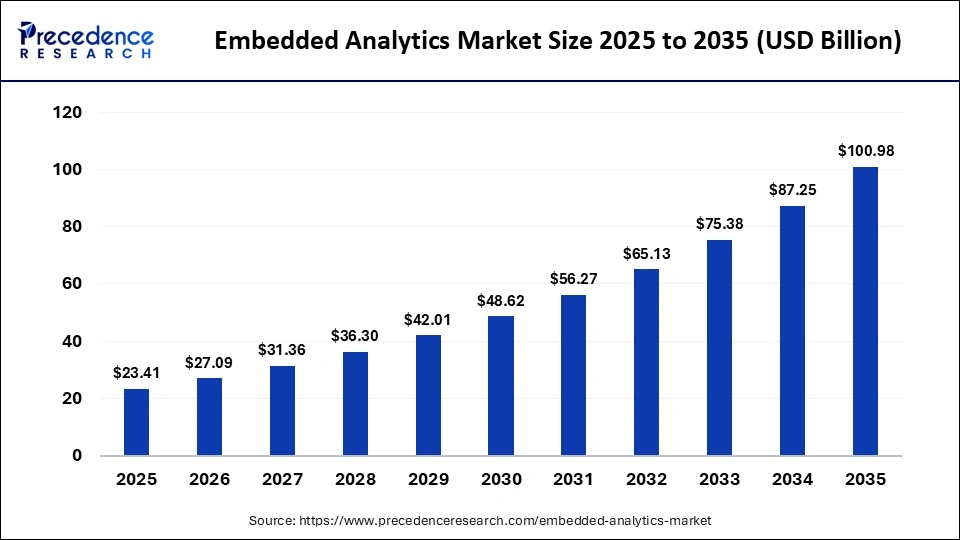
The global embedded analytics market size was calculated at USD 23.41 billion in 2025 and is predicted to increase from USD 27.09 billion in 2026 to approximately USD 100.98 billion by 2035, expanding at a CAGR of 15.74% from 2026 to 2035. This market is growing due to the rising need for data- based, real-time decision-making directly within operational applications like CRM and ERP systems.
Market Highlights
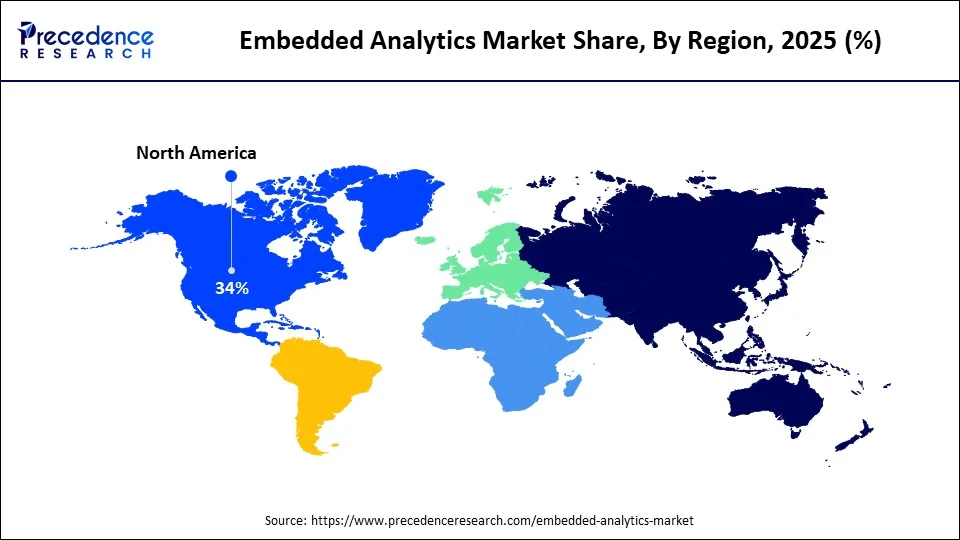
- North America dominated the global embedded analytics market with the largest market share of 34% in 2025.
- Asia Pacific is expected to grow at the fastest CAGR between 2026 and 2035.
- By deployment, the cloud segment accounted for the biggest market share of 64% in 2025.
- By deployment, the on-premise segment is expected to expand at the fastest CAGR between 2026 and 2035.
- By enterprise size, the large enterprises segment held the major market share of 57% in 2025.
- By enterprise size, the SMEs segment is expected to expand at the fastest CAGR between 2026 and 2035.
- By application, the supply chain management segment contributed the highest market share of 35% in 2025.
- By application, the ERP/CRM segment is expected to expand at the fastest CAGR between 2026 and 2035.
- By end-user, the IT & telecommunications segment captured the highest market share of 29% in 2025.
- By end-user, the retail and consumer goods segment is expected to expand at the fastest CAGR between 2026 and 2035.
What Drives the Embedded Analytics Market?
The embedded analytics market is mainly driven by the increasing demand for real-time, data-driven decision-making within pre-existing applications, allowing users to determine data without switching tools. Major drivers include the proliferation of IoT, cloud computing, and AI or ML, which generate massive information sets requiring immediate, actionable insights. Furthermore, the need for improved user experiences, faster time-to-market for applications, and even the shift toward self-service, personalized BI tools are boosting market growth.
How is AI Influencing the Embedded Analytics Market?
The integration of artificial intelligence into embedded analytics is revolutionizing how users interact with data by making insights conversational, contextual, and personalized. AI assistants in platforms like Slack or Microsoft Teams allow users to query data naturally, while AI models for churn prediction, demand forecasting, and risk scoring are directly embedded into ERP and CRM systems. Personalized dashboards now learn user behavior to highlight relevant views and suggest follow-up actions, boosting engagement and reducing dashboard fatigue. This also enables organizations to monetize insights by offering AI-driven analytics as premium or tiered features.
What are the Key Trends Influencing the Embedded Analytics Market?
- Real-Time and Context-Aware Data: There is a surge in the need for real-time analytics embedded directly into business workflows, enabling users to make data-based decisions on the fly.
- Self-Service and Low-Code Tools: 80% of organizations are mostly moving toward self-service analytics by 2026, allowing non-technical users to generate reports along with customizing dashboards without IT support.
- Shift to Cloud-Based BI: Cloud-driven embedded analytics are gaining traction because of flexibility and scalability.
- Monetization of Analytics: Firms are increasingly embedding analytics to turn information into a revenue-generating product.
Future Market Outlook
- Expansion in Emerging Markets: There is great potential for market expansion in emerging regions because of the expanding IT & telecommunication sector. As a result, the demand for cloud-based solutions is rising, as they provide affordable, scalable alternatives to costly on-premises systems, allowing businesses to quickly integrate analytics into existing applications like ERP and CRM. These regions offer opportunities for real-time, data-driven decision-making, improved operational efficiency, and deeper customer insights, especially as digital adoption and cloud infrastructure continue to grow. Additionally, emerging markets present a high potential for SaaS and analytics vendors to tap into previously underserved industries.
- Integration of AI & Smart Technologies: The integration of AI and smart technologies is expected to transform the market by enabling real-time, intelligent insights directly within applications. AI-powered analytics can automatically detect patterns, predict trends, and generate actionable recommendations without manual intervention, which enhances decision-making and operational efficiency. Smart technologies, such as IoT sensors and edge computing, allow embedded analytics to process data locally, reduce latency, and support predictive maintenance, personalized experiences, and automation across industries. This convergence of AI and smart tech also opens opportunities for advanced applications in manufacturing, healthcare, automotive, and SaaS, driving faster adoption of embedded analytics solutions.
Market Scope
| Report Coverage | Details |
| Market Size in 2025 | USD 23.41 Billion |
| Market Size in 2026 | USD 27.09 Billion |
| Market Size by 2035 | USD 100.98 Billion |
| Market Growth Rate from 2026 to 2035 | CAGR of 15.74% |
| Dominating Region | North America |
| Fastest Growing Region | Asia Pacific |
| Base Year | 2025 |
| Forecast Period | 2026 to 2035 |
| Segments Covered | Deployment, Enterprise Size, Application, End-User, and Region |
| Regions Covered | North America, Europe, Asia-Pacific, Latin America, and Middle East & Africa |
Segment Insights
Deployment Insights
What made cloud the dominant segment in the embedded analytics market?
The cloud segment dominated the market with the largest share in 2025 because it offers cost-effective solutions, eliminating the need for expensive hardware and on-premises server maintenance. Its lower total cost of ownership makes it especially attractive to small and medium-sized enterprises. Furthermore, cloud-based embedded analytics are programmed to integrate effortlessly into ERP, SaaS applications, and CRM systems.
The on-premise segment is expected to grow at the fastest CAGR throughout the forecast period. This is due to stringent data security requirements, the demand for total control over sensitive information, along with the necessity to integrate analytics solutions with pre-existing legacy systems, mainly within heavily regulated industries such as banking, finance, and healthcare. Organizations with complex legacy systems often prefer on-premise solutions for greater control, customization, and integration with existing infrastructure.
Enterprise Size Insights
Why did the large enterprises segment dominate the embedded analytics market?
The large enterprises segment dominated the market in 2025, due to their increasing need for advanced, real-time insights across complex operations and multiple departments. Large organizations are investing in embedded analytics to optimize processes, improve decision-making, and gain a competitive edge by integrating AI-driven insights directly into their ERP, CRM, and other enterprise applications. Additionally, the scalability and customization offered by modern embedded analytics solutions make them ideal for handling vast data volumes typical of large enterprises.
The SMEs segment is expected to grow at a significant CAGR in the upcoming period. This is because they increasingly rely on cost-effective, cloud-based analytics solutions that can be easily integrated into their existing applications, like CRM and ERP. These businesses leverage embedded insights to better understand customer behavior, optimize operations, and enhance sales and retention. The flexibility and cost-effectiveness of these solutions make them highly attractive to SMEs across retail and service sectors.
Application Insights
Why did the supply chain management segment dominate the embedded analytics market?
The supply chain management segment dominated the market in 2025. This is because it enables a unified, real-time view across disparate systems, allowing managers to quickly address delays, reduce costs, and improve operational efficiency. The growing adoption of AI, IoT, and machine learning for logistics, warehousing, and inventory management has further accelerated demand for integrated analytics. Embedded insights help providers and manufacturers optimize complex global supply networks by improving inventory control and minimizing lead times.
The ERP/CRM segment is expected to grow at a significant CAGR in the upcoming period, driven by the urgent demand for unified, real-time intelligence directly within core business applications, enabling users to make data-based decisions without switching tools. This integration enhances operational efficiency, improves forecasting, and offers immediate visibility into customer, finance, and supply chain data.
End-User Insights
Why did the IT & telecommunications segment dominate the embedded analytics market?
The IT & telecommunications segment dominated the market with a major share in 2025. This is because these industries generate massive volumes of data from networks, customer interactions, and service operations that require real-time analysis. Embedded analytics allows companies to monitor system performance, predict outages, optimize network usage, and enhance customer experience directly within their operational platforms. Additionally, the sector's early adoption of advanced technologies and focus on data-driven decision-making has further fueled the demand for integrated analytics solutions.
The retail and consumer goods segment is expected to grow at a significant CAGR in the upcoming period, driven by the intense focus on improving customer engagement, optimizing complex supply chains, and the demand for real-time data to drive sales. The shift to e-commerce and omnichannel sales demands immediate insights into sales performance. Embedded analytics enables retailers to monitor metrics such as average basket value, inventory turnover, and sales per square foot directly within e-commerce platforms, eliminating the demand to switch between systems.
Regional Insights
How Big is the North America Embedded Analytics Market Size?
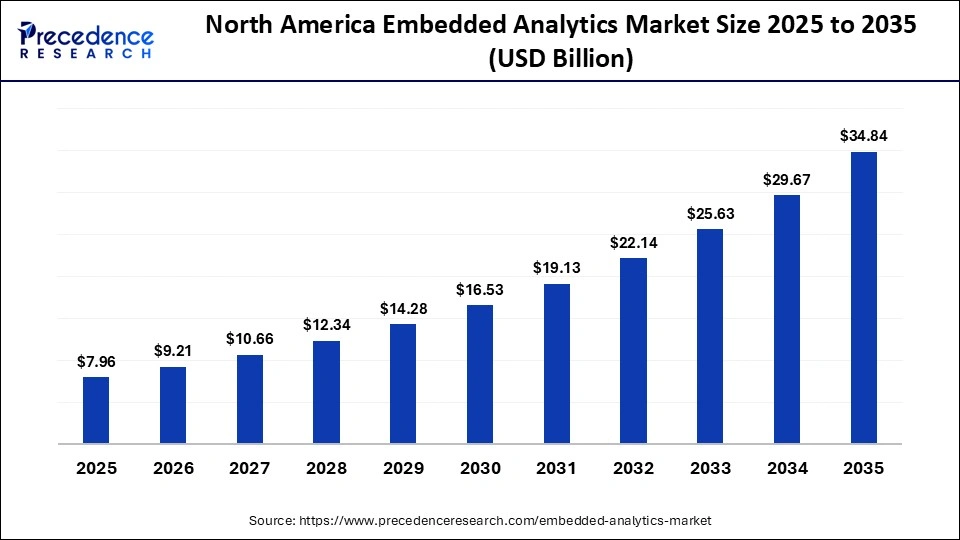
The North America embedded analytics market size is estimated at USD 7.96 billion in 2025 and is projected to reach approximately USD 34.84 billion by 2035, with a 15.91% CAGR from 2026 to 2035.
What made North America the dominant region in the embedded analytics market?
North America dominated the embedded analytics market by capturing the largest share in 2025. The region's dominance in the market is attributed to the rising digital transformation initiatives, growing need for real-time data insights, and the proliferation of embedded analytics in diverse industry verticals. There is a high adoption of cloud technologies and enterprise IT solutions and a strong emphasis on data-driven decision-making, which reinforces the region's leading position in the market.
What is the Size of the U.S. Embedded Analytics Market?
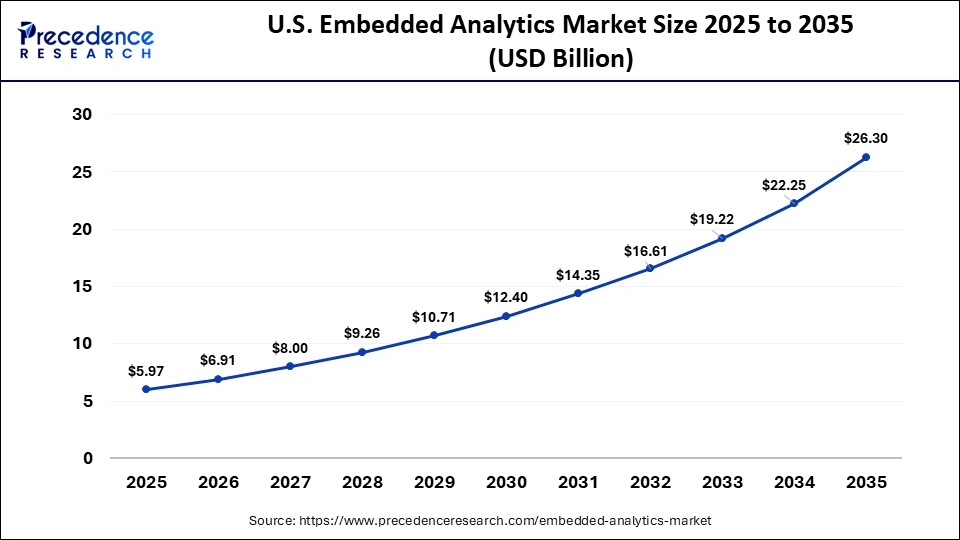
The U.S. embedded analytics market size is calculated at USD 5.97 billion in 2025 and is expected to reach nearly USD 26.30 billion in 2035, accelerating at a strong CAGR of 15.98% between 2026 and 2035.
U.S. Market Analysis
The U.S. leads the North American embedded analytics market because businesses across industries are increasingly demanding real-time, integrated data insights to drive faster and smarter decisions. Organizations are adopting embedded analytics to enhance operational efficiency, improve decision-making agility, and boost customer engagement as part of their broader digital transformation initiatives.
What makes Asia Pacific the fastest-growing region in the embedded analytics market?
Asia Pacific is expected to grow at the fastest CAGR throughout the forecast period, driven by the rapid digitalization of businesses, increasing cloud adoption, and a rising number of SMEs and startups leveraging data-driven insights. Growing investments in IT infrastructure, expanding SaaS usage, and the focus on operational efficiency and customer experience are also driving adoption. Additionally, emerging economies like India, China, and Southeast Asian nations present huge opportunities for analytics integration across industries such as retail, manufacturing, and logistics.
China Market Analysis
China's embedded analytics market is growing rapidly due to technological innovation, increasing data complexity, and widespread adoption of smart devices across industries. Organizations are leveraging these solutions for real-time insights, better data visualization, and informed strategic decision-making. The seamless integration of embedded analytics with existing systems further fuels its adoption in business operations.
What makes Europe a significant region in the embedded analytics market?
Europe holds a significant position in the market due to the growing demand for real-time automation, integrated data, and sustainable operations. Companies are increasingly adopting customized, sector-specific embedded analytics solutions, creating opportunities for niche vendors. Additionally, EU funding programs and smart city initiatives are driving large-scale deployment and innovation in the region.
UK Market Analysis
In the UK, the market is mainly driven by the shift from descriptive to predictive and prescriptive analytics, with AI-powered, real-time edge computing gaining traction. Companies are increasingly embedding analytics into SaaS applications to enhance financial reporting, customer management, and overall decision-making. This trend is accelerating the adoption of advanced, data-driven insights across industries.
How is the opportunistic rise of Latin America in the embedded analytics market?
Latin America is expected to grow at a notable rate in the market throughout the forecast period. This is mainly due to increasing digital transformation across industries like banking, retail, and telecommunications. Organizations are leveraging analytics to improve operational efficiency, optimize supply chains, and enhance customer experiences. Furthermore, growing cloud adoption, rising SaaS implementation, and increased investment in smart technologies are creating new opportunities for embedded analytics solutions in the region.
Brazil Market Analysis
Brazil's market is growing due to the rapid adoption of AI-driven solutions that enhance decision-making speed and accuracy, giving early adopters a competitive advantage. Cloud-based deployments lower upfront costs, making these solutions accessible to SMEs. Additionally, value-driven pricing models, which align costs with measurable business outcomes, are further boosting adoption across industries.
What opportunities exist in the MEA for the embedded analytics market?
The Middle East & Africa (MEA) presents immense opportunities for the market. These opportunities arise from government-led digital transformation initiatives, rapid acceptance of cloud computing, and high need for real-time data insights in key sectors such as BFSI and retail. Additionally, governments' investments in smart city projects, regulatory modernization, and data-driven decision-making initiatives are opening avenues for niche, industry-specific embedded analytics solutions. Emerging SMEs and regional enterprises are also seeking cost-effective, scalable analytics to enhance operational efficiency, creating further growth potential.
UAE Market Analysis
The market in the UAE is expanding due to the country's strong push toward digital transformation and smart city initiatives, which drive demand for real-time, data-driven insights. Adoption of cloud-based solutions and AI-powered analytics across sectors like finance, healthcare, and logistics is increasing operational efficiency and decision-making speed. Additionally, the presence of multinational companies, government-backed innovation programs, and regulatory focus on data-driven governance are further accelerating market growth.
Who are the Major Players in the Global Embedded Analytics Market?
The major players in the embedded analytics market include TABLEAU SOFTWARE, LLC, Qlik, Reveal, Toucan, Oracle, Microsoft, SAP, MICROSTRATEGY INCORPORATED, IBM, and Looker.
Recent Developments
- In April 2025, Qrvey launched a suite of Embedded Services to help SaaS companies quickly deliver customer-facing analytics. The platform integrates with in-house teams to streamline roadmap planning, implementation, testing, and deployment of embedded analytics solutions.
- In April 2025, Microsoft declared major expansions to the Embedded Analytics Solution Accelerators Partner Program at the FabCon 2025 event, stating the continued evolution of their accelerator offerings.
Segments Covered in the Report
By Deployment
- Cloud
- On-premise
By Enterprise Size
- SMEs
- Large Enterprises
By Application
- ERP/CRM
- Supply Chain Management
- Sales and Marketing
- Logistics and Delivery
- Others
By End-User
- IT & Telecommunications
- Retail and Consumer Goods
- BFSI
- Manufacturing
- Healthcare
- Others
By Region
- North America
- Europe
- Asia-Pacific
- Latin America
- Middle East & Africa
For inquiries regarding discounts, bulk purchases, or customization requests, please contact us at sales@precedenceresearch.com
Frequently Asked Questions
Tags





Ask For Sample
No cookie-cutter, only authentic analysis – take the 1st step to become a Precedence Research client
 Get a Sample




 sales@precedenceresearch.com
 Schedule a Meeting
