



Ligase Enzymes Market Size, Companies, Share, Patient Volume, Treatment Adoption Rates, Pricing Analysis, Regulatory Landscape, Competitive Positioning, and Demand Forecast
Ligase Enzymes Market (By Type: T4 DNA Ligase, Taq DNA Ligase, Ligase Chain Reaction Enzymes, RNA Ligase, Thermostable ligase; By Source: Bacteria, Fungi, Plant, Animal, Synthetic; By Application: Molecular Biology, Genetic Engineering, Pharmaceuticals, Diagnostics, Agriculture; By End-User: Research Laboratories, Biotechnology Companies, Pharmaceutical Companies, Academic Institution) - Global Industry Analysis, Size, Trends, Leading Companies, Regional Outlook, and Forecast 2026 to 2035
Source: https://www.precedenceresearch.com/ligase-enzymes-market
 Get a Sample
 Table Of Content


What is Ligase Enzymes Market Size in 2026?
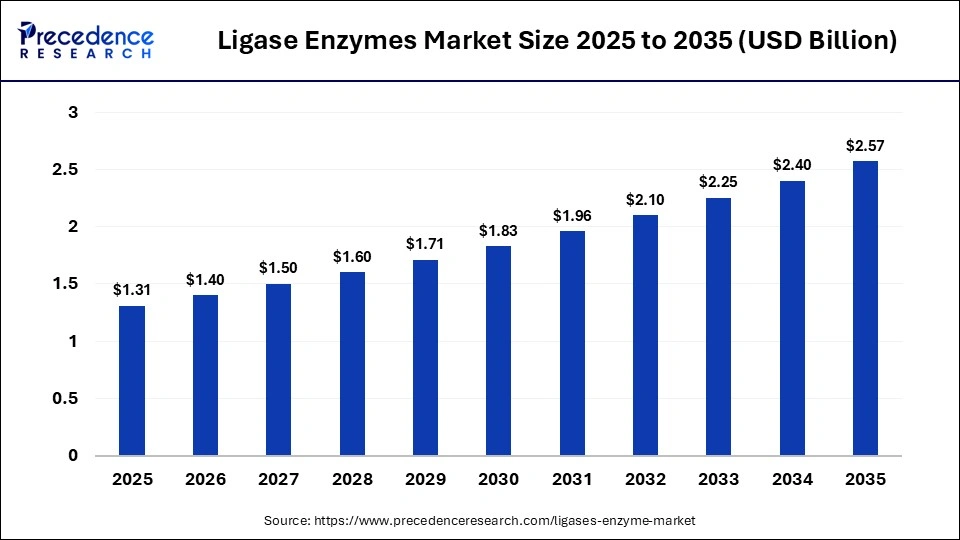
The global ligase enzymes market size was calculated at USD 1.31 billion in 2025 and is predicted to increase from USD 1.40 billion in 2026 to approximately USD 2.57 billion by 2035, expanding at a CAGR of 7.02% from 2026 to 2035. The market expansion is driven by the increasing need for genetic research and diagnostic applications, including genetic engineering, DNA repair, and recombinant DNA technology, which are indispensable for the development of biotechnological research and pharmaceutical development on a global scale.
Key Takeaways
- North America held the largest revenue share of the ligase enzymes market in 2025.
- Asia-Pacific is expected to host the fastest-growing market in the coming years.
- By product type, the T4 DNA ligase segment registered its dominance over the market in 2025.
- By product type, the Taq DNA ligase segment is expected to gain the highest share of the market between 2026 and 2035.
- By source, the bacterial segment accounted for a considerable revenue share in the market in 2025.
- By source, the synthetic segment is expected to witness the fastest growth in the market over the forecast period
- By application, the molecular biology segment held a major revenue share in the market in 2025.
- By application, the agriculture segment is expected to expand rapidly in the market in the coming years.
- By end use, the research laboratories segment held the largest revenue share in the market in 2025.
- By end use, the pharmaceutical companies segment is expected to grow at the fastest CAGR in the market between 2026 and 2035.
What is the Ligase Enzymes Market?
Ligase is a family of proteins that assist in the joining of two strands of DNA, typically by hydrolyzing a diphosphate bond in ATP or another similar energy molecule. Such enzymes are essential in biotechnological and pharmacological processes and are very critical in cell biology: DNA replication and protein synthesis are two examples.
The current market is devoted to making ligase enzymes that are highly specific and more efficacious for precision medicine and synthetic biology. Enzyme engineering is advancing at a rate that fuels growth in genomic research and clinical diagnostics. The trends in the market indicate a growing interest in wider applications for genomics, diagnostics, personalized medicine, and forensic analysis. Cancer cases, along with the prevalence of genetic disorders, are likely to increase, and the ligase enzyme market is expected to grow in the following years.
With such necessities, both governmental bodies and private organizations are ramping up investments in genetic research and drug development, and giving strong financial support for the ligase enzyme business. Moreover, the persistent growth of enzyme manufacture, combined with a rising preference for biocatalysis over traditional chemical methods are paving the way for new markets for actors in this industry.
Impact of AI in the Ligase Enzymes Market
Machine learning (ML) and artificial intelligence (AI) technologies are beginning to shape enzyme development, with ligases in particular. Such technologies are being used by researchers to predict enzyme performance and enhance the efficiency of ligases across various reactions. AI systems can look at vast genomic data and help scientists design ligases that are not just more effective, but also economically viable and tailored for certain applications. Such advancement is promising to change the face of enzyme engineering, which may eventually develop into gene therapy, diagnostics, and industrial applications.
Furthermore, the increasing application of AI and ML will enable the optimization of biomanufacturing strategies for ligases, and hence lower costs and higher yields. For example, we employ the implementation of AI-enabled methods for enzyme production to help the manufacturers improve the scaling-up process to allow ligases to be readily available for industrial and therapeutic purposes.
Trends Influencing the Ligase Enzymes Market
- Next-Generation Sequencing Using Ligase Enzyme
Ligase enzymes have emerged as more critical in next-generation sequencing (NGS) than many people realize. Ligation-based protocols of NGS rely on genomic library assembly, mutation detection, and genome analysis. When labs are processing very small or fragile samples, they rely on ligases to join those DNA pieces quickly and accurately. And companies are currently creating much stronger, more reliable variants that cut down errors, reduce unwanted by-products, and assist in enabling cleaner sequencing results in less time. - Personalized Medicines
Personalized medicine is indeed an essential opportunity for the market. Ligase plays an important role in precision medicine and CRISPR-based gene editing, for which precise DNA joining is a prerequisite. Medical practitioners are turning more and more to genomic information in order to make treatment decisions, and ligase enzymes are a key enabler of accurate DNA sequencing and mutation detection. - Efficiency with Engineered Ligase Enzyme
Engineered ligase variants with improved thermal stability, rapid kinetics, and high specificity are an increasing trend, allowing for expedited (and robust) workflows in sequencing, cloning, and diagnostics. Such engineered enzymes enable traditional restrictions to be overcome and allow better precision applications that deliver results for the research and biotechnology industries and are more reliable and economical.
Market Scope
| Report Coverage | Details |
| Market Size in 2025 | USD 1.31 Billion |
| Market Size in 2026 | USD 1.40 Billion |
| Market Size by 2035 | USD 2.57 Billion |
| Market Growth Rate from 2026 to 2035 | CAGR of 7.02% |
| Dominating Region | North America |
| Fastest Growing Region | Asia-Pacific |
| Base Year | 2025 |
| Forecast Period | 2026 to 2035 |
| Segments Covered | Product Type, Source, Application, End Use, and region |
| Regions Covered | North America, Europe, Asia-Pacific, Latin America, and Middle East & Africa |
Segmental Outlook
Product Type Insights
Which Product Type Segment Dominated the Ligase Enzymes Market?
The T4 DNA ligase segment held a dominant position in the market in 2025, primarily by virtue of its applications in molecular cloning, DNA repair, and plasmid construction. It has also been used in developing new sequencing libraries. Academic institutions and biotechnology firms always preferred it for its high performance in ligation processes and reliable functional outcomes. The proven effectiveness, widespread availability, and cost-efficiency of this method further established its dominant position in the market. It thereby won both an economic leading position and a substantial amount of revenue from the ligase industry.
The Taq DNA ligase segment is expected to grow at the fastest CAGR in the market between 2026 and 2035. They are especially effective in high-temperature ligation and in identifying mismatch mutations. With the improvement of precision medicine and molecular health test technology, Taq DNA ligase is now an essential part of identifying single-nucleotide polymorphisms (SNPs), performing ligase chain reactions (LCR), and other techniques used for PCR and DNA analysis. Its incorporation into clinical research laboratories and oncology diagnostics is anticipated to augment its volume and growth potential in the market.
Source Insights
Why Did the Bacterial Segment Dominate the Ligase Enzymes Market?
The bacterial segment held the largest revenue share in the market in 2025, as they are dependable, scalable, and commercially validated. Their universal use in molecular biology has made them the preferred choice for laboratory protocols and production methods. These enzymes regularly have high yield and stable performance for bacterial sources like E. coli, primarily used in cases of cloning, recombinant DNA technology, and sequencing.
The synthetic segment is expected to grow with the highest CAGR in the market during the studied years. This growth will be driven by increasing demand for precision-engineered functionality and specific enzyme properties. Synthetic methods, in contrast to traditional biological sourcing methods, allow for accurate molecular modifications. Researchers can customize and alter the enzyme based on their experimental requirements, enabling them to achieve desired outcomes.
Application Insights
How the Molecular Biology Segment Dominated the Ligase Enzymes Market?
The molecular biology segment contributed the biggest revenue share in the market in 2025 because almost every cloning, sequencing, or recombinant workflow must rely on ligation at some point. Ligases play a significant role in linking DNA fragments and are thus key for genetic analysis and modification. The continued growth of funds for genomic research and the development of biotechnology pipelines have solidified this sector as a powerhouse performer.
The agriculture segment is expected to witness the fastest growth in the market over the forecast period. This growth is propelled by the growing necessity of genetically enhanced crops and sustainable agricultural practices. Today, most crop development requires accurate genetic modification technology. Ligase enzymes are predicted to play a more prominent role in genome editing of the plant, trait development, and producing disease-resistant varieties.
End Use Insights
Which End Use Segment Led the Ligase Enzymes Market?
The research laboratories segment led the market in 2025, as most of the workflows that have to do with ligation began and developed in academic and institutional settings. Academic institutions, including universities, government-supported establishments, and independent research institutions, regularly consume large amounts of ligase enzymes for a multitude of applications, including cloning, sequencing, CRISPR validation, and studies on genetic mapping. Regular procurement of these enzymes has been made possible by ongoing grant funding and an expansion of life science programs.
The pharmaceutical companies segment is expected to show the fastest growth over the forecast period. These are the largest consumers of ligase enzymes in generating novel gene therapies and genetic therapeutics. There is an ongoing search in this space for new innovative avenues to improve gene editing and methods of implementing cell therapy strategies. With more studies and development in pharmaceuticals concentrating on genomics approaches or personalized treatment options, high-performance ligase demands are expected to grow rapidly.
Regional Insights
Why Did North America Dominate the Ligase Enzymes Market?
North America held a major revenue share of the market in 2025, owing to its well-established and well-connected genomic infrastructure and healthy biotechnology ecosystems. The region has always invested heavily in life sciences research and molecular diagnostics on a large scale. In the U.S. and Canada, ligase enzyme uptake reached a very high level in multiple sectors such as academic laboratories, biopharmaceutical companies, and clinical research facilities. As more money and funding poured into genomics, and then next-generation sequencing technologies were deployed early, alongside leading enzyme manufacturers making major contributions to the growth, the region had the upper hand.
U.S. Market Trends
U.S. drives the regional dominance in North America, which is cemented by its diverse ecosystem for life sciences research, pervasive use of molecular diagnostics, and the extensive integration of advanced enzyme-based technologies in academia and commercial laboratories in the U.S. Moreover, high-end vendors, which sell DNA ligases and other molecular biology reagents, support the region in the market.
How is Asia-Pacific Growing in the Ligase Enzymes Market?
Asia-Pacific is expected to host the fastest-growing market in the coming years, as biotechnology capacities and investment in genomic research increase. National governments in the region are strengthening domestic biomanufacturing and molecular research programs. Countries such as China, India, Japan, and South Korea should accelerate the uptake of ligase enzymes in diagnostics, agricultural biotechnology, and pharmaceutical R&D. Higher research money, increased clinical trial efforts, and better laboratory capacity can be expected to stimulate demand in the Asia Pacific, establishing it as the most active and fastest growing market for ligase enzymes.
China Market Trends
China's market is growing fast in the Asia-Pacific region. It is the result of massive government intervention in biotechnology development and a surge of pharmaceutical R&D. Chinese local companies have expanded the production capacity of the enzymes and produce uniquely built ligases that can serve both local and international markets. Competitive pricing and innovation are propelled by a focus on self-reliance in high-tech industries and increasing biotech start-ups in the country.
How is Europe Accelerating Advanced Genomic Innovation in the Ligase Enzymes Industry?
Europe region is expected to grow at a significant rate of market share between 2026 and 2035, due to the high-volume genomic sequencing activities across research institutions. In 2025, EMBL facilitated collaborative genome work among over 110 independent genome laboratories and advanced scientific facilities, building on cutting-edge DNA assembly workflows that demand ligase enzyme technologies in this region. (https://www.embl.org/about/)
Germany Advancing Europe's Ligase Enzymes Technology Landscape
Germany is a major contributor to the European market, due to increasing investments in molecular engineering, industrial bioprocessing, and genomic medicine infrastructure. Additionally, the Munich and Heidelberg-based academic research institutions continued with further optimisations and transcriptomics using ligase-based genomic preparation.
What is Driving Biotechnology Expansion Across the Middle East & Africa Ligase Enzymes Market?
The Middle East and Africa region is expected to register significant growth in the market during 2026 and 2035, driven by the modernization of biotechnology using advanced molecular diagnostics programs based on ligase-driven sequencing of DNA and preparation of nucleic acids technologies. South Africa conducted more molecular activities that included viral pathogen sequencing through ligase-mediated amplification workflows and high-throughput genomic preparation systems.
Saudi Arabia Emerging as a Major Analytics Innovation Center in the Middle East & Africa
Saudi Arabia is a major player in the Middle East and Africa market, owing to the growing focus on expanding genomic medicine initiatives and enhancing research facilities within the healthcare sector. Growing number of Saudi biotechnology research centers rely on recombinant DNA assembly and ligase-assisted cloning technologies. They conduct studies on their research related to hereditary diseases, thus further fueling the regional market growth.
Why Are Genomics and Agricultural Biotechnology Expanding Ligase Enzyme Demand Across Latin America?
The Latin America region is estimated to grow at a strong CAGR over the projected period, propelled by expanding biotechnology modernization initiatives across healthcare and agricultural sectors. The Brazilian government has implemented over 135 strategies to create biological innovations during 2025, driving an increased demand for ligase-assisted DNA assembly and recombinant engineering. (Source: https://www.lexology.com)
Brazil Becoming Latin America's Largest Big Data Analytics Growth Engine
Brazil leads the regional Latin America market, propelled by increasing access to high-level synthetic biology and cloning research. Public research institutes ran microbial fermentation studies using DNA assembly technology and engineered bacterial strains, creating demand for ligase enzymes in this region.
Ligase Enzymes Market Value Chain Analysis
- R&D
The processes of research and development start with the engineering of proteins,
enzyme screening and optimization to guide the innovation.
Key Players: England Biolabs, Inc., Thermo Fisher Scientific Inc., and Codexis, Inc. - Clinical Trials and Regulatory Approvals
Clinical evaluation includes controlled assessment of safety, therapeutic efficacy, and ligase reliability in diagnostic and research applications.
Key Players: Food and Drug Administration, European Medicines Agency, and Central Drug Standard Control Organization. - Patient Support and Services
Post marketing involves technical guidance, troubleshooting assistance, and application training enhance customer retention and workflow efficiency.
Key Players: Agilent Technologies, Inc., Promega Corporation, New England Biolabs.
Top Companies in the Ligase Enzymes Market
- Thermo Fisher Scientific
- Oxford Nanopore Technologies
- Merck
- Promega Corporation
- New England Biolabs
- Promega
- Illumina
- Agilent Technologies
- Zymo Research
- F. Hoffmann-la Roche
- GenScript
- Enzo Life Sciences
- Takara Bio
- QIAGEN N.V.
- Becton
- BioVision
- Dickinson
- Genetix Biotech
- ArcticZymes Technologies
Recent Developments
- In February 2026, Twist Bioscience Corporation announced the launch of its Twist TrueAmp Library Preparation Kit and Twist PCR-Free WGS Library Preparation Kit to address a wide range of sample inputs to enable clinical research. The kit efficiently converts starting DNA without bias commonly seen in whole-genome sequencing using its engineered ligase. (Source: https://www.businesswire.com)
- In July 2024, researchers at Manchester University developed a new family of ligase enzymes. These enzymes ease the assembly of peptides with an improved yield and less waste. Such ligases could transform the production of peptide-based drugs, such as cancer therapeutics, resulting in greener and more efficient biocatalytic pathways as well as partnerships with pharmaceutical companies. (Source: https://www.manchester.ac.uk)
- In February 2024, Codexis, Inc. entered an exclusive global licensing agreement with F. Hoffmann-La Roche Ltd. for its newly engineered double-stranded DNA ligase tailored for NGS library prep. This deal strengthened Roche's sequencing portfolio and gave Codexis milestone payments and a broader commercial reach for a high-efficiency ligase technology. (Source: https://ir.codexis.com)
Segments Covered in the Report
By Type
- T4 DNA Ligase
- Taq DNA Ligase
- Ligase Chain Reaction Enzymes
- RNA Ligase
- Thermostable ligase
By Source
- Bacteria
- Fungi
- Plant
- Animal
- Synthetic
By Application
- Molecular Biology
- Genetic Engineering
- Pharmaceuticals
- Diagnostics
- Agriculture
By End-User
- Research Laboratories
- Biotechnology Companies
- Pharmaceutical Companies
- Academic Institution
By Region
- North America
- Europe
- Asia-Pacific
- Latin America
- Middle East & Africa
For inquiries regarding discounts, bulk purchases, or customization requests, please contact us at sales@precedenceresearch.com
Frequently Asked Questions
Tags





Ask For Sample
No cookie-cutter, only authentic analysis – take the 1st step to become a Precedence Research client
 Get a Sample
.webp)



 sales@precedenceresearch.com
 Schedule a Meeting
