



Lithium Sulfur Battery Market Trends, Companies, Revenue / Sales Performance, Manufacturing Yield, Fab Capacity, Export & Import Dynamics, Supply Chain Analysis, Competitive Landscape, and Growth Forecast
Lithium Sulfur Battery Market (By Battery Form Factor: Pouch lithium sulfur batteries, Cylindrical lithium sulfur batteries, Prismatic lithium sulfur batteries; By Capacity Range: Below 500 mAh, 500 mAh to 2000 mAh, 2000 mAh to 5000 mAh, Above 5000 mAh; By Application: Electric vehicles, Aviation and unmanned aerial vehicles, Defense and military systems; By End-use Industry: Automotive industry, Aerospace industry, Defense sector; By Electrolyte Type: Liquid electrolyte lithium sulfur batteries, Solid electrolyte lithium sulfur batteries, Gel polymer electrolyte lithium sulfur batteries; By Cathode Architecture: Carbon sulfur composite cathodes, Polymer sulfur cathodes; By the Commercialization Stage: Research and prototype stage, Commercial production) - Global Industry Analysis, Size, Trends, Leading Companies, Regional Outlook, and Forecast 2026 to 2035
Source: https://www.precedenceresearch.com/lithium-sulfur-battery-market
 Get a Sample
 Table Of Content


What is the Lithium Sulfur Battery Market Size in 2026?
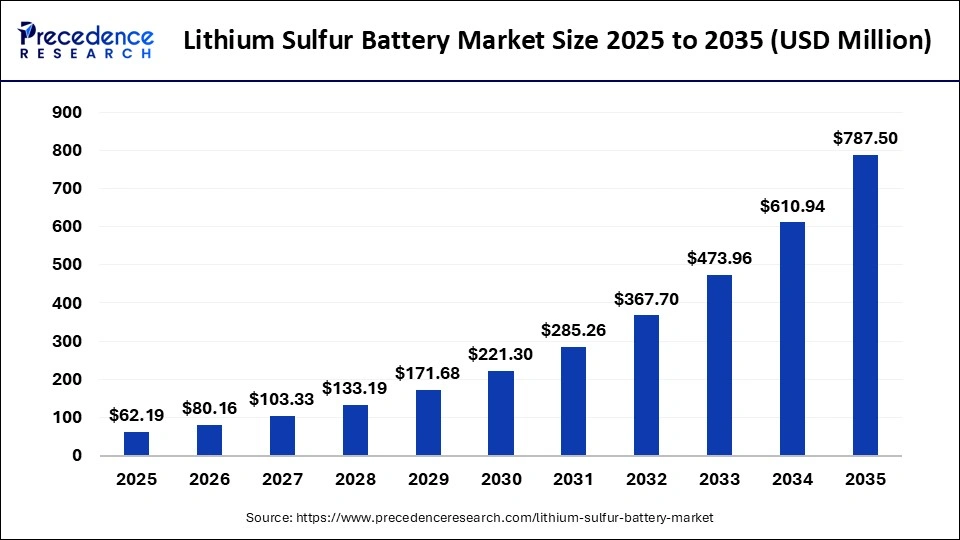
The global lithium sulfur battery market size was calculated at USD 62.19 million in 2025 and is predicted to increase from USD 80.16 million in 2026 to approximately USD 787.50 million by 2035, expanding at a CAGR of 28.90% from 2026 to 2035. The lithium sulfur battery market is observed to grow rapidly due to factors such as its higher theoretical capacity compared to conventional lithium-ion batteries, cost-effectiveness, and lower environmental impact.
Key Takeaways
- North America dominated the global lithium sulfur battery market with approximately 36.70% share in 2025.
- Asia Pacific is observed to be the fastest-growing segment with the highest CAGR in the forecast period.
- By battery form factors, the pouch lithium sulfur batteries segment led the global market in 2025 with 52.70% share and is also observed as the fastest growing segment.
- By capacity range, the 2000 mAh to 5000 mAh segment registered its major dominance over the global market with 31.60% share in 2025.
- By capacity range, the above 5000 mAh segment is observed to have the highest CAGR in the foreseen period.
- By application, the aviation and unmanned aerial vehicles segment had a major dominance over the global lithium sulfur battery market with 33.70% share in 2025, and is also observed to be the fastest growing in the foreseen period.
- By end-use industry, the aerospace industry segment led the global market with 31.60% share in 2025 and is also observed to be the fastest growing region with the highest CAGR in the foreseen period.
- By electrolyte type, the liquid electrolyte lithium sulfur batteries segment registered major dominance over the market with 61.40% share in 2025.
- By electrolyte type, the solid electrolyte lithium sulfur batteries segment is expected to expand the fastest in the foreseeable period.
- By cathode architecture, the carbon sulfur composite cathodes segment contributed the biggest revenue share of 39.80% share in 2025.
- By cathode architecture, the graphene sulfur cathodes segment is expected to expand rapidly with the highest CAGR in the foreseen period.
- By the commercialization stage, the research and prototype stage segment held the largest revenue share of 42.70% of the lithium sulfur battery market in 2025.
- By the commercialization stage, the commercial production segment is expected to witness the fastest growth in the foreseen period.
What is the Lithium Sulfur Battery Market?
The market comprises advanced rechargeable battery technologies that use sulfur as the cathode material and lithium metal as the anode to deliver high theoretical energy density and lightweight electrochemical storage. These batteries are being developed for electric mobility, aerospace systems, drones, defense electronics, and next-generation energy storage applications. The market includes cell manufacturing, materials, and integrated battery packs supplied through prototype, pilot, and early commercial production programs targeting high-energy-density applications.
Role of Technology in the Growth of Lithium Sulfur Battery Market
- Polysulfide Shuttle Mitigation: The segment involves the creation of protective coatings, redox-active interlayers, or advanced electrolyte formulations. It helps the migration of polysulfides between electrodes.
- Volume Expansion Management: The segment involves the development of nanostructured cathodes and binders to maintain structural integrity.
- Solid State Development: The procedure helps in the complete elimination of the shuttle effect and improves safety.
Lithium Sulfur Battery Market Trends
- Growing Demand for High-Density Energy: The segment highlights the growing demand for energy-dense batteries due to growing usage in different sectors.
- Aviation Industry: Growing demand for high-performance batteries for UAVs, military drones, electric planes, and high-altitude aircraft is also a major market driver.
- Improved Sustainability: Lithium batteries use sulfur that is abundant and cost-effective for battery manufacturing compared to cobalt or nickel conventional batteries. Such batteries are also sustainable.
Market Scope
| Report Coverage | Details |
| Market Size in 2025 | USD 62.19 Million |
| Market Size in 2026 | USD 80.16 Million |
| Market Size by 2035 | USD 787.50 Million |
| Market Growth Rate from 2026 to 2035 | CAGR of 28.90% |
| Dominating Region | North America |
| Fastest Growing Region | Asia Pacific |
| Base Year | 2025 |
| Forecast Period | 2026 to 2035 |
| Segments Covered | Battery Form Factor, Capacity Range, Application, End-use Industry, Electrolyte Type, Cathode Architecture, Commercialization Stage, and region |
| Regions Covered | North America, Europe, Asia-Pacific, Latin America, and Middle East & Africa |
Segmental Insights
Battery Form Factor Insights
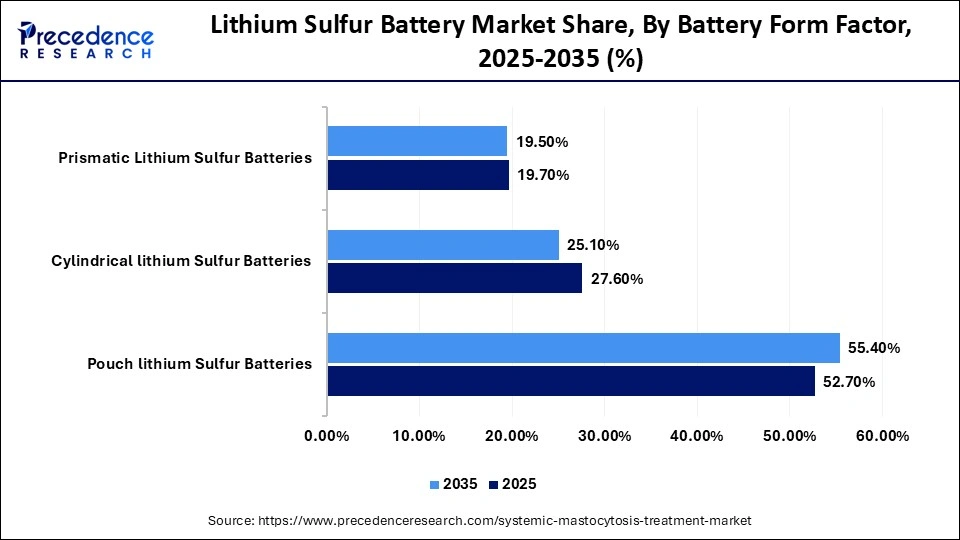
Lithium Sulfur Battery Market Share, By Battery Form Factor, 2025-2035 (%)
| Battery Form Factor | 2025 | 2035 | CAGR 2025 to 2035 |
| Pouch lithium Sulfur Batteries | 52.70% | 55.40% | 24.70% |
| Cylindrical lithium Sulfur Batteries | 27.60% | 25.10% | 21.80% |
| Prismatic Lithium Sulfur Batteries | 19.70% | 19.50% | 22.90% |
Which Component of the Battery Form Factor Segment led the Global Market in 2025?
The pouch lithium sulfur batteries segment led the global lithium sulfur battery market with 52.70% share in 2025. The segment is also observed to be the fastest-growing in the foreseeable period. The cells enable high-density power helpful for applications requiring lightweight power, such as aerospace and electric vehicles. Such cells also allow practical and easy implementation of Li-S technology.
The segment's growth is also driven by factors such as high sustainability observed with the help of water-based manufacturing processes. Cost-effectiveness observed with the help of using pouch lithium batteries compared to conventional Li-ion batteries is also a major market driver. Technological advancements helpful for handling electrolyte-lean conditions and managing lithium anode degradation are also a major market driver.
Capacity Range Insights
Lithium Sulfur Battery Market Share, By Capacity Range, 2025-2035 (%)
| Capacity Range | 2025 | 2035 | CAGR 2025 to 2035 |
| Below 500 mAh | 14.70% | 9.60% | 17.60% |
| 500 mAh to 2000 mAh | 28.30% | 21.40% | 19.20% |
| 2000 mAh to 5000 mAh | 31.60% | 30.70% | 23.10% |
| Above 5000 mAh | 25.40% | 38.30% | 28.60% |
Which Component of the Capacity Range Segment Fuelled the Market's Growth in 2025?
The 2000 mAh to 5000 mAh segment dominated the global lithium sulfur battery market in 2025, with a share of 31.60%. Such batteries are helpful to drive the growth of the segment as they provide high energy density compared to traditional Li-ion batteries. Hence, it further aids faster charging and longer runtimes in premium electronics. The segment's growth is also driven by unmanned aerial vehicles and military drones that require lightweight and high-specific energy batteries for extended runtimes in the aerospace sector. The segment also observes growth with the help of R&D of the market, which is helpful for electrode design and electrolyte formulation to improve the cycle life and safety of Li-S batteries.
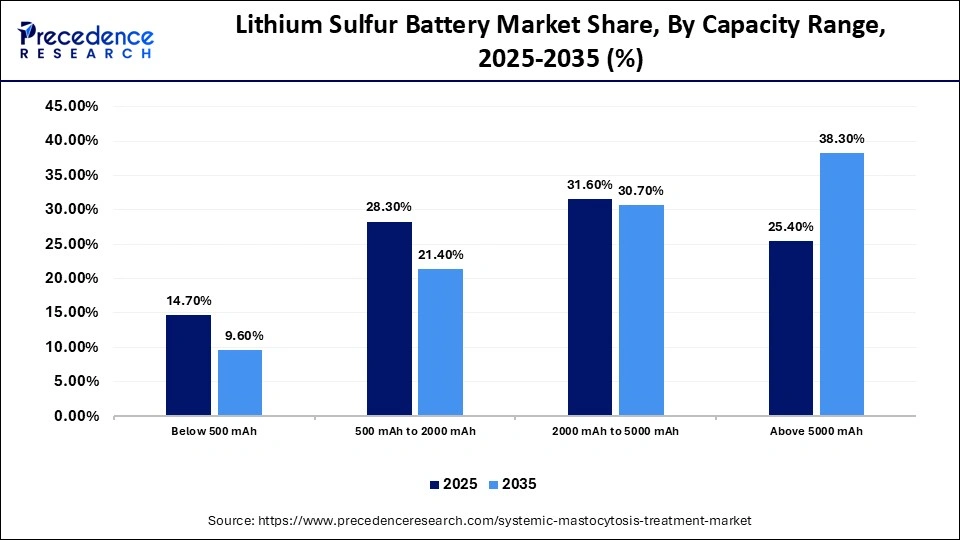
The above 5000 mAh segment is expected to expand rapidly in the foreseeable period. The segment is majorly driven by higher adoption of electric vehicles requiring high-capacity Li-S batteries compared to traditional lithium-ion solutions. Such batteries are also essential for the aerospace sector as the unmanned aerial vehicles and satellites require lightweight batteries for longer runtimes and mission endurance. Cost-effectiveness is also a major factor propelling the growth of the battery due to its abundant nature and lower cost of sulfur. Technological advancements heavily focused on improving the stability and cycle of such batteries are also a major market driver in the foreseeable period.
Application Insights
Lithium Sulfur Battery Market Share, By Application, 2025-2035 (%)
| Segment | 2025 | 2035 | CAGR (2025–2035) |
|---|---|---|---|
| Electric Vehicles | 26.40% | 29.80% | 26.70% |
| Aviation And Unmanned Aerial Vehicles | 33.70% | 36.60% | 27.60% |
| Consumer Electronics | 17.60% | 13.70% | 20.80% |
| Energy Storage Systems | 12.10% | 13.80% | 24.60% |
| Defense And Military Systems | 10.20% | 6.10% | 18.10% |
Which Component of the Application Segment Dominated the Global Market in 2025?
The aviation and unmanned aerial vehicles segment registered its dominance over the lithium sulfur battery market with 33.70% share in 2025 and is observed to be the fastest-growing segment in the foreseen period. The segment's major focus involves satellites, HAPS, and HALE aircraft, which mainly use the Li-S technology. Such batteries also have higher energy density, which is helpful to enhance the payload capacity and operational time, helping such vehicles to have longer runtimes, further propelling the growth of the segment.
Applications such as military surveillance drones, commercial inspection UAVs, and future electric aircraft require high-performance and lightweight batteries for effective operation. The efficiency of such batteries under extreme temperature conditions also enhances the use of such batteries in satellite power systems.
End Use Industry Insights
Lithium Sulfur Battery Market Share, By End-use Industry, 2025-2035 (%)
| End-use Industry | 2025 | 2035 | CAGR (2025–2035) |
|---|---|---|---|
| Automotive Industry | 24.70% | 28.60% | 26.10% |
| Aerospace Industry | 31.60% | 34.70% | 27.40% |
| Electronics Industry | 18.80% | 15.60% | 21.60% |
| Energy and Utilities Sector | 14.10% | 15.20% | 23.80% |
| Defense Sector | 10.80% | 5.90% | 17.30% |
Which Component of the End Use Industry Segment Propelled the Market's Growth in 2025?
The aerospace industry segment dominated the lithium sulfur battery market with 31.60% share in 2025. The segment is also expected to be the fastest-growing in the coming years. The segment highlights the importance of lightweight, high-power batteries for longer runtimes and effective operations necessary for applications such as military drones, UAVs, satellites, electric aircraft, and HALE aircraft.
The segment is also driven by growing demand for sustainable options in the aerospace industry to lower the environmental impact. The growing Urban Air Mobility domain, including electric vertical take-off and landing, requires advanced energy storage.
Electrolyte Type Insights
Lithium Sulfur Battery Market Share, By Electrolyte Type, 2025-2035 (%)
| Electrolyte Type | 2025 | 2035 | CAGR (2025–2035) |
|---|---|---|---|
| Liquid Electrolyte Lithium Sulfur Batteries | 61.40% | 48.70% | 20.10% |
| Solid Electrolyte Lithium Sulfur Batteries | 18.60% | 32.10% | 29.40% |
| Gel Polymer Electrolyte Lithium Sulfur Batteries | 20.00% | 19.20% | 21.80% |
How did the Liquid Electrolyte Lithium Sulfur Batteries Segment lead the Global Market in 2025?
The liquid electrolyte lithium sulfur batteries dominated the lithium sulfur battery market with 61.40% share in 2025. Such batteries have high-energy density, making them ideal for lightweight applications such as UAVs and high-performance electric vehicles. Such batteries also offer a cost-effective option to the industry due to the abundant and inexpensive nature of sulfur. Technological innovations in liquid electrolyte formulations have helped the industry by improving the performance of polysulfides. The liquid electrolyte technology is also highly demanding in the market due to its faster scaling and immediate adoption in specialized markets.
The solid electrolyte lithium sulfur batteries segment is expected to expand rapidly with the highest CAGR in the forecast period. Solid electrolyte lithium sulfur batteries eliminate the risk of flammable liquid and are hence safe to use, and are also widely adopted in the manufacturing of electric vehicles. Such batteries use lithium anodes and sulfur cathodes with five times more capacity than traditional lithium batteries. Such batteries also prevent polysulfide dissolution with advanced sulphide-based materials for better interfacial compatibility and cycling stability. The major shift of the industry towards solid state batteries due to their high performance and lower costs is also one of the major factors helpful for the industry's growth.
Cathode Architecture Insights
Which Component of the Cathode Architecture Segment Fuels Market's Growth in 2025?
The carbon sulfur composite cathodes segment had a major dominance over the lithium sulfur battery market with 39.80% share in 2025. The carbon sulfur composite cathodes help to overcome the technical limitations by providing the necessary electrical conductivity for sulfur for efficient electron transfer. The segment also focuses on enhancing the cycle life of such batteries with the help of physical and chemical traps for soluble lithium polysulfides. Carbon frameworks also buffer the volume expansion during lithiation to prevent cathode degradation.
The graphene sulfur cathodes segment is expected to have the highest CAGR in the forecast period. The segment's growth is driven by graphene-based materials useful to anchor sulfur, reduce sulfur loss, and enhance coulombic efficiency, along with extending battery cycle life. The segment also observes growth due to the high-energy density of graphene sulfur cathodes, which are helpful for electric vehicles and aerospace applications. The flexible 2D, 3D, and or core-shell configurations of graphene accommodate the volume expansion of sulfur during charging or discharging.
Commercialization Stage Insights
How did the Research and Prototype Stage lead the Global Market in 2025?
The research and prototype stage segment dominated the global lithium sulfur battery market in 2025, with 42.70%. The R&D department has major contributions in the growth of the segment, in the form of elevating the cathode structures and electrolyte formulations to mitigate the polysulfide shuttle effect. Use of 3D graphene structures, carbon nanotubes, and MoS2-coated anode nanomaterials to improve sulfur conductivity and electrode stability helps to increase energy density, further fueling the market's growth. R&D has also helped the segment to improve safety by allowing the Li-S batteries to avoid the thermal risks associated with liquid electrolytes.
The commercial production segment is observed to have the highest growth with the highest CAGR in the forecast period. The establishment of pilot lines is one of the major factors in lowering production costs and improving manufacturing efficiency. The main aim of the commercialization procedure involves overcoming technical challenges with the help of advanced cathode and electrolyte formulations. The commercialization sector also delivers battery cells for high-performance sectors such as drones, defense, logistics, and satellites. The growing usage of EVs globally is leading to higher demand for different types of lithium batteries as per the requirement, and focusing on higher energy provision is also a major market driver in the foreseeable period.
Regional Insights
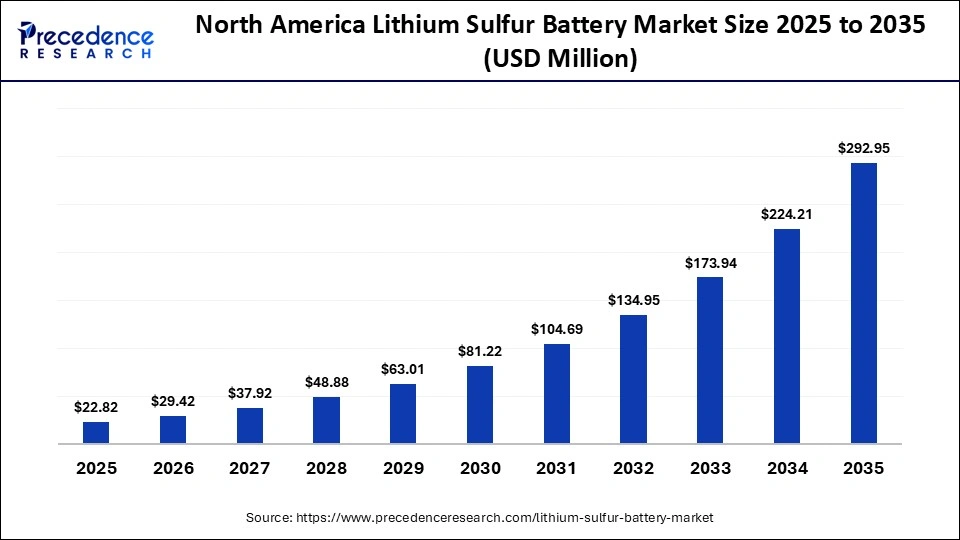
North America Lithium Sulfur Battery Market Size and Growth 2026 to 2035
The North America lithium sulfur battery market size is estimated at USD 22.82 billion in 2025 and is projected to reach approximately USD 292.95 billion by 2035, with a 29.08% CAGR from 2026 to 2035.
Why did North America lead the Global Lithium Sulfur Battery Market in 2025?
North America had a major dominance over the market with approximately 36.70% share in 2025. The growing usage of Li-S batteries in domains such as aerospace, EVs, and defense is one of the major factors helpful for the growth of the market in the foreseen period. The lightweight and high-performance capability of such batteries makes them highly demanding in various other domains as well. Such batteries are also energy-dense, helpful for drones and EVs for longer runs, further propelling the market's growth in the foreseen period.
U.S. Lithium Sulfur Battery Market Size and Growth 2026 to 2035
The U.S. lithium sulfur battery market size is calculated at USD 17.12 billion in 2025 and is expected to reach nearly USD 221.18 billion in 2035, accelerating at a strong CAGR of 29.16% between 2026 and 2035.
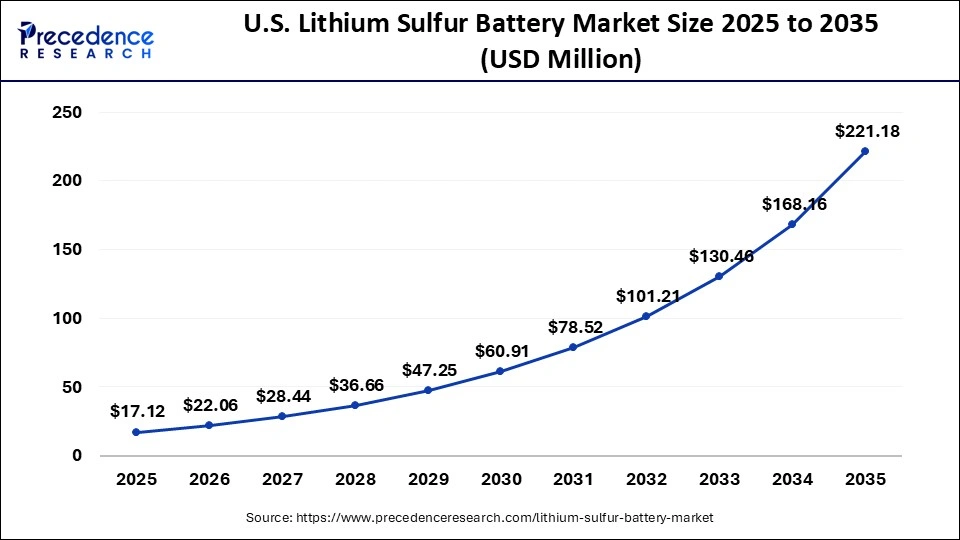
The U.S. Lithium Sulfur Battery Market Trends
The U.S. military and aerospace sectors have a major contribution to the growth of the market in the region. Major government initiatives in the form of NASA's Technology Transfer Program and grants from the Department of Energy are also major market drivers.
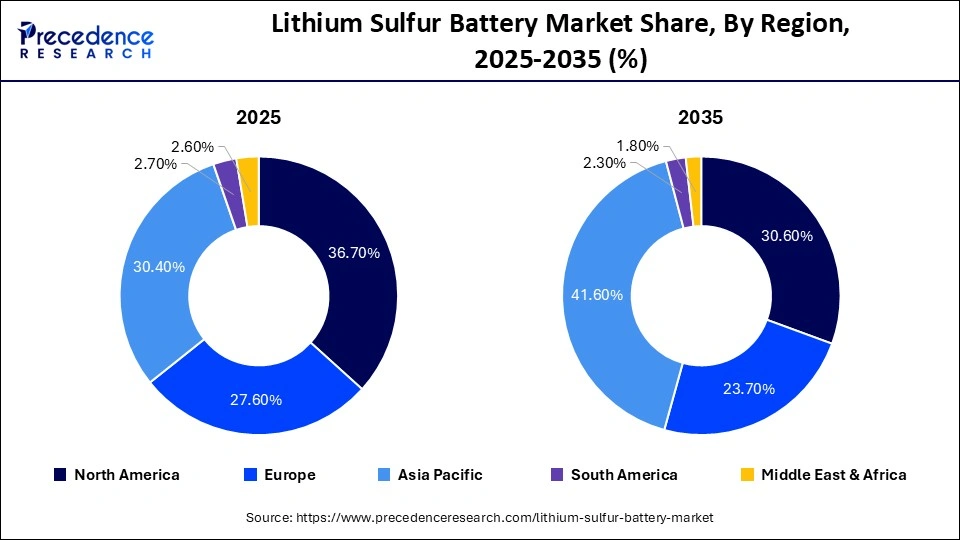
Why is the Asia Pacific region observed to be the fastest-growing region in the Foreseen Period?
Asia Pacific is expected to have the highest CAGR in the forecast period. The market in the region is majorly driven by a higher number of battery manufacturing hubs. Higher expertise in the battery industry is also a major market driver. Higher demand for lightweight, high-performance, and high-energy density cells by the aerospace segment of the region is one of the major market drivers. Higher adoption of EVs in the region is also a major market driver.
China's Lithium Sulfur Battery Market Trends
China has a major contribution to the growth of the market due to growing investment in the domain, along with a major shift of the industry towards Li-S batteries for high-density, improved performance, and sustainable results. Growing demand for Li-S batteries in the growing EV and aerospace segment of the region is another major factor fueling the market's growth.
Lithium Sulfur Battery Market Value Chain Analysis
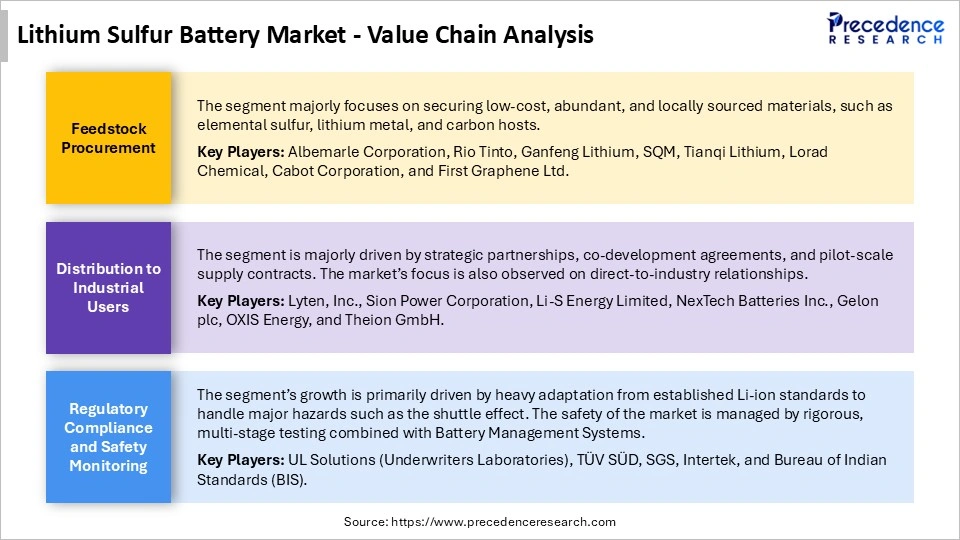
Lithium Sulfur Battery Market Companies
- Lyten
- OXIS Energy Technology
- Sion Power
- PolyPlus Battery Company
- NexTech Batteries
- Gelion Technologies
- LG Energy Solution
- Samsung SDI
- Panasonic Energy
- BYD
- Saft Groupe
- Amprius Technologies
- Johnson Matthey Battery Systems
- CALB
- CATL
Recent Developments
- In June 2025, MIT-World Peace University (MIT-WPU) launched a battery fabrication and research facility focused on lithium-ion and sodium-ion technologies on June 2025, in Mumbai.(Source- https://www.autocarpro.in)
- In May 2025, Lyten, the supermaterial applications company, announced a new national security-focused initiative to support the growing demand for high-endurance, wide-operational-radius drones for defense applications.(Source- https://www.businesswire.com)
Segments Covered in the Report
By Battery Form Factor
- Pouch lithium sulfur batteries
- Cylindrical lithium sulfur batteries
- Prismatic lithium sulfur batteries
By Capacity Range
- Below 500 mAh
- 500 mAh to 2000 mAh
- 2000 mAh to 5000 mAh
- Above 5000 mAh
By Application
- Electric vehicles
- Aviation and unmanned aerial vehicles
- Consumer electronics
- Energy storage systems
- Defense and military systems
By End-use Industry
- Automotive industry
- Aerospace industry
- Electronics industry
- Energy and utilities sector
- Defense sector
By Electrolyte Type
- Liquid electrolyte lithium sulfur batteries
- Solid electrolyte lithium sulfur batteries
- Gel polymer electrolyte lithium sulfur batteries
By Cathode Architecture
- Carbon sulfur composite cathodes
- Graphene sulfur cathodes
- Metal sulfide composite cathodes
- Polymer sulfur cathodes
By the Commercialization Stage
- Research and prototype stage
- Pilot scale production
- Commercial production
By Region
- North America
- Latin America
- Europe
- Asia-pacific
- Middle and East Africa
For inquiries regarding discounts, bulk purchases, or customization requests, please contact us at sales@precedenceresearch.com
Frequently Asked Questions





Ask For Sample
No cookie-cutter, only authentic analysis – take the 1st step to become a Precedence Research client
 Get a Sample




 sales@precedenceresearch.com
 Schedule a Meeting
