



Micro Data Center Market Size, Share and Trends 2026 to 2035
Micro Data Center Market (By Component: Solution, Service; By Enterprise Size: Large Enterprises, SMEs; By Rack Unit: Up to 20 RU, 20–40 RU, Above 40 RU; By Application: Remote Office and Branch Office, Instant Data Center, Edge Computing; By Industry Vertical: Energy, Colocation, BFSI, Government, Industrial, Healthcare, IT and telecom, Others) - Global Industry Analysis, Size, Trends, Leading Companies, Regional Outlook, and Forecast 2026 to 2035
Source: https://www.precedenceresearch.com/micro-data-center-market
 Get a Sample
 Table Of Content


What is the Micro Data Center Market Size?
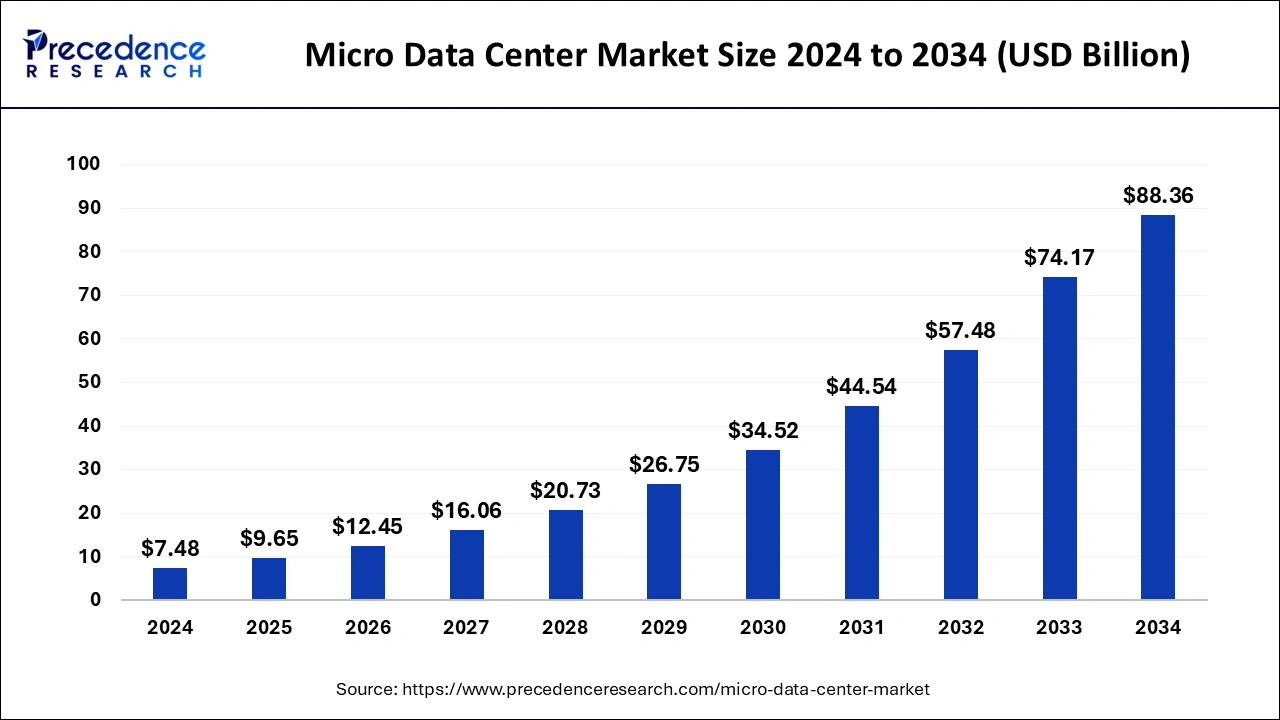
The global micro data center market size was estimated at USD 9.65 billion in 2025 and is predicted to increase from USD 12.45 billion in 2026 to approximately USD 104.22 billion by 2035, expanding at a CAGR of 26.87% from 2026 to 2035.
Micro Data Center Market Key Takeaways
- In terms of revenue, the global micro data center market was valued at USD 9.65 billion in 2025.
- It is projected to reach USD 104.22 billion by 2035.
- The market is expected to grow at a CAGR of 26.87% from 2026 to 2035.
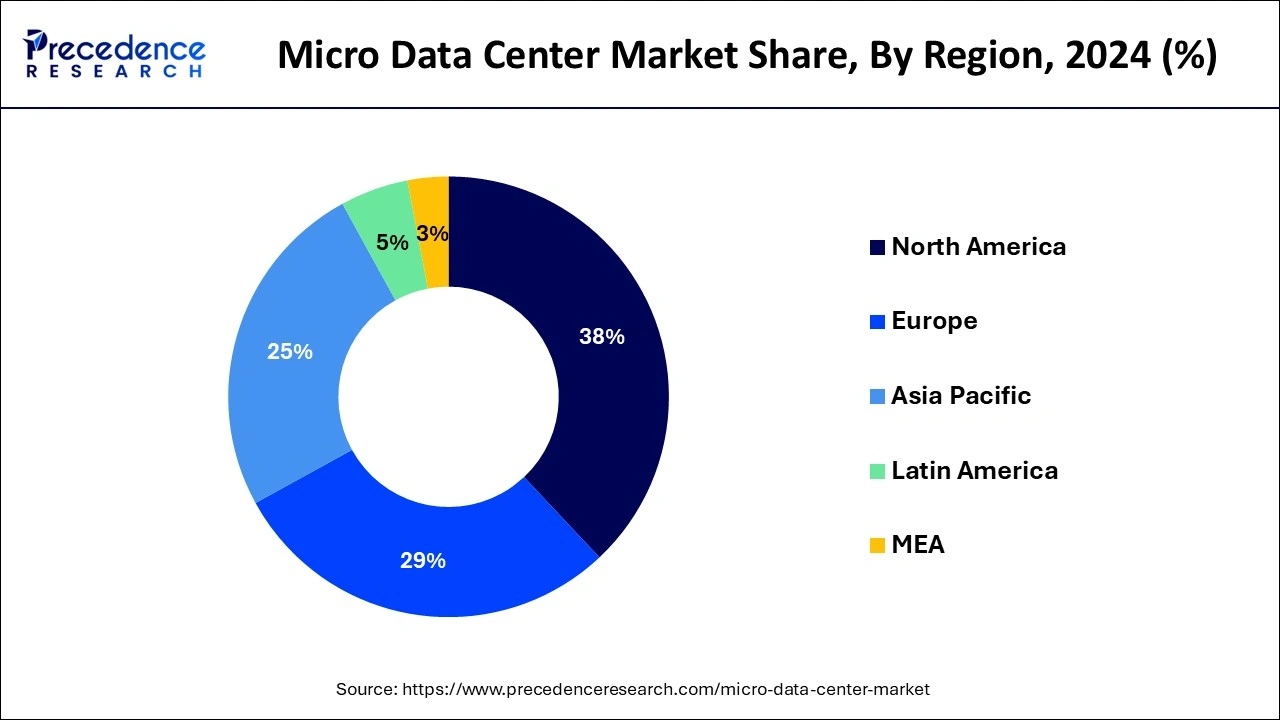
- North America dominated the global market with the largest market share of 38% in 2025.
- By component, the solution segment captured the biggest market share in 2025.
- By enterprise size, the large enterprise segment held the largest share of the market in 2025. The segment is observed to sustain the position during the forecast period.
- By application, the edge computing segment is expected to dominate the market over the forecast period.
- By industry vertical, the BFSI segment held the largest share of the market in 2025.
Market Overview
The micro data center market offers a standalone unit that has management and monitoring software, a UPS, power, and cooling systems, and a rack to accommodate all necessary IT components. Organizations may accelerate deployment speed, limit capital outlay, and reduce footprint and energy use by utilizing micro data centers.
Businesses are being encouraged to deploy micro data solutions at edge sites because of the several benefits that micro facilities provide, including increased networking and connection, cost-effectiveness, mobility, and power economy. Furthermore, these containerized (modular) or micro data center facilities may be quickly deployed, enabling businesses to expand their business operations during periods of high computing demand.
Artificial Intelligence: The Next Growth Catalyst in the Micro Data Center Market
AI is significantly accelerating the micro data center industry by increasing the need for localized, low-latency processing to support edge AI applications, such as autonomous vehicles, industrial IoT, and real-time analytics. According to Gray, the adoption of graphics processing units and tensor processing units in data centers has rushed to accelerate AI tasks due to their particular capabilities.
To handle high-density GPU-based workloads, these micro data centers are increasingly adopting advanced, integrated liquid cooling solutions and modular, plug-and-play designs that can be deployed rapidly.
Micro Data Center Market Growth Factors
- The increasing adoption of edge computing, where data processing occurs closer to the source of data generation, has fueled the demand for micro data centers. This is particularly important for applications that require low latency, such as Internet of Things (IoT), autonomous vehicles, and real-time analytics.
- Micro data centers offer a scalable and flexible solution for organizations that need to quickly expand their IT infrastructure. The modular design of these data centers allows for easy scaling by adding or removing modules based on changing requirements. The requirement of scalability offers a growth factor for the micro data center market.
- Micro data centers are well-suited for deployment in remote or harsh environments where traditional data centers may not be practical. This is especially relevant for industries like telecommunications, oil and gas, and manufacturing, where data processing at the edge is necessary.
Market Outlook
- Market Growth Overview: The micro data center market is expected to grow significantly between 2025 and 2034, driven by a shift closer to edge computing and IoT, the rapid rollout of 5G networks requiring decentralized, small-scale data centers for real-time processing, and rapid deployment and portability.
- Sustainability Trends: Sustainability trends involve renewable energy integration and BESS, energy-efficient hardware, and transition from advanced cooling solutions.
- Major Investors: Major investors in the market include Schneider Electric, Vertiv Group Corp., Dell Inc., Eaton, and IBM.
Market Scope
| Report Coverage | Details |
| Market Size by 2035 | USD 104.22 Billion |
| Market Size in 2025 | USD 9.65 Billion |
| Market Size in 2026 | USD 12.45 Billion |
| Growth Rate from 2026 to 2035 | CAGR of 26.87% |
| Base Year | 2025 |
| Forecast Period | 2026 to 2035 |
| Segments Covered | Component, Enterprise Size, Rack Unit, Application, Industry Vertical and Region |
| Regions Covered | North America, Europe, Asia-Pacific, Latin America, and Middle East & Africa |
Market Dynamics
Drivers
Rising adoption of micro data centers by organizations
Businesses rely on modular solutions that are conveniently situated at the network's edge to lower latency and enhance network connectivity for data processing and transmission. Organizations are being encouraged to deploy micro data center solutions at edge sites because of the several advantages that micro facilities provide, including increased networking and connection, cost-effectiveness, mobility, and power economy. Additionally, the quick installation of micro data center facilities enables businesses to expand their operations during periods of strong computing demand, which boosts the market for micro data centers.
Restraints
Integration and cost constraints
Integrating Micro Data Centers with existing IT infrastructure and legacy systems can be complex. Compatibility issues and the need for seamless integration may pose challenges for organizations transitioning to or incorporating micro data centers into their overall IT strategy. Additionally, micro data centers can be cost-effective for certain applications, but the initial upfront costs might still be a challenge for some organizations, particularly smaller businesses with limited budgets. The perceived cost savings may also depend on factors like energy efficiency and operational expenses. Thus, this is expected to be a major restraining factor for the micro data center market during the forecast period.
Opportunities
Sustainability benefits of micro data centers
Significant sustainability advantages can also be obtained from micro data centers. Relocating computer resources to the data source reduces the energy required to send the data over a network. Significant energy savings and a decrease in carbon emissions from the energy required to cool and power data centers can come from this. Furthermore, micro data centers frequently have extremely efficient designs with cutting-edge power management and cooling systems that use less energy. For instance, the micro data centers from Zella DC are built with energy efficiency in mind. They decrease energy usage and lower the carbon footprint of data processing by utilizing cutting-edge cooling and power management technology. The micro data centers from Zella DC are among the most energy-efficient data centers on the market right now, with a Power Usage Effectiveness (PUE) as low as 1.2. Lowering energy use and greenhouse gas emissions helps solve environmental challenges in addition to lowering operational expenses for businesses. Thus, this is expected to offer a lucrative opportunity for the micro data center market over the forecast period.
Sustainability benefits of micro data centers
In October 2024, ABB Robotics collaborated with Molg to create robotic microfactories for data center server disassembly and component recovery. The collaboration aims to tackle electronic waste production, expected to increase up to 75 million tons by 2030. The microfactories play a crucial role in significantly reducing e-waste, assisting the data center sector to operate more sustainably and efficiently.
Segment Insights
Component Insights
The solution segment held the largest share of the micro data center market in 2025. Micro data centers are designed with a modular approach, allowing organizations to scale their IT infrastructure by adding or removing modular units as needed. This modularity enhances flexibility, enabling businesses to tailor their micro data center setup to their specific requirements. In addition, they often come equipped with integrated cooling systems optimized for the smaller scale of operations.
Efficient cooling solutions are crucial for maintaining the temperature within the micro facility and ensuring optimal performance of IT equipment.
The service segment is expected to grow at the highest CAGR during the forecast period. The segment expansion is attributed to the various service launches by the key market players. For instance, in June 2022, Schneider Electric announced the "modernization" of Ecostruxure IT, its infrastructure management tool, and also introduced a faster prefabricated data center service in Europe. Under the "Easy Modular Data Center All-in-One" brand, Schneider will supply prefabricated containerized data centers ranging in power from 27kW to 80kW that are manufactured at its Barcelona facility.
Enterprise Size Insights
The large enterprise segment dominated the micro data center market in 2025. The segment is observed to sustain its position throughout the forecast period. Large enterprises may have fluctuating computing needs. The modular nature of Micro cata Centers allows these organizations to scale their IT infrastructure up or down based on demand, providing a cost-effective solution for dynamic business requirements. Additionally, they often require robust networking solutions. Micro data centers equipped with edge networking capabilities ensure optimized connectivity, enabling efficient communication between the distributed data center nodes and the broader enterprise network.
Besides, the SME segment is expected to grow at a rapid rate over the forecast period. Micro data centers provide SMEs with a cost-effective entry point into data center solutions. The modular and scalable nature of micro data centers allows SMEs to start with a smaller footprint and expand as their computing needs grow.
Application Insights
The edge computing segment is expected to dominate the micro data center market over the forecast period. Micro data centers are designed to handle edge workloads effectively. They provide the necessary computing power, storage, and networking capabilities to process and analyze data locally, minimizing the need to send large volumes of data to centralized data centers. Also, they support local data processing and analytics at the edge. This is particularly beneficial for applications that require real-time insights, such as video analytics, predictive maintenance, and edge-based machine learning.
Industry Vertical Insights
The BFSI segment held the largest share of the micro data center market in 2025. BFSI organizations deal with sensitive customer and financial data. Micro data centers can be equipped with advanced security features such as encryption, firewalls, and access controls to ensure data security and compliance with regulatory requirements. Moreover, the modular design of Micro data centers allows BFSI organizations to scale their IT infrastructure based on dynamic computing needs. This adaptability is essential for handling fluctuating workloads, such as during peak transaction times.
Besides, the IT and telecom segment is expected to grow at the highest CAGR during the forecast period. Telecom operators can deploy micro data centers at the edge of their networks to support Mobile Edge Computing (MEC). This enables faster processing of mobile services and applications, leading to improved performance for mobile users. Thus, this is expected to drive the market growth.
Regional Insights
What is the U.S. Micro Data Center Market Size?
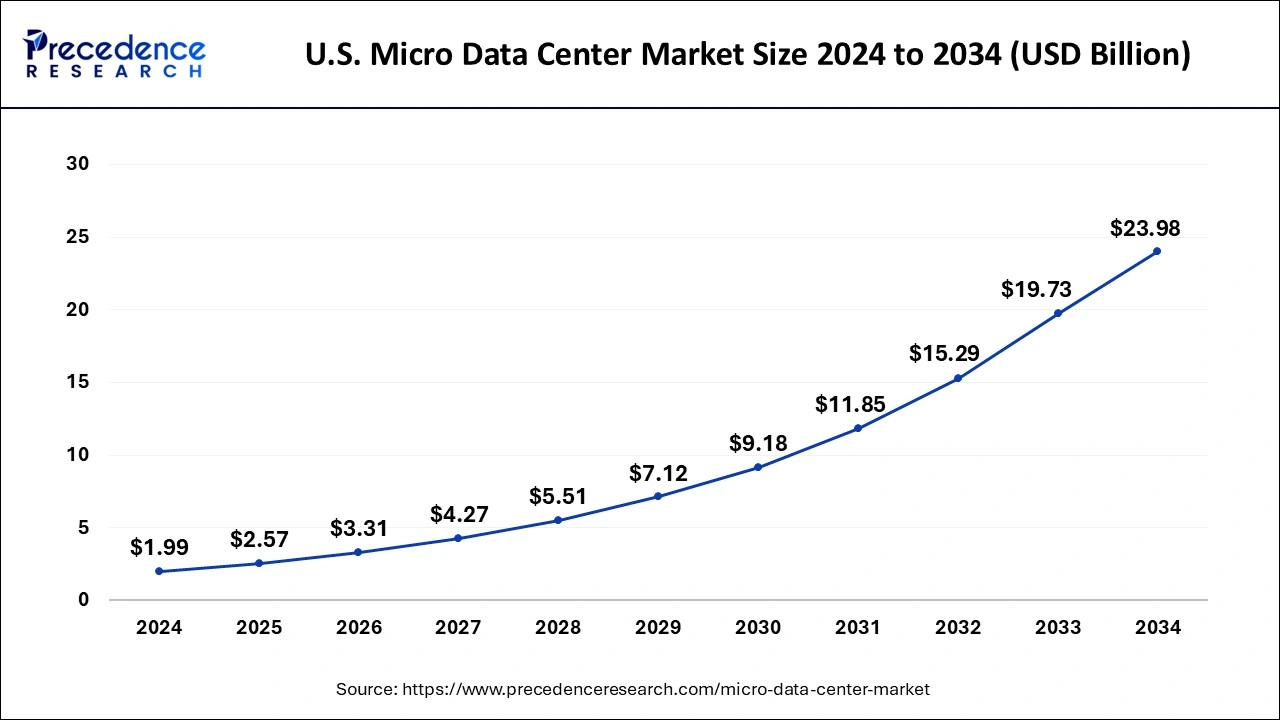
The U.S. micro data center market size reached USD 2.57 billion in 2025 and is projected to reach USD 28.36 billion by 2035, growing at a CAGR of 27.14% from 2026 to 2035.
North America held the largest share of 38% in 2025. The demand for micro data centers in North America is fueled by the growing adoption of edge computing. These data centers bring processing capabilities closer to end-users, reducing latency and enhancing the performance of applications and services.
- In February 2025, STMicroelectronics announced its plan to launch a new computer chip targeting the booming market for AI data centre equipment, which it has developed in cooperation with Amazon's web services arm (AWS). With top U.S. software firms planning to spend USD 500 billion on AI infrastructure as part of the Stargate venture.
U.S. Micro Data Center Market Trends
The U.S.'s growing need for low-latency, real-time data processing in IoT devices and 5G networks is accelerating the deployment of edge micro data centers. The enterprises favour modular, rapid-deployable units, allowing for quick, flexible infrastructure scaling, particularly for SMEs and remote locations. A growing focus on energy-efficient cooling in small, contained spaces and the modernization of existing IT, and growing industrial focus in sectors such as BFSI, retail/ distribution, and telecom.
Moreover, the deployment of 5G networks in North America has led to increased demand for micro data centers to support the distributed and low-latency requirements of 5G infrastructure, especially in densely populated urban areas. For instance, according to the recent data published by 5G Americas, by the end of 2027, there will be 601 million 5G connections in North America, or around 100 million connections annually, at a 36% population penetration rate. There are presently 267 5G and 703 LTE commercial networks in use. Thus, the aforementioned stats are expected to propel the micro data center market during the forecast period.
How did the Asia Pacific experience significant growth in the Micro Data Center Industry?
The Asia Pacific region's convergence of AI, 5G, and stringent data sovereignty laws is transforming the micro data center market into a vital component of modern digital infrastructure. The shift towards high-density processing to the network edge enables these compact units enable the real-time analytics and low-latency performance required by next-generation IoT and autonomous applications.
China Micro Data Center Market Trends
China's shift toward prefabricated modularity and rack-mounted designs prioritizes rapid deployment and high scalability. The growing demands of 5G and edge AI, these compact units minimize latency while integrating advanced green technologies, such as liquid cooling, to meet strict global sustainability standards.
Value Chain Analysis of the Micro Data Center Market
- Raw Material & Component Supply
In this stage of manufacturing, essential hardware components, including racks/enclosures, uninterruptible power supplies, cooling units, security systems, and monitoring software.
Key Players: Schneider Electric, Eaton Corporation, Vertiv Group Corp., and Panduit Corp. - Manufacturing & Integrated System Production
The manufacturers assemble components into pre-engineered, self-contained micro data center units. These units are designed for rapid deployment in edge locations, often featuring advanced cooling and robust security.
Key Players: Huawei Technologies, Dell Technologies, Vertiv, Schneider Electric, Rittal, and Delta Electronics. - Service Providers
The service providers use advanced software to monitor environmental conditions and provide proactive maintenance to ensure reliability.
Key Players: Schneider Electric, Vertiv, IBM, Eaton, Dell Technologies.
Micro Data Center Market Companies
- Schneider Electric: Schneider Electric provides fully integrated, secure micro data center solutions under its EcoStruxure IT portfolio, which includes pre-packaged power, cooling, and management software for rapid edge computing deployment.
- Rittal GmbH & Co. KG: Rittal offers the RiMatrix Micro Data Center, a compact, modular, and preconfigured IT infrastructure system designed to bring secure data processing close to the source (edge).
- IBM Corporation: IBM contributes to the micro data center market by integrating high-performance computing, such as their Power11 systems, into compact, energy-efficient, and secure hardware configurations suitable for on-premises, edge locations.
- Hewlett Packard Enterprise Development LP: HPE offers the "HPE Edge Center," a self-contained, single-cabinet modular data center that integrates compute, storage, networking, and software-defined management for rapid deployment.
- Vertiv Group Corp.: Vertiv designs comprehensive, pre-integrated micro data centers, including the Vertiv™ VRC-S, which combine rack, intelligent power distribution, UPS, cooling, and monitoring into one unit.
- Delta Power Solutions: Delta Electronics provides compact and reliable micro data center infrastructure solutions, focusing on integrating its high-efficiency modular UPS and cooling technologies into secure rack systems.
Other Major Key Players
- ALTRON
- Eaton
- Canovate
- Cannon Technologies Ltd.
Recent Developments
- In January 2023, Micro Focus declared the grand launch of a new data center in the UK. Customers in the United Kingdom have access to software as a service (SaaS) solutions for IT Operations Management (ITOM) from their local data center, which conforms with local data residency laws about data protection, privacy, storage, and transfer.
- In August 2023, Vertiv, a worldwide supplier of vital digital infrastructure and continuity solutions, declared that the VertivTM SmartCabinetTM 2, a self-contained micro data center for edge computing applications, such as those used by banks and financial institutions, warehousing, education, government, and retail clients, is now locally available in Africa. The SmartCabinetTM 2 fulfils the needs of smaller edge computing sites by providing all the functionality of a full data center in a small, easily deployable form. The system is housed in a cabinet that is more compact in height, width, and depth than previous VertivTM SmartCabinetTM models. It consists of an enclosed rack, a 3500W VertivTM Liebert integrated cooling unit, a VertivTM Liebert uninterruptible power supply (UPS), and a power management unit.
- In November 2022, the EcoStruxureTM Micro Data Center R-Series 42U Medium Density from Schneider Electric, a pioneer in the digital transformation of energy management and automation, is a new solution for the company to address the issues of managing hybrid IT infrastructure. Schneider Electric is now offering IT professionals and IT solution providers a fully integrated, turnkey solution that is easy to purchase and implement by expanding its ruggedized Micro Data Center offering.
- In April 2025, Vertiv, a global leader in critical digital infrastructure and continuity solutions, and Maxcom, a pioneer in technology providers in the Maldives, announced a strategic partnership to expand Micro Data Center & IT Systems solutions in the Maldives. The collaboration focuses on promoting and deploying the Vertiv Smart Solutions global edge and modular data centers (MDC) portfolio, providing power, cooling, and support to enable the acceleration of the local data center industry.
- In August 2024, by partnering with NGON, MARA announced the launch of a 25-megawatt micro data center operation across wellheads in Texas and North Dakota, transforming excess gas into power for the data centers and providing a valuable service to energy producers, assisting in increasing methane mitigation efficiency up to 99%.
- In July 2024, Vertiv, a global provider of critical digital infrastructure and continuity solutions, announced the launch of the Vertiv MegaMod CoolChip, a liquid cooling-equipped prefabricated modular (PFM) data center solution engineered to enable efficient and reliable AI computing. The solution can be configured to support the platforms of leading AI compute providers and scaled to customer requirements.
Segments Covered in the Report
By Component
- Solution
- Service
By Enterprise Size
- Large Enterprises
- SMEs
By Rack Unit
- Up to 20 RU
- 20–40 RU
- Above 40 RU
By Application
- Remote Office and Branch Office
- Instant Data Center
- Edge Computing
By Industry Vertical
- Energy
- Colocation
- BFSI
- Government
- Industrial
- Healthcare
- IT and telecom
- Others
By Region
- North America
- Europe
- Asia-Pacific
- Latin America
- Middle East and Africa
For inquiries regarding discounts, bulk purchases, or customization requests, please contact us at sales@precedenceresearch.com
Frequently Asked Questions
Tags





Ask For Sample
No cookie-cutter, only authentic analysis – take the 1st step to become a Precedence Research client
 Get a Sample




 sales@precedenceresearch.com
 Schedule a Meeting
