



Micro Location Technology Market Trends, Companies, Revenue / Sales Performance, Subscriber Growth, Pricing Strategies, Cloud Adoption, Infrastructure Expansion, Competitive Landscape, and Industry Outlook
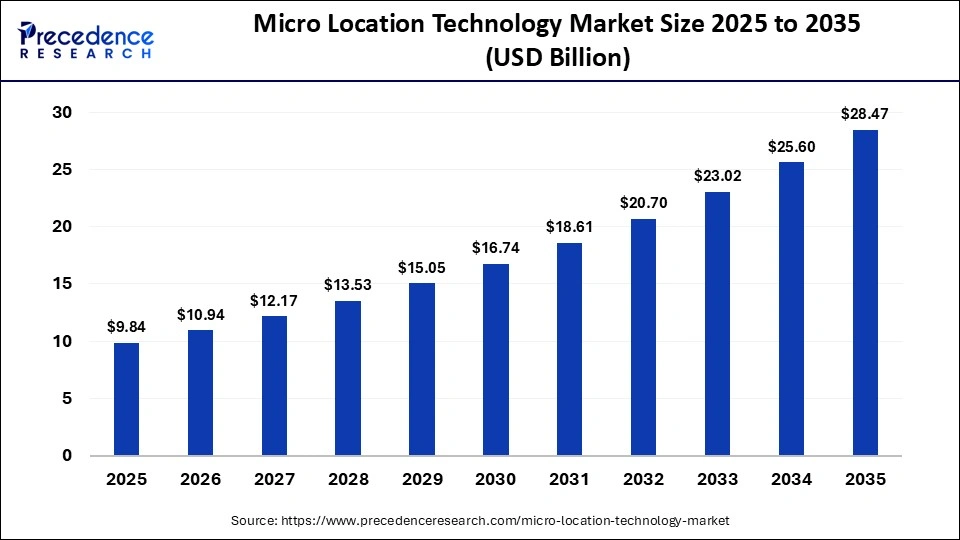
ICT industry specialist Shivani Zoting estimates the micro location technology market at USD 10.94 billion in 2026, with continued technology adoption expected to take the market to USD 28.47 billion by 2035 at a CAGR of 11.21%. Leading micro location technology market providers such as Cisco Systems, Inc., Aruba Networks (HPE), Zebra Technologies Corporation, Siemens AG, Ruckus Networks (CommScope), Kontakt.io are expanding their capabilities across segments including By Application, By Deployment Type, By End-Use.
Source: https://www.precedenceresearch.com/micro-location-technology-market
 Get a Sample
 Table Of Content


What is the Micro Location Technology Market Size in 2026?
The global micro location technology market size was calculated at USD 9.84 billion in 2025 and is predicted to increase from USD 10.94 billion in 2026 to approximately USD 28.47 billion by 2035, expanding at a CAGR of 11.21% from 2026 to 2035. Technological advancements and the adoption of BLE, UWB, and IoT are key drivers of market growth.
Key Takeaways
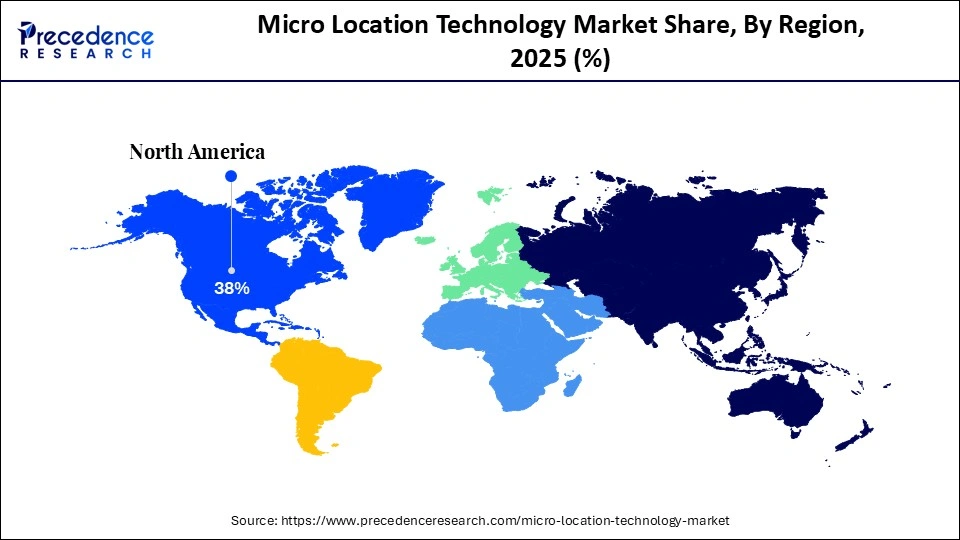
- North America dominated the global market with the largest market share of 38% in 2025.
- Asia-Pacific is expected to grow at the fastest CAGR in the market during the forecast period.
- By technology, the Bluetooth low energy segment led the global market in 2025.
- By technology, the ultra wideband segment is expected to grow at the fastest CAGR in the market between 2026 and 2035.
- By application, the retail segment dominated the market in 2025.
- By application, the healthcare segment is expected to grow with the highest CAGR in the market during the studied years.
- By deployment type, the cloud based segment held a dominant position in the market in 2025.
- By deployment type, the on premises segment is expected to expand rapidly in the market in the coming years.
- By end use, the smartphones segment held the largest market share in 2025.
- By end use, the wearable devices segment is expected to witness the fastest growth in the market over the forecast period.
What is the Micro Location Technology Market?
Micro-location refers to the precise tracking of entities, typically accurate within centimeters, whereas geofencing creates virtual boundaries around points of interest. Ultra wideband technology is becoming increasingly popular in the sports industry and other fields due to its cost effectiveness and superior accuracy compared to conventional systems. Additionally, this technology improves accident prevention by facilitating communication between cyclists or pedestrians and connected vehicles within a 200-meter radius, thereby lowering the risk of collisions. Its uses are broadening in healthcare, retail, and commercial sectors, aiding in the advancement of micro-location technologies.
Impact of Artificial Intelligence on Micro Location Technology
Artificial intelligence (AI) is being applied across various functions, including the development of integrated solutions that combine micro-location capabilities. This enables predictive analytics and enhanced contextual insights. At the same time, there is increasing pressure to transition toward greener, low-carbon modes of production, making it important to understand whether and how AI adoption facilitates green technology innovation. Moreover, the effects of AI adoption may vary significantly across sectors, depending on factors such as technology intensity, environmental regulation, and innovation capacity.
Micro Location Technology Market Trends
- Emergence of Hybrid BLE & UWB Beacons: The emergence of hybrid Bluetooth low energy (BLE) and ultra-wideband (UWB) beacons enables enterprises to achieve high precision tracking within approximately 30 cm, while maintaining low installation complexity and long battery life. These characteristics make them ideal for industrial and asset management applications.
- Advancement in Bluetooth 5.1 Technology: Bluetooth 5.1 technology enhances the accuracy of BLE systems, making them more reliable for indoor navigation by improving direction finding capabilities and enabling precise positioning in complex indoor environments.
- Integration with the Internet of Things (IoT): The integration of micro location technology with the IoT allows companies to create smarter, more connected environments that respond in real time to the movement of people and assets, thereby improving operational efficiency.
Market Scope
| Report Coverage | Details |
| Market Size in 2025 | USD 9.84 Billion |
| Market Size in 2026 | USD 10.94 Billion |
| Market Size by 2035 | USD 28.47 Billion |
| Market Growth Rate from 2026 to 2035 | CAGR of 11.21% |
| Dominating Region | North America |
| Fastest Growing Region | Asia-Pacific |
| Base Year | 2025 |
| Forecast Period | 2026 to 2035 |
| Segments Covered | Technology, Application, Deployment Type, End-Use, and Region |
| Regions Covered | North America, Europe, Asia-Pacific, Latin America, and Middle East & Africa |
Market Dynamics
Drivers
Revolution in UWB & BLE and Advanced Technology Upgradation
Continuous innovations in UWB and BLE, along with advanced technology upgrades, are driving the adoption of micro-location solutions by enabling low-power location data processing and delivering highly accurate, reliable, real-time positioning results across industries.
Restraint
Data Security Concerns
The risk of tracking without user consent, along with potential data breaches and misuse of location technology, is raising significant cybersecurity and privacy concerns.
Opportunity
Growing Use of Beacon Technology in Retail
Retailers are increasingly using beacon technology to deliver personalized indoor marketing, enhance customer experiences, and optimize inventory management, thereby creating strong growth opportunities for the adoption of micro-location technologies in the retail sector.
Segmental insights
Technology Insights
The Bluetooth Low Energy Segment Dominated the Market in 2025
The Bluetooth low energy segment dominated the micro location technology market in 2025, due to its rising adoption and intense competition. BLE supports long battery life and does not require handling large volumes of data. BLE modules and chipsets are low-cost, especially as they gain widespread adoption across industries for their energy efficiency and reliable connectivity.
BLE is widely used in industrial monitoring, glucose and blood pressure monitoring, consumer health tracking (e.g., Fitbit), smartwatches, geographically targeted promotions, and public transportation apps. The extended battery life is largely due to its ability to switch to sleep mode when not in use and wake only when data transfer is required.
The ultra-wideband segment is expected to show the fastest growth over the forecast period, primarily due to its capability for high-precision positioning. UWB further supports data communication rates of up to 27 Mbps. It delivers high-accuracy ranging and positioning, strong security, low interference with other communication systems, and low power consumption. These advantages are unlocking new opportunities across mobile, automotive, industrial, and consumer IoT markets and applications.
Application Insights
The Retail Segment Led the Market in 2025
The retail segment led the micro location technology market in 2025, driven by growing demand for personalized customer experience and improved operational efficiency. Micro location technology enables optimized store layouts, shorter wait times, and targeted marketing, while also strengthening theft prevention and security. Motion sensors support energy savings through occupancy-based lighting control. LiDAR facilitates in-store navigation in large retail spaces, and optical sensors provide insights into customer reach and product interaction on shelves.
The healthcare segment is expected to gain the highest market share between 2026 and 2035, driven by continuous innovation in patient care and operational excellence. Healthcare providers are increasingly deploying IoT sensors, tags, and specialized software to track the real-time location of medical equipment, patients, and staff within hospitals and clinics. This enhanced asset-tracking capability helps prevent loss and theft of critical equipment such as IV pumps, ventilators, and wheelchairs, while improving overall utilization.
In addition, patient and staff badges enhance safety, support efficient patient flow management, and can trigger alerts when individuals enter restricted or high-risk areas. Collectively, these capabilities are accelerating the adoption of micro location technologies across the healthcare sector, boosting the segment's growth.
Deployment Type Insights
The Cloud-based Segment Dominated the Market in 2025
The cloud-based segment contributed the biggest micro location technology market share in 2025, primarily because cloud tools offer businesses greater operational flexibility. By leveraging energy efficient data centers, cloud solutions help organizations advance their environmental and sustainability goals while significantly reducing overall carbon footprints. In addition, cloud deployment helps enterprises avoid overbuilding and overprovisioning on premises data centers, freeing IT teams from routine infrastructure management. This allows them to focus on more strategic, value adding initiatives, thereby supporting the strong growth of the cloud based segment.
The on premises segment is expected to witness the fastest growth in the market over the forecast period, as industries increasingly prioritize data security and regulatory compliance. On premises deployments offer organizations full control over data by storing information on local servers, enabling custom security measures tailored to specific business requirements and providing a high degree of customization to meet unique operational and workflow needs. This model also simplifies compliance management with industry-specific regulations and internal policies, making the on-premise segment a preferred choice for businesses that require stringent security, control, and regulatory adherence.
End-Use Insights
The Smartphones Segment Contributed the Highest Market Share in 2025
The smartphones segment accounted for the highest micro location technology market share in 2025, driven by the widespread integration of BLE, UWB, NFC, and Wi Fi in modern devices. These embedded technologies enable precise location tracking, seamless connectivity, and a broad range of micro location applications. Wi Fi is increasingly used as an alternative or complement to GPS for location based services and micro location use cases.
Android further strengthens this segment by offering built in support for BLE and robust APIs that let apps discover nearby devices, access services, and exchange data efficiently. Together, these capabilities cement smartphones as the primary interface for micro location technologies and are promoting the market.
The wearable devices segment is expected to expand rapidly in the market in the coming years, driven by rising adoption of smartwatches, rings, bracelets, and other form factors integrating GPS chips for enhanced functionality. These devices commonly leverage UWB, BLE, and Wi Fi for connectivity and accurate positioning. They also combine sensors such as accelerometers, gyroscopes, and magnetometers to track movement and location via dead reckoning, further expanding micro location use cases in consumer and industrial applications.
Regional Insights
North America Micro Location Technology Market Size and Growth 2026 to 2035
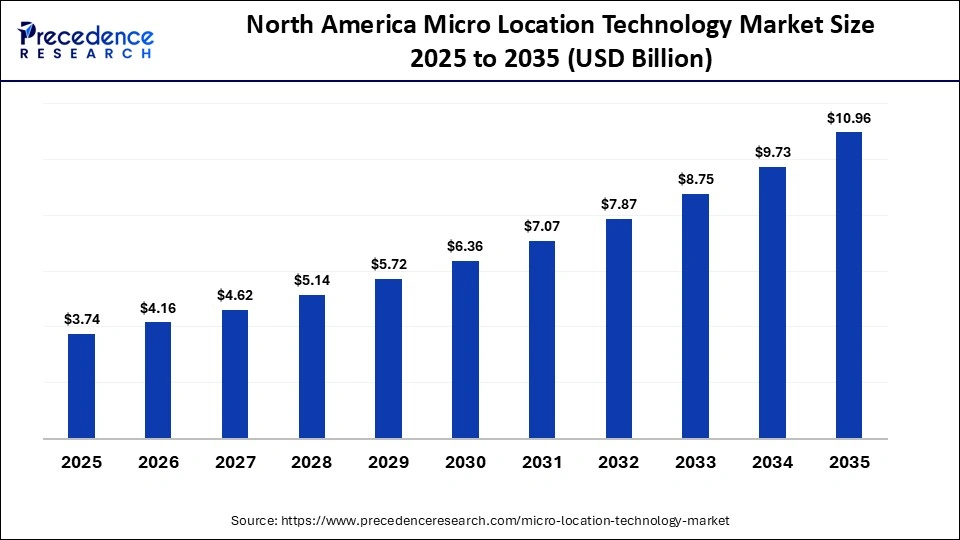
The North America micro location technology market size is estimated at USD 3.74 billion in 2025 and is projected to reach approximately USD 10.96 billion by 2035, with a 11.35% CAGR from 2026 to 2035.
Why North America Dominated the Micro Location Technology Market?
North America held a major market share in 2025, driven by robust institutional demand in the healthcare, retail, and industrial sectors, bolstered by the region's sophisticated IT infrastructure and early embrace of location-based technologies. Prominent technology companies and specialized providers in the area are consistently innovating to improve their service offerings.
Notably, the incorporation of AI and IoT into micro-location solutions is transforming the market. These technologies facilitate highly precise location tracking for various applications, including asset management and personalized marketing, thereby further promoting market expansion.
U.S. Micro Location Technology Market Size and Growth 2026 to 2035
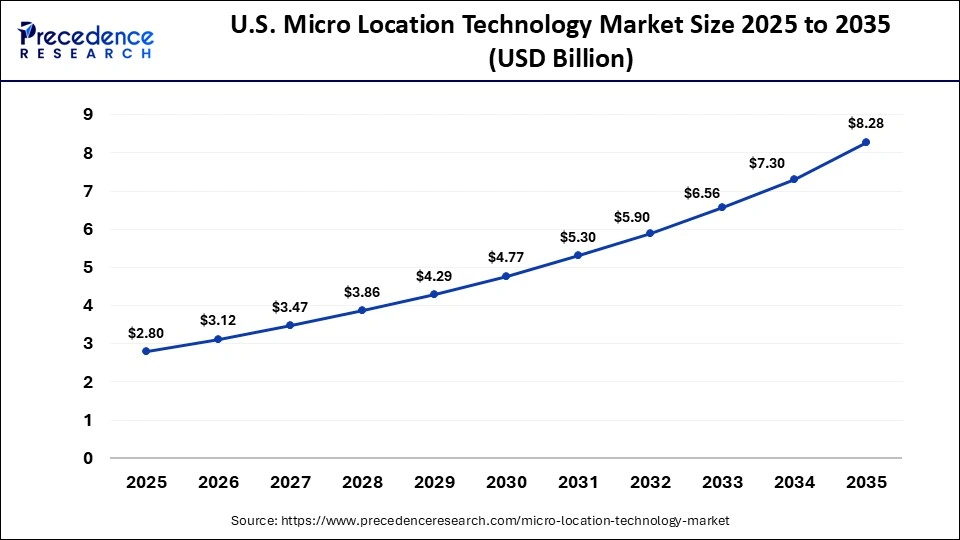
The U.S. micro location technology market size is calculated at USD 2.80 billion in 2025 and is expected to reach nearly USD 8.28 billion in 2035, accelerating at a strong CAGR of 11.45% between 2026 and 2035.
U.S. Market Trends
The U.S. region is at the forefront of market trends in North America. The healthcare sector is swiftly implementing BLE- and RFID-based RTLS solutions for tracking patients, managing assets, and ensuring hygiene compliance. Simultaneously, prominent retailers like Walmart and Target are channeling investments into AI-driven proximity marketing and indoor analytics platforms to improve in-store experiences. The combination of leading technology firms, sophisticated infrastructure, and a high rate of IoT device adoption positions the U.S. as a powerful player in the region.
How is Asia-Pacific Growing in the Micro Location Technology Market?
Asia-Pacific is expected to experience the fastest growth during the predicted timeframe, driven by increasing smartphone adoption and advancements in retail modernization. The market is driven by enhanced by swift urbanization, government-initiated smart city initiatives, and improved connectivity. Moreover, the region is experiencing robust demand from logistics centers, large retail spaces, and healthcare systems, where the integration of real-time location tracking is being utilized to enhance asset efficiency, patient movement, and workforce effectiveness.
China Market Trends
China's market is driven by significant investments in sensor networks and 5G-enabled micro-location technologies, aiming to establish the nation as a center for future growth. China's prominent status is supported by the expansion of digital infrastructure, national smart city initiatives, and extensive industrial automation. Additionally, government programs like China's Smart Hospital Blueprint are facilitating the rapid deployment of healthcare Real-Time Location Systems (RTLS). Concurrently, the expanding e-commerce and retail sectors are propelling the adoption of proximity marketing and indoor navigation solutions.
Micro Location Technology Market Companies
- Cisco Systems, Inc.
- Aruba Networks (HPE)
- Zebra Technologies Corporation
- Siemens AG
- Ruckus Networks (CommScope)
- Kontakt.io
- Estimote, Inc.
- Ubisense Ltd.
- CenTrak, Inc.
- Sewio Networks
- BlueCats
- Humatics Corporation
- Apple Inc.
- Google LLC (Alphabet)
- HERE Technologies
Recent Developments
- In September 2025, in a groundbreaking fusion of science fiction and reality, smart dust technology, tiny wireless sensors capable of collecting vast amounts of data, emerged as a potential game-changer for industries ranging from environmental monitoring to healthcare, while also raising serious ethical and privacy concerns.(Source: https://www.energy-reporters.com)
- In August 2025, U.S. authorities secretly embedded location tracking devices in selected shipments of advanced chips deemed at high risk of being illegally diverted to China, according to two people with direct knowledge of the previously undisclosed law enforcement tactic. The measures are intended to detect AI chips being rerouted to destinations under U.S. export restrictions and apply only to specific shipments under investigation.(Source: https://www.reuters.com)
Segments Covered in the Report
By Technology
- Bluetooth Low Energy
- Wi-Fi Positioning Systems
- Ultra-Wideband
- Near Field Communication
By Application
- Retail
- Hospitality
- Healthcare
- Transport and Logistics
By Deployment Type
- On-premises
- Cloud-based
By End-Use
- Consumer Electronics
- Smartphones
- Wearable Devices
- IoT Devices
By Region
- North America
- Latin America
- Europe
- Asia-pacific
- Middle and East Africa
For inquiries regarding discounts, bulk purchases, or customization requests, please contact us at sales@precedenceresearch.com
Frequently Asked Questions





Ask For Sample
No cookie-cutter, only authentic analysis – take the 1st step to become a Precedence Research client
 Get a Sample




 sales@precedenceresearch.com
 Schedule a Meeting
