



AI Energy Efficiency Tools Market Revenue to Attain USD 24.95 Bn by 2035
Published: 23 Apr 2026
Author: Precedence Research



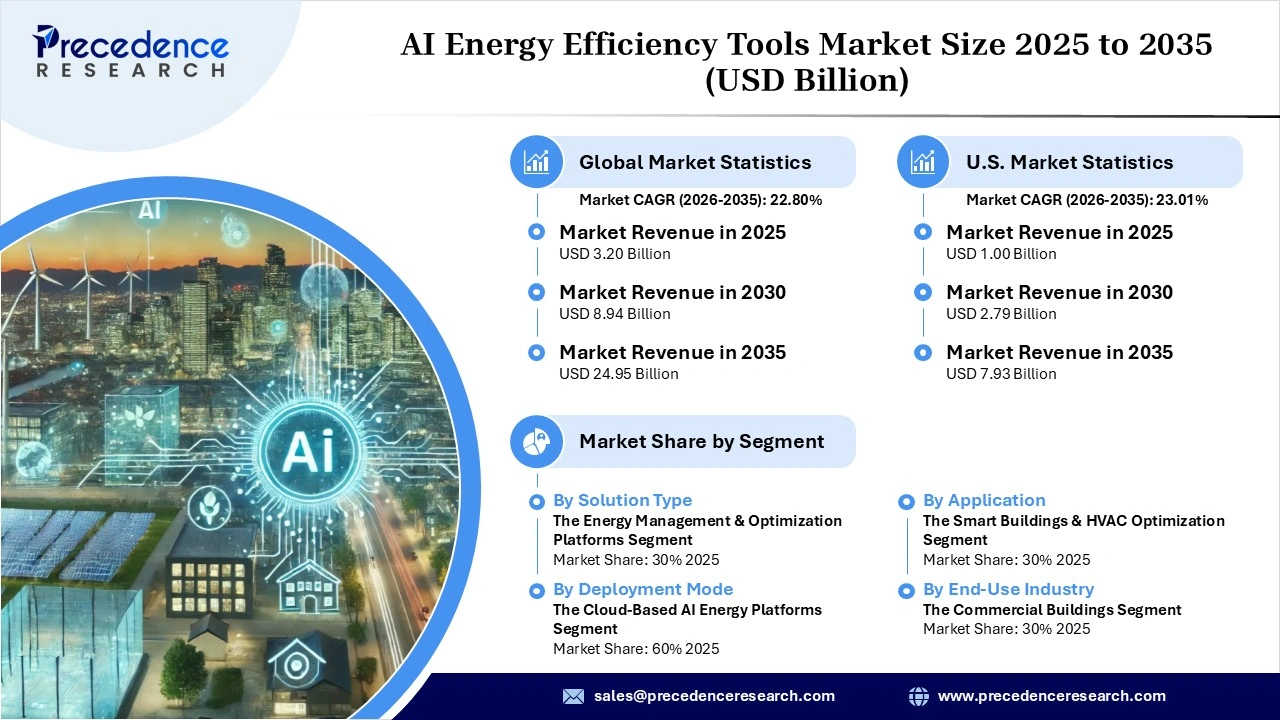
The global AI energy efficiency tools market revenue surpassed USD 3.20 billion in 2025 and is predicted to attain around USD 24.95 billion by 2035, growing at a CAGR of 22.80% from 2026 to 2035. The market is gaining momentum as organizations increasingly recognize that reducing energy waste is no longer merely a sustainability initiative, but a clear financial imperative. In this context, AI-enabled systems are emerging as quiet enablers of efficiency, transforming complex and often inefficient infrastructures into highly optimized, cost-conscious networks through continuous monitoring and intelligent process control.
Market at a Glance
The AI energy efficiency tools market comprises an evolving ecosystem of software and intelligent systems that utilize machine learning, as well as real-time data and predictive analytics to lower unnecessary energy consumption in buildings, manufacturing plants, and power networks. Such tools consistently recognize patterns, forecast demand, and enhance operations dynamically. This realm is where energy management has transitioned from manual processes to being algorithmically driven for subtle changes from optimization of smart HVAC systems to grid balancing. The market is being driven by technological advancements, rising energy costs, stricter climate targets, and the growing need for intelligent systems.
What Drives the AI Energy Efficiency Tools Market?
- Rise in Adoption of AI: Rising adoption of AI technologies drives the market. By 2028, AI is expected to account for over half of data center electricity consumption, highlighting a growing operational paradox. However, this also creates a significant opportunity for efficiency gains, as AI-driven optimization tools are increasingly being deployed to manage and reduce energy use, particularly within hyperscale data centers where workloads and power demands are most intense.
- Investment in Data Centers Infrastructures: Utilities are projected to invest $1.4 trillion by 2030 to support AI-driven electricity demand, particularly from data centers. This scale of investment indicates a parallel demand for efficient tools to manage operational costs and grid stress.
- Expansion of Smart Infrastructure and Digitalization: The rapid adoption of smart buildings, Industry 4.0 systems, IoT sensors, and cloud-connected infrastructure is generating large volumes of energy data. AI tools are essential to analyze this data and automate real-time decision-making for energy optimization across complex systems.
Rapid AI Adoption is Reshaping Global Energy Demand
- AI adoption is accelerating rapidly, with 65% of organizations already using generative AI, nearly doubling within a single year.
- An estimated 77% of organizations are expected to adopt AI technologies at a fast pace, further increasing demand for more efficient and optimized AI systems.
- This rapid adoption has a significant energy impact: AI-powered everyday applications, such as search engines, could increase electricity consumption by up to 10 times in certain use cases.
- Data centers are emerging as major global energy consumers, with their share of worldwide electricity demand expected to double by 2030.
- In terms of enterprise adoption, 74% of energy and utility firms have recently implemented AI, primarily to improve operational efficiency and enhance grid management systems.
- However, while 63% of organizations plan to deploy AI for sustainable IT initiatives, only 23% currently prioritize sustainability as a core design principle, highlighting a gap between intent and execution.
Market Segmentation Overview
- By solution type, the energy management & optimization platforms segment accounted for a 30% share in the AI energy efficiency tools market in 2025 because they brought AI directly into the core of enterprise energy systems. Their ability to continuously fine-tune consumption, cut operational costs, track sustainability, and perform real-time optimization made them less of an upgrade and more of a necessity.
- By solution type, the predictive maintenance for energy systems segment is expected to grow at the fastest CAGR of 24% in the market between 2026 and 2035 because of their ability to identify equipment inefficiencies before their progression into failures. These systems minimize both energy waste and expensive downtime by recognizing early signs of equipment fatigue or malfunction.
- By deployment mode, the cloud-based AI energy platforms segment held a 60% share of the market in 2025, as they allow centralized monitoring across scattered assets, while seamlessly integrating with IoT-enabled systems, making large-scale energy optimization manageable without heavy on-site infrastructure.
- By deployment mode, the edge AI energy optimization systems segment is expected to expand at a CAGR of 24.5% between 2026 and 2035, driven by the need for real-time decision-making. Deployed directly within smart buildings, factories, and IoT environments, these systems reduce latency and enable immediate energy adjustments, making them critical in scenarios where milliseconds translate into measurable cost savings.
- By application, the smart buildings & HVAC optimization segment accounted for a share of 30% in the market in 2025, as buildings have evolved into intelligent systems, with AI-driven HVAC solutions dynamically adjusting to occupancy and environmental conditions, significantly reducing energy waste while improving operational efficiency.
- By application, the data center energy optimization segment is expected to expand at a CAGR of 26% in the coming years, fueled by the rapid expansion of AI-driven workloads. As power density increases, operators are prioritizing AI-enabled cooling and energy management systems to optimize performance while minimizing energy consumption.
- By end-use industry, the commercial buildings segment held a major share of 30% in the market in 2025, driven by their high energy consumption and the growing adoption of smart building technologies. AI tools are becoming essential for facility managers to control costs and meet efficiency targets at scale.
- By end-use industry, the IT & data centers segment is expected to grow at the fastest CAGR of 26% in the AI energy efficiency tools market between 2026 and 2035, driven by exponential growth in cloud computing and AI workloads. Increasing energy intensity is pushing operators toward AI-based optimization solutions to balance performance, cost, and uptime.
Regional Analysis
North America dominated the global AI energy efficiency tools market with a share of 40.0% in 2025, driven by widespread AI adoption across industries. Smart buildings have transitioned from experimental deployments to commercial standards, enabling real-time energy monitoring and optimization. In the U.S., the growth of the market has been fueled by the expansion of data centers and a strong corporate commitment to ESG principles. Meanwhile, Canada focused on grid modernization and the integration of clean energy, reinforcing the region’s leadership in the market.
Asia Pacific held a market share of 25% in 2025 and is expected to grow at the fastest CAGR of 26.5% in the AI energy efficiency tools market during the forecast period, as rapid industrialization is placing increasing pressure on energy systems, while smart city initiatives are transforming how energy is consumed and managed. China is advancing AI applications across manufacturing, infrastructure, and grid operations, while India is steadily adopting smart building technologies to meet rising demand. In Japan and South Korea, mature technology ecosystems are enabling more precise, data-driven energy optimization strategies, positioning the region as a high-growth market despite structural and regulatory challenges.
AI Energy Efficiency Tools Market Coverage
| Report Attribute | Key Statistics |
| Market Revenue in 2025 | USD 3.20 Billion |
| Market Revenue by 2035 | USD 24.95 Billion |
| CAGR from 2026 to 2035 | 22.80% |
| Quantitative Units | Revenue in USD million/billion, Volume in units |
| Largest Market | North America |
| Base Year | 2025 |
| Regions Covered | North America, Europe, Asia-Pacific, Latin America, and the Middle East & Africa |
Top Companies in the AI Energy Efficiency Tools Market
Companies such as Schneider Electric SE, Siemens AG, Honeywell International Inc., and ABB Ltd. have been anchoring the market with deep-rooted expertise in infrastructure and automation. At the same time, technology giants IBM Corporation, Microsoft Corporation, Google LLC (Alphabet Inc.), Cisco Systems, Inc., and Oracle Corporation have been reshaping the space from a data-first perspective, treating energy not just as a utility but as an optimization problem waiting to be solved at scale.
Segments Covered in the Report
By Solution Type
- Energy Management & Optimization Platforms
- AI-based Demand Response Systems
- Predictive Maintenance for Energy Systems
- Building Energy Management Systems (AI-enabled BEMS)
- Industrial Energy Optimization Tools
By Deployment Mode
- Cloud-based AI Energy Platforms
- On-premise Energy Management Systems
- Edge AI Energy Optimization Systems
By Application
- Smart Buildings & HVAC Optimization
- Data Center Energy Optimization
- Smart Grids & Utilities Optimization
- Industrial Process Energy Optimization
- Renewable Energy Integration & Forecasting
By End-Use Industry
- Commercial Buildings
- Industrial & Manufacturing
- Energy & Utilities
- IT & Data Centers
- Healthcare
- Others
By Region
- North America
- Latin America
- Europe
- Asia-pacific
- Middle and East Africa
Get this report to explore global market size, share, CAGR, and trends, featuring detailed segmental analysis and an insightful competitive landscape overview @ https://www.precedenceresearch.com/sample/8330
You can place an order or ask any questions. Please feel free to contact us at sales@precedenceresearch.com |+1 804 441 9344