



AI Energy Efficiency Tools Market Trends, Companies, Revenue / Sales Performance, Subscriber Growth, Pricing Strategies, Cloud Adoption, Infrastructure Expansion, Competitive Landscape, and Industry Outlook
AI Energy Efficiency Tools Market (By Solution Type: Energy Management & Optimization Platforms, AI-based Demand Response Systems, Predictive Maintenance for Energy Systems, Building Energy Management Systems (AI-enabled BEMS), Industrial Energy Optimization Tools; By Deployment Mode: Cloud-based AI Energy Platforms, On-premise Energy Management Systems, Edge AI Energy Optimization Systems; By Application: Smart Buildings & HVAC Optimization, Data Center Energy Optimization, Smart Grids & Utilities Optimization, Industrial Process Energy Optimization, Renewable Energy Integration & Forecasting; By End-Use Industry: Commercial Buildings, Industrial & Manufacturing, Energy & Utilities, IT & Data Centers, Healthcare, Other) - Global Industry Analysis, Size, Trends, Leading Companies, Regional Outlook, and Forecast 2026 to 2035
Source: https://www.precedenceresearch.com/ai-energy-efficiency-tools-market
 Get a Sample
 Table Of Content


What is the AI Energy Efficiency Tools Market Size in 2026?
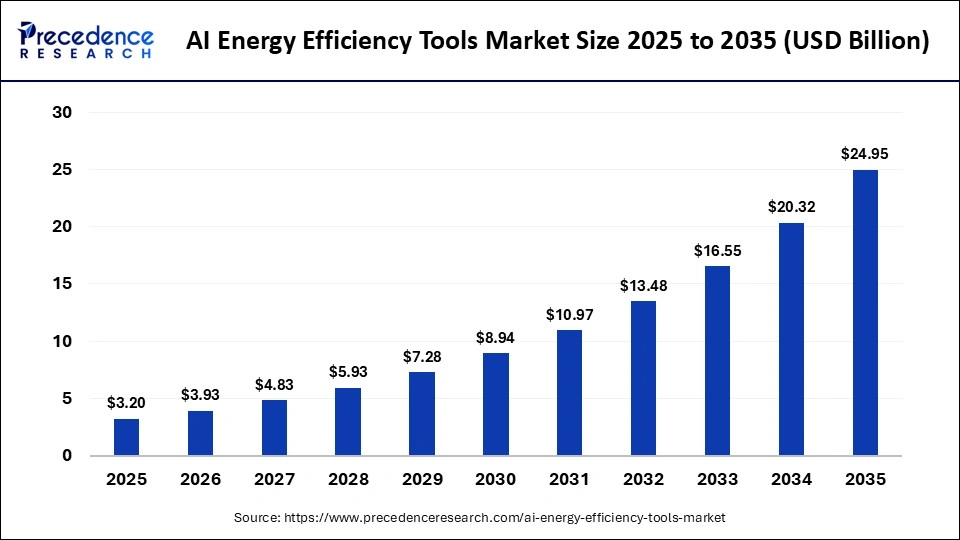
The global AI energy efficiency tools market size accounted for USD 3.20 billion in 2025 and is predicted to increase from USD 3.93 billion in 2026 to approximately USD 24.95 billion by 2035, expanding at a CAGR of 22.80% from 2026 to 2035. The market is significantly expanding due to the urgent need for cost reduction, rapid data center development, growing complexity of modern energy grids, and strict government regulations on carbon emissions.
Key Takeaways
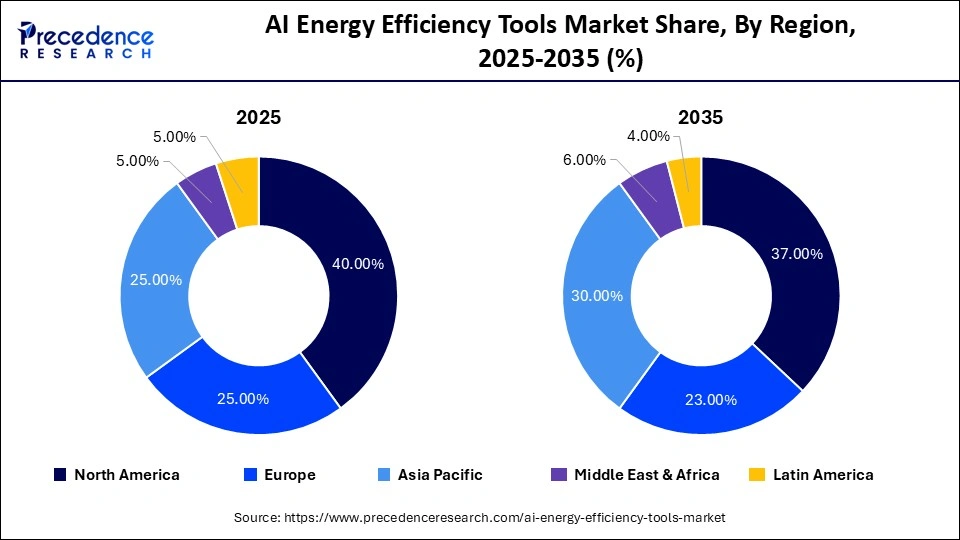
- North America held the largest market share of 40% in 2025.
- The Asia Pacific is expected to grow at the fastest CAGR of 26.5% during the foreseeable period of 2026-2035.
- By solution type, the energy management & optimization platforms segment held the largest market share of 30% in 2025.
- By solution type, the AI-based demand response systems segment is the second-largest shareholder and is expected to grow at a CAGR of 20.5% during the forecast period.
- By deployment mode, the cloud-based AI energy platforms segment held the largest market share of 60% in 2025.
- By deployment mode, the on-premise energy management systems segment is the second-largest shareholder and is expected to grow at a CAGR of 15.5% during the projection period.
- By application, the smart buildings & HVAC optimization segment held the largest market share of 30% in 2025.
- By application, the data center energy optimization segment is the second-largest shareholder and is expected to grow at the fastest CAGR of 26.0% between 2026 and 2035.
- By end-use industry, the commercial buildings segment held the largest market share of 30% in 2025.
- By end-use industry, the industrial & manufacturing segment is the second-largest shareholder and is expected to grow at a CAGR of 22.0% in the coming years.
Market Overview
The AI energy efficiency tools market is experiencing a rapid growth rate due to the increasing energy costs, stringent sustainability regulations, and need to manage decentralized power grids for energy saving. Because of this, AI tools are becoming mandatory for the industrial, commercial, and utility sectors to optimize overall energy consumption and minimize carbon footprints.
Additionally, high energy costs and volatility in energy prices are placing significant financial pressure on industrial manufacturing and commercial real estate sectors, thereby accelerating the adoption of AI solutions. The growing demand for predictive maintenance, focus on industrial energy management, and the integration of generative AI are driving the market.
AI Energy Efficiency Tools Market Trends
- There is a rapid shift from general-purpose GPUs toward specialized tensor processing units (TPUs) and other AI-optimized hardware, driven by the need for improved power efficiency in deep learning workloads.
- Data centers are increasingly adopting advanced cooling technologies and leveraging AI-based optimization to reduce energy consumption and improve overall operational efficiency.
- AI is being rapidly deployed to develop virtual power plants that integrate distributed energy resources such as rooftop solar, EV charging infrastructure, and battery systems, enabling improved demand forecasting and grid balancing.
- Battery energy storage systems are also being integrated with AI to manage the intermittency of renewable energy sources, ensuring a more stable and continuous power supply.
Market Scope
| Report Coverage | Details |
| Market Size in 2025 | USD 3.20 Billion |
| Market Size in 2026 | USD 3.93 Billion |
| Market Size by 2035 | USD 24.95 Billion |
| Market Growth Rate from 2026 to 2035 | CAGR of 22.80% |
| Dominating Region | North America |
| Fastest Growing Region | Asia Pacific |
| Base Year | 2025 |
| Forecast Period | 2026 to 2035 |
| Segments Covered | Solution Type, Deployment Mode, Application, End-Use Industry, and Region |
| Regions Covered | North America, Europe, Asia-Pacific, Latin America, and Middle East & Africa |
Market Dynamics
Drivers
Growing Energy Demand in Every Sector
Increasing energy demand and sustainability mandates are driving the AI energy efficiency tools market. The rapid expansion of generative AI and data centers is creating an urgent need for improved efficiency, with data center electricity consumption expected to nearly double by 2030. As a result, organizations are under increasing pressure to align AI development with ambitious environmental and sustainability goals. Consequently, AI is being widely deployed to monitor energy usage and reduce operational carbon footprints across industries.
Restraint
High Implementation Cost
The market is constrained by factors such as high energy consumption and substantial initial implementation costs. Training and operating AI models require significant computational resources, making AI a major contributor to global electricity demand. In addition, the development and deployment of advanced AI systems remain highly capital-intensive, which can limit adoption, particularly among smaller organizations.
Opportunity
Technological Innovations
Advancements in edge AI and the development of next-gen hardware create significant opportunities in the AI energy efficiency tools market. The shift toward smaller, task-specific models instead of energy-intensive large language models is further supporting efficiency gains. In addition, the adoption of carbon-efficient hardware is accelerating global market growth by reducing energy consumption and improving sustainability.
Segment Insights
Solution Type Insights
AI Energy Efficiency Tools Market Share, By Solution Type, 2025-2035 (%)
| Solution Type | 2025 | 2035 | CAGR (%) |
| Energy Management & Optimization Platforms | 30.00% | 32.00% | 23.50% |
| AI-based Demand Response Systems | 20.00% | 19.00% | 20.50% |
| Predictive Maintenance for Energy Systems | 15.00% | 16.00% | 24.00% |
| AI-enabled Building Energy Management Systems (BEMS) | 20.00% | 18.50% | 22.00% |
| Industrial Energy Optimization Tools | 15.00% | 14.50% | 23.00% |
The Energy Management & Optimization Platforms Segment Led the Market in 2025
The energy management & optimization platforms segment dominated the AI energy efficiency tools market with a major share of 30% in 2025. The segment's dominance is attributed to the ability of these platforms to integrate AI with the energy systems of organizations. These platforms enable real-time optimization, cost reduction, and sustainability tracking that support market expansion globally.
The AI-based demand response systems segment was the second-largest shareholder in 2025, holding a share of 20%, and is expected to grow at a CAGR of 20.5% during the foreseeable period. The segment growth is driven by the rapid deployment of demand response systems by utilities and large enterprises. The growing focus on balancing grid loads and reducing peak energy consumption with the help of AI-based forecasting also contributes to segmental growth.
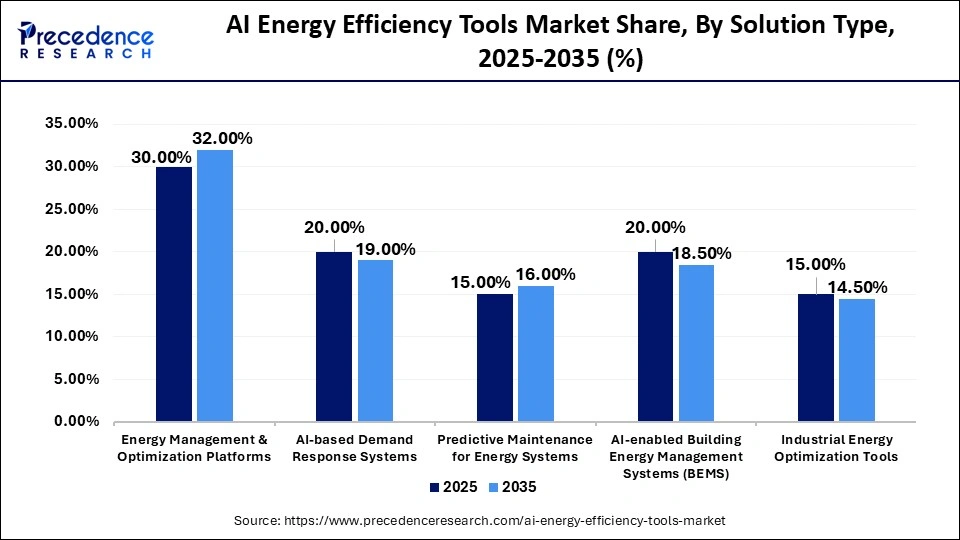
The predictive maintenance for energy systems segment held a 15% share of the market in 2025 and is expected to grow at a CAGR of 24% during the projection period. The segment is rapidly growing due to the increasing use of AI to find equipment failures earlier before they damage the grid completely. These solutions reduce overall repair costs, energy wastage, and downtime.
The AI-enabled building energy management systems (BEMS) segment held the market share of 20% in 2025 and is expected to grow at a CAGR of 22.0% during the foreseeable period. This is due to the fact that BMS solutions are being rapidly used and adopted by commercial building development. These solutions help in HVAC optimization and real-time energy monitoring to enhance overall efficiency.
Deployment Mode Insights
AI Energy Efficiency Tools Market Share, By Deployment Mode, 2025-2035 (%)
| Deployment Mode | 2025 | 2035 | CAGR (%) |
| Cloud-based AI Energy Platforms | 60.00% | 65.00% | 25.50% |
| On-premise Energy Management Systems | 25.00% | 20.00% | 15.50% |
| Edge AI Energy Optimization Systems | 15.00% | 15.00% | 24.50% |
The Cloud-Based AI Energy Platforms Segment Held a 60% Market Share in 2025
The cloud-based AI energy platforms segment dominated the AI energy efficiency tools market while holding the largest share of 60% in 2025. The dominance of the segment is attributed to its scalability, centralized monitoring, and ability to integrate with IoT-powered energy systems across various distributed assets. The launch of cloud-based AI tools by market players is another leading factor that reinforced the segment's dominance.
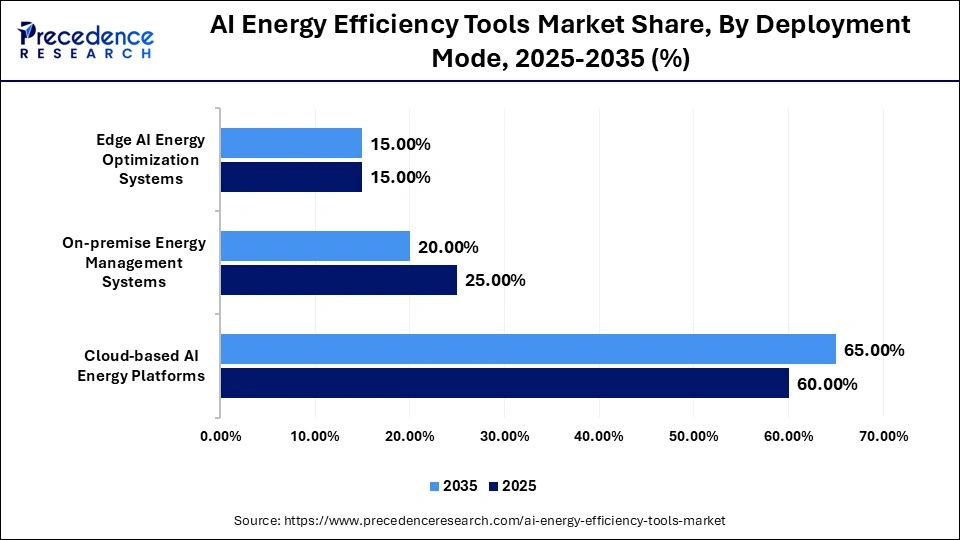
The on-premises energy management systems segment held the second-largest market share of 25% in 2025 and is expected to grow at a CAGR of 15.5% during the foreseeable period. This is mainly due to the high preference of on-premises systems in highly regulated sectors. Sectors like BFSI and healthcare need complete control over data and infrastructure to secure confidential data, boosting the adoption of on-premises systems.
The edge AI energy optimization systems segment held the market share of 15% in 2025 and is expected to grow at a CAGR of 24.5% during the forecast period of 2026-2035. The growth of the segment is attributed to the growing need for real-time energy optimization in smart buildings, highly regulated industries, and IoT-based environments, which significantly drives the adoption of edge AI energy optimization systems.
Application Insights
The Smart Buildings & HVAC Optimization Segment Held a 30% Market Share in 2025
The smart buildings & HVAC optimization segment dominated the AI energy efficiency tools market with a major share of 30% in 2025. This dominance is attributed to the rapid adoption of AI-powered building management systems. The growing need to optimize HVAC operations and reduce overall energy costs has made AI tools essential in enhancing efficiency within smart building environments.
The data center energy optimization segment held a share of 20% in 2025 and is expected to grow at a CAGR of 26.0% during the foreseeable period of 2026-2035. The segment growth is driven by the surge in AI workloads and the increasing demand for efficient cooling systems and optimized power consumption.
AI Energy Efficiency Tools Market Share, By Application, 2025-2035 (%)
| Application | 2025 | 2035 | CAGR (%) |
| Smart Buildings & HVAC Optimization | 30.00% | 28.00% | 21.00% |
| Data Center Energy Optimization | 20.00% | 22.00% | 26.00% |
| Smart Grids & Utilities Optimization | 20.00% | 21.00% | 23.50% |
| Industrial Process Energy Optimization | 20.00% | 19.00% | 22.50% |
| Renewable Energy Integration & Forecasting | 10.00% | 10.00% | 25.00% |
The smart grids & utilities segment held the market share of 20% in 2025 and is projected to grow at a CAGR of 23.5% during the foreseeable period of 2026-2035. The growth of the segment is primarily driven by the rising adoption of AI solutions by utility providers for grid optimization, load forecasting, and efficient energy distribution.
The industrial process energy optimization segment held the market share of 20% in 2025 and is expected to grow at a CAGR of 22.5% during the foreseeable period of 2026-2035. The growth of this segment is supported by the increasing integration of AI tools in industrial operations to reduce energy consumption and minimize waste, thereby improving efficiency and supporting sustainability goals.
End-Use Industry Insights
The Commercial Buildings Segment Held a 30% Share of the Market in 2025
The commercial buildings segment dominated the AI energy efficiency tools market with the largest share of 30% in 2025. The segment's dominance is attributed to the increasing adoption of AI tools by commercial buildings to minimize high energy consumption and reduce carbon footprints. The rapid expansion of smart cities requires robust AI systems to manage energy effectively and reduce energy wastage, which is another major factor of the segment's dominance.
The industrial & manufacturing segment was the second-largest shareholder in 2025, holding a share of 25%, and is expected to grow at a CAGR of 22.0% during the foreseeable period of 2026-2035. The segment growth is attributed to the growing concerns over rising energy prices and environmental sustainability. As a result, industries are increasingly using AI tools to optimize energy usage in production processes and reduce operational costs.
AI Energy Efficiency Tools Market Share, By End-Use Industry, 2025-2035 (%)
| End-Use Industry | 2025 | 2035 | CAGR (%) |
| Commercial Buildings | 30.00% | 28.00% | 21.50% |
| Industrial & Manufacturing | 25.00% | 24.00% | 22.00% |
| Energy & Utilities | 20.00% | 21.50% | 24.50% |
| IT & Data Centers | 15.00% | 17.00% | 26.00% |
| Healthcare | 5.00% | 5.00% | 20.00% |
| Others | 5.00% | 4.50% | 19.00% |
The energy & utilities segment held the market share of 20% in 2025 and is projected to grow at a CAGR of 24.5% in the upcoming period. This is because utilities are increasingly adopting AI for grid optimization, demand forecasting, and distribution of energy with high efficiency.
The IT & data centers segment held a market share of 15% in 2025 and is anticipated to grow at a CAGR of 26.0% during the foreseeable period. The segment growth is largely driven by exponential growth in AI workloads and cloud computing. The growing demand for cooling systems in data centers also contributes to the increased demand for AI energy efficiency tools.
Regional Insights
North America AI Energy Efficiency Tools Market Size and Growth 2026 to 2035
The North America AI energy efficiency tools market size is estimated at USD 1.28 billion in 2025 and is projected to reach approximately USD 10.10 billion by 2035, with a 22.95% CAGR from 2026 to 2035.
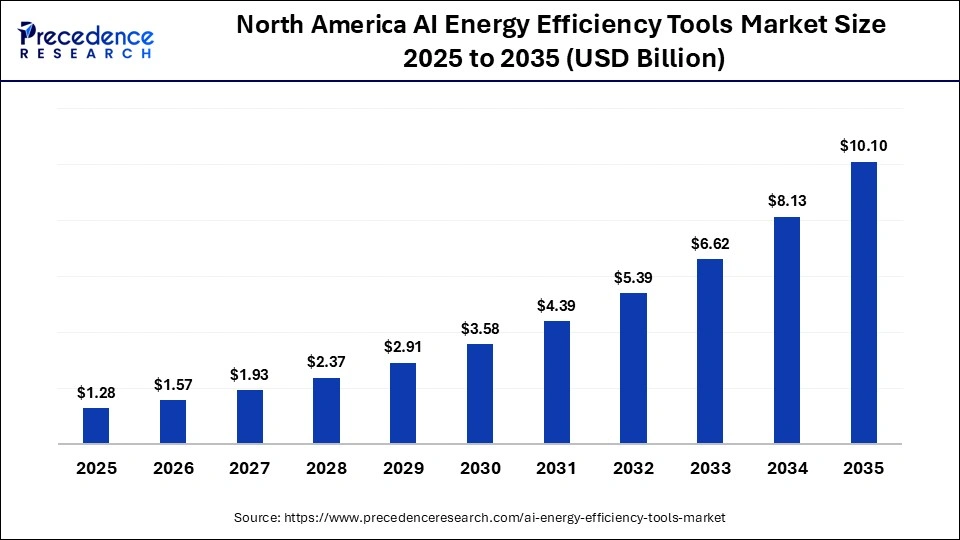
North America Held the Highest Market Share of 40% in 2025
North America dominated the AI energy efficiency tools market with the largest share of 40% in 2025, driven by the rapid adoption of AI technologies, expansion of smart building infrastructure, and strong sustainability initiatives. The region's growth is further supported by the rising need to manage energy consumption within the rapidly expanding data center sector. North America also benefits from a mature digital ecosystem, a high concentration of technology companies, and significant investments from leading utility providers.
The expansion of data centers is increasing demand for real-time energy monitoring and AI-driven efficiency solutions across industrial, commercial, and residential sectors. Moreover, supportive government policies and regulatory pressure to achieve carbon neutrality contributed to the region's dominance in the market.
U.S. AI Energy Efficiency Tools Market Size and Growth 2026 to 2035
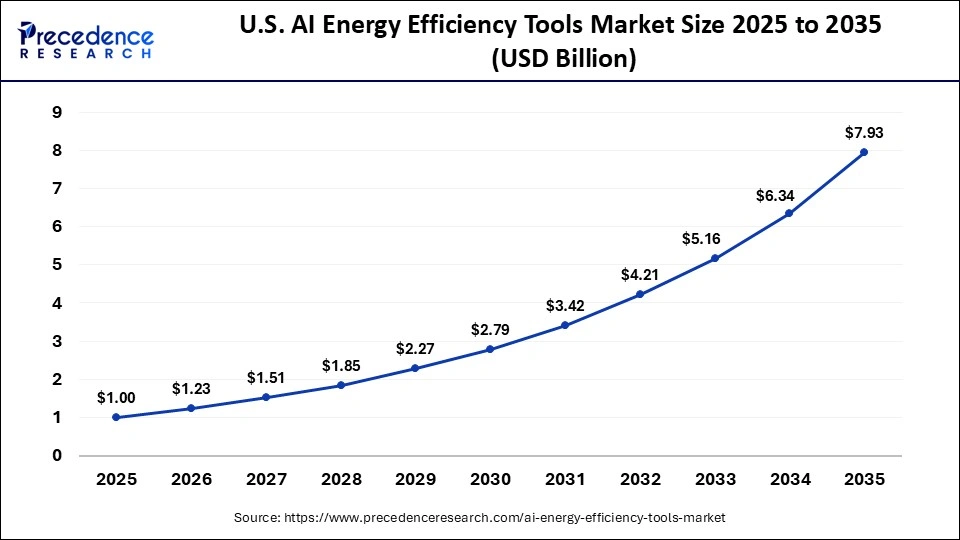
The U.S. AI energy efficiency tools market size is calculated at USD 1.00 billion in 2025 and is expected to reach nearly USD 7.93 billion in 2035, accelerating at a strong CAGR of 23.01% between 2026 and 2035.
U.S. AI Energy Efficiency Tools Market Analysis
The U.S. is a major contributor to the North American market, driven by the high investment in AI computing and mature technological systems that support the urgent need for grid optimization and data center expansion. The U.S. possesses a mature technology system with cloud-based and highly advanced metering infrastructure that allows rapid adoption of AI tools. The U.S. utilities are actively leveraging AI for grid automation, backed by government initiatives to promote carbon neutrality and clean energy.
Asia Pacific: The Fastest-Growing Region
Asia Pacific is expected to grow at the fastest CAGR during the forecast period due to a combination of factors like rapid industrialization and the expansion of smart city projects, both of which are significantly increasing regional energy demand. The regional market growth is further supported by large-scale integration of renewable energy systems, high adoption of AI-based energy efficiency solutions, and strong focus on smart infrastructure development to meet rising industrial energy requirements.
Governments across Asia Pacific are actively funding AI research and development, offering incentives to accelerate the adoption of AI in the energy sector while targeting carbon emission reduction goals. As a result, organizations in the region are increasingly leveraging AI and machine learning models to optimize energy consumption and improve operational efficiency.
China AI Energy Efficiency Tools Market Analysis
China is a frontier in the adoption of AI tools for energy efficiency and a major contributor to market growth in Asia Pacific. The country is actively expanding AI infrastructure, including large-scale data centers that require advanced liquid cooling systems and AI-driven power management to reduce electricity consumption. Initiatives such as the “Eastern Data, Western Computing” project strategically locate data centers near renewable energy sources, helping to optimize energy usage and reduce reliance on carbon-intensive power grids.
How is the Opportunistic Rise of Europe in the AI Energy Efficiency Tools Market?
Europe held a 25% market share in 2025 and is expected to grow at a significant rate in the coming years. This is mainly due to its strong regulatory focus on sustainability and aggressive carbon neutrality targets. The region's emphasis on energy efficiency policies, combined with widespread adoption of smart grids and green building initiatives, is accelerating the deployment of AI-based optimization solutions. Additionally, increasing investments in digital infrastructure and industrial decarbonization are creating favorable conditions for long-term market growth.
AI Energy Efficiency Tools Market Companies
- Schneider Electric SE
- Siemens AG
- Honeywell International Inc.
- Johnson Controls International plc
- IBM Corporation
- Microsoft Corporation
- Google LLC (Alphabet Inc.)
- ABB Ltd.
- Cisco Systems, Inc.
- Oracle Corporation
- Uplight, Inc.
- Verdigris Technologies, Inc.
- BrainBox AI Inc.
- GridPoint, Inc.
- Enel X (Enel Group)
Recent Developments
- In April 2025, ABB announced a strategic investment with ABB Motion Ventures in Octaipipe, which is a UK-based innovator in AI-powered software, aiming to operate a data center with intelligent AI tools for energy saving.(Source: https://new.abb.com)
- In November 2025, a leading tech giant, Google launched a free energy assessment tool for manufacturing facilities for cost savings and carbon emission reduction. It is designed for a global supply chain with secure data governance.(Source: https://esgnews.com)
Segments Covered in the Report
By Solution Type
- Energy Management & Optimization Platforms
- AI-based Demand Response Systems
- Predictive Maintenance for Energy Systems
- Building Energy Management Systems (AI-enabled BEMS)
- Industrial Energy Optimization Tools
By Deployment Mode
- Cloud-based AI Energy Platforms
- On-premise Energy Management Systems
- Edge AI Energy Optimization Systems
By Application
- Smart Buildings & HVAC Optimization
- Data Center Energy Optimization
- Smart Grids & Utilities Optimization
- Industrial Process Energy Optimization
- Renewable Energy Integration & Forecasting
By End-Use Industry
- Commercial Buildings
- Industrial & Manufacturing
- Energy & Utilities
- IT & Data Centers
- Healthcare
- Others
By Region
- North America
- Latin America
- Europe
- Asia-pacific
- Middle and East Africa
For inquiries regarding discounts, bulk purchases, or customization requests, please contact us at sales@precedenceresearch.com
Frequently Asked Questions





Ask For Sample
No cookie-cutter, only authentic analysis – take the 1st step to become a Precedence Research client
 Get a Sample




 sales@precedenceresearch.com
 Schedule a Meeting
