



Applied AI in Autonomous Vehicles Market Revenue to Attain USD 202.55 Bn by 2035
Published: 16 Apr 2026
Author: Precedence Research



Applied AI in Autonomous Vehicles Market Revenue and Trends 2026 to 2035
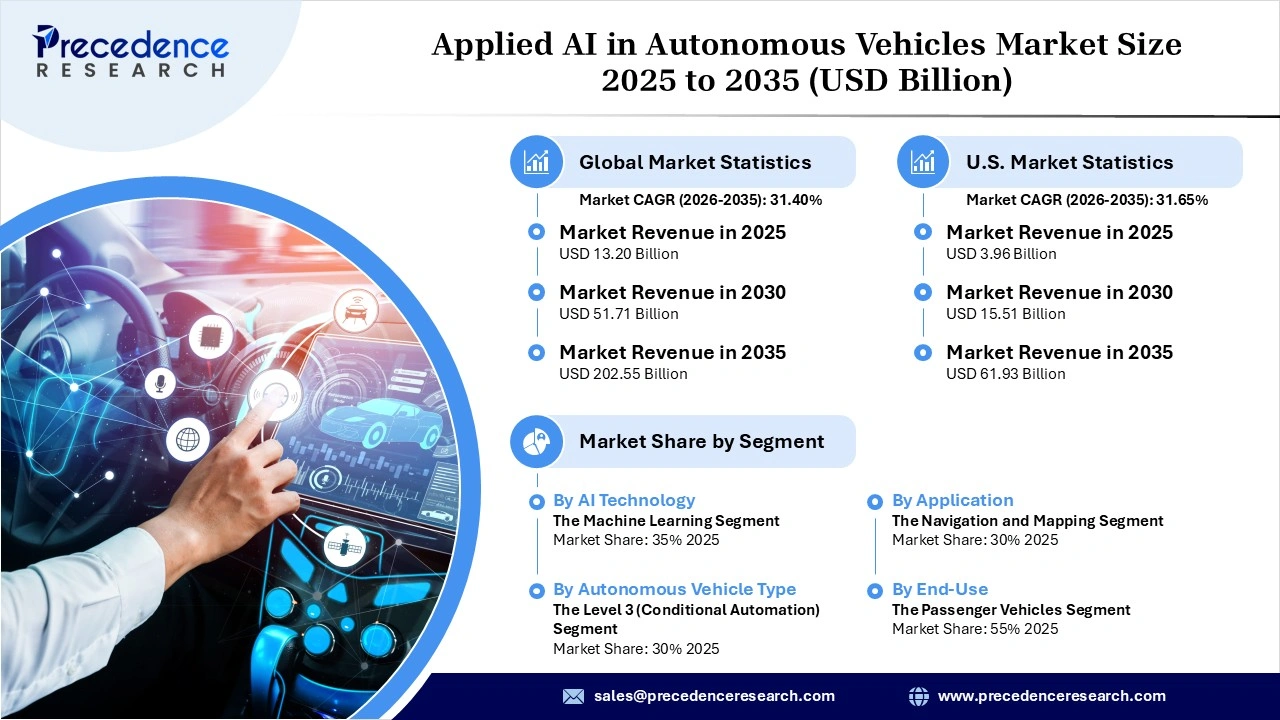
The global applied AI in autonomous vehicles market revenue was valued at USD 13.20 billion in 2025 and is expected to attain around USD 202.55 billion by 2035, growing at a CAGR of 31.40% during forecast period. The market is driven by advancements in machine learning, computer vision, and sensor fusion technologies that enable safer and more efficient self-driving systems. Growing focus on vehicle safety and the demand for efficient mobility solutions also drive the market.
Market at a Glance
The applied AI in autonomous vehicles market refers to the deployment of machine intelligence, such as computer vision, deep learning, and real-time decision systems, into vehicles to interpret environments, predict behavior, and enable autonomous operation. It is a multiple-component technology that combines sensors, data-processing systems, and adaptive algorithms. These components work as the brain of autonomous vehicles, improving performance and autonomy.
What Drives the Applied AI in Autonomous Vehicles Market?
- Robotaxi Services Expansion: Robotaxi services are rapidly moving from pilot programs to large-scale commercial deployment, with companies expanding AI-powered fleets into real urban environments. For instance, Uber, in collaboration with NVIDIA, plans to roll out robotaxis across 28 global cities by 2028, while Waymo has already completed over 14 million rides, highlighting the shift toward operational, revenue-generating autonomous mobility.
- Advancements in AI Technologies: Rapid improvements in AI technologies such as computer vision, deep learning, and sensor fusion are enabling vehicles to interpret complex real-world environments with higher accuracy. These advancements allow autonomous systems to make faster and more reliable driving decisions, significantly improving safety and performance.
- Cost Reduction in AI Hardware and Software Systems: Declining costs of AI computing hardware, sensors, and software platforms are making autonomous vehicles more economically feasible. This cost efficiency is encouraging wider adoption by manufacturers and accelerating the commercialization of autonomous driving technologies.
Statistical Overview of Autonomous Driving
- The autonomous vehicle ecosystem is projected to reach $2.3 trillion by 2030, highlighting AI as the core driver of next-generation mobility systems rather than just a supporting technology.
- With around 94% of road accidents caused by human error, AI-driven autonomous driving is increasingly seen as a critical safety solution that can significantly reduce collisions.
- Large-scale real-world data collection, such as millions of autonomous miles driven by companies like Waymo and Tesla, is continuously improving AI model performance and reliability.
- AI-powered route optimization is reducing urban congestion by up to 30%, improving overall transportation efficiency through predictive analytics.
- The expected deployment of over 54 million AI-powered autonomous vehicles by 2040 indicates strong long-term structural adoption of autonomous mobility technologies.
Market Segmentation Overview
- By technology, the machine learning segment held a major revenue share of 35% in the market in 2025, as it is crucial in autonomous vehicles, quietly orchestrating decision-making, path planning, and predictive algorithms. Its ability to constantly learn from dynamic driving environments, which enables vehicles to get ahead of the game rather than being reactive, is one of its strongest points.
- By technology, the computer vision segment held the second-largest market share of 30% in 2025, as it is a backbone, translating raw visual data into actionable awareness. One particular use is that as cars rely increasingly on visual processing to understand their environment and make real-time safety-critical decisions, it aids in identifying pedestrians, vehicles, and road conditions.
- By autonomous vehicle type, the level 3 (conditional automation) segment dominated the applied AI in autonomous vehicles market with a major revenue share of 30% in 2025. This is mainly due to the increased need for vehicles capable of handling complex traffic scenarios. This automation strikes a balance between control and independence.
- By autonomous vehicle type, the level 2 (partial automation) segment was the second-largest shareholder in 2025, holding a 25% market share, due to its practical usability. Features like adaptive cruise control and lane assistance have made partial automation an easy place for users to start, enabling widespread adoption and slowly prepping users for more autonomous work.
- By application, the navigation and mapping segment accounted for a revenue share of 30% in the market in 2025, driven by the need for real-time route optimization based on live road conditions and environmental inputs. By integrating predictive mapping with real-time data, these systems reduce uncertainty in complex driving scenarios and enhance overall mobility efficiency.
- By application, the object and pedestrian detection segment was the second-largest shareholder with a 25% share in 2025 and is expected to grow at a significant rate in the coming years. This is primarily due to the strong focus on safety in autonomous driving systems. By enabling vehicles to recognize and anticipate the movement of objects and pedestrians, this technology reduces collision risks and builds confidence in autonomous decision-making.
- By end-use, the passenger vehicles segment led the applied AI in autonomous vehicles market with the largest share of 55% in 2025, driven by rising consumer reliance on AI-enabled features for improved safety, comfort, and driving convenience. Advanced smart technologies are transforming everyday driving into semi-autonomous experiences that combine enhanced security with greater ease of mobility.
- By end-use, the commercial vehicles segment held the second-largest market share of 20% in 2025, supported by strong economic incentives focused on operational efficiency and cost reduction. Fleet and logistics operators are increasingly adopting AI to optimize routing, reduce dependence on human drivers, and improve overall supply chain productivity, making it a key tool for cost control and efficiency gains.
Regional Analysis
North America dominated the applied AI in autonomous vehicles market with a major share of 40% in 2025, driven by sustained investments in AI and autonomous systems R&D. The U.S. leads the region with extensive real-world testing of self-driving vehicles, supportive regulatory frameworks, and strong deep-tech funding, while Canada contributes through expanding AI research centers and talent development that support algorithm innovation. This combination of advanced infrastructure, strong financial backing, and flexible policy support has positioned North America as the global leader in this market.
Asia Pacific is expected to grow at the fastest CAGR in the market during the forecast period, driven by strong government initiatives and rapidly advancing urban mobility ecosystems. China is leading with large-scale pilot programs aimed at accelerating robotaxi commercialization, while Japan is focusing on autonomous driving solutions to address aging population challenges and transport shortages. South Korea is also driving growth through smart city development integrated with high-speed 5G vehicle networks, enabling faster adoption of connected and autonomous mobility systems.
Applied AI in Autonomous Vehicles Market Coverage
| Report Attribute | Key Statistics |
| Market Revenue in 2025 | USD 13.20 Billion |
| Market Revenue by 2035 | USD 202.55 Billion |
| CAGR from 2026 to 2035 | 31.40% |
| Quantitative Units | Revenue in USD million/billion, Volume in units |
| Largest Market | North America |
| Base Year | 2025 |
| Regions Covered | North America, Europe, Asia-Pacific, Latin America, and the Middle East & Africa |
Top Companies in the Applied AI in Autonomous Vehicles Market
Tesla, Inc. has placed significant emphasis on data-driven learning by training its systems using extensive real-world driving data. NVIDIA Corporation and Qualcomm Technologies, Inc. have established themselves as essential providers of computational power, facilitating real-time AI processing in vehicles. Established automotive manufacturers like Toyota Motor Corporation, BMW Group, and Mercedes-Benz Group AG have been progressively incorporating AI into both premium and mass-market automobiles while ensuring a balance between innovation, safety measures, and adherence to regulatory requirements.
Segments Covered in the Report
By AI Technology
- Computer Vision
- Machine Learning
- Deep Learning
- Natural Language Processing (NLP)
- Sensor Fusion and Data Analytics
By Autonomous Vehicle Type
- Level 1 (Driver Assistance)
- Level 2 (Partial Automation)
- Level 3 (Conditional Automation)
- Level 4 (High Automation)
- Level 5 (Full Automation)
By Application
- Navigation and Mapping
- Object and Pedestrian Detection
- Path Planning and Decision Making
- Driver Monitoring
- Traffic Prediction and Traffic Light Recognition
- Vehicle Control and Operation
- Others
By End-Use
- Passenger Vehicles
- Commercial Vehicles
- Public Transport
- Freight and Logistics
- Other
By Region
- North America
- Latin America
- Europe
- Asia-pacific
- Middle and East Africa
Get this report to explore global market size, share, CAGR, and trends, featuring detailed segmental analysis and an insightful competitive landscape overview @ https://www.precedenceresearch.com/sample/8307
You can place an order or ask any questions, please feel free to contact us at sales@precedenceresearch.com |+1 804 441 9344