



Huntingtons Disease Market Revenue to Attain USD 6.48 Bn by 2035
Published: 08 Jun 2026
Author: Precedence Research



Huntingtons Disease Market Revenue and Trends 2026 to 2035
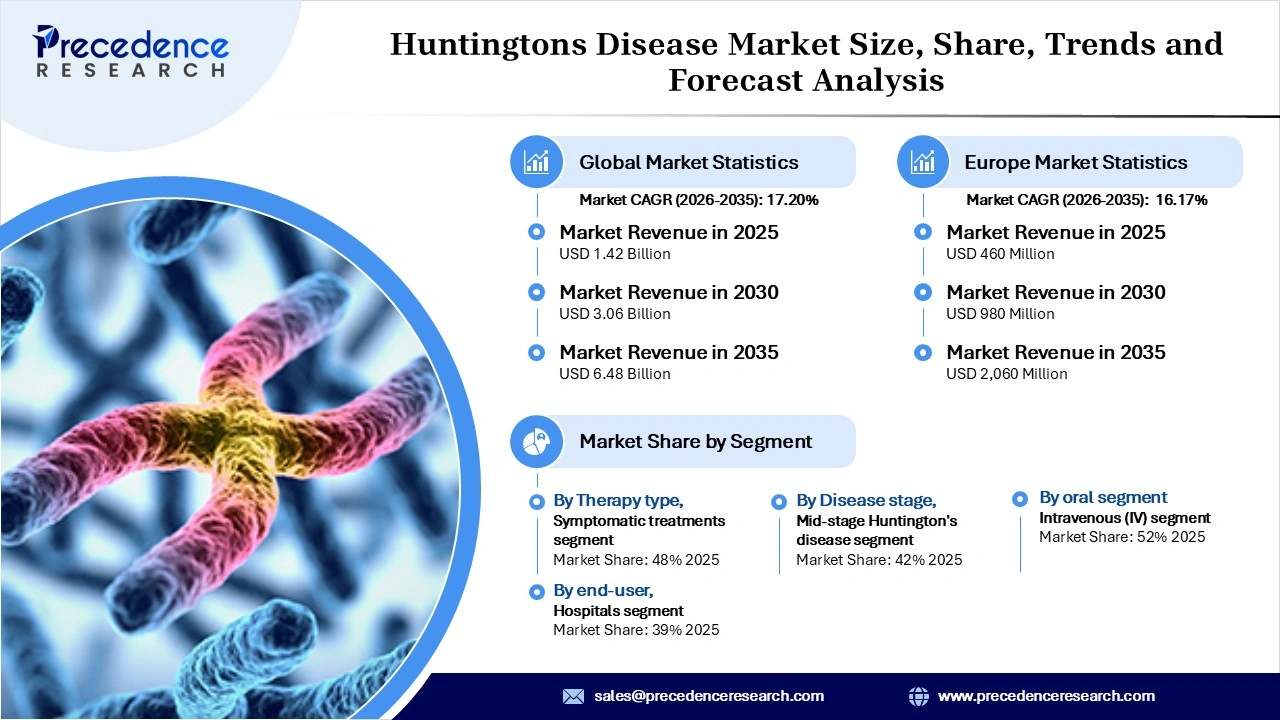
The global huntingtons disease market revenue reached USD 1.42 billion in 2025 and is predicted to attain around USD 6.48 billion by 2035 with a CAGR of 17.20%. The market is gaining steady ground as breakthroughs in gene-silencing therapies, rising investments in rare disease research, and a growing push for earlier neurological diagnosis shift the industry from symptom control toward the possibility of slowing the disease itself.
Market at a Glance
The Huntington’s disease market includes a wide collection of treatments, diagnostic tools, genetic testing technologies, supportive care, and research programs that seek to address the rare hereditary neurodegenerative disorder, and include these treatments and therapeutic measures. This market consists of symptomatic therapies, gene therapies, RNA-targeted therapies, and clinical development advances targeting the slowing of progression of the disease. The expansion of the same is also enabled by precision neurology, enhanced incentives for orphan drugs, and a wider push by pharmaceutical and biotechnology companies to adopt therapeutics for rare diseases.
This market is beyond classical medications to manage symptoms but also involves cutting-edge gene-editing techniques and RNA-lowering treatments that aim to influence the trajectory of the disorder itself. They include diagnostic evaluations, biomarker development initiatives, neurorehabilitation services, and specialized neurological care, with emerging opportunities stemming from research into precision medicine as well as from commercialization models for orphan drugs.
Market Forecast for Huntington’s Disease Market
- Rare Disease Funding: More than half of FDA novel drug approvals in 2025 were linked to rare diseases, reflecting how aggressively pharmaceutical companies are moving into orphan-drug development. Huntington’s disease is benefiting from this broader shift, particularly because orphan-drug incentives provide extended exclusivity periods, tax credits, and regulatory support for developers entering underserved neurological spaces.
- Biomarker Research is Driving Huntington’s Care: The market is gradually expanding beyond therapeutics into biomarker monitoring and predictive diagnostics. Companies developing neurofilament light chain (NfL) testing and mutant huntingtin (mHTT) tracking tools are expected to benefit as regulators increasingly demand measurable neurological endpoints in clinical trials. The ability to monitor disease activity through biomarkers could significantly improve therapy selection and accelerate future approvals.
Growing Commercial Potential of Huntington’s Disease Market
- uniQure announced evidence that its highly successful experimental gene therapy for Huntington’s disease (AMT-130) showed a statistically significant 75% decrease in disease progression over the course of 36 months. This is a significant step forward towards therapies that change the trajectory of neurological disorders rather than only treating symptoms.
- High doses are improving a 60% reduction of decline in Total Functional Capacity in patients compared to non-high doses, further expanding market confidence in long-term gene therapies for neurodegenerative diseases.
- uniQure successfully raised an astonishing USD 323.7 million from a public offering in 2025, demonstrating that many investors are taking an interest in therapies aimed at rare neurological diseases.
- As of September 2025, cash reserves amounted to almost USD 694.2 million, thus affording the company operational stability until 2029 and being able to continue developing its Huntington’s therapy.
- Research and development spending rose to USD 34.4 million during Q3 2025, with USD 6.6 million directly linked to preparation for AMT-130 regulatory submission activities.
- uniQure’s regulatory preparation expenses and commercialization planning indicate that Huntington’s disease is evolving from a limited, rare disorder segment into a commercially watched precision neurology market.
Market Segmentation Overview
- By therapy type, the symptomatic treatments segment accounted for a considerable revenue share of 48% in the Huntington’s disease market in 2025, due to the sustained clinical reliance on VMAT2 inhibitors for chorea control and the continued demand for psychiatric symptom management therapies. Its established role in long-term disease care, particularly for neurological disease, facilitates symptomatic treatments.
- By therapy type, the gene therapies segment is expected to grow at the fastest CAGR of 28.5% in the market between 2026 and 2035, as advancements in gene silencing and replacement technologies continue to reshape neurological drug development. Rising clinical trial activity targeting mutant huntingtin protein, along with increasing investments in precision genetic medicine, is expected to accelerate the transition toward disease-modifying therapies.
- By disease stage, the mid-stage Huntington’s disease segment held a major revenue share of 42% in the market in 2025, because patients in this phase required intensive symptomatic and psychiatric management therapies. The growing use of VMAT2 inhibitors and supportive therapies, combined with expanding multidisciplinary neurological care programs, strengthened treatment demand as patients experienced worsening motor dysfunction and cognitive impairment during disease progression.
- By disease stage, the early-stage Huntington’s disease segment is steadily growing with a CAGR of 21.5% in the market between 2026 and 2035, due to increasing adoption of early genetic testing and diagnosis. Rising focus on early therapeutic intervention, alongside the development of disease-modifying therapies designed to delay neurological deterioration, is expected to encourage treatment initiation before severe motor and psychiatric symptoms fully develop.
- By route of administration, the oral segment held the largest revenue share of 52% in the Huntington’s disease market in 2025, because of its widespread use in symptomatic psychiatric and chorea treatment regimens. Patients consistently preferred convenient long-term oral medications for daily disease management, while continued development of oral CNS therapeutics reinforced their strong commercial position across outpatient neurological care settings.
- By route of administration, the intrathecal segment is expected to expand rapidly in the market with a CAGR of 27.5% in the coming years, due to the rapid development of CNS-targeted RNA and gene therapies. Increasing use of antisense oligonucleotide delivery systems and expanding precision neurology treatment approaches are expected to strengthen demand for direct central nervous system drug delivery.
- By end-user, the hospitals segment accounted for a considerable revenue share of 39% in the market in 2025, due to strong use of advanced neurological diagnostic and treatment services, and increasing administration of investigational biologics and gene therapies. The expansion of multidisciplinary Huntington’s disease management programs within hospital settings further supported their leading position in delivering specialized long-term neurological care.
- By end-user, the homecare settings segment is expected to grow at the fastest CAGR of 19.5% in the market between 2026 and 2035, as increasing demand for chronic neurological disease management at home continues to rise. The growing adoption of telehealth platforms, remote patient monitoring technologies, and home-based supportive care services is expected to reshape long-term Huntington’s disease treatment delivery, particularly for patients with mobility limitations.
Regional Analysis
North America dominated the global Huntington’s disease market with a market share of 43% in 2025, due to its numerous research initiatives on neurodegenerative diseases. This led to significant uptake of both symptomatic and investigational treatments in the region, owing to early patient access and a well-established culture of clinical trials. Moreover, large funding allocated to specific gene and RNA-targeted therapies also accelerated innovation. Commercial opportunities were fostered by strong orphan drug designations and reimbursement systems. In this setting, the U.S. propped it up with leading biotech hubs, and Canada supported it with coordinated public health care while extending neurological research initiatives.
Asia-Pacific held a market share of 17% in 2025 and is expected to grow at the fastest CAGR of 24.5% in the market during the forecast period, due to advancements in neurological healthcare infrastructure. Rising awareness about genetic neurodegenerative diseases is also driving earlier visits by doctors and higher diagnosis rates. The growing availability of new biologics and precision medicine is expanding the uptake of therapies, and new investment in biotechnology in conjunction with CNS advances is creating pathways for innovation across the region. China is making progress on genomic research projects, but India is focusing on specialized care centers in neurology and increased funds for biotech.
Huntingtons Disease Market Coverage
| Report Attribute | Key Statistics |
| Market Revenue in 2025 | USD 1.42 Billion |
| Market Revenue by 2035 | USD 6.48 Billion |
| CAGR from 2026 to 2035 | 17.20% |
| Quantitative Units | Revenue in USD million/billion, Volume in units |
| Largest Market | North America |
| Base Year | 2025 |
| Regions Covered | North America, Europe, Asia-Pacific, Latin America, and the Middle East & Africa |
Top Companies in the Huntington’s Disease Market
Roche Holding AG, Novartis AG, Pfizer Inc., Teva Pharmaceutical Industries Ltd., and H. Lundbeck A/S have helped build portfolios dealing with neurodegenerative diseases and central nervous system (CNS) disorders while building capabilities in late-stage clinical trials and commercial operations. At the same time, newer businesses such as Wave Life Sciences, uniQure N.V., Prilenia Therapeutics, Sage Therapeutics, PTC Therapeutics, Annexon Biosciences, Voyager Therapeutics, Neurocrine Biosciences, and Ionis Pharmaceuticals have also enhanced their pipeline building, including innovative RNA-targeting platforms, gene therapies, and methodologies to lower protein levels. Additionally, AstraZeneca PLC and other diversified entities have made significant contributions by investing in various neurological research projects.
Segments Covered in the Report
By Therapy Type
- Symptomatic Treatments
- VMAT2 Inhibitors
- Antipsychotics
- Antidepressants
- Mood Stabilizers
- Gene Therapies
- RNA-targeted Therapies
- Cell-based Therapies
- Disease-modifying Therapies
- Supportive Care Therapies
By Disease Stage
- Early-stage Huntington's Disease
- Mid-stage Huntington's Disease
- Advanced-stage Huntington's Disease
By Route of Administration
- Oral
- Intravenous (IV)
- Intrathecal
- Subcutaneous
By End-User
- Hospitals
- Specialty Neurology Clinics
- Homecare Settings
- Rehabilitation Centers
- Research and Academic Institutes
By Distribution Channel
- Hospital Pharmacies
- Retail Pharmacies
- Specialty Pharmacies
- Online Pharmacies
By Region
- North America
- Latin America
- Europe
- Asia-pacific
- Middle and East Africa
Get this report to explore global market size, share, CAGR, and trends, featuring detailed segmental analysis and an insightful competitive landscape overview @ https://www.precedenceresearch.com/sample/8455
You can place an order or ask any questions. Please feel free to contact us at sales@precedenceresearch.com |+1 804 441 9344