



Implantable Sensor Orthopedic Market Revenue to Attain USD 13.17 Bn by 2035
Published: 19 Jun 2026
Author: Precedence Research



Implantable Sensor Orthopedic Market Revenue and Trends 2026 to 2035
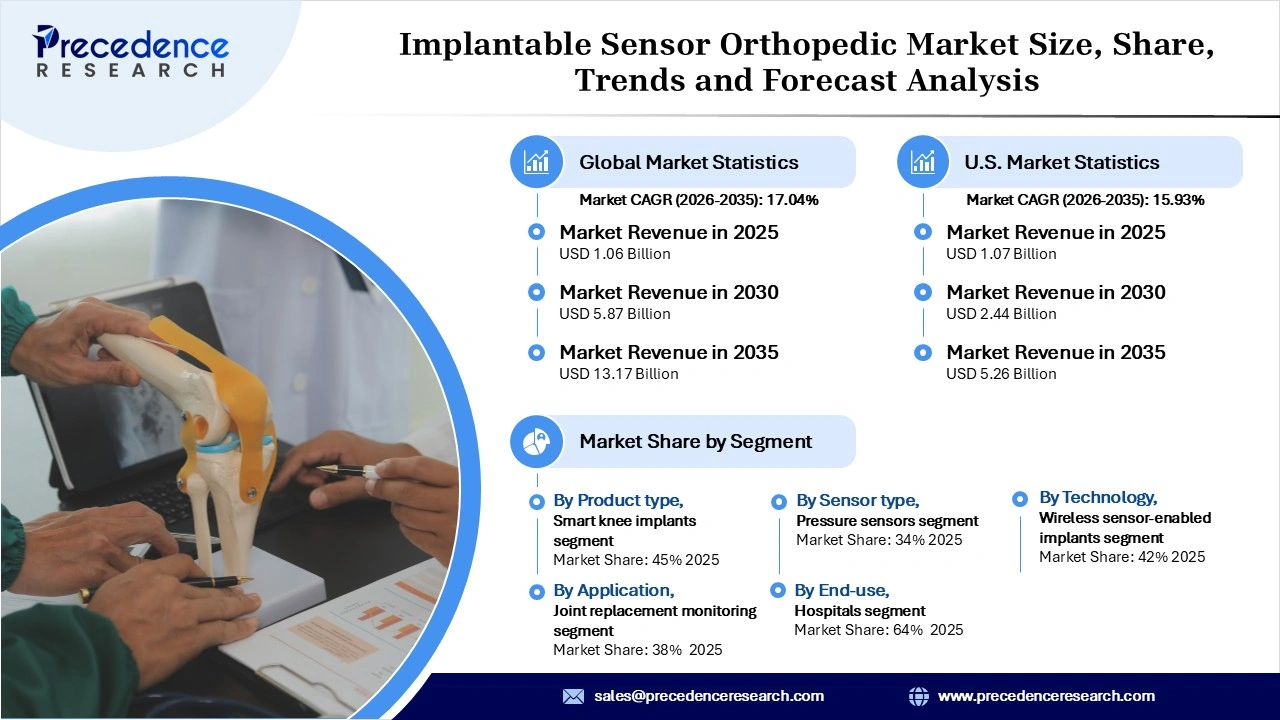
The global implantable sensor orthopedic market revenue was valued at USD 1.06 billion in 2025 and is expected to attain around USD 13.17 billion by 2035, growing at a CAGR of 17.04% during forecast period. The market is driven by the increasing demand for real-time monitoring of biomechanical forces, joint load, and bone healing in patients who have undergone orthopedic surgeries like joint replacement, spinal fusion, and fracture fixation.
Real-Time Orthopedic Monitoring Using Smart Implants
The implantable sensor orthopedic market involves sensors that can be implanted into and connected to orthopedic devices for continuous monitoring of various parameters inside the body. Such sensors include strain gauge, accelerometer, pressure transducer, temperature sensor, and near-field communication sensor, which are either powered remotely or with the help of passive telemetry.
The market includes implantable sensor modules, smart orthopedic implants, wearable devices, and software and data analytics tools. The applications of these devices include continuous monitoring of contact force in total knee or hip joint replacement surgeries, spinal fusion assessment, early detection of joint implant looseness and wear, and measurement of intraosseous pressure in bone fractures. This market has been adopted by academic medical centers, specialty orthopedic hospitals, and clinical trial laboratories.
Self-Powered Smart Implants With Integrated Sensors
The next big innovation in the market is the development of self-powered implants that continuously monitor their biomechanical state, including factors such as loading, movement, and bone fusion status. New spinal cages are already being equipped with piezo-based sensors that utilize the patient’s bodily movements to generate energy without the use of any built-in batteries. In 2026, Canary Medical and NanoHive Medical partnered exclusively to create self-powered smart spinal cages by integrating Canary Medical’s Implantable sensor platform into NanoHive Medical’s innovative 3D-printed Hive Soft Titanium platform, providing postoperative data on bone fusion and segmental movement.
Usage of Smart Orthopedic Implants in Regular Clinical Operations
The implantable sensor orthopedic market witnesses smart implant orthopedic devices moving from the research phase to regular clinical application because of clearances from regulatory bodies. Hospitals that have embraced these devices are able to monitor the recovery process of patients using smart implants for the knees and the spinal area. In 2025, Lompoc Valley Medical Center conducted its first surgery involving a smart implant for a knee through the Persona IQ device offered by Zimmer Biomet, which is the first-ever smart knee implant to be released in the market.
Public Research Grants Drive Advanced Orthopedic Sensor Technology Innovations
Government research agencies play an important role in providing financial support to academic and industry-based researchers to advance orthopedic implant technologies. Such investments can help address high-risk projects in their early stages that otherwise may not be financed privately due to the uncertainty involved. The funding of various proof-of-concept studies and interdisciplinary cooperation efforts helps to decrease dependence on foreign technologies. In 2025, the National Institutes of Health (NIH) granted a total budget of USD 410,000 over a period of two years in the form of an exploratory/development research grant to researchers at the University of Pittsburgh. This grant is intended to assist with their effort to create a wireless and battery-free metamaterial interbody cage that can generate electricity from spine micro-motions.
OrthoSens Secures USD 706,200 for Smart Sensors That Do Not Require Batteries
In 2025, OrthoSens, a Swiss medical device startup, announced that it had raised USD 706,200 in non-dilutive capital to develop ultra-thin, battery-free sensors that can be incorporated into existing orthopedic implants. These sensors measure data such as loads on the implants, the healing process, and motions to alert surgeons and physiotherapists to any problems. The target markets of these sensors include the USD 56 billion orthopedic implant market and the USD 5.3 billion remote monitoring market.
Market Segmentation Overview
- By product type, the smart knee implants segment led the implantable sensor orthopedic market with 45% share in 2025, because it is the most clinically proven product due to its ability to monitor patients’ progress during treatment via the collection of gait parameters and range of motion measurements.
- By product type, the smart spinal implants segment is expected to expand at the highest CAGR of 18.9% during the forecast period, because spinal fusions rank as one of the most frequently performed surgeries and are expensive, and experience a high incidence of complications like pseudoarthrosis and hardware failure, which increases the need for constant monitoring.
- By sensor type, the pressure sensors segment dominated the market with 34% share in 2025, owing to their strong relevance to the clinical performance of implants used in orthopedics, which can be measured via factors such as joint loading and bone contact pressure.
- By sensor type, the multi-parameter sensors segment is expected to grow at the fastest CAGR of 20.4% from 2026 to 2035, since using a combined pressure, temperature, and motion sensor in one device gives an improved perspective on the recovery process. The use of such systems can help detect infections, loosening, and non-union cases on time.
- By technology, the wireless sensor enabled implants segment led the implantable sensor orthopedic market with 42% share in 2025, due to the fact that it does not require any external cables, ensuring constant and real-time transmission of the biomechanical data without limiting the movement of patients and causing infections.
- By technology, the AI-integrated monitoring implants segment is expected to expand at the highest CAGR of 22.5% during the forecast period, because it offers predictive capabilities which help detect preclinical signs of potential complications like loose implants and non-unions, and AI models can analyze huge amounts of biomechanical information generated by smart implants.
- By application, the joint replacement monitoring segment dominated the market with 38% share in 2025, because total knee replacement and hip replacement are some of the most commonly conducted orthopedic procedures in the world, and need smart implants for patient tracking and complication detection.
- By application, the rehabilitation and mobility tracking segment is expected to grow at the fastest CAGR of 19.4% from 2026 to 2035, due to the ability of smart sensors to provide real-time analytics of gait and range of motion monitoring, enabling more personalized treatment options.
- By end user, the hospitals segment led the implantable sensor orthopedic market with 64% share in 2025, because joint replacement and spinal fusion surgeries are performed in hospitals where implantable sensors are installed and integrated into the workflow process, and hospitals have special surgical teams, post-operative monitoring setups, and electronic health record systems.
- By end user, the ambulatory surgical centers (ASCs) segment is expected to expand at the highest CAGR of 20.1% during the forecast period, since joint replacement and spine fusion procedures are being increasingly conducted in an outpatient setting, due to financial considerations and advances in same-day discharge procedures.
- By distribution channel, the direct sales segment dominated the market with 58% share in 2025, due to the fact that intelligent orthopedic implants and sophisticated devices need substantial education, training, and technical support for surgeons, which can be achieved through sales personnel of the manufacturing company.
- By distribution channel, the tender procurement segment is expected to grow at the fastest CAGR of 19.5% from 2026 to 2035, since big hospital chains and group purchasing organizations are adopting competitive bidding for expensive smart orthopedic implants as a way to achieve uniformity in treatment methods, gain volume discounts, and maintain reliable supplies.
Regional Analysis
North America led the implantable sensor orthopedic market with 41% share in 2025, owing to the quick uptake of smart implant innovations, substantial funding for research and development of advanced medical technologies, and a conducive regulatory framework that has facilitated the approval of innovative smart implants. The U.S. dominated the market in North America due to the significant presence of leading orthopedic device companies, substantial NIH and private funding directed towards the development of sensor-enabled implants, and early adoption of smart implants by major academic medical centers. Canada is a significant contributor to the market because of publicly funded programs focused on digital health and orthopedic innovations, and a healthcare system that is increasingly embracing remote monitoring techniques to lower hospital readmission rates.
Asia-Pacific is expected to expand at the highest CAGR of 21.2% during the forecast period, owing to its largest and fastest aging demographic, resulting in an enormous number of surgeries related to joint replacements and spinal fusions, in addition to its position as a center of manufacture for economically viable orthopedic instruments. China led the market in Asia-Pacific because of its large population base, government investments for the development of native solutions within the orthopedic industry, and significant uptake of innovative technologies in hospitals. India witnessed notable market growth due to the significant prevalence of osteoarthritis and spinal problems in the elderly population, and government policies that favor the localization of production of medical devices.
Europe held the second-largest market share of 27% in 2025, because of its advanced orthopedic implant manufacturing industry, the presence of an efficient health system, and the adoption of digital health services for post-surgical monitoring. Germany dominated the market in Europe due to the significant prevalence of joint replacement surgeries and collaboration between research organizations and businesses developing advanced orthopedic implant technologies. The UK is a significant contributor to the market owing to its emphasis on value-based medicine, the presence of clinical trials of smart knee and spine implants and telemedicine practices, and government funding for digital health innovations.
Implantable Sensor Orthopedic Market Coverage
| Report Attribute | Key Statistics |
| Market Revenue in 2025 | USD 1.06 Billion |
| Market Revenue by 2035 | USD 13.17 Billion |
| CAGR from 2026 to 2035 | 17.04% |
| Quantitative Units | Revenue in USD million/billion, Volume in units |
| Largest Market | North America |
| Base Year | 2025 |
| Regions Covered | North America, Europe, Asia-Pacific, Latin America, and the Middle East & Africa |
Top Companies in the Implantable Sensor Orthopedic Market
Zimmer Biomet Holdings, Inc., Stryker Corporation, Smith+Nephew plc, and Johnson and Johnson Medtech (DePuy Synthes) are some of the key players that utilize advanced pressure, motion, and temperature sensors to develop smart knee and hip implants. Medtronic plc, Globus Medical, Inc., NuVasive, Inc., and Orthofix Medical Inc. specialize in spinal implants with sensor technology, developing instrumented pedicle screws and rod strain gauges. Smart Implant Solutions specializes in battery-free wireless sensor technology in orthopedic load measurement. Integra Lifesciences Holdings Corporation offers smart implants for hand, shoulder, and foot treatments. Orthosensor Inc. focuses on intraoperative ligament balancing with its VERASENSE system.
Segments Covered in This Report
By Product Type
- Smart Knee Implants
- Smart Hip Implants
- Smart Spinal Implants
- Trauma & Extremity Implants
- Others
By Sensor Type
- Pressure Sensors
- Load & Strain Sensors
- Motion Sensors
- Temperature Sensors
- Multi-parameter Sensors
By Technology
- Wireless Sensor-enabled Implants
- Bluetooth-enabled Implants
- IoT-enabled Smart Implants
- AI-integrated Monitoring Implants
By Application
- Joint Replacement Monitoring
- Post-operative Recovery Monitoring
- Rehabilitation & Mobility Tracking
- Infection Detection
- Implant Performance Monitoring
- Others
By End User
- Hospitals
- Orthopedic Specialty Clinics
- Ambulatory Surgical Centers (ASCs)
- Research Institutes & Academic Centers
- Others
By Distribution Channel
- Direct Sales
- Medical Device Distributors
- Group Purchasing Organizations (GPOs)
- Tender Procurement
By Region
- North America
- Latin America
- Europe
- Asia-pacific
- Middle and East Africa
Get this report to explore global market size, share, CAGR, and trends, featuring detailed segmental analysis and an insightful competitive landscape overview @ https://www.precedenceresearch.com/sample/8499
You can place an order or ask any questions. Please feel free to contact us at sales@precedenceresearch.com |+1 804 441 9344