



Implantable Sensor Orthopedic Market Size, Companies, Share, Patient Volume, Treatment Adoption Rates, Pricing Analysis, Regulatory Landscape, Competitive Positioning, and Demand Forecast
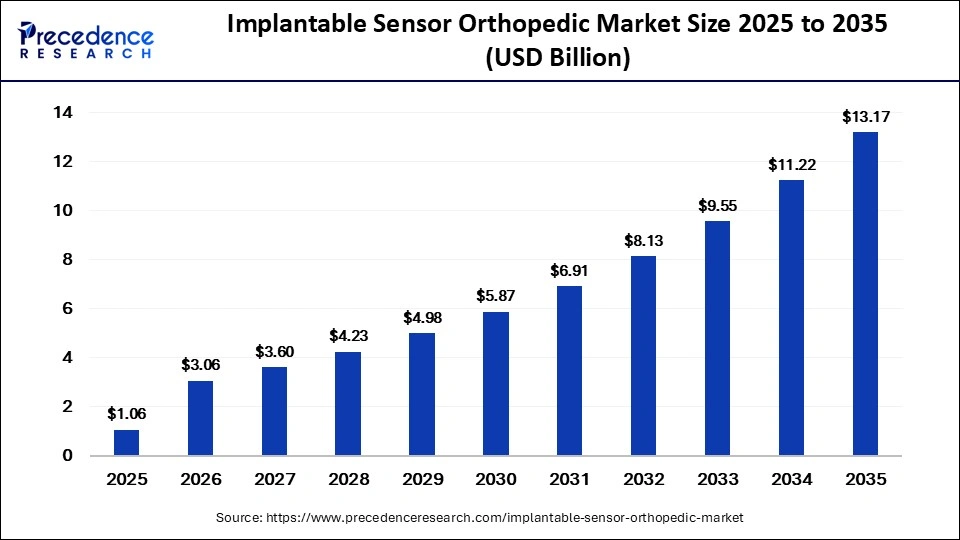
Rohan Patil, a Healthcare Industry Expert, highlights that the implantable sensor orthopedic market has reached USD 3.06 billion in 2026 and is on track to reach USD 13.17 billion by 2035, advancing at a CAGR of 17.04%. Key implantable sensor orthopedic market companies shaping the market include Zimmer Biomet Holdings, Inc., Stryker Corporation, Smith+Nephew plc, while major growth segments span product type, sensor type, technology, application, end user, distribution channel.
Source: https://www.precedenceresearch.com/implantable-sensor-orthopedic-market
 Get a Sample
 Table Of Content


Implantable Sensor Orthopedic Market Size and Forecast 2026 to 2035
The global implantable sensor orthopedic market size accounted for USD 1.06 billion in 2025 and is predicted to increase from USD 3.06 billion in 2026 to approximately USD 13.17 billion by 2035, expanding at a CAGR of 17.04% from 2026 to 2035. The increasing incidence of accidents and chronic diseases, along with further advancements in healthcare devices, support market growth.
Key Takeaways
- North America led the implantable sensor orthopedic market with a share of 41% in 2025.
- Asia-Pacific is expected to be the fastest-growing region with a CAGR of 21.2% in the forecasted duration.
- By product type, the smart knee implants segment led the market with 45% share in 2025.
- By product type, the smart spinal implants segment is expected to be the fastest growing with a CAGR of 18.9% in the coming years.
- By sensor type, the pressure sensors segment accounted for the highest revenue share with 34% share in 2025.
- By sensor type, the multi-parameter sensors segment is expected to be the fastest-growing with a CAGR of 20.4% in the foreseeable period.
- By technology, the wireless sensor-enabled implants segment held the largest revenue share of 42% in the implantable sensor orthopedic market in 2025.
- By technology, the AI-integrated monitoring implants segment is expected to grow at the fastest CAGR of 22.5% in the forthcoming years.
- By application, the joint replacement monitoring segment accounted for the highest revenue share of 38% in 2025.
- By application, the rehabilitation and mobility tracking segment is expected to grow at the highest CAGR of 19.4% in the foreseeable period.
- By end user, the hospitals segment held the largest revenue share of 64% in 2025.
- By end user, the ambulatory surgical centers (ASCs) segment is expected to be the fastest-growing, with a CAGR of 20.1% from 2026 to 2035.
Market Overview
Implantable sensor orthopaedic devices encompass sensors, microchips, and wireless communication technologies, and are commonly referred to as smart, intelligent, or active implants. These innovative implants gather real-time data, monitor environmental conditions, and respond effectively to enhance patient care. Additionally, sensors can detect various parameters, including temperature, pressure, strain, and even biological markers such as pH levels or specific molecules. The field of implantable sensor orthopedics has seen remarkable advancements in the market.
Impact of Artificial Intelligence on the Implantable Sensor Orthopedic Market
Artificial intelligence (AI) is fuelling significant growth in the healthcare devices sector. AI-driven methodologies are converting raw data into actionable clinical insights, enhancing the effectiveness of implantable sensor orthopedics. The integration of AI also facilitates ongoing health monitoring. Moreover, AI-assisted planning has enhanced implant sizing and positioning, improved acetabular fit, and achieved a remarkable 92.9% accuracy in predicting knee component placement, compared to just 45% with manual methods. Additionally, AI algorithms for identifying orthopedic implants show even greater accuracy and can greatly expedite the planning of complex revision arthroplasty procedures.
Implantable Sensor Orthopedic Market Trends
- Personalized Medicine and Smart Drug Delivery Integration: The growing emphasis on personalized medicine and targeted drug delivery is driving demand for implantable sensors integrated with smart drug delivery systems, enhancing treatment precision, patient monitoring, and therapeutic outcomes.
- Advancements in MEMS and NEMS Miniaturization: Continuous developments in microelectromechanical systems (MEMS) and nanoelectromechanical systems (NEMS) are enabling sensor miniaturization, fostering research and innovation toward highly compact, efficient, and advanced implantable sensing technologies.
- Rising Adoption of Flexible Implantable Materials: Flexible materials are emerging as a key trend in implantable sensor development due to their ability to conform to curved and soft tissues, improving biocompatibility, functionality, and long-term performance.
Market Report Coverage and Key Metrics
| Report Coverage | Details |
| Market Size in 2025 | USD 1.06 Billion |
| Market Size in 2026 | USD 3.06 Billion |
| Market Size by 2035 | USD 13.17 Billion |
| Market Growth Rate from 2026 to 2035 | CAGR of 17.04% |
| Dominating Region | North America |
| Fastest Growing Region | Asia Paicfic |
| Base Year | 2025 |
| Forecast Period | 2026 to 2035 |
| Segments Covered | Product Type, Sensor Type, Technology, Application, End User, Distribution Channel, and Region |
| Regions Covered | North America, Europe, Asia-Pacific, Latin America, and Middle East & Africa |
Market Dynamics
Drivers
Increasing Injury Incidence and Implant Innovation
The increasing prevalence of chronic musculoskeletal disorders, rising accident rates, and a growing elderly population are driving the market. Additionally, advancements in microelectronics, sensor miniaturization, and biocompatible materials are enhancing implant performance, expanding clinical applications, and accelerating adoption across healthcare systems.
Restraint
Device Failure and Material Constraints
High rates of complications, including infections, inadequate biological integration, and wear-related implant loosening, can lead to premature device failure. Furthermore, the use of rigid sensor materials presents biocompatibility challenges, often requiring additional encapsulation layers that increase complexity and costs.
Opportunity
Home Healthcare and Monitoring Opportunity
Growing demand for remote patient monitoring and home-based healthcare presents significant opportunities for the market. Implantable sensors integrated with telemedicine platforms enable continuous real-time health monitoring, improving patient outcomes, supporting preventive care strategies, and enhancing clinician decision-making capabilities.
Market Segmentation Analysis
Product Type Insights
The Smart Knee Implants Segment Dominated the Market With a 45% Share in 2025
The smart knee implants segment dominated the implantable sensor orthopedic market with a 45% share in 2025, driven by its position as the largest joint replacement segment and the rising prevalence of osteoarthritis. Smart implants incorporating embedded sensor technology offer an opportunity to improve post-operative recovery, reduce implant failure rates, and increase overall patient satisfaction. Strong demand for outcome monitoring and growth in robotic-assisted surgeries support the segment's dominance.
Implantable Sensor Orthopedic Market Share, By Product Type, 2025-2035 (%)
| Product Type | 2025 | 2035 | CAGR(%) |
| Smart Knee Implants | 45.00% | 47.00% | 18.1% |
| Smart Hip Implants | 28.00% | 27.00% | 16.8% |
| Smart Spinal Implants | 15.00% | 16.00% | 18.9% |
| Trauma & Extremity Implants | 8.00% | 7.00% | 15.4% |
| Others | 4.00% | 3.00% | 13.0% |
The smart hip implants segment held 28% of the market share in 2025 and is expected to grow at a CAGR of 16.8% in the coming years, supported by the growing elderly population and increasing hip replacement procedures. These smart sensors provide insights into the need for postoperative aids and guide rehabilitation after total hip replacement. Enhanced implant longevity monitoring and improved patient outcomes support the segment's growth.
The smart spinal implants segment held 15% of the market share in 2025 and is expected to be the fastest-growing segment with a CAGR of 18.9% during the forecast period, due to rising spinal disorders and growing demand for remote patient monitoring. Smart spinal implants can stimulate healing and provide objective information about healing progression. Advancements in spinal instrumentation and growth in minimally invasive procedures support market growth.
Sensor Type Insights
The Pressure Sensors Segment Led the Market with a 34% Share in 2025
The pressure sensors segment led the implantable sensor orthopedic market with a 34% share in 2025, driven by applications in joint balancing and real-time pressure monitoring. Implantable sensors offer precise pressure measurements within the body while minimizing the infection risks associated with catheters and wires. Additionally, improved implant positioning and enhanced surgical outcomes further bolster growth.
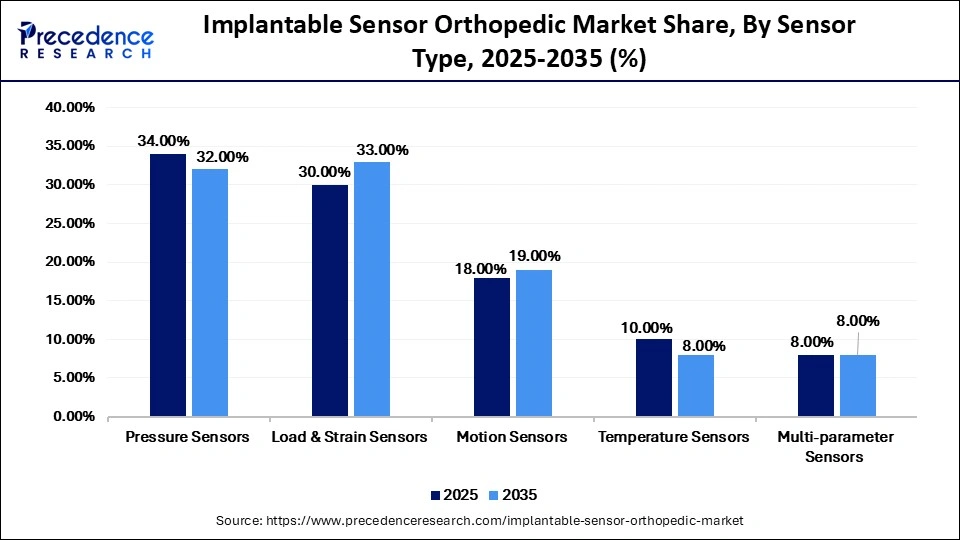
The load and strain sensors segment held 30% of the market share in 2025 and is expected to grow at a CAGR of 18.5% during the forecast period, supported by implant stress monitoring and personalized rehabilitation programs. By integrating strain gauge sensors within the femoral stem or acetabular cup, engineers can effectively measure the transfer of forces between the implant and bone during recovery. This approach enhances the assessment of implant longevity and fosters data-driven care models.
The multi-parameter sensors segment captured an 8% of the market share in 2025 and is expected to expand rapidly with a CAGR of 20.4% from 2026 to 2035, due to advanced analytics capabilities and comprehensive patient monitoring. These sensors facilitate the understanding of the complex interplay of signals that contribute to disease onset, progression, and therapeutic response. Furthermore, AI-enabled diagnostics and next-generation smart implants are expected to drive market growth.
Technology Insights
The Wireless Sensor-Enabled Implants Segment Dominated the Market with a 42% Share in 2025
The wireless sensor enabled implants segment dominated the implantable sensor orthopedic market with a 42% share in 2025, due to real-time data transmission and improved patient convenience. Wireless implantable sensors that integrate genetically engineered cells can detect specific molecules for continuous monitoring. Reduced clinical visits and better treatment outcomes support segment growth.
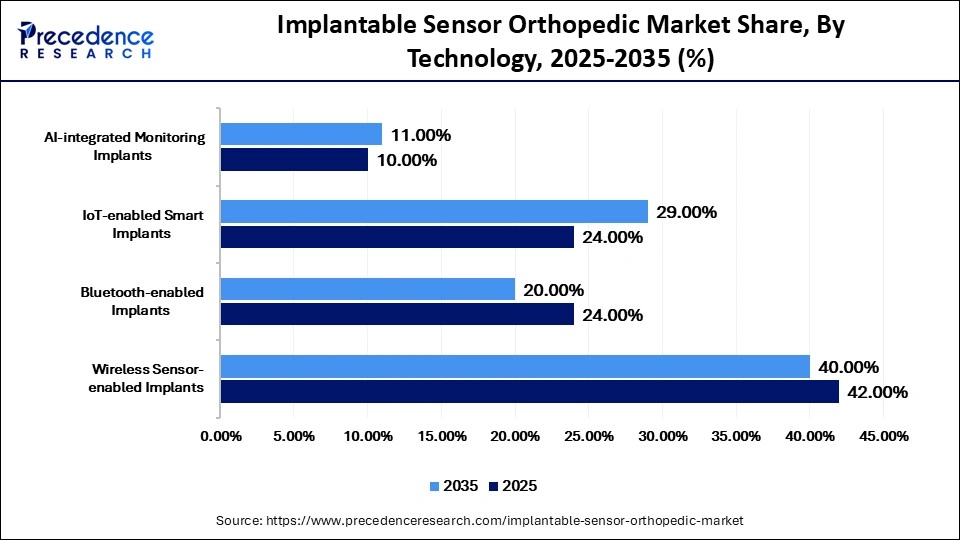
The Bluetooth-enabled implants segment captured about 24% of the market share in 2025 and is expected to grow at a CAGR of 14.8% in the coming years due to smartphone connectivity and patient engagement tools. Furthermore, it enables cost-effective monitoring while growing digital health adoption and remote physician access support segment growth.
The AI-integrated monitoring implants segment held 10% of the market share in 2025 and is expected to be the fastest-growing segment with a CAGR of 22.5% in the forthcoming years, driven by predictive complication detection and personalized recovery pathways. AI-driven medical devices can tailor treatments based on individual patient profiles, including genetic data, medical history, and physiological parameters. Moreover, advanced decision support systems and growing AI adoption support segment growth.
Application Insights
The Joint Replacement Monitoring Segment Led the Market with A 38% Share in 2025
The joint replacement monitoring segment held the largest revenue share of 38% in the implantable sensor orthopedic market in 2025, supported by an increase in arthroplasty procedures and the rising need for monitoring implant performance. Applications for joint replacement monitoring include total knee arthroplasty, hip arthroplasty, spine surgery, fracture healing, and the early detection of infection and implant loosening. Additionally, a reduction in revision surgeries further supports this segment's expansion.
Implantable Sensor Orthopedic Market Share, By Application, 2025-2035 (%)
| Application | 2025 | 2035 | CAGR (%) |
| Joint Replacement Monitoring | 38.00% | 39.00% | 17.9% |
| Post-operative Recovery Monitoring | 23.00% | 24.00% | 18.3% |
| Rehabilitation & Mobility Tracking | 17.00% | 18.00% | 19.4% |
| Infection Detection | 9.00% | 8.00% | 15.6% |
| Implant Performance Monitoring | 10.00% | 9.00% | 17.0% |
| Others | 3.00% | 2.00% | 12.5% |
The post-operative recovery monitoring segment held 23% of the market share in 2025 and is expected to grow at a CAGR of 18.3% in the coming years, driven by trends in remote patient management and a decrease in hospital readmissions. Wearable devices used in the early postoperative period can detect anomalies in vital signs, showcasing the effectiveness of AI-enhanced sensors, particularly in resource-limited settings. Furthermore, improved rehabilitation outcomes contribute to this segment's growth.
The rehabilitation and mobility tracking segment held 17% of the market share in 2025 and is expected to grow at a CAGR of 19.4% in the forecast period, driven by the demand for personalized rehabilitation and the integration of wearable technology. Commonly utilized sensors in rehabilitation research include strain gauges, capacitive sensors, piezoresistive sensors, and piezoelectric devices. Functional outcome measurement and remote therapy monitoring are key factors supporting this segment's growth.
End User Insights
The Hospitals Segment Dominated the Market with a 64% Share in 2025
The hospitals segment dominated the implantable sensor orthopedic market with a 64% share in 2025, driven by the high volume of orthopaedic surgeries and access to advanced technologies. Furthermore, integrated patient monitoring systems, strong reimbursement support, and specialized orthopaedic departments are supporting segment growth.
Implantable Sensor Orthopedic Market Share, By End User, 2025-2035 (%)
| End User | 2025 | 2035 | CAGR (%) |
| Hospitals | 64.00% | 60.00% | 16.8% |
| Orthopedic Specialty Clinics | 16.00% | 18.00% | 18.4% |
| Ambulatory Surgical Centers (ASCs) | 11.00% | 14.00% | 20.1% |
| Research Institutes & Academic Centers | 6.00% | 5.00% | 14.5% |
| Others | 3.00% | 3.00% | 13.0% |
The orthopedic specialty clinics segment held 16% of the market share in 2025 and is expected to grow at a CAGR of 18.4% in the coming years, driven by focused orthopaedic care. A growing number of outpatient procedures and digital patient management systems are further supporting segment growth.
The ambulatory surgical centers (ASCs) segment held 11% of the market share in 2025 and is expected to grow at the highest CAGR of 20.1% in the forthcoming years. This growth is driven by the shift toward outpatient surgeries and cost-effective care delivery. Furthermore, advanced surgical technologies and increasing procedure volumes are promoting adoption.
Market Regional Analysis: North America, Europe, Asia-Pacific
U.S. Implantable Sensor Orthopedic Market Size and Growth 2026 to 2035
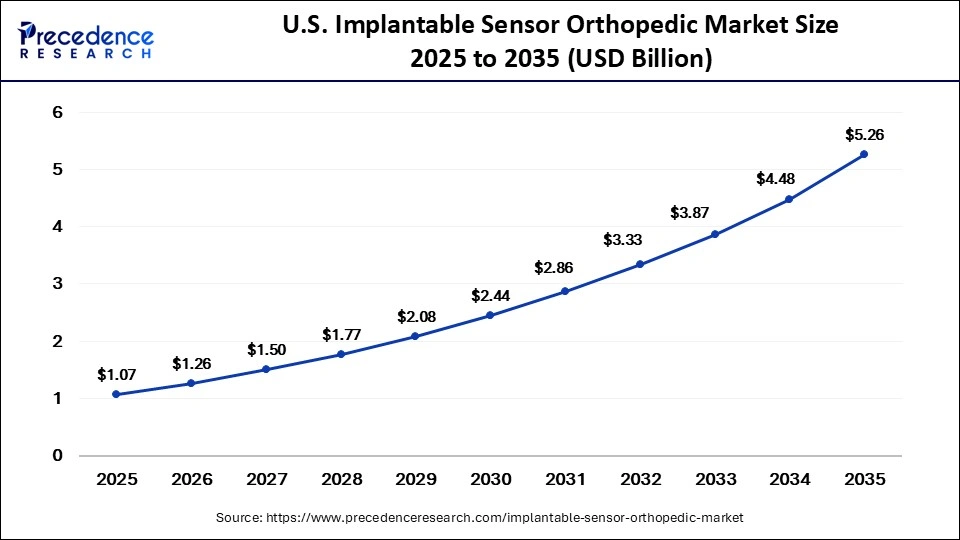
The U.S. implantable sensor orthopedic market size was evaluated at USD 1.07 billion in 2025 and is projected to reach around USD 5.26 billion by 2035, growing at a CAGR of 15.93% from 2026 to 2035.
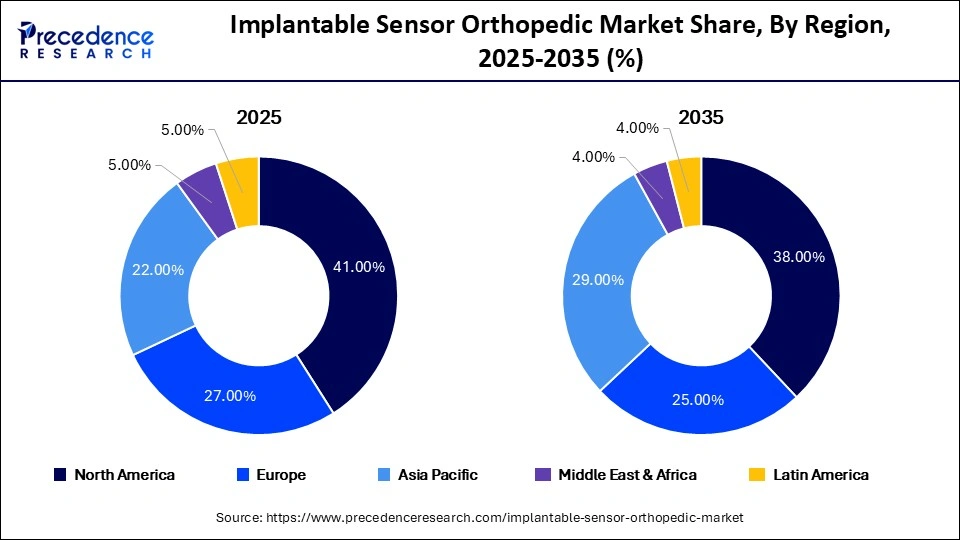
North America: Dominated with 41% share in 2025
North America held a major market share of 41% in 2025, due to the early adoption of smart implants and advanced healthcare infrastructure. Moreover, rising orthopedic procedures, a strong reimbursement environment, and the presence of leading manufacturers support the region's dominance.
United States Market Analysis
The U.S. is at the forefront of the North American market, driven by the strong adoption of connected medical devices and substantial investments in biotechnology and medical device innovation. In the U.S. alone, more than 7.5 million orthopedic devices are implanted each year.
How is Asia-Pacific Growing in the Implantable Sensor Orthopedic Market?
Asia-Pacific held 22% of the market share in 2025 and is expected to experience the fastest growth with a CAGR of 21.2% during the predicted timeframe, driven by rapid healthcare modernization and rising musculoskeletal disorders. Furthermore, growing orthopedic surgery volumes, increasing healthcare expenditure, and an expanding medical device manufacturing base promote the market growth.
China Market Analysis
China is at the forefront of the Asia-Pacific market due to government initiatives and rising awareness about orthopedic health. The demand for advanced surgical procedures and innovative implant technologies is increasing as healthcare providers seek to enhance patient outcomes.
Which Factors Drive the Implantable Sensor Orthopedic Market in Europe?
Europe held 27% of the market share in 2025 and is considered to be a significantly growing area with a CAGR of 16.1%, due to a growing aging population, increasing joint replacement surgeries, and digital healthcare integration. Moreover, government support for medical innovation and the expansion of orthopedic research further support market growth.
Germany Market Analysis
The German market is growing as minimally invasive techniques are gaining traction and enhancing recovery times and patient outcomes in orthopedic procedures. Moreover, the regulatory environment in Germany appears to support the development and approval of new orthopedic devices.
Will the Middle East and Africa Grow in the Implantable Sensor Orthopedic Market?
The Middle East and Africa region held 5% of the market share in 2025 and is expected to grow at a CAGR of 14.5% in the coming years, driven by improving healthcare infrastructure and the growing adoption of advanced implants. Furthermore, rising orthopedic treatment demand, medical tourism growth, and increasing investments in specialty hospitals support market growth.
UAE Market Analysis
The UAE is witnessing significant growth in the market, driven by technological innovations in biomaterial implant sensors and miniaturization, which are enhancing implant performance. Furthermore, rising medical tourism in the UAE is further contributing to market growth.
What are the Key Trends of the Implantable Sensor Orthopedic Market in Latin America?
Latin America accounted for 6% of the market share in 2025 and is expected to grow with a CAGR of 14.8% throughout the forecast period, supported by expanding access to orthopedic care and increasing sports injuries. Furthermore, growing demand for advanced implants, healthcare modernization initiatives, and rising awareness of digital health technologies support market growth.
Brazil Market Analysis
Brazil is performing well in the Latin American market, driven by rising demand for advanced surgical procedures and innovative implant technologies, as healthcare providers seek to enhance patient outcomes. Manufacturers are focusing on developing cost-effective solutions tailored to specific needs.
Implantable Sensor Orthopedic Market Value Chain Analysis
- Research & Development
Developing biocompatible smart materials and battery-free telemetry sensors to monitor real-time joint stress and temperature.
Key Players: Canary Medical, OrthoSens, CytexOrtho.
- Clinical Trials and Regulatory Approvals
Running rigorous human trials and navigating FDA or CE MDR pathways to validate device safety.
Key Players: Stryker Corporation, Zimmer Biomet, Johnson & Johnson MedTech.
- Packaging and Serialization
Securing delicate smart implants in sterile, tamper-evident packaging with unique serial codes for electronic tracking.
Key Players: Steris, Nelipak Healthcare Packaging, Oliver Healthcare Packaging.
- Distribution to Hospitals and Pharmacies
Transporting temperature-sensitive smart implants through secure, traceable healthcare supply chains to orthopedic centers and clinics.
Key Players: Cardinal Health, Owens & Minor, Henry Schein.
- Patient Support and Services
Monitoring post-operative healing remotely through apps and cloud platforms to personalize patient rehabilitation plans.
Key Players: Canary Medical, Zimmer Biomet, Exer AI.
Market Competitive Landscape: Leading Companies and Strategies
The implantable sensor orthopedic market for implantable sensor technology in orthopedics is viewed as either semi-consolidated or highly consolidated. Manufacturers are prioritizing precision alignment and sensor-enhanced instruments for joint and spine surgeries. Additionally, there is a strong focus on dynamic soft tissue balancing and providing real-time load feedback during procedures.
Market participants encounter challenges such as regulatory complexities, elevated development and surgical costs, and hardware limitations associated with powering sensors within the body. To address these challenges, companies are investing in digital health ecosystems and innovative smart joint technologies to secure niche market segments. Furthermore, they are forming partnerships in cloud analytics to facilitate closed-loop patient feedback.
Top Companies in the Implantable Sensor Orthopedic Market
- Zimmer Biomet Holdings, Inc.
- Stryker Corporation
- Smith+Nephew plc
- Johnson & Johnson MedTech (DePuy Synthes)
- Medtronic plc
- Globus Medical, Inc.
- Orthosensor Inc.
- Exactech, Inc.
- MicroPort Orthopedics Inc.
- Conformis, Inc.
- NuVasive, Inc.
- Orthofix Medical Inc.
- Arthrex, Inc.
- Integra LifeSciences Holdings Corporation
- Smart Implant Solutions
Recent Developments Implantable Sensor Orthopedic Market (2025-2026)
- In June 2026, Auxano Medical, a company focused on advancing osseointegration and bone-implant interface technology, announced the launch of its newly redesigned website. The updated platform offers surgeons, distributors, and industry partners expanded access to information on Auxano Medical's proprietary surface morphology technology and its growing portfolio of orthopedic implant systems, including the ARKEO™ Wedge Fixation System and the INTREPED Intraosseous Fusion Device.(Source: https://www.einnews.com)
- In May 2026, Ortho Development Corporation (ODEV), a designer and manufacturer of high-quality orthopedic implants and surgical instruments, launched the full commercial launch of the Trivicta Hip Stem, a cementless triple-taper femoral component for primary total hip arthroplasty. Following a controlled market introduction, the system is now available to surgeons and health systems nationwide through Ortho Development's authorized U.S. distribution network.(Source: https://www.prnewswire.com)
Segments Covered in the Report
By Product Type
- Smart Knee Implants
- Smart Hip Implants
- Smart Spinal Implants
- Trauma & Extremity Implants
- Others
By Sensor Type
- Pressure Sensors
- Load & Strain Sensors
- Motion Sensors
- Temperature Sensors
- Multi-parameter Sensors
By Technology
- Wireless Sensor-enabled Implants
- Bluetooth-enabled Implants
- IoT-enabled Smart Implants
- AI-integrated Monitoring Implants
By Application
- Joint Replacement Monitoring
- Post-operative Recovery Monitoring
- Rehabilitation & Mobility Tracking
- Infection Detection
- Implant Performance Monitoring
- Others
By End User
- Hospitals
- Orthopedic Specialty Clinics
- Ambulatory Surgical Centers (ASCs)
- Research Institutes & Academic Centers
- Others
By Distribution Channel
- Direct Sales
- Medical Device Distributors
- Group Purchasing Organizations (GPOs)
- Tender Procurement
By Region
- North America
- Latin America
- Europe
- Asia-pacific
- Middle and East Africa
For inquiries regarding discounts, bulk purchases, or customization requests, please contact us at sales@precedenceresearch.com
Frequently Asked Questions





Ask For Sample
No cookie-cutter, only authentic analysis – take the 1st step to become a Precedence Research client
 Get a Sample




 sales@precedenceresearch.com
 Schedule a Meeting
