



Robotic Simulator Market Revenue to Attain USD 3,093.68 Mn by 2035
Published: 07 Apr 2026
Author: Precedence Research



Robotic Simulator Market Revenue and Trends 2026 to 2035
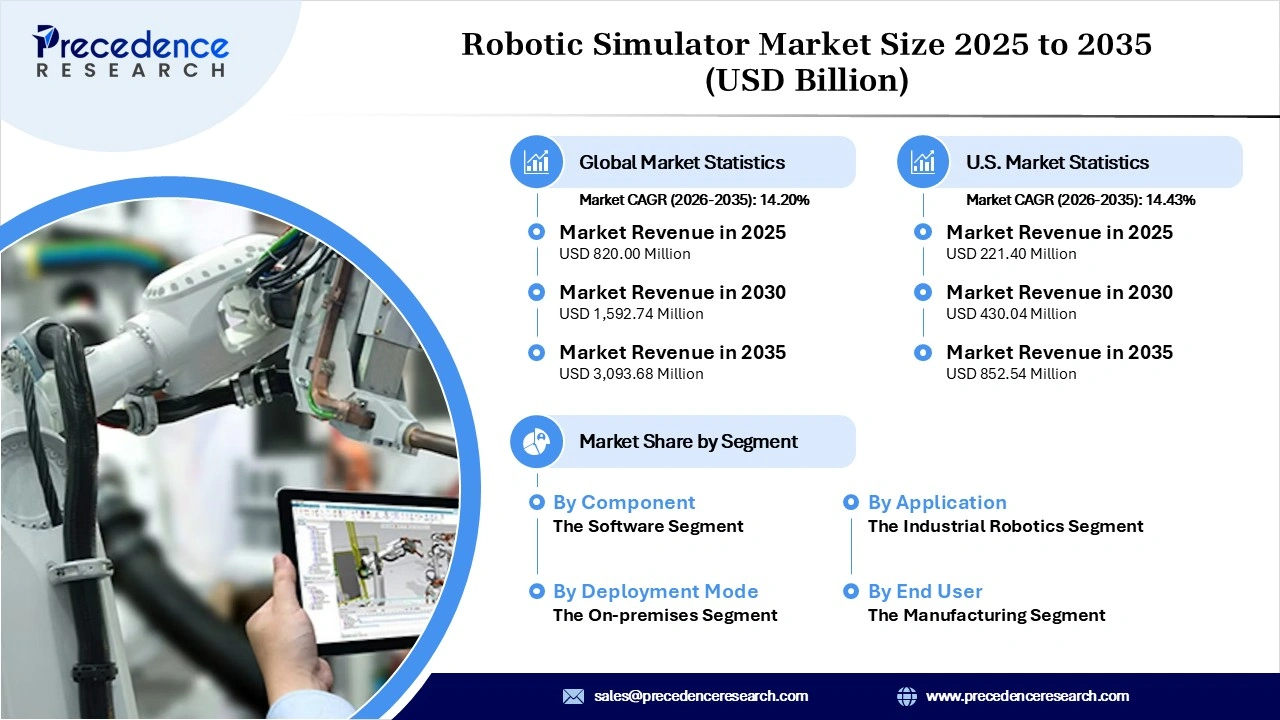
The global robotic simulator market revenue surpassed USD 820.00 million in 2025 and is predicted to attain around USD 3,093.68 million by 2035, growing at a CAGR of 14.20%. The robotic simulator market is expanding rapidly, driven by rising adoption of automation and robotics across industries, increasing demand for virtual training and testing, and advancements in AI-powered simulation technologies.
Market at a Glance
The robotics simulator market involves software and solutions that enable the recreation of real-world robotic operations without physical deployment. These solutions are widely used across industrial automation, healthcare, aerospace, and research sectors, where precision and reliability are critical. By simulating physics, motion dynamics, and system interactions, engineers can test and solve problems virtually, minimizing risk before deploying machines in real-world environments.
Robotic simulators find applications beyond manufacturing, impacting sectors such as surgical training centers and autonomous vehicle testing. It comprises diverse software platforms and cloud-based simulation frameworks that facilitate design validation and optimization for robotic systems. As industries increasingly adopt automation and artificial intelligence (AI), simulation systems are being integrated directly into operational workflows to enhance efficiency and accuracy.
Robotics simulations are delivering measurable efficiency improvements, achieving up to a 70% reduction in programming time compared to traditional on-site methods. These gains are motivating manufacturers to adopt simulation for testing and integrate it into broader operational strategies, enhancing overall productivity and return on investment.
Future Market Landscape and Key Opportunities
- Adoption Across Various Industries: The major opportunity in the robotic simulator market lies in the rapid adoption of advanced simulation technologies across multiple sectors, including manufacturing, healthcare, aerospace, and autonomous vehicles. Increasing integration of AI, digital twins, and cloud-based platforms allows companies to optimize robotic design, training, and operations without physical deployment, reducing costs and accelerating time-to-market. Additionally, the growing focus on Industry 4.0, telemedicine, and autonomous systems presents significant scope for expansion, as organizations seek scalable, high-fidelity simulation solutions to improve efficiency, safety, and innovation.
- Industrial Collaborations Driving Commercial Expansion: A 2026 collaboration between ABB and NVIDIA aims to enhance robot training through highly realistic simulated environments, enabling robots to adapt to real-world variables such as vibration and lighting. This technology is expected to accelerate deployment timelines and reduce costs by minimizing reliance on physical prototypes, with companies like Foxconn already experimenting with these systems.
Market Growth Forecast
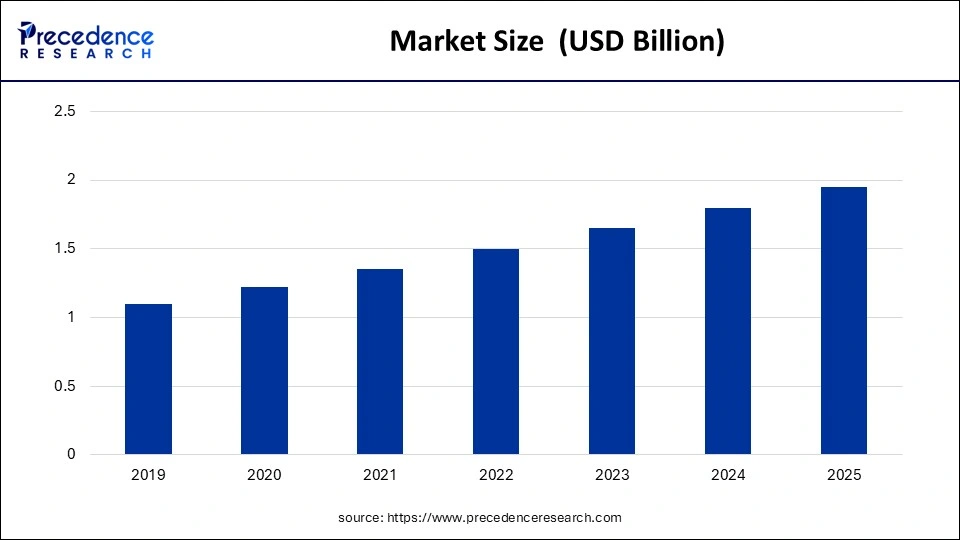
The diagram illustrates the steady growth of the global robotics simulator market over seven years, with valuations measured in billions of USD. This consistent expansion reflects an increasing industrial reliance on virtual testing environments and digital twin technologies to optimize robotic deployments and reduce physical prototyping costs.
Market Segmentation Overview
- By component, the software segment held a major revenue share of 72.0% in the robotic simulator market in 2025, propelled by the need for digital twins, AI-driven simulations, and real-time modeling. In industrial and research applications, its critical role in offline programming and efficient robotic design processes has secured a competitive advantage.
- By component, the services segment is expected to grow at the fastest CAGR in the market during the studied years, as companies increase focus on integration, customization, and workforce training. Rising demand for ongoing technical support and consulting, particularly for complex robotic implementations, is positioning services as strategic enablers rather than merely supporting functions.
- By deployment mode, the on-premises segment led the global market with a share of 60.0% in 2025. This is mainly due to concerns over data security, system control, and customization. Enterprises often preferred systems that could be seamlessly integrated with existing infrastructure without compromising operational oversight. However, on-premises solutions can be easily integrated into existing systems.
- By deployment mode, the cloud-based segment is expected to grow at the fastest CAGR in the market between 2026 and 2035, driven by its scalability and cost-effectiveness. Features such as remote access, collaborative functionality, and real-time updates are expected to accelerate deployment, enhance flexibility, and broaden adoption opportunities.
- By application, the industrial robotics segment accounted for a major share of 45.0% in the robotic simulator market in 2025 due to the widespread adoption of automation and the need for process optimization in manufacturing industries. Simulation-based tools enable manufacturers to reduce downtime, improve operational efficiency, and minimize costs, making them essential for high-volume production environments.
- By application, the autonomous vehicles & drones segment is expected to grow at the fastest rate between 2026 and 2035 due to rapid advancements in self-driving technologies and AI integration, which require extensive virtual testing before real-world deployment. Additionally, increasing emphasis on safety validation, regulatory compliance, and performance optimization is driving the adoption of simulation platforms in this sector.
- By end user, the manufacturing segment held a major revenue share of 38.0% in the market in 2025, driven by Industry 4.0 innovations and the shift toward smart factories. With automation and productivity gains becoming essential, robotic simulators are now regarded as critical tools rather than optional assets.
- By end user, the aerospace & defense segment is expected to expand rapidly in the coming years, fueled by increasing reliance on robotics for critical operations. The demand for reliable simulation platforms for military missions and space applications is anticipated to accelerate adoption significantly.
Regional Insights
North America dominated the robotic simulator market with a major share of 39.0% in 2025, supported by a well-established robotics ecosystem, substantial R&D investments, and early adoption of emerging technologies. In the U.S., simulation has been pivotal across aerospace, defense, and factory automation, while in Canada, research-driven applications and collaborations between academia and industry have strengthened the region’s technological capabilities.
On the other hand, Asia Pacific held a 24% share of the market in 2025 and is expected to grow at the fastest CAGR during the forecast period. This is mainly due to rapid industrial growth, increasing use of robotics technology, and government-backed manufacturing initiatives. China is leading simulation development, while Japan contributes through precision robotics expertise. Additionally, cost optimization and government-led digital strategies are accelerating the adoption of simulation technologies in countries like India, making them an essential operational capability.
Robotic Simulator Market Coverage
| Report Attribute | Key Statistics |
| Market Revenue in 2025 | USD 820.00 Million |
| Market Revenue by 2035 | USD 3,093.68 Million |
| CAGR from 2026 to 2035 | 14.20% |
| Quantitative Units | Revenue in USD million/billion, Volume in units |
| Largest Market | North America |
| Base Year | 2025 |
| Regions Covered | North America, Europe, Asia-Pacific, Latin America, and the Middle East & Africa |
Top Companies in the Robotic Simulator Market
Companies such as ABB Ltd., KUKA AG, FANUC Corporation, and Yaskawa Electric Corporation view simulation as an integral part of factory automation, prioritizing accuracy and operational continuity over mere visualization. Siemens AG and Rockwell Automation, Inc. incorporate simulation into comprehensive digital manufacturing systems, creating a seamless workflow between virtual and physical operations. Meanwhile, NVIDIA Corporation advances this concept further by leveraging AI-driven simulated environments to train robots entirely in virtual settings.
Segments Covered in the Report
By Component
- Software
- Simulation Software
- Programming & Offline Programming Tools
- Digital Twin Platforms
- Services
- Integration Services
- Consulting Services
- Training & Support Services
By Deployment Mode
- On-Premises
- Enterprise Installed Systems
- Local Simulation Platforms
- Cloud-Based
- SaaS-Based Simulation
- Remote Collaboration Platforms
By Application
- Industrial Robotics
- Assembly Line Simulation
- Welding & Painting Simulation
- Material Handling Simulation
- Medical Robotics
- Surgical Simulation
- Rehabilitation Robotics
- Autonomous Vehicles & Drones
- Autonomous Driving Simulation
- UAV/Drone Simulation
- Research & Education
- Academic Training
- Robotics R&D
By End User
- Manufacturing
- Automotive Manufacturing
- Electronics Manufacturing
- Heavy Machinery
- Healthcare
- Hospitals
- Medical Training Institutes
- Automotive
- OEM
- Tier 1 Suppliers
- Aerospace & Defense
- Military Robotics
- Space Robotics
- Education & Research
- Universities
- Research Institutes
By Region
- North America
- Asia Pacific
- South America
- Europe
- MEA
Get this report to explore global market size, share, CAGR, and trends, featuring detailed segmental analysis and an insightful competitive landscape overview @ https://www.precedenceresearch.com/sample/8273
You can place an order or ask any questions, please feel free to contact us at sales@precedenceresearch.com |+1 804 441 9344