



Robotic Simulator Market Trends, Companies, Revenue / Sales Performance, Subscriber Growth, Pricing Strategies, Cloud Adoption, Infrastructure Expansion, Competitive Landscape, and Industry Outlook
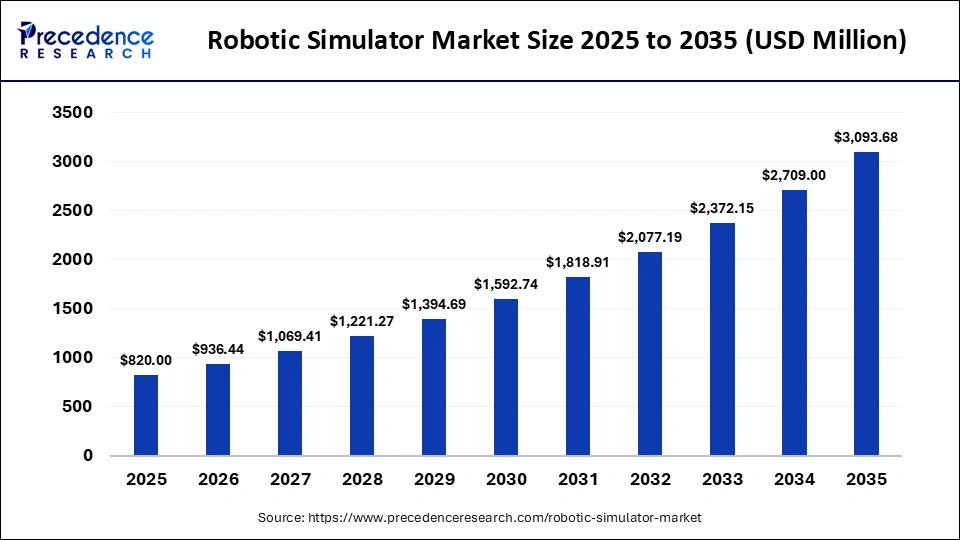
ICT industry specialist Shivani Zoting estimates the robotic simulator market at USD 936.44 million in 2026, with continued technology adoption expected to take the market to USD 3,093.68 million by 2035 at a CAGR of 14.20%. Leading robotic simulator market providers such as ABB Ltd., KUKA AG, FANUC Corporation, Yaskawa Electric Corporation, Siemens AG, Dassault Systemes are expanding their capabilities across segments including By Component, By Deployment Mode, By Application, By End User.
Source: https://www.precedenceresearch.com/robotic-simulator-market
 Get a Sample
 Table Of Content


What is the Robotic Simulator Market Size in 2026?
The global robotic simulator market size was calculated at USD 820.00 million in 2025 and is predicted to increase from USD 936.44 billion in 2026 to approximately USD 3,093.68 million by 2035, expanding at a CAGR of 14.20% from 2026 to 2035. The market is driven by rising adoption of surgical and industrial robotics and advancements in high-fidelity simulation technologies for enhanced accuracy, safety, and operational efficiency.
Key Takeaways
- North America led the robotic simulator market in 2025 with approximately 36% share.
- Asia Pacific is projected to experience the fastest growth in the upcoming period.
- By component, the software segment dominated the market in 2025 with about 72% share.
- By component, the services segment accounted for 28% market share in 2025 and is expected to grow at the fastest rate over the forecast period.
- By deployment mode, the on-premises segment dominated the market with around 60% share in 2025.
- By deployment mode, the cloud-based segment is projected to expand at the fastest rate over the forecast period.
- By application, the industrial robotics segment dominated the market with about 45% share in 2025.
- By application, the autonomous vehicles & drones segment accounted for about 15% market share in 2025 and is anticipated to grow at the fastest rate over the forecast period.
- By end user, the manufacturing segment dominated the market with nearly 38% share in 2025.
- By end user, the aerospace & defense segment is expected to register the fastest growth over the forecast period.
Robotic Simulator Market Overview
A robotic simulator is software used to predict and analyze a robot's behavior under various conditions without the need for physical prototypes, which are costly and time-consuming to build. Robot simulation allows developers to train, test, and validate robot behavior in physically accurate digital twins. It is used for fast algorithm development, factory automation simulations, fast prototyping and verification, robotics-related education, remote monitoring, safety double-checking, as a digital twin, and much more. Robot simulation enables robotics engineers and researchers to create virtual models of robots and their environments. This technology facilitates the testing and validation of robot designs, control algorithms, and interactions with various elements in a simulated, risk-free environment.
Impact of Artificial Intelligence on the Robotic Simulator Market
Artificial intelligence is significantly enhancing the robotic simulator market by enabling more realistic and adaptive simulation environments that improve training outcomes. AI algorithms analyze user performance in real time, providing personalized feedback and optimizing skill development for surgical, industrial, and research applications. Additionally, AI-driven predictive modeling helps simulate complex scenarios, reducing training risks and accelerating proficiency in robot-assisted operations.
AI-powered robotic simulations can adjust to new circumstances, analyze data in real time, and make informed decisions. AI empowers robots to make autonomous choices. Machine learning (ML) allows robots to acquire knowledge from data and experiences rather than depending exclusively on pre-programmed instructions. ML further enables robotic simulations to learn from data and experiences instead of relying solely on hard-coded directives.
Robotic Simulator Market Trends
- Need for Predictive Maintenance & Remote Monitoring: Robotic simulators are increasingly being used for predictive maintenance, helping industries anticipate failures and schedule timely interventions. This reduces downtime and ensures continuous and remote monitoring capabilities.
- Demand for Customized Solutions: There is a growing shift toward customizable robotic simulation solutions, as businesses move away from one-size-fits-all approaches. Tailored simulations improve user engagement and make training and operations more relevant to specific industrial needs.
- Integration of CAD-Based Simulation Platforms: The adoption of CAD-integrated off-line programming platforms is rising, enabling users to easily generate and visualize robot paths. These intuitive systems enhance human-robot interaction and allow even basic users to create simulations quickly and efficiently.
Market Scope
| Report Coverage | Details |
| Market Size in 2025 | USD 820.00 Million |
| Market Size in 2026 | USD 936.44 Million |
| Market Size by 2035 | USD 3,093.68 Million |
| Market Growth Rate from 2026 to 2035 | CAGR of 14.20% |
| Dominating Region | North America |
| Fastest Growing Region | Asia-Pacific |
| Base Year | 2025 |
| Forecast Period | 2026 to 2035 |
| Segments Covered | Component, Deployment Mode, Application, End User, and Region |
| Regions Covered | North America, Europe, Asia-Pacific, Latin America, and Middle East & Africa |
Market Dynamics
Drivers
Growing Demand for Virtual Testing & Training
The increasing need for virtual testing environments and simulation-based training is driving the adoption of robotic simulators. Industries are leveraging these solutions to optimize design processes and enhance operational efficiency without real world risks.
Restraint
Ethical and Data Security Concerns in Healthcare
The use of robotics, especially in healthcare, raises concerns around patients' data privacy, decision-making autonomy, and ethical usage. Ensuring secure handling of sensitive health information and compliance with regulations remains a major challenge in the market.
Opportunity
Expanding Applications in Healthcare and Automation
Expanding applications in healthcare and industrial automation are creating significant growth opportunities for the robotic simulator market by increasing demand for advanced training solutions. In healthcare, robotic simulators enable surgeons and medical professionals to practice complex procedures safely, improving precision and patient outcomes. In industrial automation, simulators allow operators to train on robotic systems virtually, reducing operational risks, optimizing workflows, and accelerating the adoption of robotics across manufacturing and logistics sectors.
Segment Insights
Component Insights
Robotic Simulator Market Share, By Component , 2025-2035 (%)
| Component | 2025 | 2035 |
| Software | 72% | 66% |
| Services | 28% | 34% |
The Software Segment Dominated the Market in 2025 with a 72% Share
The software segment dominated the robotic simulator market with the largest share of 72% in 205, driven by the increasing adoption of digital twins, AI-based simulation, and real-time modelling. The rising demand for programming and offline programming tools and the need for efficient robotic design and digital twin platforms also reinforced the segment's dominance. Robotics simulation software tools enable users to create, examine, and verify complex robotic motion paths and processes using a complete set of manual and automated capabilities. Platforms such as Unity, NVIDIA Isaac Sim, and Gazebo support simulation-based testing that accelerates both software deployment on robots and robot deployment on-site.
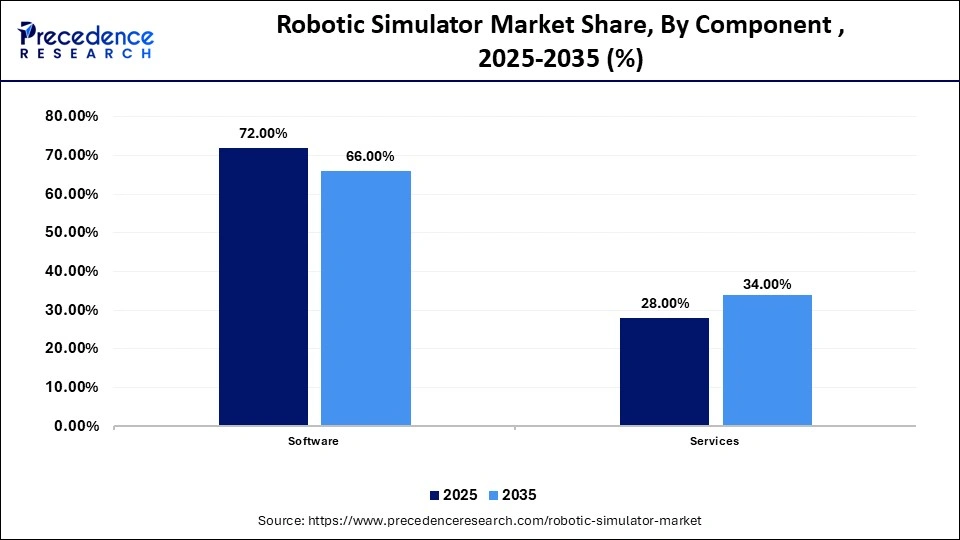
The services segment held nearly 28% market share in 2025 and is expected to grow at the fastest rate during the forecast period, driven by the increasing demand for integration, customization, workforce training, ongoing support, and consulting services. Robotic simulation services provide a virtual environment for comprehensive testing and analysis of robotic systems. These services include virtual prototyping, which creates detailed simulations to evaluate system functionality; performance optimization, which analyzes and enhances system efficiency; and risk mitigation, which identifies and addresses potential issues before real-world implementation, supporting broader market adoption.
Deployment Mode Insights
Robotic Simulator Market Share, By Deployment Mode, 2025-2035 (%)
| Deployment Mode | 2025 | 2035 |
| On-Premises | 60% | 52% |
| Cloud-Based | 40% | 48% |
The On-Premises Segment Led the Market in 2025 with a 60% Share
The on-premises segment led the robotic simulator market while holding around 60% share in 2025, driven by the need for high data security, customization, and control over operations. On-premise models are easy to integrate with existing enterprise systems, boosting their adoption. Companies and healthcare institutions prefer on-premise deployment for sensitive data protection, low-latency performance, and full control over system customization. Additionally, on-premise setups support large-scale, high-fidelity simulations required for training, testing, and optimization of robotic systems, making them the preferred choice for many end users.
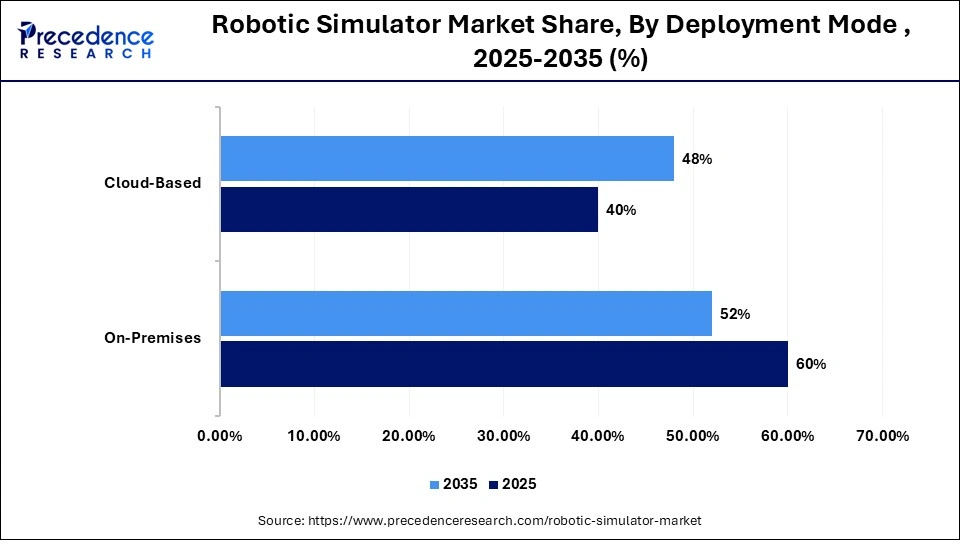
The cloud-based segment accounted for around 40% share of the market in 2025 and is expected to grow at the fastest rate over the projected period, driven by the growing need for scalability, cost efficiency, remote access, collaboration tools, and real-time updates. Cloud-based capabilities, such as SaaS-based simulation and remote collaboration platforms, enable multiple simulation jobs to run simultaneously while reducing the local processing power required by leveraging remote computing resources. These advantages are boosting the rapid adoption of cloud-based robotic simulation solutions and supporting overall segmental growth.
Application Insights
The Industrial Robotics Segment Held a 45% Market Share in 2025
The industrial robotics segment dominated the robotic simulator market with about 45% share in 2025, driven by increasing automation in manufacturing, demand for process optimization, reduced downtime, and cost efficiency. Industrial robotics is considered one of the most impactful and widely adopted technological advancements, as robots can perform routine tasks such as assembling products, lifting items, welding, and painting. These capabilities are significantly promoting the growth of the industrial robotics segment in the market.
The autonomous vehicles & drones segment captured nearly 15% share of the market in 2025 and is expected to grow at the fastest rate over the forecast period. The growth of the segment is driven by increasing production of autonomous vehicles, stricter safety testing requirements, and deeper integration of AI. Simulations for autonomous driving and UAVs/drones allow engineers to validate components and systems in scalable virtual environments, identify and resolve issues before real-world deployment, analyze drone dynamics, conduct trade-off assessments, and fine-tune parameters to optimize performance.
Robotic Simulator Market Share, By Application, 2025-2035 (%)
| Application | 2025 | 2035 |
| Industrial Robotics | 45% | 40% |
| Medical Robotics | 18% | 20% |
| Autonomous Vehicles & Drones | 15% | 22% |
| Research & Education | 22% | 18% |
The research & education segment accounted for around 22% share of the market in 2025 and is expected to grow at a notable rate in the coming years. This is mainly due to the increasing integration of robotics into academic curricula and hands-on training programs. Educational institutions and research centers are adopting simulators to provide safe, cost-effective, and scalable environments for skill development, experimentation, and innovation. Additionally, the use of technologies like AI-driven tutoring, digital twins, and remote laboratories enhances learning and research capabilities, further driving demand in this segment.
The medical robotics segment held nearly 18% market share in 2025 and is expected to grow at a significant rate over the forecast period, driven by demand for robotic surgeries, training simulations, increasing healthcare automation, and stringent precision requirements. Medical robotics supports patient assistance and pharmacy automation, can perform minimally invasive endoscopic procedures, and can be worn as exoskeletons that provide users with additional support, strength, and mobility. These capabilities are significantly accelerating the adoption of medical robotics solutions.
End User Insights
The Manufacturing Segment Dominated the Market with a 38% Share in 2025
The manufacturing segment dominated the robotic simulator market with approximately 38% share in 2025, driven by Industry 4.0 adoption, growth of smart factories, rising automation, and a strong focus on productivity optimization. Robotic simulators play a critical role across automotive, electronics, and heavy machinery manufacturing by minimizing rework and associated costs, while helping prevent delays in the production and procurement of components.
The aerospace & defense segment held a 12% market share in 2025 and is expected to grow at the fastest rate during the projection period, driven by the increasing use of robotics in defense, space exploration, and mission-critical simulations. Robotic systems improve efficiency and quality by performing delicate or high-risk tasks, while combined simulation and real-world testing enable rapid validation of complex behaviors, such as coordinated drone formations. Moreover, these platforms serve as effective communication tools, allowing safe demonstrations for customers and partners, particularly as land forces increasingly adopt robotic systems.
Robotic Simulator Market Share, By End User, 2025-2035 (%)
| End User | 2025 | 2035 |
| Manufacturing | 38% | 34% |
| Healthcare | 16% | 18% |
| Automotive | 20% | 18% |
| Aerospace & Defense | 12% | 18% |
| Education & Research | 14% | 12% |
The healthcare segment held about 16% of market share in 2025, driven by the rising adoption of medical robots, simulation-based training, and precision healthcare solutions. These technologies facilitate minimally invasive procedures, improved monitoring of chronic patients, and more efficient clinical workflows. Additionally, robotics and automation in laboratories and medical training institutes reduce repetitive tasks, allowing experts to focus on higher-value research and innovation.
The automotive segment held around 20% market share in 2025, driven by the use of robotic simulation for production line optimization, robot programming, and quality testing. The high precision and speed of these solutions are critical for improving production efficiency and ensuring product quality. Moreover, robotic simulators support innovation by enabling the design and validation of increasingly complex vehicles, fostering sustained adoption across the automotive sector.
Regional Insights
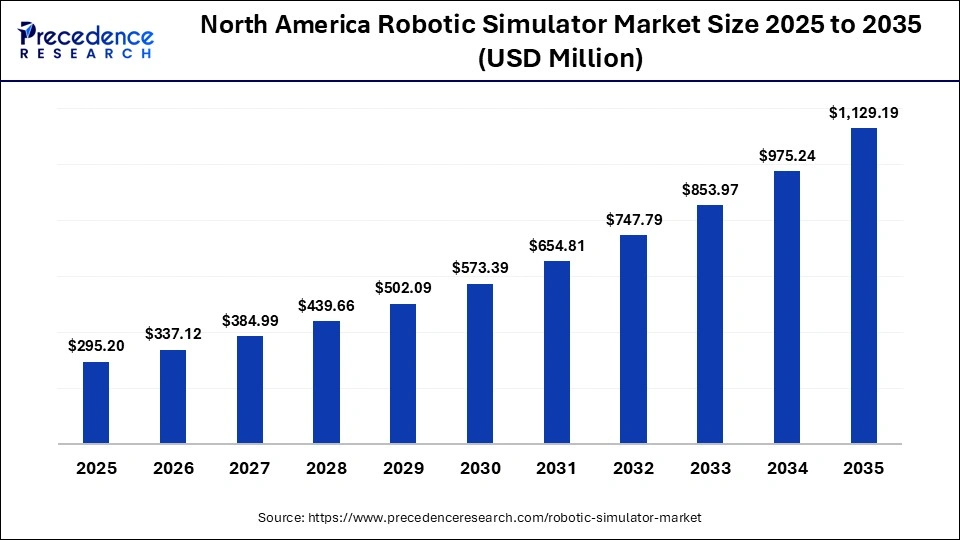
North America Robotic Simulator Market Size and Growth 2026 to 2035
The North America robotic simulator market size is estimated at USD 295.20 million in 2025 and is projected to reach approximately USD 1,129.19 million by 2035, with a 14.36% CAGR from 2026 to 2035.
North America Dominated the Robotic Simulator Market with a 36% Share in 2025
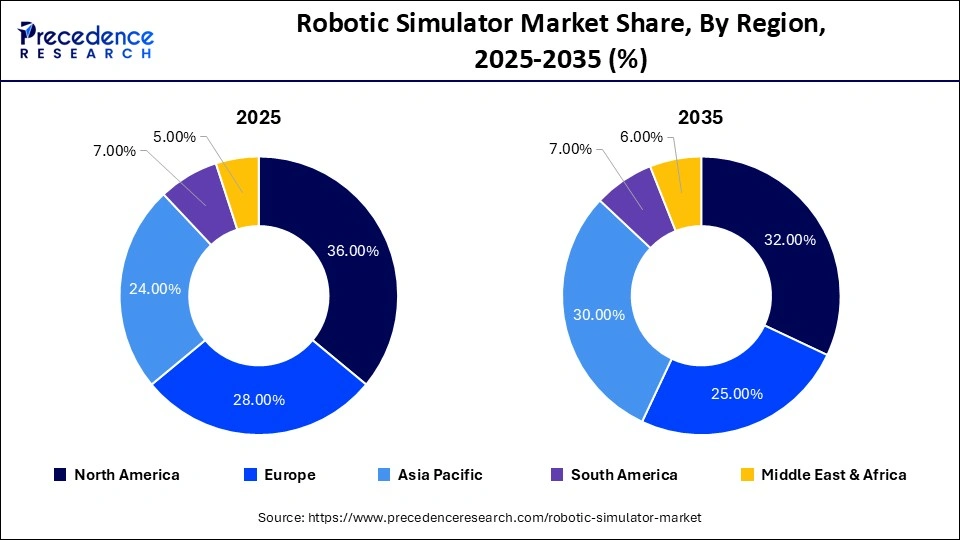
North America dominated the robotic simulator market in 2025, holding about 36% share. This is mainly due to a strong robotics ecosystem, high R&D investments, and early adoption of robotics across industries. The region's dominance is further reinforced by increasing adoption of artificial intelligence, integration with virtual and augmented reality, and rising demand for automation skills training. Moreover, the presence of major market players such as NVIDIA, Amazon Robotics, and Rockwell Automation reinforced the region's leading position.
U.S. Robotic Simulator Market Size and Growth 2026 to 2035
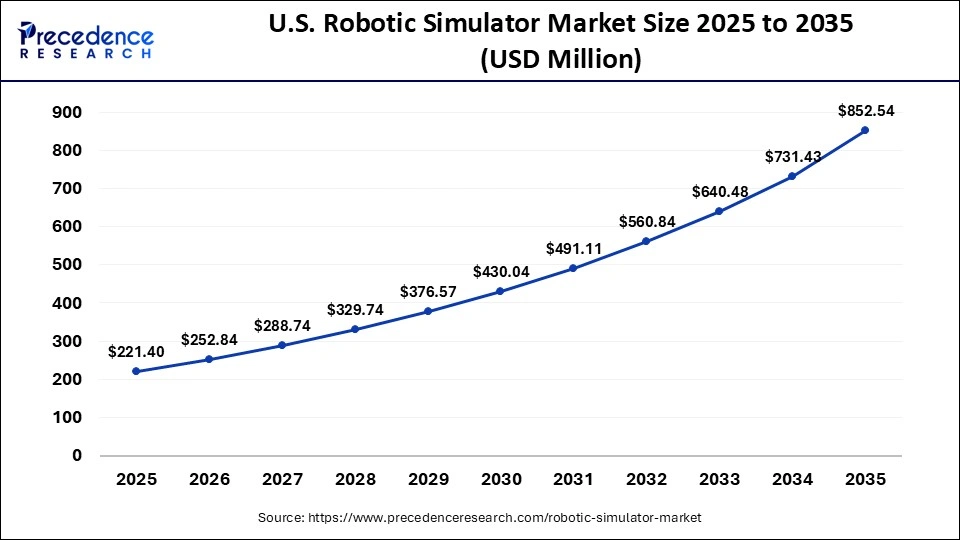
The U.S. robotic simulator market size is calculated at USD 221.40 million in 2025 and is expected to reach nearly USD 852.54 million in 2035, accelerating at a strong CAGR of 14.43% between 2026 and 2035.
U.S. Market Analysis
The U.S. leads the North American market, bolstered by a strong manufacturing foundation and government initiatives that promote artificial intelligence and robotics. The automotive sector is the primary adopter of industrial robot simulation, representing around 33% of all robot installations in the country in 2024. Furthermore, a technologically advanced population and a well-developed infrastructure significantly contribute to market expansion.
Asia Pacific: The Fastest-Growing Region
Asia Pacific held about 24% share of the market in 2025 and is projected to grow at the fastest rate throughout the forecast period. This growth is mainly driven by the rapid industrialization, increasing robotics adoption, supportive government initiatives, and an expanding manufacturing sector. The region's booming e-commerce and healthcare industries are fueling demand for service and surgical robot simulators, while rising investment in smart manufacturing and Industry 4.0 initiatives, alongside heavy spending on automation and robotics, is further accelerating the adoption of robotic simulators.
China Market Analysis
China is leading the Asia Pacific robotic simulator market, supported by government policies that promote technological development and automation. The market growth in the country is further fueled by extensive manufacturing capabilities and strong state-led initiatives encouraging robotics adoption. Companies such as 51WORLD, DeepMirror, and UINO are further advancing robotic simulation technologies, strengthening China's competitive position in the market.
Europe: The Second-Largest Market
Europe was the second-largest shareholder in 2025, holding around 28% share, supported by an established automation industry, strong regulatory backing, and rising adoption of simulation technologies. Increasing automation across industries and stringent regulatory standards are driving demand for high-precision training and testing solutions. Additionally, government initiatives and funding programs promoting Industry 4.0 and robotics education are accelerating the adoption of robotic simulators across the region.
UK Market Analysis
The UK leads the European robotic simulator market, bolstered by its advanced engineering sectors and the swift integration of simulation technologies to improve training and operational efficiency, especially in manufacturing and healthcare. Robust government support, encompassing initiatives and funding programs designed to promote automation and innovation, is further driving market expansion.
Robotic Simulator Market Companies
- ABB Ltd.
- KUKA AG
- FANUC Corporation
- Yaskawa Electric Corporation
- Siemens AG
- Dassault Systèmes
- NVIDIA Corporation
- Rockwell Automation, Inc.
- Universal Robots A/S
- Comau S.p.A.
- Omron Corporation
- Kawasaki Heavy Industries
- MathWorks, Inc.
- Autodesk, Inc.
- Coppelia Robotics AG
Recent Developments
- In March 2026, PTC launched an innovative robotics design-to-simulation workflow that integrates its cloud-native Onshape CAD/PDM platform with the NVIDIA Isaac Sim open simulation framework. Unveiled at NVIDIA GTC 2026, this workflow enables teams to simulate robot designs using a single source of truth, thereby saving time, minimizing errors, expediting development, and facilitating physical AI through subsequent training in NVIDIA Isaac Lab.(Source: https://www.prnewswire.com)
- In March 2026, ABB Robotics announced that it incorporated NVIDIA Omniverse libraries into RobotStudio to provide physical AI for the industry, effectively bridging the gap between virtual training and real-world deployment with accuracy levels reaching up to 99%.(Source: https://www.abb.com)
Segments Covered in the Report
By Component
- Software
- Simulation Software
- Programming & Offline Programming Tools
- Digital Twin Platforms
- Services
- Integration Services
- Consulting Services
- Training & Support Services
By Deployment Mode
- On-Premises
- Enterprise Installed Systems
- Local Simulation Platforms
- Cloud-Based
- SaaS-Based Simulation
- Remote Collaboration Platforms
By Application
- Industrial Robotics
- Assembly Line Simulation
- Welding & Painting Simulation
- Material Handling Simulation
- Medical Robotics
- Surgical Simulation
- Rehabilitation Robotics
- Autonomous Vehicles & Drones
- Autonomous Driving Simulation
- UAV/Drone Simulation
- Research & Education
- Academic Training
- Robotics R&D
By End User
- Manufacturing
- Automotive Manufacturing
- Electronics Manufacturing
- Heavy Machinery
- Healthcare
- Hospitals
- Medical Training Institutes
- Automotive
- OEM
- Tier 1 Suppliers
- Aerospace & Defense
- Military Robotics
- Space Robotics
- Education & Research
- Universities
- Research Institutes
By Region
- North America
- Latin America
- Europe
- Asia-pacific
- Middle and East Africa
For inquiries regarding discounts, bulk purchases, or customization requests, please contact us at sales@precedenceresearch.com
Frequently Asked Questions
Tags





Ask For Sample
No cookie-cutter, only authentic analysis – take the 1st step to become a Precedence Research client
 Get a Sample




 sales@precedenceresearch.com
 Schedule a Meeting
