



Quantum Computing in Healthcare Market Size, Key Companies, Company Technology Portfolio, Quantum Technology Adoption, Drug Discovery Applications, Cloud Deployment Trends, Competitive Landscape, and Growth Forecast
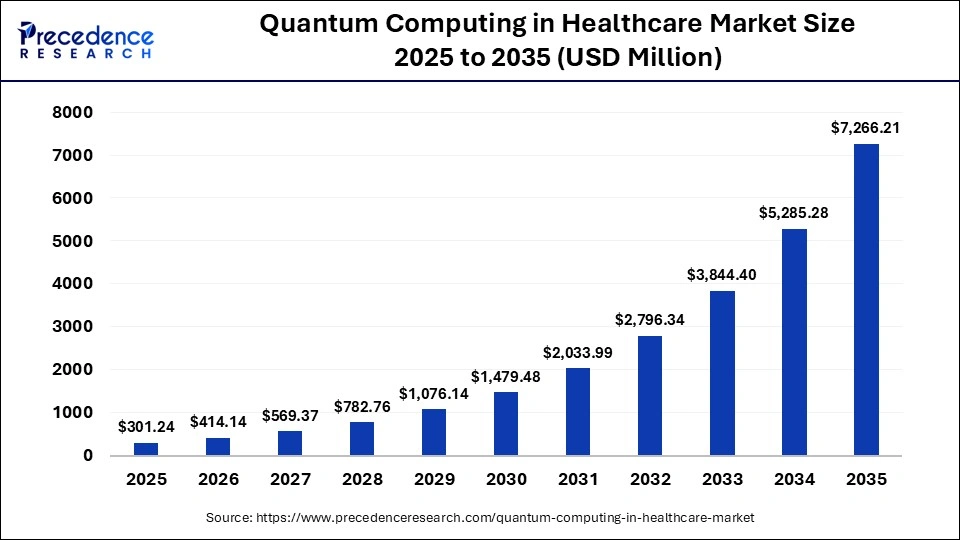
Deepa Pandey, a Healthcare Industry Expert, highlights that the quantum computing in healthcare market has reached USD 414.14 million in 2026 and is on track to reach USD 7,266.21 million by 2035, advancing at a CAGR of 37.48%. Key quantum computing in healthcare market companies shaping the market include IBM, Microsoft, Google, while major growth segments span by component, by technology, by deployment model, by application, by end user.
Source: https://www.precedenceresearch.com/quantum-computing-in-healthcare-market
 Get a Sample
 Table Of Content


What is Quantum Computing in Healthcare Market Size?
The global quantum computing in healthcare market size accounted for USD 301.24 million in 2025 and is predicted to increase from USD 414.14 million in 2026 to approximately USD 7,266.21 million by 2035, expanding at a CAGR of 37.48% from 2026 to 2035. Quantum computing is important for the healthcare market because it allows faster drug discovery and also more accurate diagnostics through improved medical imaging and greatly personalized medicine by determining vast genetic and patient data. Moreover, it promises to accelerate research, enhance patient outcomes, and even create more efficient and resilient healthcare systems.
Market Highlights
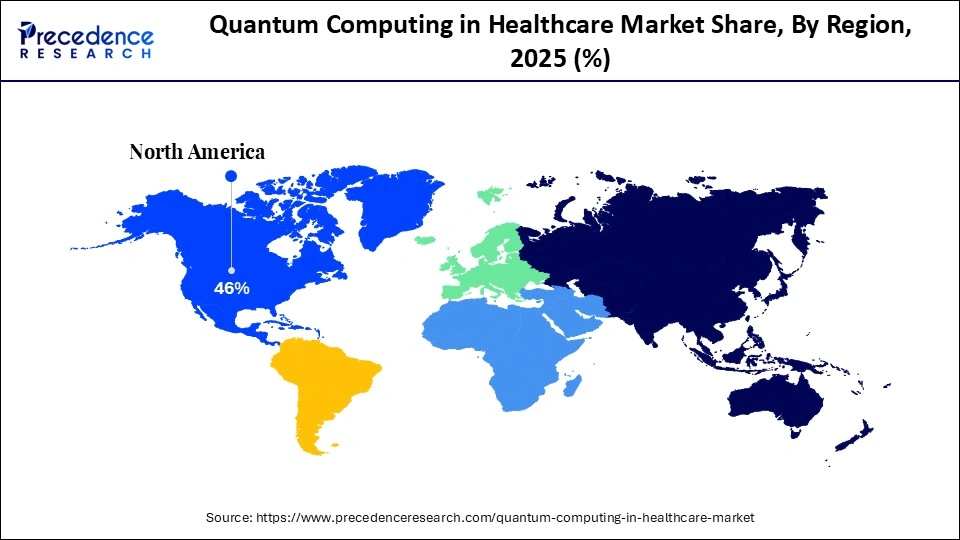
- North America dominated the quantum computing in healthcare market with a share of 46% in the year 2025.
- Asia Pacific is expected to be the fastest growing, with the highest CAGR of 37.9% between 2026 and 2035.
- By component, the software segment held the largest share of 39% in 2025 and is expected to show a 36.2% CAGR during the forecasted period.
- By technology, the superconducting qubits segment contributed more than 34% of the market share in 2025.
- By technology, the photonic/optical quantum computing segment is growing at a remarkable 37.40% CAGR between 2026 and 2035.
- By deployment model, the cloud-based/quantum cloud segment held the major share of 43% in 2025.
- By deployment model, the hybrid deployment segment is poised to grow at a solid CAGR of 35.60% CAGR between 2026 and 2035.
- By application, the drug discovery & development segment captured the biggest market share of 41% in 2025.
- By application, the genomics & precision medicine segment expanding at a double-digit CAGR of 36.80% between 2026 and 2035.
- By end user, the pharmaceutical & biotechnology companies segment generated more than 38% of the market share in 2025.
- By end user, the healthcare IT companies segment grows at a remarkable 35.90% CAGR between 2026 and 2035.
What is the Quantum Computing in Healthcare?
Quantum computing in healthcare is generally the application of quantum mechanics to understand and solve complex medical problems, with the aim of revolutionizing drug discovery and personalized medicine, along with diagnostics. It utilizes the principles of superposition and entanglement to determine vast amounts of information, simulate molecular interactions, and improve treatment plans in ways that are impossible for traditional computers. By determining an individual's unique genetic profile and health data, quantum algorithms can assist in creating highly tailored treatment plans and forecast a patient's response to various therapies.
Beyond personalized treatment design, quantum computing supports advanced molecular modeling by simulating protein folding, drug-target interactions, and biochemical pathways with higher accuracy. This capability can significantly shorten early-stage drug discovery timelines and reduce dependency on costly trial-and-error experimentation. In diagnostics, quantum-enhanced data analysis can improve pattern recognition across large imaging and genomic datasets. Quantum optimization techniques are also being explored to improve clinical trial design and patient stratification. Over time, these applications are expected to complement classical computing systems rather than fully replace them.
Quantum Computing in Healthcare Market Outlook
- Industry Growth Overview: The quantum computing in healthcare market is witnessing early but accelerating growth as healthcare systems, pharmaceutical companies, and research institutions seek to solve computational problems beyond the limits of classical computing. Growth is driven by the need to process complex biological data, accelerate drug discovery, optimize molecular simulations, and improve precision medicine workflows. Quantum algorithms are increasingly explored for protein folding, genomic analysis, and large-scale clinical data modeling, where exponential variable interactions challenge traditional systems. Advances in quantum hardware stability, hybrid quantum-classical architectures, and cloud-based access models are improving practical experimentation and early-stage deployment. As a result, pilot use cases are expanding across drug development, diagnostics, and healthcare analytics.
- Sustainability Trends: Sustainability considerations are emerging as an indirect but important factor in quantum computing adoption within healthcare. Quantum-enabled optimization can reduce the time, cost, and resource intensity of drug discovery and clinical trial simulations, lowering material waste and energy consumption associated with traditional trial-and-error research. Healthcare organizations are also evaluating quantum-assisted modeling to optimize hospital operations, supply chains, and treatment pathways, contributing to more efficient resource utilization. As data centers face increasing scrutiny over energy use, interest is growing in quantum-classical hybrid systems that deliver higher computational efficiency per problem solved.
- Global Expansion: Global expansion of quantum computing in healthcare is being led by regions with strong research ecosystems and public funding support. North America and Europe remain primary centers due to established life sciences industries, advanced computing infrastructure, and strong university–industry collaboration. Asia-Pacific is rapidly emerging, supported by national quantum initiatives, growing biopharmaceutical manufacturing capacity, and investments in digital health infrastructure. Governments and academic institutions are facilitating cross-border research collaborations, while cloud-based quantum platforms are lowering geographic barriers to experimentation in emerging markets.
- Major Investors: Major investors in quantum computing for healthcare include strategic technology companies, pharmaceutical firms, sovereign innovation funds, and public research agencies. Investment activity is focused on quantum hardware development, quantum software platforms, and healthcare-specific algorithms for chemistry, genomics, and optimization. Large pharmaceutical companies are forming long-term partnerships with quantum technology providers to gain early access to capabilities that can shorten drug development timelines. Public funding programs are also playing a central role in de-risking early-stage research and supporting translational projects.
- Startup Ecosystem: The quantum computing healthcare ecosystem is supported by a growing number of startups focused on quantum algorithms, simulation software, and healthcare-focused applications. Emerging companies are developing quantum-enhanced tools for drug target identification, molecular docking, medical imaging optimization, and clinical trial design. Startups often operate within hybrid environments, combining quantum experimentation with classical high-performance computing to deliver near-term value. Venture capital interest is supporting pilot deployments, proof-of-concept studies, and integration with existing healthcare data systems.
Key Technological Shift in the Quantum Computing in Healthcare Market
The key technological shift in the quantum computing healthcare market is the advancement of hybrid quantum-classical computing models along with quantum-improved machine learning (QML), which are necessary for paving the way for practical applications in drug discovery, personalized medicine, and diagnostics. While fully fault-tolerant universal quantum computers remain a long-term goal, this hybrid approach permits the healthcare industry to start leveraging quantum abilities today. It can dramatically enhance the resolution and accuracy of medical imaging technologies such as MRIs. These algorithms can determine patterns in complex images that classical systems would typically miss, contributing to earlier and more accurate diagnoses of conditions such as cancer.
Artificial intelligence plays a central role in enabling this shift by acting as the orchestration layer between classical and quantum systems. AI-driven models are used to pre-process large clinical datasets, optimize quantum circuits, and interpret quantum-generated outputs in clinically meaningful ways. In drug discovery, AI combined with quantum simulations accelerates candidate screening by narrowing chemical search spaces before quantum execution. AI also improves error mitigation, model training efficiency, and result validation, making near-term quantum healthcare applications more reliable and scalable.
Quantum Computing in Healthcare Market Key Trends
Advances in personalized medicine and genomics
Quantum computers can operate massive, complex datasets to determine disease risks, speed up drug discovery, and improve treatments for individual patients. This capability is vital for precision medicine, which determines genetic and other information to create tailored healthcare solutions that are faster and even more effective than conventional methods. Quantum algorithms can understand huge amounts of genetic data, like entire genomes, in a fraction of the time it takes with the latest technology, leading to quicker and more accurate insights into disease-associated genetic markers.
Market Scope
| Report Coverage | Details |
| Market Size in 2025 | USD 301.24 Million |
| Market Size in 2026 | USD 414.14 Million |
| Market Size by 2035 | USD 7,266.21 Million |
| Market Growth Rate from 2026 to 2035 | CAGR of 37.48% |
| Dominating Region | North America |
| Fastest Growing Region | Asia Pacific |
| Base Year | 2025 |
| Forecast Period | 2026 to 2035 |
| Segments Covered | Component, Technology, Deployment Model, Application, End User, and region |
| Regions Covered | North America, Europe, Asia-Pacific, Latin America, and Middle East & Africa |
Segments Insights
Component Insights
How is Software Dominating the Quantum Computing in Healthcare Market?
The software segment dominated the market for quantum computing-based healthcare with a 39% share during 2025, by allowing faster drug discovery and even personalized medicine through its ability to manage complex calculations and by also accelerating genomic sequencing together with medical image analysis. Software can determine patient genomes much quicker than classical methods, allowing a deeper understanding of disorders and the advancement of personalized treatments. Quantum algorithms can improve treatment plans based on a person's genetic makeup, increasing treatment efficacy and decreasing side effects.
The services segment is set to be the fastest-growing in the quantum computing in healthcare market with a 36.2% CAGR, as there is a high need for specialized expertise to assist healthcare institutions in adopting and even applying quantum technology. These services involve implementation, training, system integration, and consulting, which are important for bridging the gap between quantum providers and also healthcare users to guarantee smooth deployment and alignment with clinical needs. Services are required to integrate quantum solutions with pre-existing healthcare workflows, like cloud and IoT platforms, which are increasingly utilized in healthcare.
Technology Insights
How is Superconducting Qubits Leading the Quantum Computing in Healthcare Market?
The superconducting Qubits segment led the market with a 34% share in 2025 by providing superior performance and speed, as well as scalability for complex simulations and even data analysis. This allows healthcare professionals to provide customized treatment plans based on a person's unique genetic profile, contributing to more effective and precise therapies. Meanwhile, for cancer treatment, superconducting qubits can run many simulations concurrently to analyze the most effective radiation strategy. This improves dosage to kill cancerous cells while reducing damage to healthy tissue.
The photonic/optical quantum computing segment is expected to be the fastest-growing in the quantum computing in healthcare market with a CAGR of 37.4%, as its scalability and lower power consumption, along with its ability to function at room temperature, eliminate the demand for complex and expensive cooling systems needed by other quantum technologies such as superconducting qubits. Photonic quantum computers are usually more scaled up than a few other types, as they don't need the cryogenic cooling systems required for superconducting qubits. This makes them a potentially more cost-effective solution in the long term.
Deployment Model Insights
How is Cloud-Based / Quantum Cloud Leading the Quantum Computing in Healthcare Industry?
The cloud-based/quantum cloud segment led the quantum computing in healthcare industry, accounting for a 43% share in 2025, since platforms provide scalable computing power, enabling healthcare organizations to manage varying computational demands for complex problems without deeply indulging in their own quantum hardware. Thus, it makes advanced quantum tools accessible to a broader range of researchers and even institutions. Quantum cloud services eliminate the demand for costly, eventually in-house quantum hardware, making the technology more affordable as well as reducing the expense of research and development.
The hybrid deployment segment is the fastest-growing in the quantum computing in healthcare market, with an expected 35.6% CAGR. Hybrid deployment enables a gradual shift, allowing healthcare organizations to enhance and add to preexisting analytics without replacing them entirely. Thus, the public cloud element of a hybrid model offers the scalability needed to manage complex, data-intensive healthcare tasks, like analyzing massive genomic datasets. Hybrid architectures support secure on-premise handling of sensitive patient data while offloading quantum workloads to cloud-based quantum processors. This approach improves regulatory compliance and data governance without limiting computational experimentation.
Application Insights
How is Drug Discovery & Development Leading the Quantum Computing in Healthcare Market?
The drug discovery & development segment dominated the market with a 41% share in 2025. Quantum computers can simulate molecular interactions, like protein-ligand binding, usually faster than classical computers, potentially minimizing discovery timelines from years to days. Beyond initial screening, this computing can improve drug formulation, forecast crystallization processes, and enhance the integrity of biologics during manufacturing. These capabilities support more precise candidate selection and reduce late-stage development risk. They also enable better process optimization for complex biologics, improving yield consistency and manufacturing efficiency.
The genomics & precision medicine segment is the fastest-growing in the quantum computing in healthcare market with a 36.8% expected CAGR, as the explosion of genomic as well as multi-omics data from sequencing is mostly overwhelming classical computers. Quantum computers can manage this complexity, making them vital for deciphering the intricate patterns in this data. The advancement of new drugs demands simulating and determining the interactions of countless molecules. Thus, quantum computing can accelerate this process, which is a major driver for the expansion in the genomics and precision medicine segment.
End User Insights
How Are Pharmaceutical & Biotechnology Companies Leading the Quantum Computing in Healthcare Market?
The pharmacuetical & biotechnology companies dominated the market with a 38% share in 2025. Quantum computers can highly simulate how molecules interact with greater accuracy as well as speed than conventional computers, which is vital for identifying promising drug candidates. The technology assists in identifying specific mutations, for instance, in oncology, to guide the advancement of highly targeted therapies. Consequently, major pharma firms are forming collaborations with quantum computing leaders such as IBM and Google to generate practical applications. Pharmaceutical and biotech companies are making remarkable investments in quantum startups to obtain early access to technology and talent.
The healthcare IT companies' segment is set to be the fastest-growing in the quantum computing in healthcare market with a CAGR of 35.9%, as it allows personalized medicine, faster drug discovery, and even complex data determination by integrating quantum computing with pre-existing healthcare infrastructure and offering accessible platforms. This integration is boosted by significant investments in quantum technology, the demand to solve complex biological problems, and the rising demand for efficient solutions in diagnostics, pharmaceuticals, and genomics.
Regional Insights
How Big is the North America Quantum Computing in Healthcare Market Size?
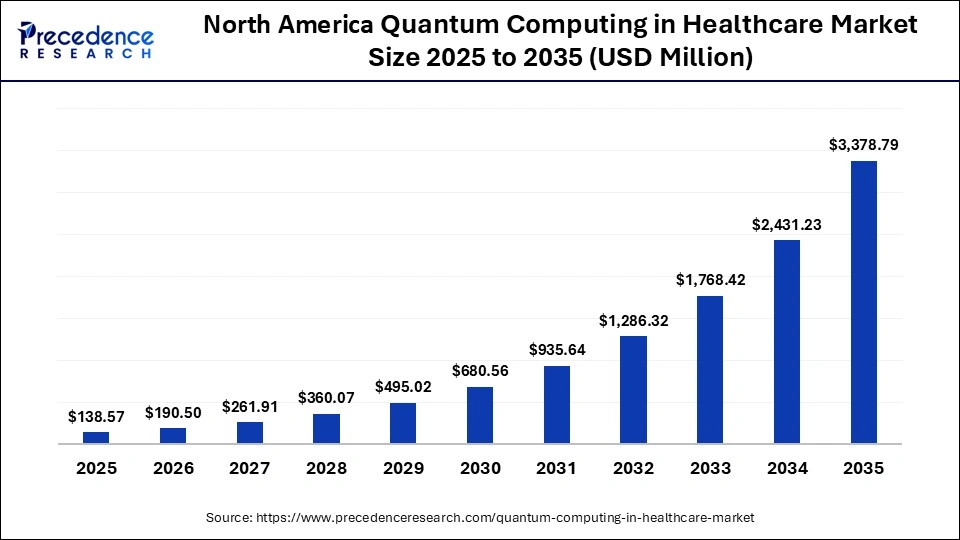
The North America quantum computing in healthcare market size is estimated at USD 138.57 million in 2025 and is projected to reach approximately USD 3,378.79 million by 2035, with a 37.63% CAGR from 2026 to 2035.
Why Is North America Leading in the Quantum Computing in Healthcare Market?
North America led the quantum computing in healthcare market with a 46% share in 2025, due to strong and sustained government as well as private funding, mature research and development ecosystems, and deep collaboration between industry and academia. The region benefits from advanced high-performance and cloud computing infrastructure and a strong focus on precision medicine, which drives early adoption of quantum approaches in drug discovery, genomics, and complex healthcare data analysis. The presence of leading technology firms, pharmaceutical companies, and research universities accelerates progress across quantum hardware, software platforms, and hybrid cloud deployment models. In addition, early pilot programs and federally supported quantum initiatives are enabling faster translation of research into healthcare use cases.
Strong regulatory and data governance frameworks support secure experimentation with sensitive clinical and genomic data. Concentration of large academic medical centers enables real-world validation through pilot studies and clinical research collaborations. These conditions collectively shorten innovation cycles and reinforce North America's leadership in early-stage healthcare deployment of quantum technologies.
What is U.S. Quantum Computing in Healthcare Market?
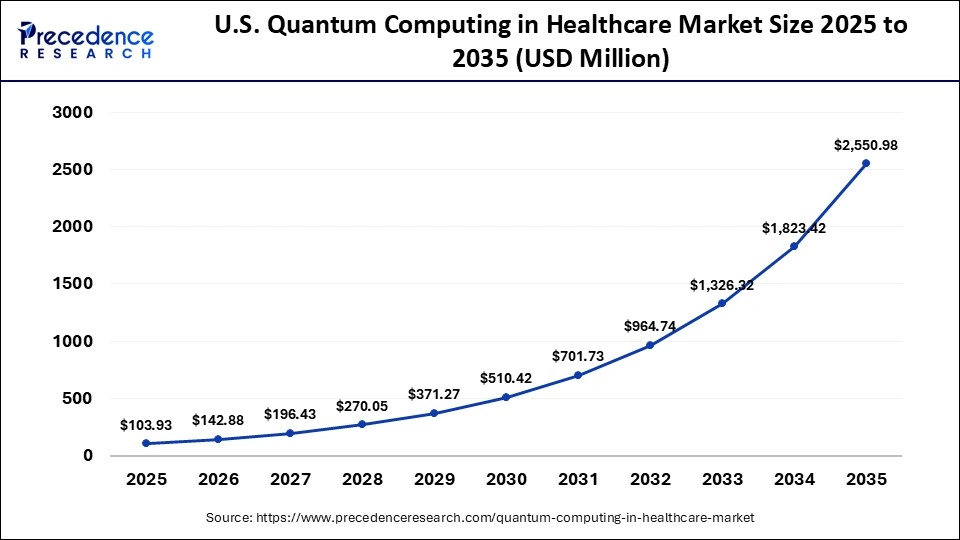
The U.S. quantum computing in healthcare market size is exhibited at USD 103.93 million in 2025 and is projected to be worth around USD 2,550.98 million by 2035, growing at a CAGR of 37.72% from 2026 to 2035.
U.S. Quantum Computing in Healthcare Market Trends
The United States quantum computing in healthcare market is advancing through early-stage pilots focused on drug discovery, genomics, and complex clinical data analysis. Strong federal funding and public-private research programs are supporting experimentation with hybrid quantum-classical models. Pharmaceutical companies and academic medical centers are collaborating to evaluate quantum-enhanced molecular simulation and optimization workflows. Cloud-based access to quantum platforms is lowering entry barriers for healthcare research organizations. These trends are accelerating practical validation while preparing the ecosystem for longer-term clinical adoption.
Why Asia Pacific Leaps from Manufacturing Hub to Quantum Computing in Healthcare Market?
Asia Pacific is set to be the fastest-growing region in the market for quantum computing in healthcare with a 37.9% CAGR, with a transition driven by strategic public investment, a deepening pool of highly skilled technical talent, and clear government policy alignment toward advanced digital technologies. The shift is supported by both push factors away from low-margin manufacturing and pull factors attracting capital into high-value computing and life sciences innovation. Governments across the region, including those in Japan, China, India, and Singapore, are actively funding quantum research and national healthcare digitization strategies. This support includes the development of dedicated research hubs and structured public–private partnerships. Together, these efforts are accelerating the region's role in quantum-enabled healthcare research and early clinical experimentation.
Strong semiconductor manufacturing capabilities and cloud infrastructure are supporting early access to quantum hardware through hybrid platforms. Regional collaboration between universities, hospitals, and technology firms is enabling applied research in drug discovery and genomics. These factors are helping Asia Pacific move beyond experimentation toward scalable healthcare use cases.
China Quantum Computing in Healthcare Market Trends
The China quantum computing in healthcare market is progressing through state-backed research programs focused on drug discovery, genomics, and large-scale biomedical data analysis. National laboratories and leading universities are integrating quantum algorithms with AI to improve molecular simulation and protein structure prediction. Public funding is supporting hybrid quantum-classical platforms that allow healthcare researchers to access quantum capabilities via domestic cloud infrastructure. Pharmaceutical companies are collaborating with research institutes to test quantum-assisted optimization in early-stage drug screening. These efforts are positioning China for scalable, research-driven adoption as quantum hardware matures.
Why is Europe Growing Significantly in the Quantum Computing in Healthcare Market?
Europe's growth is driven by a strong foundation in quantum science, substantial public funding, and structured collaboration between research institutions, technology firms, and pharmaceutical companies. Coordinated investment from national governments and the European Union has accelerated applied quantum research with direct relevance to healthcare, including drug discovery, genomics, and clinical data modeling. For example, Germany has committed large-scale public funding through its federal research programs to advance quantum computing infrastructure and applications. These investments have translated into multiple national quantum initiatives and a growing pipeline of healthcare-focused quantum startups.
In parallel, Europe benefits from a high concentration of quantum scientists and interdisciplinary research centers linking physics, life sciences, and medical informatics. Pharmaceutical companies are partnering with academic labs to explore quantum-assisted molecular simulation and optimization. Strong data protection and ethical research frameworks support secure experimentation with sensitive health data. Cross-border collaboration programs further enable knowledge sharing and scalable pilot projects across the region.
Germany Quantum Computing in Healthcare Market Trends
In Germany, quantum computing adoption in healthcare is advancing through strong federal research funding and close integration between academic institutions, hospitals, and technology providers. National quantum programs are supporting applied research in drug discovery, molecular simulation, and genomics optimization. University hospitals and research centers are piloting hybrid quantum-classical models to handle complex biomedical datasets. Collaboration with pharmaceutical and life sciences companies is accelerating translational research use cases. These factors are positioning Germany as a central European hub for quantum-enabled healthcare innovation.
Why is the Middle East and Africa Emerging in the Market for Quantum Computing in Healthcare?
The Middle East and Africa region is emerging due to rising government investment in advanced digital infrastructure, healthcare modernization, and scientific research capacity. Countries such as the United Arab Emirates and Saudi Arabia are integrating quantum computing into national digital health and innovation strategies to support precision medicine and biomedical research. Expansion of genomic programs and population health initiatives is increasing demand for high-performance computing tools capable of handling complex datasets.
Strategic partnerships with global technology providers and research institutions are enabling early access to quantum platforms through cloud-based models. In parallel, Africa is strengthening research capabilities through regional innovation hubs and international collaborations. Together, these developments are laying the groundwork for gradual adoption of quantum computing in healthcare research and analytics.
UAE Quantum Computing in Healthcare Industry Trends
The United Arab Emirates is advancing quantum computing in healthcare through strong government-led digital health and innovation strategies. National initiatives focused on genomics, precision medicine, and population health analytics are creating demand for advanced computational capabilities. Partnerships with global technology firms are enabling access to hybrid quantum-classical platforms via cloud infrastructure. Leading hospitals and research centers are exploring quantum-assisted drug discovery and complex data modeling. These trends position the UAE as an early regional adopter of quantum-enabled healthcare research.
Quantum Computing in Healthcare Market Value Chain Analysis
Research and Development
- Research and development form the foundation of quantum computing in healthcare, centered on algorithm design, quantum chemistry models, and biomedical data processing techniques. R&D efforts focus on translating theoretical quantum advantages into practical healthcare use cases.
- Key Players: IBM, Google Quantum AI, Microsoft
Quantum Hardware and Infrastructure
- This stage involves the development of quantum processors, cryogenic systems, control electronics, and secure cloud access environments required to run healthcare-relevant quantum workloads.
- Key Players: IBM, Rigetti Computing, IonQ
Software Platforms and Algorithm Integration
- Quantum software platforms integrate healthcare datasets, classical preprocessing, and quantum execution layers. Emphasis is placed on hybrid workflows that allow healthcare researchers to test quantum advantages without full hardware dependency.
- Key Players: Microsoft, Zapata Computing, QC Ware
Healthcare Deployment and Partnerships
- Healthcare deployment occurs through collaborations with pharmaceutical companies, hospitals, research institutes, and contract research organizations. These partnerships focus on pilot studies, validation, and gradual scaling into production research workflows.
- Key Players: IBM, Roche, Pfizer
Who are the Major Players in the Global Quantum Computing in Healthcare Market?
- IBM
- Microsoft
- Amazon Web Services (AWS)
- IonQ, Rigetti Computing
- D-Wave Systems
- Quantinuum
Recent Developments
- In October 2025, UNESCO, in collaboration with Cleveland Clinic, called for researchers to apply for remote access to a computing program on transforming scientific ideas in healthcare and life sciences into quantum use cases. Under the framework of UNESCO's Remote Access to Lab Equipment (UNESRALE) Initiative and the International Year of Quantum Science and Technology, the program aims to train researchers in quantum computing through online learning resources and access to quantum hardware to test problem sets, with a focus on utilizing quantum computing in research-specific projects. (Source: https://www.unesco.org)
- In February 2025, Microsoft launched Majorana, the world's first quantum chip powered by a new Topological Core architecture that it anticipates will realize quantum computers capable of solving meaningful, even industrial-scale problems in years, not decades. (Source: https://news.microsoft.com)
Segment Covered in the Report
By Component
- Hardware
- Superconducting Qubits
- Trapped Ions
- Quantum Annealers
- Photonic Quantum Systems
- Other Quantum Hardware Technologies
- Software
- Quantum Programming Platforms
- Simulation & Modeling Software
- AI & Machine Learning Integration Tools
- Quantum Encryption and Data Security Tools
- Services
- Consulting & Advisory Services
- Quantum Computing-as-a-Service (QCaaS)
- Training & Support
- Custom Algorithm Development
By Technology
- Quantum Annealing
- Superconducting Qubits
- Trapped Ions
- Quantum Dots
- Photonic / Optical Quantum Computing
- Others (Topological, Neutral Atoms, etc.)
By Deployment Model
- On-Premise
- Cloud-Based / Quantum Cloud
- Hybrid Deployment
By Application
- Drug Discovery & Development
- Molecular Simulation & Modeling
- Target Identification & Validation
- Quantum Chemistry for Compound Optimization
- Genomics & Precision Medicine
- Genomic Data Analysis
- Gene Sequencing Acceleration
- Personalized Treatment Prediction
- Medical Imaging & Diagnostics
- Image Reconstruction & Enhancement
- Pattern Recognition in Radiology & Pathology
- Quantum-AI Image Analytics
- Healthcare Operations Optimization
- Scheduling & Resource Allocation
- Clinical Workflow Optimization
- Supply Chain & Logistics Management
- Epidemiology & Public Health
- Disease Modeling & Outbreak Prediction
- Population Health Analytics
- Data Security & Encryption
- Quantum Cryptography
- Secure Data Sharing in Healthcare Ecosystems
By End User
- Pharmaceutical & Biotechnology Companies
- Healthcare Providers
- Research & Academic Institutions
- Government & Public Health Agencies
- Healthcare IT Companies
By Region
- North America
- Europe
- Asia-Pacific
- Latin America
- Middle East & Africa
For inquiries regarding discounts, bulk purchases, or customization requests, please contact us at sales@precedenceresearch.com
Frequently Asked Questions





Ask For Sample
No cookie-cutter, only authentic analysis – take the 1st step to become a Precedence Research client
 Get a Sample
.webp)



 sales@precedenceresearch.com
 Schedule a Meeting
