



Trailer Telematics Market Size, Companies, Share, Vehicle Production Volume, Sales Performance, Export & Import Analysis, Technology Adoption, Competitive Positioning, and Demand Trends
Trailer Telematics Market (By Trailer Type: Dry Van Trailers, Refrigerated Trailers, Flatbed, Tankers; By Communication Technology: GPS Tracking, Cellular Connectivity, Satellite & Others – smaller; By Component: Hardware, Software, Services–smaller; By Application: Fleet Management, Predictive Maintenance, Cold Chain Monitoring, Asset Tracking & Others; By Deployment/Distribution Channel: Aftermarket, OEM Integrated; By End User: Logistics & Transportation, Retail & Distribution, Construction & Others) - Global Industry Analysis, Size, Trends, Leading Companies, Regional Outlook, and Forecast 2026 to 2035
Source: https://www.precedenceresearch.com/trailer-telematics-market
 Get a Sample
 Table Of Content


What is the Trailer Telematics Market Size in 2026?
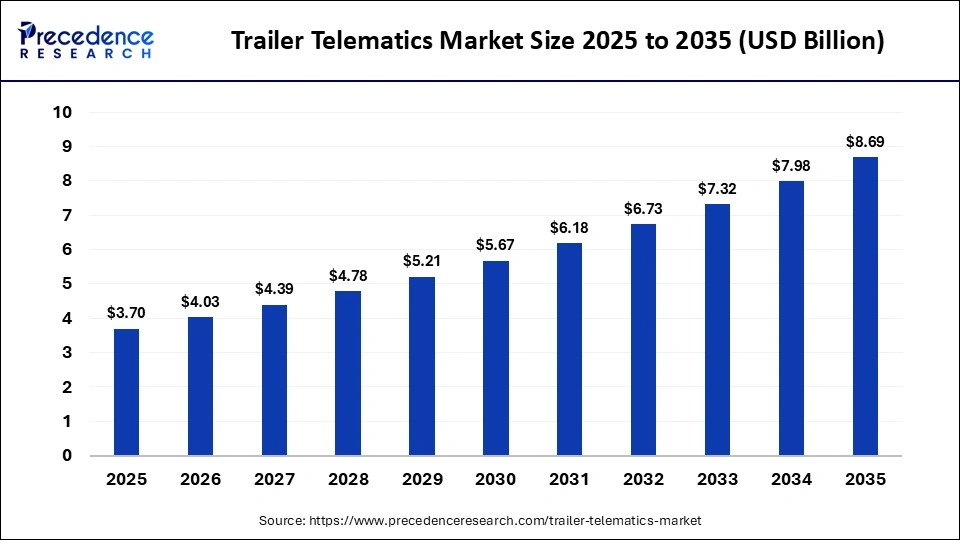
The global trailer telematics market size was calculated at USD 3.70 billion in 2025 and is predicted to increase from USD 4.03 billion in 2026 to approximately USD 8.69 billion by 2035, expanding at a CAGR of 8.90% from 2026 to 2035. The market focuses on systems that use GPS, sensors, and connectivity to provide real-time tracking, cargo condition monitoring, predictive maintenance insights, and fleet optimization for logistics, transportation, and supply chain operations. Demand is driven by the need for enhanced visibility, safety, regulatory compliance, operational efficiency, and cost savings in fleet management across global markets.
Key Takeaways
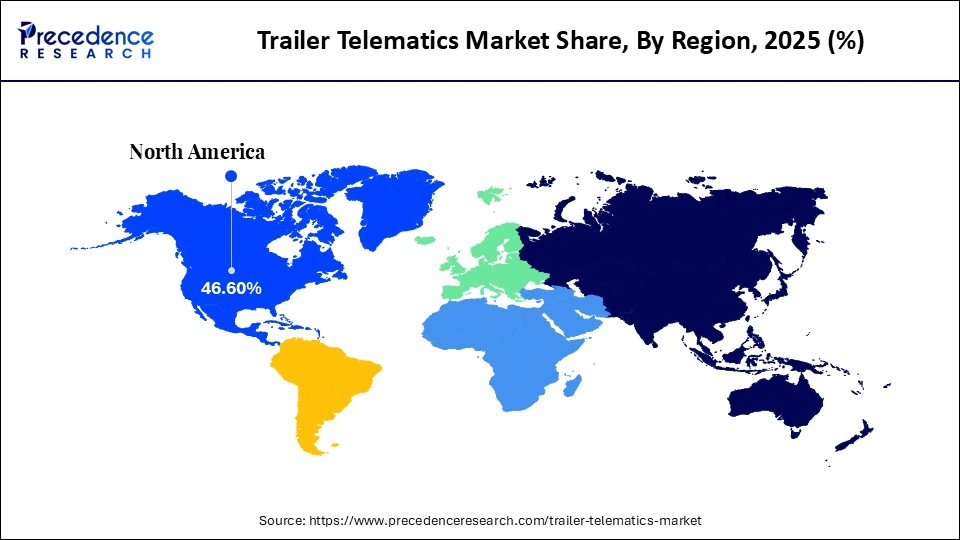
- North America led the trailer telematics market with a share of approximately 46.6% in the global market in 2025.
- Asia-Pacific is estimated to expand at the highest CAGR of approximately 9.5% in the market between 2026 and 2035.
- By trailer type, the dry van trailers segment held a dominant revenue share of approximately 41.5% in the market in 2025.
- By trailer type, the refrigerated trailers segment is expected to grow with the highest CAGR of approximately 8.0% between 2026 and 2035.
- By communication technology, the GPS tracking segment led the market with a share of approximately 55.7% in 2025.
- By communication technology, the cellular connectivity segment is expected to expand at the fastest CAGR of approximately 8.3% from 2026 to 2035.
- By component, the hardware segment held the largest trailer telematics market share of approximately 63.8% in 2025.
- By component, the software segment is projected to grow rapidly with a CAGR of approximately 8.2% between 2026 and 2035.
- By application, the fleet management segment contributed the biggest market share of approximately 47.6% in the market in 2025.
- By application, the predictive maintenance segment is expected to show the fastest growth with a CAGR of approximately 7.8% between 2026 and 2035.
Why is the Trailer Telematics Market Gaining Strategic Importance?
Trailer telematics refers to connected systems that use GPS, sensors, and wireless communication to monitor trailer location, cargo condition, utilization, and maintenance in real time. The market is gaining strategic importance due to rising e-commerce demand, the need for supply chain visibility, regulatory compliance requirements, asset optimization, theft prevention, and data-driven fleet management strategies across transportation and logistics industries.
How is AI Reshaping the Global Trailer Telematics Industry?
AI is reshaping the trailer telematics market by enabling advanced data analysis that turns raw sensor information into predictive insights for maintenance, routing, and utilization optimization. Machine learning algorithms improve anomaly detection, forecast equipment failures before they occur, and enhance decision-making through pattern recognition. AI-powered platforms support dynamic route planning, automated alerts, and intelligent load balancing, ultimately driving greater operational efficiency, reduced downtime, better asset utilization, and improved safety across logistics and fleet management operations worldwide.
Primary Trends Influencing the Trailer Telematics Market
- Real-Time Visibility and Supply Chain Transparency: Shippers and carriers increasingly demand real-time tracking of trailers and freight to mitigate delays, reduce uncertainty, and improve coordination across distribution networks. Trailer telematics provides precise location and status data, enabling proactive decision-making and improved customer service in complex supply chains.
- Predictive Maintenance and Asset Reliability: Advanced sensors and analytics within telematics systems help predict equipment failures before they occur by monitoring tire pressure, brakes, temperature, and other critical components. This trend reduces unplanned downtime, cuts repair costs, and extends trailer life, making fleets more reliable and operationally efficient.
- Integration of IoT and Connected Technologies: The proliferation of Internet of Things (IoT) devices, cloud computing, and machine-to-machine communication enables seamless data flow from trailers to centralized platforms. This connectivity supports automated alerts, advanced diagnostics, and AI-driven insights that optimize routing, safety, and utilization across fleets.
- Enhanced Cargo Security and Theft Prevention: Cargo theft and unauthorized trailer movement remain significant challenges for logistics operators. Telematics systems equipped with door sensors, geofencing, and remote immobilization provide greater security, allowing immediate alerts if a trailer deviates from approved routes or if unauthorized access occurs.
- Regulatory Compliance and Electronic Logging: Stringent regulations around hours of service, emissions, and electronic logging require detailed documentation of fleet operations. Trailer telematics supports compliance by capturing accurate data on movements, load conditions, and operational metrics, simplifying reporting and reducing administrative burdens for carriers.
- Sustainability and Fuel Efficiency Initiatives: Organizations are prioritizing sustainability by reducing idle time, optimizing routes, and improving load planning. Telematics insights help fleets minimize fuel consumption and emissions by identifying inefficiencies, contributing to corporate ESG goals, and lowering operational costs across transportation networks.
Market Scope
| Report Coverage | Details |
| Market Size in 2025 | USD 3.70 Billion |
| Market Size in 2026 | USD 4.03 Billion |
| Market Size by 2035 | USD 8.69 Billion |
| Market Growth Rate from 2026 to 2035 | CAGR of 8.90% |
| Dominating Region | North America |
| Fastest Growing Region | Asia Pacific |
| Base Year | 2025 |
| Forecast Period | 2026 to 2035 |
| Segments Covered | Trailer Type, Communication Technology, Component, Application, Deployment/Distribution Channel, End User, and region |
| Regions Covered | North America, Europe, Asia-Pacific, Latin America, and Middle East & Africa |
Segmental Insights
Trailer Type Insights
Which Trailer Type Segment Dominated the Trailer Telematics Market?
The dry van trailers segment dominated the market with a share of approximately 41.5% in 2025 because these trailers are widely used across general freight transport, making visibility and utilization data highly valuable. Their high fleet penetration drives strong demand for tracking, cargo condition monitoring, and security. Additionally, dry vans benefit from telematics-enabled preventive maintenance and route optimization, helping fleets reduce costs, improve delivery reliability, and enhance overall operational efficiency in diverse logistics applications.
The refrigerated trailers segment is expected to show the fastest growth with a CAGR of 8.0% over the forecast period, due to rising demand for perishable food, pharmaceuticals, and temperature-sensitive products. Real-time temperature monitoring, route tracking, and automated alerts help prevent spoilage and ensure regulatory compliance. Additionally, the growing adoption of IoT-enabled sensors and cloud-based fleet platforms enhances supply chain visibility, reduces operational losses, and improves delivery reliability across cold chain logistics networks.
Communication Technology Insights
Why Did the GPS Tracking Segment Dominate the Trailer Telematics Market?
The GPS tracking segment held a dominant market share of approximately 55.7% in 2025 because it serves as the foundational technology for real-time trailer location monitoring, route optimization, and asset utilization management. Fleet operators rely on GPS data to reduce idle time, prevent theft, improve dispatch efficiency, and enhance delivery accuracy. Its cost-effectiveness, ease of integration, and widespread adoption across logistics networks make it the most essential and widely implemented telematics solution.
The cellular connectivity segment is expected to gain the highest market share with a CAGR of 8.3% between 2026 and 2035, due to expanding 4G and 5G infrastructure and increasing demand for real-time data transmission. It enables continuous trailer tracking, remote diagnostics, over-the-air software updates, and instant alerts for fleet operators. Its cost-effectiveness, scalability, and seamless integration with cloud-based platforms enhance operational visibility, improve decision-making, and support efficient fleet and supply chain management across regions.
Component Insights
What Made the Hardware Segment Dominant in the Trailer Telematics Market?
The hardware segment registered its dominance over the global market with a share of 63.8% in 2025 because physical devices such as GPS units, sensors, telematics control units, and communication modules are essential for capturing and transmitting real-time data. Without these onboard components, location tracking, cargo condition monitoring, and connectivity functions cannot operate. High adoption of rugged, reliable hardware across commercial fleets and continuous upgrades to support advanced features contribute to its leading position in the market.
The software segment is expected to expand rapidly in the market with a CAGR of 8.2% in the coming years, due to increasing adoption of cloud-based fleet management platforms, advanced data analytics, and AI-driven insights. Software solutions enable real-time monitoring, predictive maintenance, automated compliance reporting, and seamless system integration. The shift toward subscription-based models and digital transformation across logistics operations further accelerates demand for scalable and intelligent telematics software platforms.
Application Insights
Which Application Segment Led the Trailer Telematics Market?
The fleet management segment led the market with a share of approximately 47.6% in 2025 because it provides comprehensive visibility and control over entire trailer operations, including tracking, diagnostics, maintenance scheduling, and driver performance. Fleet operators prioritize integrated systems that consolidate data for decision-making, cost reduction, and efficiency improvements. The demand for centralized platforms that enhance asset utilization, optimize routing, and improve safety drives strong adoption of fleet management solutions across logistics and transportation networks.
The predictive maintenance segment is expected to witness the fastest growth in the market with a CAGR of 7.8% over the forecast period because it helps fleets foresee equipment failures before they occur, reducing downtime and costly repairs. By analyzing sensor data and performance trends, predictive systems optimize maintenance schedules and extend asset life. This proactive approach improves operational reliability, lowers total maintenance costs, and enhances fleet efficiency, making it increasingly attractive for logistics operators seeking data-driven performance improvements.
Regional Insights
North America Trailer Telematics Market Size and Growth 2026 to 2035
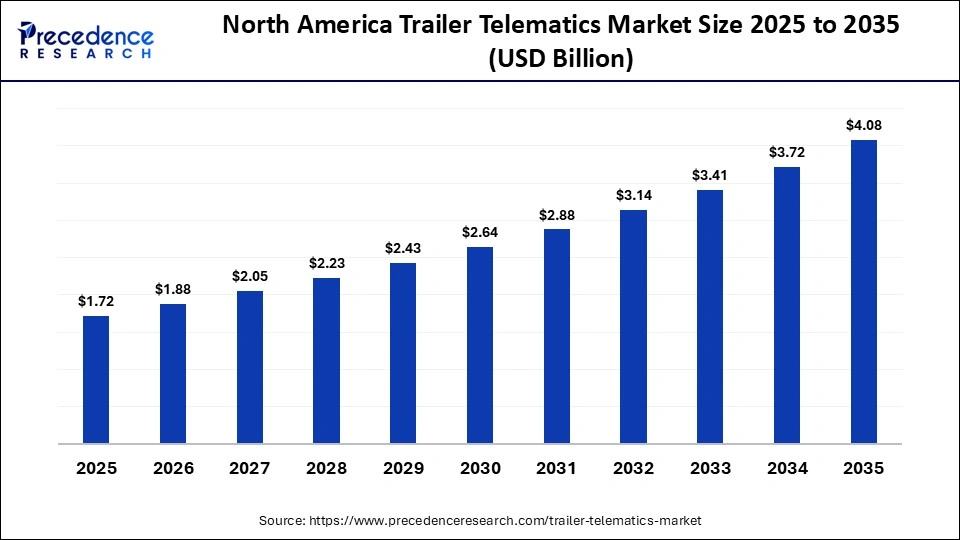
The North America trailer telematics market size is estimated at USD 1.72 billion in 2025 and is projected to reach approximately USD 4.08 billion by 2035, with a 9.02% CAGR from 2026 to 2035.
Why North America Dominated the Trailer Telematics Market?
North America held a major market share of approximately 46.6% in 2025, due to well-established logistics infrastructure, high adoption of advanced fleet technologies, and strict regulatory requirements for safety and compliance. A strong presence of major telematics providers, widespread use of IoT and connected vehicle solutions, and demand for real-time asset visibility further drive market leadership. Additionally, large commercial trucking fleets and early technology integration across transportation networks reinforce the region's dominance.
U.S. Trailer Telematics Market Size and Growth 2026 to 2035
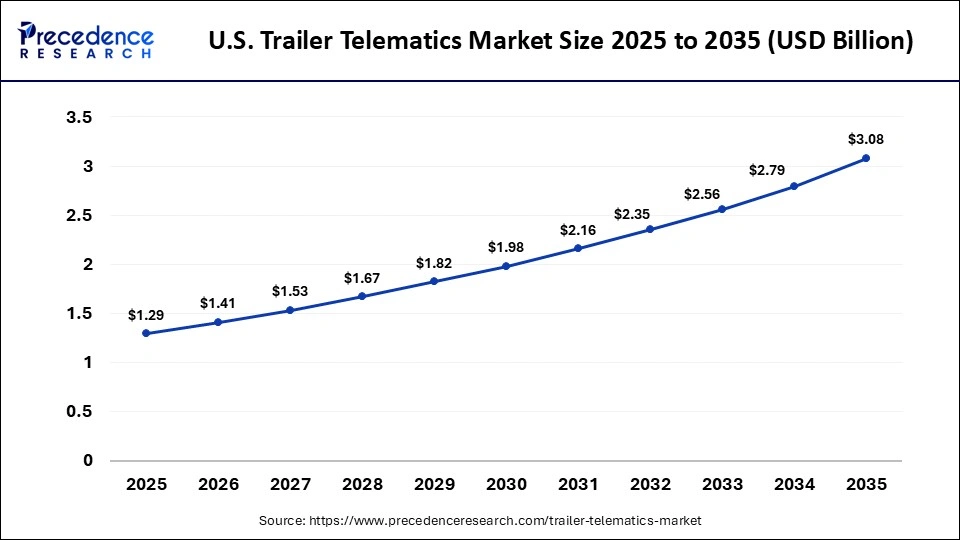
The U.S. trailer telematics market size is calculated at USD 1.29 billion in 2025 and is expected to reach nearly USD 3.08 billion in 2035, accelerating at a strong CAGR of 9.09% between 2026 and 2035.
U.S. Market Trends
In the U.S., trailer telematics is expanding rapidly due to the country's massive for-hire trucking capacity and high trailer-to-tractor ratio, which creates significant idle asset challenges. Fleets are aggressively deploying telematics to improve trailer pool optimization, reduce detention time at distribution centers, and enhance drop-and-hook efficiency. Strong integration with transportation management systems, rising cargo theft incidents, and demand for cold chain monitoring in food and pharma logistics are further accelerating advanced telematics adoption nationwide.
Why is Asia-Pacific Experiencing the Fastest Growth of the Trailer Telematics Market?
Asia-Pacific is expected to grow at the fastest CAGR of 9.5% in the market over the studied period because rapid infrastructure development in China and India is creating new long-haul and intermodal freight corridors that require real-time asset visibility. Expansion of organized logistics players, increased investment in smart ports and express transportation networks, and rising demand for cold chain solutions in perishables are driving adoption. Additionally, government initiatives promoting digital freight ecosystems further accelerate telematics deployment across the region.
China Market Trends
In China, trailer telematics is advancing rapidly as logistics companies adopt smart technologies to manage sprawling freight networks and complex intermodal operations. Growing demand for real-time monitoring in high-volume e-commerce and manufacturing supply chains is pushing fleets to integrate AI-driven analytics and IoT sensors. Strategic national investment in smart highways, digital freight platforms, and connected infrastructure accelerates telematics deployment, while stricter safety and emissions policies further encourage advanced trailer tracking and predictive maintenance solutions.
Will Europe Grow in the Trailer Telematics Market?
Europe is expected to grow at a considerable CAGR in the upcoming period, due to the strict enforcement of EU Mobility Package regulations, mandatory smart tachograph upgrades, and digital freight documentation requirements across cross-border corridors. High intermodal freight movement linking major ports and inland logistics hubs is increasing demand for real-time trailer tracking and load monitoring. Additionally, strong cold-chain distribution networks and sustainability-driven fleet optimization strategies are accelerating telematics deployment across regional transport operators.
Trailer Telematics Market Companies
- Geotab Inc.
- ORBCOMM Inc.
- Spireon Inc.
- SkyBitz, Inc.
- Phillips Connect Technologies LLC
- Samsara Inc.
- Teletrac Navman
- Trimble Inc.
- CalAmp Corp.
- Fleet Complete
- Omnitracs LLC
- WABCO Holdings Inc.
- Teletrac Navman (duplicate listed once)
- Blue Tree Systems
Recent Developments
- In February 2026, Geotab Inc., a provider of connected transportation solutions, introduced its next wave of AI-powered telematics at Geotab Connect, unveiling a roadmap for Australian and New Zealand fleets that shifts telematics from basic tracking to an operational intelligence platform. The initiative focuses on real-time video safety tools, rugged asset tracking, and data-driven decision support to improve efficiency and visibility in challenging conditions.(Source: https://www.geotab.com)
- In February 2026, Ford expanded telematics asset tracking, Ford Pro Telematics, that supports BeWhere asset trackers, enabling fleets to monitor trailers, tools, and equipment alongside vehicles within a single platform, expanding telematics utility beyond core trucking use cases.
- In October 2025, C.H. Robinson announced upgrades to its Drop Trailer Plus program, combining AI and telematics data to transform trailer pool management. With real-time inventory visibility and automated scheduling, carriers can optimize trailer utilization, reduce yard hunts, and streamline operations across large fleets. (Source: https://www.ttnews.com)
Segments Covered in the Report
By Trailer Type
- Dry Van Trailers
- Refrigerated Trailers
- Flatbed
- Tankers
By Communication Technology
- GPS Tracking
- Cellular Connectivity
- Satellite & Others – smaller
By Component
- Hardware
- Software
- Services – smaller
By Application
- Fleet Management
- Predictive Maintenance
- Cold Chain Monitoring
- Asset Tracking & Others
By Deployment/Distribution Channel
- Aftermarket
- OEM Integrated
By End User
- Logistics & Transportation
- Retail & Distribution
- Construction & Others
By Region
- North America
- Asia Pacific
- Europe
- Latin America
- Middle East & Africa
For inquiries regarding discounts, bulk purchases, or customization requests, please contact us at sales@precedenceresearch.com
Frequently Asked Questions
Tags





Ask For Sample
No cookie-cutter, only authentic analysis – take the 1st step to become a Precedence Research client
 Get a Sample




 sales@precedenceresearch.com
 Schedule a Meeting
