

U.S. & Europe Bioreactor Bags Market Revenue, Leading Companies, Company Technology / Innovation, Diagnostic Testing Volume, Adoption Rates, Pricing Metrics, Supply Chain Performance, Competitive Positioning, and Industry Trends
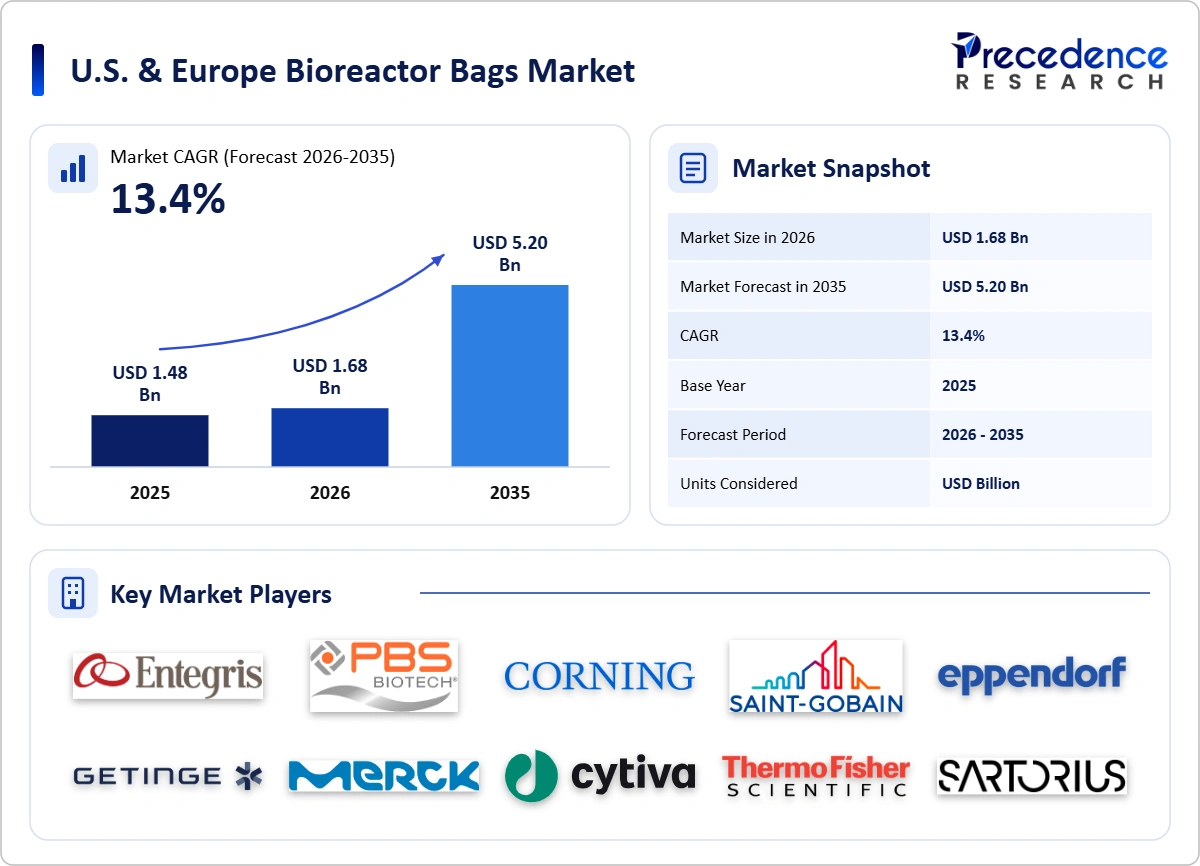
Payal Rabde, a Healthcare Industry Expert, highlights that the U.S. & Europe bioreactor bags market has reached USD 1.68 billion in 2026 and is on track to reach USD 5.20 billion by 2035, advancing at a CAGR of 13.4%. Key U.S. & Europe bioreactor bags market companies shaping the market include Sartorius, Thermo Fisher Scientific, Cytiva (Danaher), while major growth segments span type, Volume, application, end-user.
Source: https://www.precedenceresearch.com/us-and-europe-bioreactor-bags-market
 Get a Sample
 Table Of Content
Key Takeaways
Market Size & Growth Outlook
- Market size in 2025: USD 1.48 billion
- Estimated market size in 2026: USD 1.68 billion
- Projected market size by 2035: USD 5.20 billion
- CAGR (2026-2035): 13.4%
Regional Market Spotlight
- In 2025, the U.S. led the market with a 58% revenue share and is projected to be the fastest-growing region, registering a CAGR of 13.89% from 2026 to 2035.
- Europe accounted for 42% of the market in 2025.
Segmental Spotlight
- 3D Stirred-Tank Bags emerged as the leading type segment, accounting for 68% of the market in 2025.
- The above-500 L segment dominated the volume category, holding a 50% market share in 2025.
- In 2025, Monoclonal Antibodies represented the largest application segment, accounting for 50% of the market.
- Biopharmaceutical Companies dominated the end-user segment, holding a 56% market share in 2025.
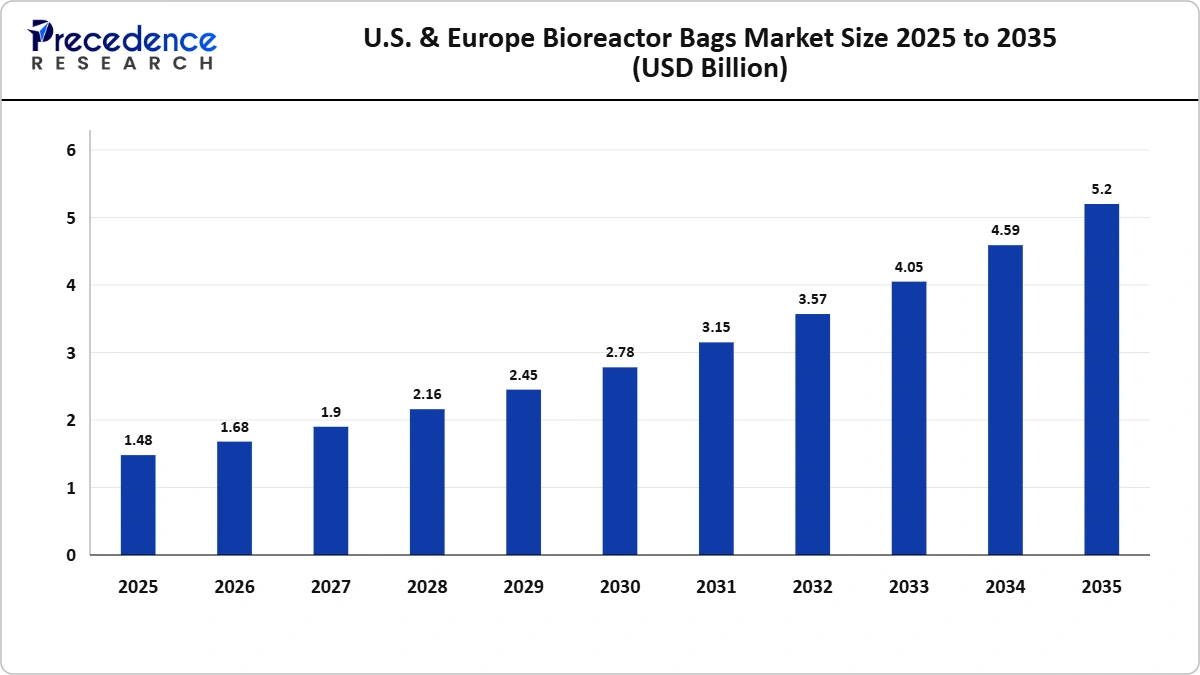
U.S. & Europe Bioreactor Bags Market Size and Forecast, 2025-2035 (USD Billion)
Note: 2025 is the base year; 2026-2035 values are forecasts.
Sources: Expert interviews, secondary sources, Precedence Research database, and Precedence Research analysts.
The U.S. & Europe bioreactor bags market is projected to grow from USD 1.48 billion in 2025 to USD 5.20 billion by 2035, driven by the adoption of single-use bioreactor bags in biologics manufacturing. Growing biologics production, cell and gene therapy development, CDMO expansion, and shorter facility implementation timelines are supporting market growth.
The market is expected to reach USD 2.78 billion by 2030 and sustain a CAGR of 13.4% from 2026 to 2035. Single-use bioreactor bags support regenerative medicine, enzyme production, and clinical trial supply.
Analyst View: We developed the market estimate using single-use bioreactor installations, bag consumption per batch, and average bag prices across the U.S. and Europe. The estimate was cross-validated against the single-use revenues of leading suppliers. Published estimates for this exact market scope are limited, so our valuation is based on underlying market demand and supplier data.
Market Trends
- Adoption of larger single-use bioreactor bags supports cost-efficient commercial-scale biologics manufacturing.
- Growing cell therapy manufacturing activity is increasing demand for application-specific single-use bags and compatible closed processing systems.
- Reliable supply of qualified polymer films and product-contact materials is essential because changes in material composition can require additional compatibility, extractables, and process-qualification assessments.
- Comprehensive bag integrity testing enhances product quality, sterility, and manufacturing reliability.
- Development of recyclable and sustainable films helps reduce plastic waste and environmental impact.
- Advancements in perfusion manufacturing increase demand for single-use bioreactor systems and improve production efficiency.
U.S. & Europe Bioreactor Bags Market Drivers, Restraints, and Opportunities
Driver
The U.S. & Europe bioreactor bags market is driven by rising biologics production, cell and gene therapy development, increased CDMO capacity, and quicker facility construction. The demand for single-use bioreactor bags is enhanced by the growing production of monoclonal antibodies and other biologics in manufacturing facilities.
The adoption of single-use systems aids manufacturers in reducing cleaning requirements and speeding up facility development, while CDMOs are expanding their capabilities to meet the increasing demand for biologics and contract manufacturing services.
Restraint
Plastic waste poses a significant challenge to the market, particularly due to the substantial waste generated by single-use bioreactor bags post-manufacturing. Rising environmental concerns are prompting manufacturers to investigate recyclable materials and enhance waste management strategies to mitigate this issue.
Supply concentration is another restraint, as manufacturers depend on a limited number of suppliers for specialized films and single-use assemblies. Extractables concerns and potential bag failures can also affect product selection and manufacturing reliability.
Opportunity
The development and commercialization of cell and gene therapies are creating new opportunities for manufacturers of single-use bioreactor bags. As demand for advanced therapies grows, there is a rise in the requirement for specialized bags and flexible manufacturing systems tailored to these applications.
Large-scale bioreactor bags, recyclable films, perfusion processes, and onshoring initiatives also provide growth opportunities. Manufacturers that improve film performance, bag integrity, and supply reliability can strengthen their market positions during the forecast period.
Market Drivers - Impact & CAGR Contribution (2026-2035)
| Driver | Impact | ≈ CAGR Contribution | Time Horizon | Key Regions |
| Biologics growth | High | +5.23 pp | Short to long term | All covered regions, strongest in U.S. |
| Cell and gene therapy | Medium | +4.41 pp | Medium to long term | All covered regions, fastest uptake in U.S. |
| CDMO expansion | Medium | +3.76 pp | Short to medium term | All covered regions |
| Faster facility build | Low | +2.94 pp | Long term | U.S. |
Note: Contributions are indicative estimates of each factor's effect on annual growth.
Sources: Expert interviews, secondary sources, Precedence Research database, and Precedence Research analysts.
Biologics growth significantly impacts the U.S. and Europe bioreactor bags market, adding about 5.23 percentage points to annual growth. The rise in cell and gene therapy production and CDMO expansion further supports development, contributing a total of roughly 16.35 percentage points of indicative annual growth. This influence is particularly pronounced in the U.S., characterized by increasing investment and manufacturing capacity.
Market Restraints - Impact & Negative CAGR Contribution (2026-2035)
| Restraint | Impact | ≈ Negative CAGR Contribution | Time Horizon | Key Regions |
| Plastic waste | High | -1.33 pp | Short to medium term | All covered regions |
| Supply concentration | High | -0.97 pp | Medium term | Smaller and price-sensitive markets |
| Extractables concerns | Medium | -0.65 pp | Short term | U.S. and other mature markets |
Note: Contributions are indicative estimates of each factor's effect on annual growth.
Sources: Expert interviews, secondary sources, Precedence Research database and Precedence Research analysts.
Plastic waste, supply concentration, and extractables concerns are expected to reduce annual market growth by approximately 2.95 percentage points, with plastic waste representing the most significant restraint. These challenges may influence purchasing decisions and increase the need for reliable materials and improved manufacturing processes.
The impact of these restraints is expected to ease as suppliers and buyers adapt, supporting the projected market CAGR of 13.4% from 2026 to 2035.
U.S. & Europe Bioreactor Bags Market Segmentation: 2025 Share and Size
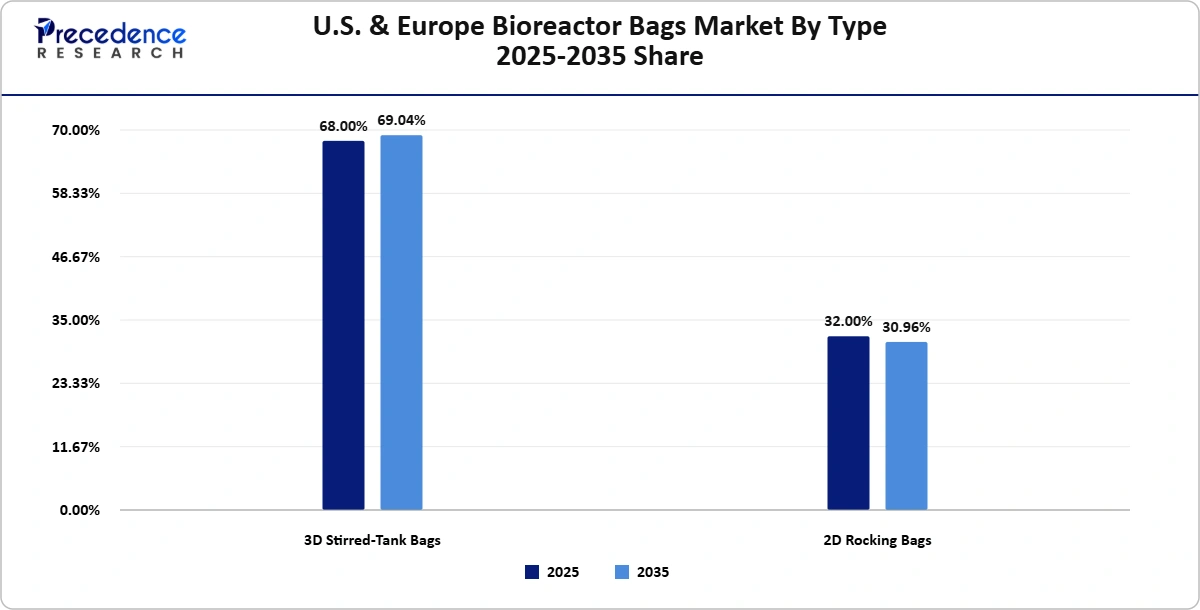
U.S. & Europe Bioreactor Bags Market By Type 2025-2035 Share
Note: 2025 is the base year; 2035 shares and CAGRs are forecasts.
Sources: Expert interviews, secondary sources, Precedence Research database and Precedence Research analysts.
In 2025, 3D Stirred-Tank Bags held a 68% share of the U.S. & Europe bioreactor bags market, primarily due to their extensive use in production-scale single-use bioreactors. In contrast, 2D Rocking Bags accounted for 32%. Additionally, 3D Stirred-Tank Bags are expected to experience the fastest growth among segments through 2035.
3D Stirred-Tank Bags accounted for 68% of the market in 2025 and are projected to grow at a CAGR of 13.59% from 2026 to 2035. These bags are widely used in production-scale single-use bioreactors and support commercial biologics manufacturing. Their established role in large-scale production is expected to sustain demand. The segment is projected to grow broadly in line with the overall market.
2D Rocking Bags represented 32% of the market in 2025. The segment is forecast to expand at a CAGR of 12.99% through 2035. These bags enable seed trains and cell therapy applications, expected to meet the demand for smaller-scale manufacturing and specialized processes. However, the segment is projected to grow more slowly than the overall market throughout the forecast period.
Segment Outlook: During the forecast period, 3D Stirred-Tank Bags are anticipated to maintain their dominance in the market, growing their share from 68% in 2025 to about 69.04% in 2035, with a robust CAGR of 13.59%, particularly in the U.S. & Europe bioreactor bags market.
U.S. & Europe Bioreactor Bags Market By Volume 2025 Share
| Segments | 2025 Share | 2035 Share | CAGR 2026-2035 |
| Up to 50 L | 22.00% | 25.58% | 15.12% |
| 50-500 L | 28.00% | 27.31% | 13.12% |
| 500-2,000 L & Above | 50.00% | 47.12% | 12.72% |
Note: 2025 is the base year; 2035 shares and CAGRs are forecasts.
Sources: Expert interviews, secondary sources, Precedence Research database and Precedence Research analysts.
In 2025, The above-500 L segment accounted for 50% of the U.S. & Europe bioreactor bags market, followed by 50-500 L at 28% and up to 50 L at 22%. Large-capacity bags dominate because commercial antibody production requires larger single-use manufacturing systems. Meanwhile, the up to 50 L segment is projected to record the fastest growth from 2026 to 2035.
Up to 50 L bags accounted for 22% of the market in 2025. The segment is projected to grow at a CAGR of 15.12% from 2026 to 2035. These bags are used in process development and cell therapy applications. The demand for smaller-scale and specialized manufacturing systems is expected to support segment growth. The segment is projected to grow faster than the overall market.
50-500 L bags represented 28% of the market in 2025 and are expected to register a CAGR of 13.12% through 2035. These bags support clinical manufacturing batches and flexible production needs, with their use throughout various manufacturing stages expected to meet demand. The segment is projected to grow alongside the overall market during the forecast period.
500-2,000 L and above bags segment held the largest market share of 50% in 2025 and is forecast to grow at a CAGR of 12.72% between 2026 and 2035. These large-capacity bags are extensively used in commercial antibody production and large-scale biologics manufacturing. Their established use in production facilities is expected to maintain their leading position. However, growth is projected to remain below the overall market average.
Segment Outlook: The above-500 L segment is expected to remain the largest volume category by 2035, although its share is projected to decline from 50% in 2025 to approximately 47.12% in 2035. In contrast, up to 50 L is anticipated to record the highest CAGR of 15.12%, increasing its market share to 25.58% through 2035.
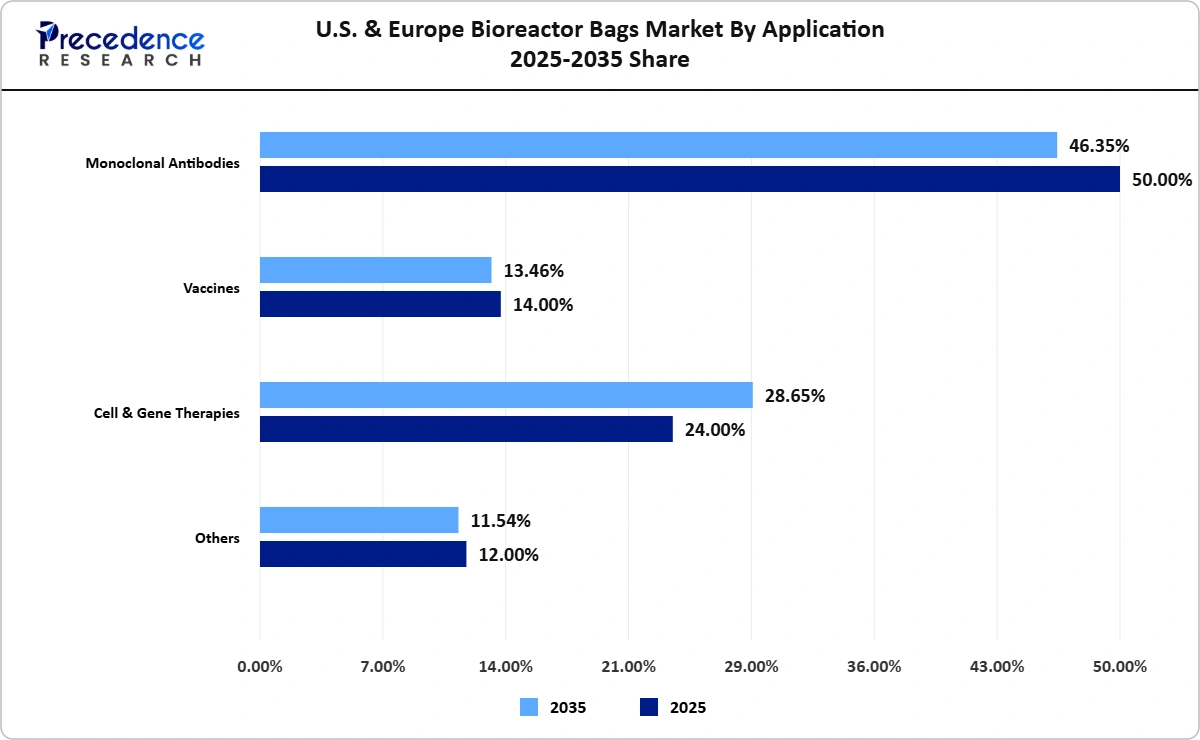
U.S. & Europe Bioreactor Bags Market By Application 2025-2035 Share
Note: 2025 is the base year; 2035 shares and CAGRs are forecasts.
Sources: Expert interviews, secondary sources, Precedence Research database and Precedence Research analysts.
Monoclonal Antibodies accounted for 50% of the U.S. & Europe bioreactor bags market in 2025, followed by Cell and Gene Therapies at 24%, Vaccines at 14%, and Others at 12%.
Monoclonal Antibodies dominate because of their extensive use in biologics manufacturing. Meanwhile, Cell and Gene Therapies are projected to record the fastest growth among application segments through 2035.
Monoclonal Antibodies accounted for 50% of the market in 2025 and are projected to grow at a CAGR of 12.54% from 2026 to 2035. Monoclonal antibody production represents a major application of single-use bioreactor bags. Increasing biologics manufacturing is expected to sustain demand. However, the segment is projected to grow more slowly than the overall market.
Vaccines represented 14% of the market in 2025. The segment is forecast to expand at a CAGR of 12.94% through 2035. Single-use bioreactor bags support flexible manufacturing capacity for vaccine production. Their role in biologics manufacturing is expected to maintain demand. Nevertheless, the segment is projected to grow slightly below the overall market.
Cell & Gene Therapies held a 24% market share in 2025 and are expected to record the highest growth among application segments, with a CAGR of 15.44% from 2026 to 2035. Increasing development and manufacturing of advanced therapies are creating demand for specialized single-use systems. The expansion of cell therapy manufacturing is expected to accelerate segment growth beyond the overall market.
Others captured 12% of the market in 2025. The segment is projected to grow at a CAGR of 12.94% between 2026 and 2035. This category includes other biologic applications, such as recombinant proteins. Demand from specialized manufacturing processes is expected to support segment development. However, the segment is projected to grow more slowly than the overall market.
Segment Outlook: Through 2035, monoclonal antibodies are projected to remain the largest application, although their share is expected to decline from 50% in 2025 to approximately 46.35% in 2035. In contrast, cell and gene therapies are expected to record the highest CAGR of 15.44%, increasing their market share to 28.65% by 2035.
U.S. & Europe Bioreactor Bags Market By End User 2025 Share
| Segments | 2025 Share | 2035 Share | CAGR 2026-2035 |
| Biopharmaceutical Companies | 56.00% | 52.50% | 12.68% |
| CDMOs | 34.00% | 37.69% | 14.58% |
| Academic & Research Institutes | 10.00% | 9.81% | 13.08% |
Note: 2025 is the base year; 2035 shares and CAGRs are forecasts.
Sources: Expert interviews, secondary sources, Precedence Research database and Precedence Research analysts.
In 2025, Biopharmaceutical Companies accounted for 56% of the U.S. & Europe bioreactor bags market, followed by CDMOs at 34% and Academic and Research Institutes at 10%. Biopharmaceutical Companies dominate because they represent the largest group of buyers for single-use bioreactor bags. Meanwhile, CDMOs are projected to record the fastest growth during the forecast period.
Biopharmaceutical Companies accounted for 56% of the market in 2025 and are projected to grow at a CAGR of 12.68% from 2026 to 2035. These companies represent the largest end-user group due to their extensive biologics manufacturing operations. Increasing production of monoclonal antibodies, vaccines, and other biologics is expected to sustain demand. However, the segment is projected to grow more slowly than the overall market.
CDMOs represented 34% of the market in 2025 and are expected to expand at a CAGR of 14.58% through 2035. Contract development and manufacturing organizations are expanding their manufacturing capabilities to serve increasing demand for biologics production. Their adoption of flexible single-use manufacturing systems is expected to support faster segment growth.
Academic and Research Institutes captured 10% of the market in 2025 and are forecast to grow at a CAGR of 13.08% by 2035. These institutions use bioreactor bags for research, process development, and specialized biological studies. Their contribution to research and development is expected to sustain demand. However, the segment is projected to grow slightly below the overall market.
Segment Outlook: Biopharmaceutical Companies are expected to remain the largest end-user segment during the forecast period, although their share is projected to decline from 56% in 2025 to approximately 52.50% in 2035. CDMOs are anticipated to record the highest end-user-level CAGR of 14.58%, increasing their share to 37.69%. Academic and Research Institutes will continue to serve specialized research and development requirements.
Analyst View: In our analysis, segment estimates were developed by allocating market demand according to product portfolios, application requirements, end-user demand, and pricing. 3D Stirred-Tank Bags, 500-2,000 L and Above, Monoclonal Antibodies, and Biopharmaceutical Companies remain the leading segments because they address the core requirements of existing biologics manufacturing facilities. However, up to 50 L bags, Cell and Gene Therapies, and CDMOs are expected to gain market share as advanced therapies, specialized manufacturing, and contract production expand.
Country Analysis of the U.S. & Europe Bioreactor Bags Market
U.S. & Europe Bioreactor Bags Market By Country 2025 Share
| Country | 2025 Share | 2035 Share | CAGR 2026-2035 |
| U.S. | 58.00% | 60.58% | 13.89% |
| Europe | 42.00% | 39.42% | 12.69% |
Note: 2025 is the base year; 2035 shares and CAGRs are forecasts.
Sources: Expert interviews, secondary sources, Precedence Research database and Precedence Research analysts.
The U.S. dominated the U.S. & Europe bioreactor bags market in 2025, capturing 58% of the total revenue share. The country is expected to maintain its lead, supported by its large biologics and cell therapy manufacturing base. Europe followed with a 42% market share and is expected to maintain substantial demand through established biopharmaceutical manufacturing facilities and single-use system suppliers.
The U.S. accounted for 58% of the market in 2025 and is projected to register a CAGR of 13.89% from 2026 to 2035. The country leads because of its extensive biologics and cell therapy manufacturing base. Growing investment in biologics production, advanced therapies, and manufacturing capacity is expected to support market expansion. The U.S. is projected to grow faster than the overall regional market.
Europe held a 42% market share in 2025 and is anticipated to grow at a CAGR of 12.69% through 2035. The region has established single-use suppliers and biologics manufacturing facilities across Germany, Ireland, Switzerland, and Belgium. The presence of major biopharmaceutical manufacturers and production infrastructure continues to support demand. However, Europe is expected to grow more slowly than the overall market.
Analyst View: In our analysis, regional estimates were developed using demand, installed manufacturing capacity, spending, and supplier presence across the U.S. and Europe. The U.S. maintains its leading position due to its established biologics manufacturing base and strong supplier presence. Its higher projected growth reflects expanding investment, adoption, and production capacity.
Competitive Landscape
Top 10 Companies in the U.S. & Europe Bioreactor Bags Market, 2025
| Rank | Company Name | 2025 Share (%) | Key Products / Business | Headquarters |
| 1 | Sartorius | 28.00% | Flexsafe bags for BIOSTAT bioreactors | Germany |
| 2 | Thermo Fisher Scientific | 24.00% | HyPerforma and DynaDrive bags | United States |
| 3 | Cytiva (Danaher) | 17.00% | Xcellerex and WAVE bags | United States |
| 4 | Merck KGaA (MilliporeSigma) | 10.00% | Mobius bags | Germany |
| 5 | Getinge (Applikon) | 2.00% | Single-use bioreactor bags | Sweden |
| 6 | Eppendorf | 2.00% | BioBLU vessels | Germany |
| 7 | Saint-Gobain Life Sciences | 2.00% | Single-use assemblies | France |
| 8 | Corning | 1.00% | Cell culture bags | United States |
| 9 | PBS Biotech | 1.00% | Vertical-Wheel bags | United States |
| 10 | Entegris | 1.00% | Single-use bags | United States |
Note: Company shares are 2025 estimates.
Sources: Company press releases, expert interviews, secondary sources, Precedence Research database and Precedence Research analysts.
Sartorius led the U.S. & Europe bioreactor bags market with an estimated 28% share of 2025 revenue, followed by Thermo Fisher Scientific at 24% and Cytiva (Danaher) at 17%. Sartorius maintains its lead with its Flexsafe bags for BIOSTAT bioreactors. Thermo Fisher Scientific competes through its HyPerforma and DynaDrive bags, while Cytiva offers Xcellerex and WAVE bags.
Other prominent participants include Merck KGaA (MilliporeSigma), Getinge (Applikon), Eppendorf, Saint-Gobain Life Sciences, Corning, PBS Biotech, and Entegris. These companies compete through Mobius bags, single-use bioreactor bags, BioBLU vessels, single-use assemblies, cell culture bags, Vertical-Wheel bags, and other single-use products.
In 2025, the top 10 companies accounted for an estimated 88% of the revenue, while the remaining 12% was shared among several assembly manufacturers. The U.S. & Europe bioreactor bags market is highly concentrated, with competition centred on film quality, extractables data, bag integrity, manufacturing scale, supply security, and compatibility with bioreactor platforms.
Company Snapshots
Sartorius: Sartorius maintained a leading position in the U.S. & Europe bioreactor bags market, accounting for an estimated 28% share in 2025. The German company offers Flexsafe bags designed for use with its BIOSTAT bioreactor systems, strengthening its presence in single-use bioprocessing. According to the Precedence Research Companies Quadrant, the company is classified as a Leader.
Thermo Fisher Scientific: In 2025, Thermo Fisher Scientific accounted for approximately 24% of the market, supported by its HyPerforma and DynaDrive bag offerings. Its established single-use bioreactor portfolio positions it as a Leader in the Precedence Research Companies Quadrant.
Cytiva (Danaher): With an estimated 17% market share in 2025, Cytiva, a U.S.-based company, provides Xcellerex and WAVE bags within its single-use bioprocessing portfolio. The company is classified as a Leader in the Precedence Research Companies Quadrant.
Merck KGaA (MilliporeSigma): The Germany-based company Merck KGaA held around 10% of the bioreactor bags market in 2025, supported by its Mobius bag portfolio. It is recognized as a Leader in the Precedence Research Companies Quadrant, highlighting its significance in single-use bioprocessing products and biopharmaceutical manufacturing solutions.
Getinge (Applikon): With an estimated 2% market share in 2025, the Sweden-headquartered manufacturer specializes in single-use bioreactor bags. Its product offerings and market presence place it in the Leader category of the Precedence Research Companies Quadrant.
Eppendorf: Accounting for an estimated 2% share of the regional market in 2025, the Germany-headquartered company offers BioBLU vessels as part of its single-use bioprocessing portfolio. Its specialized vessel solutions support its presence in the bioreactor market, placing it in the Leader category of the Precedence Research Companies Quadrant.
Saint-Gobain Life Sciences: Part of Compagnie de Saint-Gobain S.A. and headquartered in France, in 2025, the company held an estimated 2% market share. Its portfolio includes single-use assemblies. The company is classified as an Innovator in the Precedence Research Companies Quadrant.
Corning: Headquartered in the United States, Corning accounted for approximately 1% of the market in 2025, with its product portfolio including cell culture bags. The company is categorized as an Innovator in the Precedence Research Companies Quadrant.
PBS Biotech: With specialization in Vertical-Wheel bags, the U.S.-based PBS Biotech accounted for an estimated 1% of the market in 2025. Its focused product portfolio positions it in the Innovator category of the Precedence Research Companies Quadrant.
Entegris: Entegris held about 1% of the regional market in 2025, aided by its single-use bag products in the bioprocessing sector, and applies its materials and fluid management expertise to biopharmaceutical processing. It is classified as an Innovator in the Precedence Research Companies Quadrant.
Companies Ecosystem
The U.S. & Europe bioreactor bags ecosystem connects film suppliers, bag manufacturers, bioreactor platform providers, end users, and regulatory organizations. Each stage contributes to the development, manufacturing, supply, and adoption of single-use bioreactor bags across biologics production.
| Ecosystem Stage | Role in the Market | Key Companies |
| Film Suppliers | Make multilayer films | Film makers, Saint-Gobain |
| Bag Makers | Make bioreactor bags | Sartorius, Thermo Fisher, Cytiva, MilliporeSigma |
| Bioreactor Platforms | Hold bags | Single-use bioreactor systems |
| Users | Run cultures | Biopharma, CDMOs |
| Regulators | Approve processes | FDA, EMA |
Sources: Company press releases, expert interviews, secondary sources, Precedence Research database and Precedence Research analysts.
Film Suppliers: Key participants in the manufacturing of multilayer films for single-use bioreactor bags include film manufacturers and Saint-Gobain.
Bag Makers: Bag manufacturers create single-use bioreactor bags for biologics manufacturing, with key players including Sartorius, Thermo Fisher Scientific, Cytiva, and MilliporeSigma.
Bioreactor Platforms: Bioreactor platforms provide the systems in which single-use bags are installed and used during manufacturing processes.
Users: Biopharmaceutical companies and CDMOs utilize single-use bioreactor bags for the production and manufacturing of biologics.
Regulators: Regulatory organizations such as the FDA and EMA impose requirements and oversee manufacturing processes.
Value in the U.S. & Europe bioreactor bags market flows from upstream material and technology suppliers to bag manufacturers and bioreactor platform providers, then to end users. Companies that integrate multiple stages or establish long-term relationships with end users can capture a larger share of market value.
Precedence Research Companies Quadrant
The Precedence Research Companies Quadrant positions key participants in the U.S. & Europe bioreactor bags market by market strength, reflecting revenue scale, market share, and geographic reach, and by innovation and growth strategy, reflecting product portfolio breadth, R&D intensity, and partnerships. Positions reflect each company's estimated 2025 share of the U.S. & Europe bioreactor bags market and our assessment of its product innovation, portfolio breadth, and partnerships.
Sources: Company press releases, expert interviews, secondary sources, Precedence Research database and Precedence Research analysts.
Leaders: Sartorius, Thermo Fisher Scientific, Cytiva (Danaher), Merck KGaA (MilliporeSigma), Getinge (Applikon) and Eppendorf combine high market share with broad portfolios and established market positions.
Innovators: Saint-Gobain Life Sciences, Corning, PBS Biotech and Entegris bring advanced technologies and specialised products.
Recent Developments
- May 2026: Thermo Fisher Scientific launched the Gibco CTS DynaXS single-use stirred-tank bioreactor for cell therapy expansion, extending single-use bag-based systems to cell therapy manufacturing.
U.S. & Europe Bioreactor Bags Market Segments
By Type
- 3D Stirred-Tank Bags
- 2D Rocking Bags
By Volume
- Up to 50 L
- 50-500 L
- 500-2,000 L & Above
By Application
- Monoclonal Antibodies
- Vaccines
- Cell & Gene Therapies
- Others
By End User
- Biopharmaceutical Companies
- CDMOs
- Academic & Research Institutes
By Region
- U.S.
- Europe (Germany, U.K., France, Ireland, Switzerland, Rest of Europe)
Research Methodology: The U.S. & Europe bioreactor bags market was defined as the market for single-use bioreactor bags across the United States and Europe. The assessment includes 2D rocking bags and 3D stirred-tank bags across different volume categories, including up to 50 L, 50-500 L, 500-2,000 L, and above. These products are manufactured using multilayer polyethylene and other qualified polymer-film structures and are used in monoclonal antibody, vaccine, cell and gene therapy, and other biologics applications. The 2025 base-year estimate was generated via a detailed analysis of demand volumes and prices across various factors, including product types and regions. Validation included comparisons with revenues from leading suppliers and published market data. Data were allocated based on demand and product portfolios, and key estimates were verified against company disclosures, regulatory data, and expert interviews, excluding any unreconciled inputs. The 2026-2035 market forecast considers biologics growth, cell and gene therapy development, CDMO expansion, shorter facility implementation timelines, and the adoption of single-use manufacturing systems. It also accounts for plastic waste, supply concentration, and extractables concerns. All segment, regional, and company estimates were reconciled to the same 2025 base year, and the forecast was recalculated and validated using the projected CAGR of 13.4%.
Analyst View: The U.S. & Europe bioreactor bags market is projected to grow significantly through 2035, driven by rising biologics production, advancements in cell and gene therapies, and the expansion of CDMOs. 3D stirred-tank bags are expected to remain the leading product type, with Monoclonal Antibodies as the primary application. Biopharmaceutical companies will continue to dominate as end users, though CDMOs and cell therapies are expected to increase their market share. The U.S. will remain a key player due to its strong manufacturing base, while Europe will leverage its existing facilities. Market opportunities include smaller-volume bags and recyclable materials, although challenges like plastic waste and supply risks may limit growth. Manufacturers focusing on quality and reliability can enhance their market position.
Sources and References
- BioPharma Boardroom. "Thermo Fisher launches Gibco CTS DynaXS Single Use Bioreactor to advance scalable cell therapy manufacturing". May 2026. News. (Source: biopharmaboardroom.com)
For inquiries regarding discounts, bulk purchases, or customization requests, please contact us at sales@precedenceresearch.com
Frequently Asked Questions





Ask For Sample
No cookie-cutter, only authentic analysis – take the 1st step to become a Precedence Research client
 Get a Sample




 sales@precedenceresearch.com
 Schedule a Meeting