



U.S. Biologics Market Size, Share, Trends, Companies, and Forecast 2026-2035
Deepa Pandey, a Healthcare Industry Expert, highlights that the U.S. biologics market has reached USD 223.60 billion in 2026 and is on track to reach USD 525.67 billion by 2035, advancing at a CAGR of 9.95%. Key U.S. biologics market companies shaping the market include Eli Lilly & Company, Samsung Biologics, F Hoffman La Roche, while major growth segments span By Source, By Product, By Indication, By Manufacturing, By Distribution Channel.
Source: https://www.precedenceresearch.com/us-biologics-market
 Get a Sample
 Table Of Content


U.S. Biologics Market Size and Forecast 2026 to 2035
The U.S. biologics market size is predicted to increase from USD 223.60 billion in 2026 to approximately USD 525.67 billion by 2035, expanding at a CAGR of 9.95% from 2026 to 2035. The growing adoption of stem cell therapy for the treatment of cancers, along with technological advancements in genetic engineering, has boosted market growth.
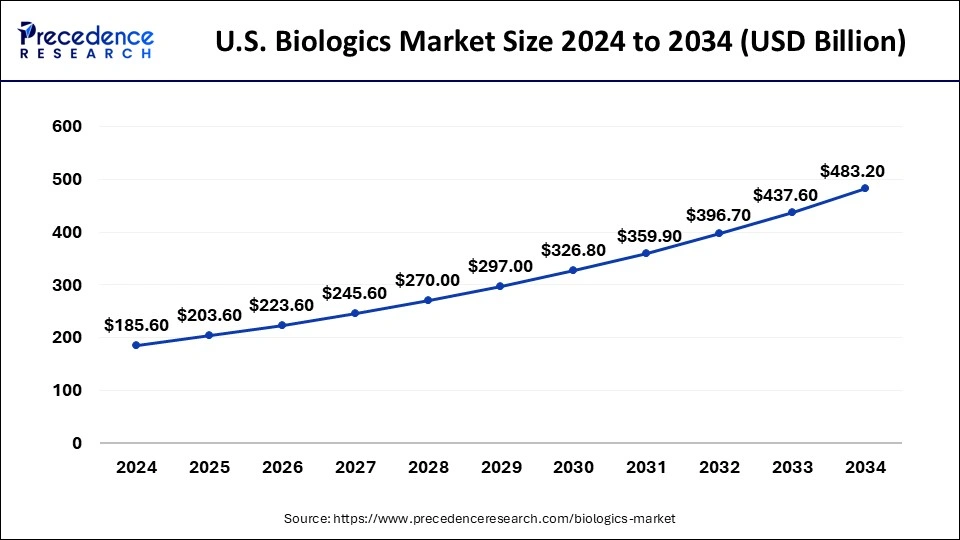
Key Takeaways
- By source, the microbial segment dominated the market in 2026.
- By source, the mammalian segment is likely to grow at a significant CAGR during the forecast period.
- By product, the monoclonal antibodies (MABs) segment held the largest share of the market in 2026.
- By product, the vaccines segment is expected to grow with the highest CAGR during the forecast period.
- By disease, the oncology segment held the highest share of the market in 2026.
- By disease, the cardiovascular disorders segment is anticipated to grow at the fastest rate during the forecast period.
- By manufacturing, the outsourced segment held a notable share of the market in 2026.
- By manufacturing, the in-house segment is anticipated to expand at a significant CAGR during the forecast period.
- By distribution channel, the hospital pharmacies segment dominated the market in 2026.
- By distribution channel, the online pharmacies segment is expected to grow at the highest CAGR during the forecast period.
Market Overview
The US biologics market has been expanding rapidly due to the growing prevalence of chronic disorders, such as CVD and cancers. Pharmaceutical companies are investing heavily to establish new R&D centers for developing advanced therapeutics. The government is launching several policies to strengthen the pharmaceutical industry in this nation. The U.S. has a well-established network of hospitals, which in turn increases the demand for biologics.
How is AI Impacting the US Biologics Market?
AI is heavily integrated into the US biologics industry to strengthen its overall operational landscape. AI-based platforms are designed to enhance drug discovery, optimize production processes, and enhance regulatory compliance. AI algorithms are also used to detect process deviations and monitor quality parameters to ensure batch-to-batch consistency of biologics.
- In April 2026, Amazon launched the Amazon Bio Discovery. Amazon Bio Discovery is an AI-enabled platform designed to accelerate the drug development process in the U.S.
What are the Trends in the U.S. Biologics Industry?
- Partnerships: Numerous gene therapy manufacturers are partnering with healthcare providers to distribute high-quality biologics across the U.S.
- Investments: Some of the prominent pharma companies are making significant investments to develop advanced biologics for the patients of the U.S.
- Approvals: The FDA is engaged in approving a wide range of biologics for treating cancers and CVDs.
Market Dynamics
Drivers
Establishment of New Manufacturing Units
The pharma companies are making significant investments to inaugurate new production centers in the U.S. These production units are established to develop a wide range of biologics, such as MABs, vaccines, cell therapies, and recombinant therapies for the treatment of chronic disorders. Some of the manufacturing plants cater to the end-users of this nation, while a few centers are producing biologics for export purposes.
Restraint
Side-Effects and High-Production Cost
There are various side effects associated with monoclonal antibodies, which lowers their adoption among patients, thereby hampering the U.S. biologics market. The production cost of biologics is rising significantly due to the growing wage rates and increasing prices of microbial substances, which in turn restrain the market expansion.
Opportunity
Precision Oncology Therapeutics
The use of bispecific antibodies and antibody-drug conjugates (ADCs) enhances the treatment of cancer by destroying cancer cells while sparing healthy tissues. Thus, the growing popularity of precision oncology therapeutics is anticipated to create numerous opportunities in the coming years.
Market Segmentation Analysis
Source Insights
The Microbial Segment Dominated the Market in 2026
The microbial segment held the largest share of the U.S. biologics market in 2026. This is due to the increasing application of Escherichia coli and Saccharomyces cerevisiae for the production of vaccines. The pharmaceutical companies are engaged in cultivating engineered microbes in massive quantities to produce complex biological drugs on a large scale.
The mammalian segment is expected to grow at a significant CAGR during the forecast period. This is mainly due to the growing use of mammalian cells for the manufacturing of monoclonal antibodies that are used to treat cancers. These cells are also essential for the production of several human proteins, such as clotting factors (Factor VIII) and erythropoietin (EPO).
Product Insights
What Made Monoclonal Antibodies (MABs) the Dominant Segment in the Market?
The monoclonal antibodies (MABs) segment dominated the U.S. biologics market in 2026 with a major share. This is mainly due to the growing use of MABs for the treatment of autoimmune disorders and infectious diseases. Numerous biotech companies are making significant investments to establish new production units to upscale the production of monoclonal antibodies.
The vaccines segment is expected to grow at the highest CAGR during the forecast period. This is due to the increasing demand for high-quality vaccines for treating a wide range of chronic disorders. The vaccine manufacturers are collaborating with CDMO companies to increase their production capability by lowering overall costs.
Disease Insights
The Oncology Segment Led the Market in 2026
The oncology segment held the largest share of the market in 2026. This is due to the surging prevalence of breast cancer among women. The healthcare professionals are rapidly adopting stem cell therapy and CAR-T cell therapy for the treatment of cancer in the U.S. The government has launched several policies to strengthen the oncology sector in this nation.
The cardiovascular disorders segment is expected to expand with the highest growth rate during the forecast period. This is due to the growing adoption of recombinant therapies for the treatment of cardiovascular diseases. Several leading healthcare providers are establishing new cardiology units to provide high-quality treatment to healthcare patients.
Manufacturing Insights
Why Did the Outsourced Segment Led the Market in 2026?
The outsourced segment led the U.S. biologics market, holding a notable share in 2026. This is due to the rise in the number of CDMO providers in the U.S., which are delivering high-quality production services at low prices. Nowadays, pharma companies are partnering with third-party vendors to delegate their production activities, which allows the pharma brands to engage in research and development.
The in-house segment is expected to expand with a considerable CAGR during the forecast period. This is due to the growing emphasis of biopharma companies to develop advanced therapies in their own production centers to gain maximum profits. The in-house production method allows the medicine manufacturers to validate the efficacy of therapies before commercializing them in the market.
Distribution Channel Insights
The Hospital Pharmacies Segment Held a Dominant Share of the Market in 2026
The hospital pharmacies segment led the market in 2026 by holding a major share. This is owing to the surging investment by the government in strengthening the public hospital infrastructure. Modern hospitals are constructing pharmacies in their compounds to deliver medicinal items during the time of emergency.
The online pharmacies segment is likely to grow at the highest CAGR during the forecast period. This is due to the availability of a wide range of advanced therapies on e-commerce platforms such as Amazon, eBay, and Walmart. Additionally, the rising adoption of smartphones and superior internet connectivity allows consumers to purchase medicinal items from online platforms.
State-Wise Analysis
New York
New York has a wide network of hospitals to deliver high-quality treatment during an emergency. Numerous biotech startups are constantly engaged in the R&D of genetic therapies for the treatment of cancer. The pharma companies are investing rapidly in opening new production hubs in this state.
Massachusetts
Massachusetts is a prominent contributor to the U.S. biologics market. The growing prevalence of autoimmune diseases has increased the demand for RNAi therapies. The U.S. government has invested rapidly in establishing new public hospitals in this state. The tech-friendly consumers of this region prefer to purchase medicines from online platforms.
Texas
In Texas, the demand for monoclonal antibodies has increased significantly due to the surging prevalence of infectious diseases. Numerous CDMO providers have opened their production centers in Texas for its superior logistics infrastructure. The rising cases of immunological disorders further increase the demand for biologics.
Value Chain Analysis of the US Biologics Market
- Raw Materials Sourcing
The raw materials used in the production of biologics include mammalian cells, bacteria, and yeast.
Key Companies: CBRE Group, Colliers, Cushman & Wakefield, and JLL
- Clinical Trials and Regulatory Approvals
The clinical trials of biologics are a multi-stage process designed to test large-molecule therapies in humans.
Key Companies: Intertek, FDA, and BSI Group America.
- Distribution Channel
The distribution channel of biologics comprises specialized, temperature-controlled networks designed to maintain the integrity of living drugs.
Key Companies: Cardinal Health, McKesson and MTF Biologics.
Competitive Landscape
The U.S. biologics market is highly fragmented due to the dominance of industry giants and the growing proliferation of startups. The leading brands operating in this sector include F. Hoffman-La Roche, Celltrion Addgene, Eli Lilly & Company, and Amgen. These brands are constantly engaged in the research and development of biologics for the treatment of chronic disorders. Also, they are adopting several strategies, such as product launches, partnerships and business expansions, to maintain and strengthen their position in the industry. Some of the prominent startups dealing in biologics include Arsenal Bio, Tune Therapeutics, and Sherlock Biosciences.
- In May 2026, Amgen invested around US$2 billion. This investment was made to establish a biologics production capacity in Puerto Rico, U.S.
Companies Operating in the US Biologics Market
- Eli Lilly & Company
- Samsung Biologics
- F Hoffman La Roche
- Pfizer Inc.
- Merck & Co. Inc
- Novo Nordisk A/S
- Celltrion Addgene
- Amgen
- AbbVie Inc.
- Sanofi
Recent Developments US Biologics Market (2025-2026)
- In June 2026, Vertex Pharmaceuticals Incorporated announced that the FDA had approved the biologics license application (BLA) submission for povetacicept. Povetacicept is used to treat IgA nephropathy.(Source: https://news.vrtx.com)
- In June 2026, Alvotech announced that it had submitted the biologics license applications (BLAs) for AVT05. AVT05 is a high-quality biologic used to treat a variety of chronic inflammatory conditions.(Source: https://www.globenewswire.com)
- In January 2026, BD (Becton, Dickinson and Company) invested around US$110 million. This investment was made to enhance the supply chain of biologics across the U.S. (Source: https://news.bd.com)
Segments Covered in the Report
By Source
- Microbial
- Mammalian
- Others
By Product
- Monoclonal Antibodies
- Human mABs
- Humanized mABs
- Chimeric mABs
- Murine mABs
- Vaccines
- RecombinantProteins
- Antisense, RNAi & molecular therapy
- Cell Based Therapies
- Stem Cell Therapy
- CAR-T Cell Therapy
- Tissue Engineering
- Others
By Disease
- Oncology
- Immunological Disorders
- Cardiovascular Disorders
- Hematological Disorders
- Others
By Manufacturing
- Outsourced
- In-house
By Distribution Channel
- Hospital Pharmacies
- Retail Pharmacies
- Online Pharmacies
For inquiries regarding discounts, bulk purchases, or customization requests, please contact us at sales@precedenceresearch.com
Frequently Asked Questions





Ask For Sample
No cookie-cutter, only authentic analysis – take the 1st step to become a Precedence Research client
 Get a Sample
.webp)



 sales@precedenceresearch.com
 Schedule a Meeting
