



U.S. Biotechnology Market Size, Share, Trends, Companies, and Forecast 2026-2035
Deepa Pandey, a Healthcare Industry Expert, highlights that the U.S. biotechnology market has reached USD 361.07 billion in 2026 and is on track to reach USD 1,142.07 billion by 2035, advancing at a CAGR of 13.70%. Key U.S. biotechnology market companies shaping the market include Eli Lilly and Company, AbbVie Inc., Johnson and Johnson, while major growth segments span By Application, By Technology.
Source: https://www.precedenceresearch.com/us-biotechnology-market
 Get a Sample
 Table Of Content


U.S. Biotechnology Market Size and Forecast 2026 to 2035
The U.S. biotechnology market size is predicted to increase from USD 361.07 billion in 2026 to approximately USD 1,142.07 billion by 2035, expanding at a CAGR of 13.70% from 2026 to 2035. The market is witnessing substantial growth due to an increasing prevalence of chronic and rare diseases, spurring high demand for precision biologics and gene therapies. Backed by significant research and development investments and FDA approvals, companies are prioritizing targeted platforms that provide highly effective, personalized patient care across critical therapeutic areas.
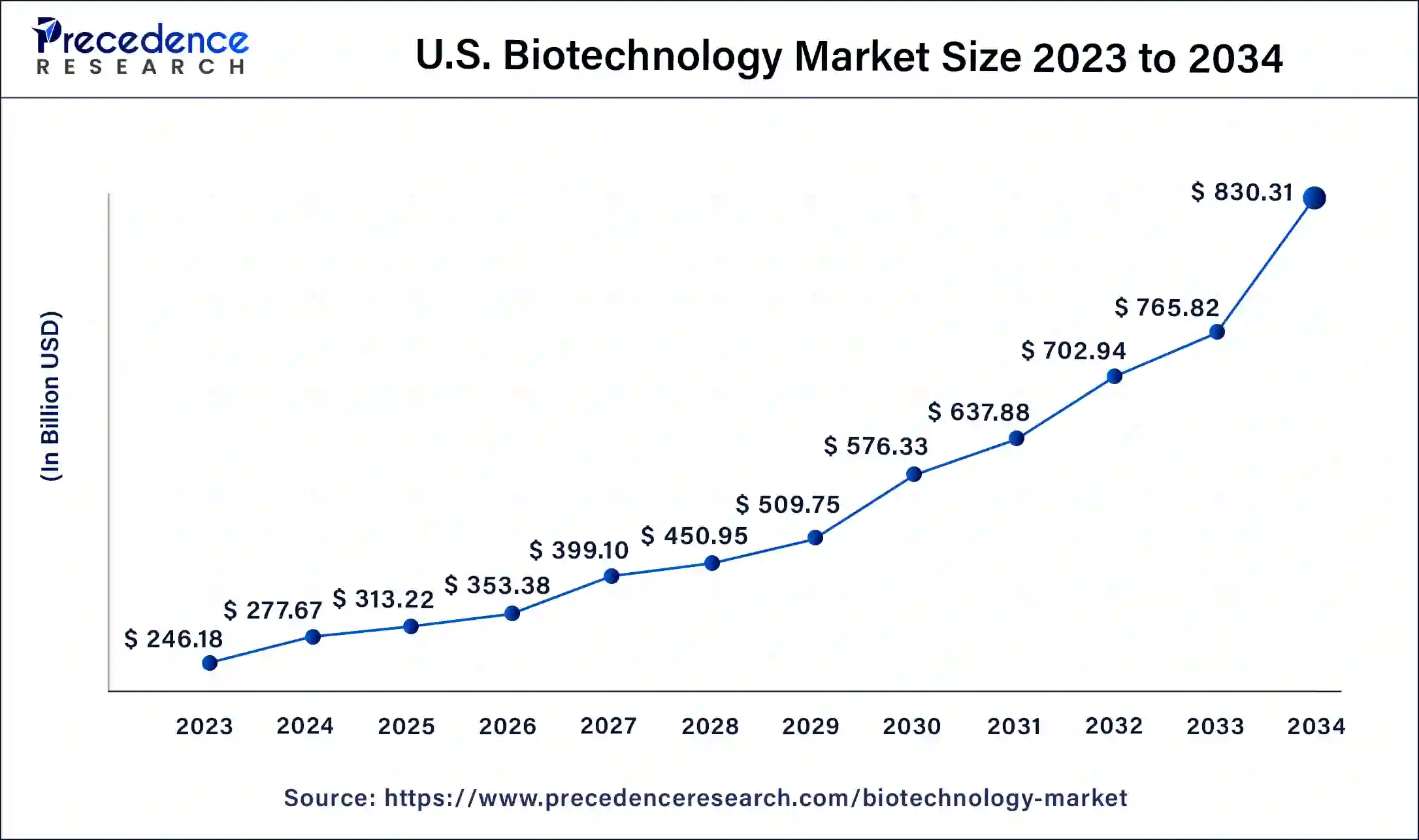
Key Takeaways
- By application, the bio-pharmacy segment captured the highest market share in 2026.
- By application, the bio-informatics segment is poised to grow at a healthy CAGR between 2026 and 2035.
- By technology, the tissue engineering and regeneration segment accounted for the largest market share in 2026.
- By technology, the chromatography segment is projected to grow at a solid CAGR between 2026 and 2035.
Market Overview
The U.S. biotechnology market encompasses the scientific and commercial sectors that utilize living organisms, cells, and biological systems to develop products in healthcare, agriculture, and industrial manufacturing. It combines natural sciences and engineering to create innovative processes and goods. Biotechnology is divided into several branches, red, green, white, and blue, and is experiencing rapid growth, projected to reach trillions in value. This growth is driven by AI-powered innovations and concentrated in major hubs, offering significant advancements in medical and industrial applications at a fast pace.
How is AI Transforming the U.S. Biotechnology Industry?
Artificial intelligence (AI) is revolutionizing the market by accelerating research and development, streamlining clinical trials, and advancing precision medicine. AI models can efficiently screen vast chemical and biological databases to predict molecular interactions and design synthetic proteins while identifying therapeutic targets. By integrating clinical, lifestyle, and multi-omics data, AI enables the creation of highly personalized and effective treatments. The shift from small-scale pilots to enterprise-grade workflows is automating processes, from supply chain logistics to manufacturing optimization.
U.S. Biotechnology Market Trends
- Expanding Therapeutic Horizons: While the focus has largely been on oncology and rare diseases, biotech innovation is now targeting complex conditions such as Alzheimer's, autoimmune disorders, and genetic abnormalities. States like Massachusetts, particularly Boston and Cambridge, as well as the San Francisco Bay Area in California, are global epicenters for these advanced clinical applications.
- Increasing Prevalence of Chronic Conditions: An aging population and rising rates of metabolic and neurological diseases in states like Florida, Texas, and New York have driven an unprecedented demand for innovative biologics and personalized medicines.
- Business Expansions and Onshoring: To counter geopolitical instability and supply chain vulnerabilities, market players are making significant investments in new biomanufacturing plants across North Carolina, particularly in Research Triangle Park, and Pennsylvania.
- Joint Ventures and Research and Development Powerhouses: Pharmaceutical companies are rapidly collaborating with data technology and AI providers to streamline drug discovery, particularly in California, where the tech sector intersects with the biotech industry.
- World-Class Hospital and Research Networks: Major hospital systems and academic medical centers in regions such as Maryland and New York are continuously expanding their networks to support cutting-edge clinical research and patient care.
- Regulatory Navigation: The U.S. FDA, along with regional hubs in the Maryland/D.C. corridor, is continually working to streamline protocols to expedite commercial approvals for novel gene therapies and biologics.
- Conducting Clinical Trials: Pharmaceutical companies are conducting thousands of active clinical trials across the nation. Massachusetts currently leads the country in clinical trial density and NIH research awards, fostering a highly collaborative pipeline from the lab to patient care.
Market Dynamics
Drivers
AI-Powered Drug Discovery and Precision Bio Manufacturing
AI-driven drug discovery and precision bio-manufacturing are transforming the U.S. biotechnology landscape. Through rapid screening of molecular targets and predictions of drug efficacy, AI reduces the lengthy trial periods characteristic of traditional methods. This computational advancement, when combined with ongoing bioprocessing, significantly lowers research costs and accelerates the delivery of personalized therapies for complex cancers and rare diseases.
Restraint
Stringent Regulatory Frameworks and Manufacturing Bottlenecks
Despite these scientific advances, the industry faces substantial commercial hurdles, including acute local skills gaps in single-use biomanufacturing and complex regulatory variances across organizations like the FDA. Histories of tightened venture capital funding and prolonged clinical trial costs also create operational and compliance challenges that restrict rapid scalability and delay market entry for emerging therapies.
Opportunity
Expanding Market Reach in Rare Disease Therapeutics
The market is actively pursuing orphan drug development and targeted biologics for severe chronic conditions that have been previously underserved. With a looming patent cliff, major pharmaceutical companies are strategically acquiring late-stage pipelines and partnering with agile biotech startups to gain significant market share in high-margin, specialized therapeutics.
How are Government Initiatives Supporting the U.S. Biotechnology Market?
Government initiatives support the U.S. biotechnology sector by expediting regulatory reviews, providing financial incentives, and optimizing reimbursement policies. Frameworks such as the Biosimilar User Fee Act (BsUFA), the Orphan Drug Act, and RMAT designations help mitigate financial risks, accelerate drug development, and foster market competition, ultimately lowering healthcare costs and promoting medical innovation.
- For instance, the FDA grants Orphan Drug Designation to products intended for rare diseases, allowing sponsors to benefit from tax credits, user fee exemptions, and seven years of market exclusivity.
Market Segmentation Analysis
Application Insights
The bio-pharmacy segment dominated the U.S. biotechnology market in 2026. This dominance is primarily due to the increasing demand for targeted therapies, a shift in the industry towards personalized medicine, and substantial investments in research and development of biologics and precision therapeutics. There is a noticeable transition from traditional chemical drugs to biological drugs, including monoclonal antibodies and recombinant proteins. Additionally, an aging population and the growing prevalence of chronic conditions are driving U.S. authorities to adopt biologic products for innovative treatments.
The bio-informatics segment is expected to experience the fastest growth during the forecast period. This growth is largely driven by the exponential increase in genomic data, the push for personalized medicine, and the integration of AI and cloud computing in drug discovery. Genomics holds the largest share of bioinformatics applications. Decreasing DNA sequencing costs and advancements in high-throughput technologies are producing massive datasets that require specialized computational tools for decoding, assembling, and analyzing, ultimately streamlining pipelines and reducing development costs.
Technology Insights
The tissue engineering and regeneration segment held a dominant position in the market in 2026. This is primarily due to the use of a combination of cells, bioengineered scaffolds, and growth factors to restore and repair damaged tissues. The high prevalence of degenerative bone and joint diseases has made regenerative bone grafts and scaffolds highly sought after. The integration of cutting-edge 3D bioprinting technology allows manufacturers to create customized scaffolds and spatial arrangements that closely mimic native extracellular matrices, dramatically enhancing tissue functionality and patient compatibility.
The chromatography segment is expected to have the fastest growth during the forecast period. This growth is largely driven by intense demand for downstream purification in biotherapeutics and a surge in advanced techniques. Laboratories are moving away from traditional HPLC to UHPLC for faster analysis, higher throughput, and improved resolution in quality control. The integration of smart automation, valve switching, and AI scheduling minimizes manual errors and optimizes high-throughput workflows, especially since regulatory bodies like the FDA mandate rigorous evaluations of the safety and efficacy.
U.S. Biotechnology Market Value Chain Analysis
- Research and Development
This focuses on identifying target genes, developing therapeutic vectors, and performing initial safety and efficacy testing in laboratories and animal models.
Key Players: Novartis, Pfizer, Sarepta Therapeutics, Charles River Laboratories, and IQVIA.
- Clinical Trials and Regulatory Approval
In this highly scrutinized environment, human trials are conducted to prove safety and efficacy, followed by the extensive data submission process for Biologics Evaluation and Research.
Key Players: Sarepta Therapeutics, Pfizer, Novartis, and Bluebird Bio.
- Manufacturing
Biologic and cell therapies require highly complex production of viral vectors and the precise formulation and filling of final drug products under strict sterile conditions.
Key Players: Catalent, Lonza, FUJIFILM Diosynth Biotechnologies, Biogen, and Gilead Sciences.
- Logistics and Patient Delivery
This focuses on specialized cryogenic or cold-chain logistics to transport bespoke, time-sensitive therapies from manufacturing sites directly to hospitals.
Key Players: DHL Group, FedEx Logistics, Marken, and UPS Healthcare.
Market Competitive Landscape: Leading Companies and Strategies
The U.S. biotechnology market is highly competitive and established, characterized by the rising prevalence of chronic diseases, supportive government funding, and rapid advancements in precision medicine. Key players such as Amgen, Gilead Sciences, and Pfizer lead the market through substantial investments in research and development, strategic mergers, and AI-integrated drug discovery. For instance, Vertex Pharmaceuticals expanded its rare disease pipeline by acquiring Alpine Immune Sciences.
Emerging players face significant barriers, including high research costs, lengthy regulatory approval timelines, and specialized manufacturing demands. However, companies like Insitro, Maze Therapeutics, 10x Genomics, and Serif Biomedicines hold future opportunities to capture substantial market share through breakthroughs in gene therapies, mRNA technology, and personalized bioinformatics.
US Biotechnology Market Companies
- Eli Lilly and Company
- AbbVie Inc.
- Johnson and Johnson
- Amgen Inc.
- Gilead Sciences, Inc.
- Merck and Co.
- Pfizer Inc.
- Vertex Pharmaceuticals Incorporated
- Bristol Myers Squibb
- Regeneron Pharmaceuticals, Inc.
Recent Developments US Biotechnology Market (2025-2026)
- In April 2026, Eli Lilly and Company announced that the FDA approved Foundayo™ (orforglipron) to aid adults with obesity or overweight conditions. Taken with a reduced-calorie diet and increased physical activity, this once-daily pill offers greater flexibility in treatment. Availability will begin through LillyDirect and soon in retail pharmacies.(Source: https://www.prnewswire.com)
- In May 2026, argenx SE announced a label expansion for VYVGART (efgartigimod alfa-fcab) and VYVGART Hytrulo for treating generalized myasthenia gravis (gMG) in adults. This expansion includes all serotypes and is based on the Phase 3 ADAPT SERON study, showing significant improvements in gMG symptoms across various serotypes while maintaining a favorable safety profile.(Source: https://argenx.com)
Segments Covered in the Report
By Application
- Bio-pharmacy
- Bio-industries
- Bio-services
- Bio-agriculture
- Bio-informatics
By Technology
- Fermentation
- Tissue Engineering and Regeneration
- Polymerase Chain Reaction (PCR) Technology
- Nanobiotechnology
- Chromatography
- Deoxyribonucleic Acid (DNA) Sequencing
- Cell Based Assay
- DNA Sequencing
- Others
For inquiries regarding discounts, bulk purchases, or customization requests, please contact us at sales@precedenceresearch.com
Frequently Asked Questions





Ask For Sample
No cookie-cutter, only authentic analysis – take the 1st step to become a Precedence Research client
 Get a Sample
.webp)



 sales@precedenceresearch.com
 Schedule a Meeting
