



U.S. Pharmaceutical Water Market Size, Companies, Share, Patient Volume, Treatment Adoption Rates, Pricing Analysis, Regulatory Landscape, Competitive Positioning, and Demand Forecast
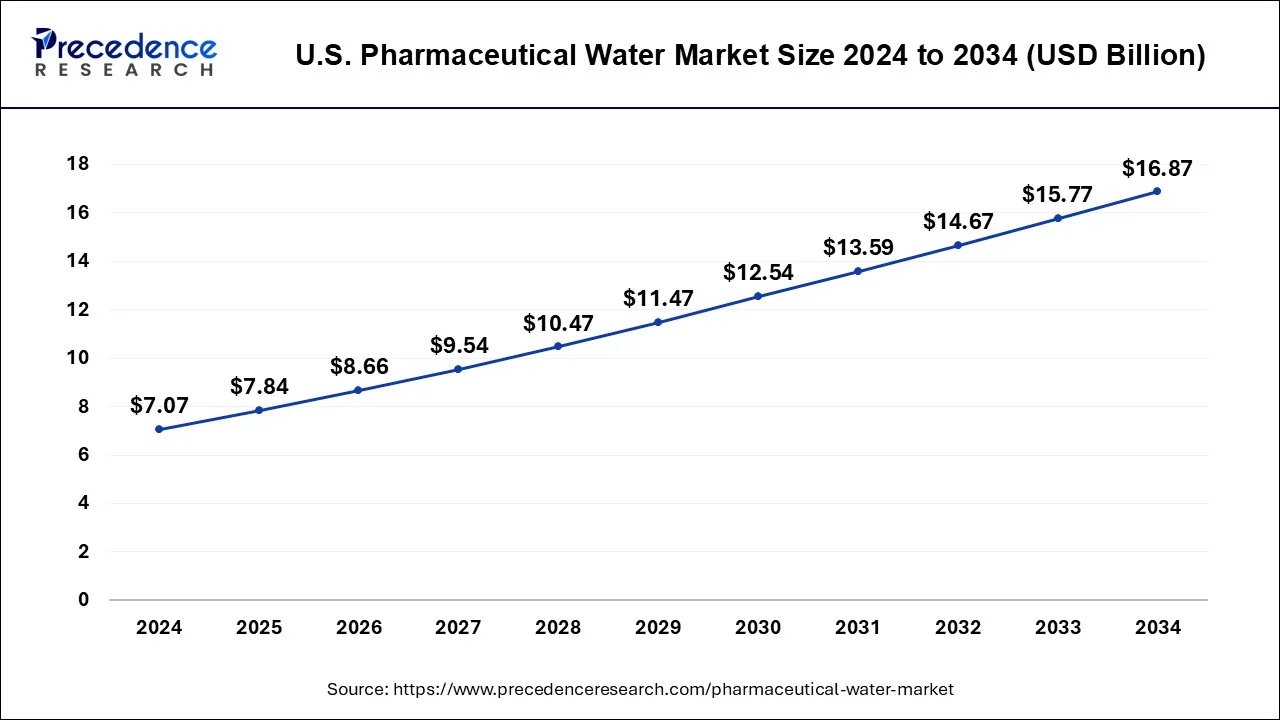
Rohan Patil, a Healthcare Industry Expert, highlights that the U.S. pharmaceutical water market has reached USD 8.66 billion in 2026 and is on track to reach USD 17.97 billion by 2035, advancing at a CAGR of 8.65%. Key U.S. pharmaceutical water market companies shaping the market include Veolia Water Technologies, Thermo Fisher Scientific, Danaher Corporation, Merck KGaA, while major growth segments span By Type, By Application.
Source: https://www.precedenceresearch.com/us-pharmaceutical-water-market
 Get a Sample
 Table Of Content


US Pharmaceutical Water Market Size and Forecast 2026 to 2035
The US pharmaceutical water market size accounted for USD 7.84 billion in 2025 and is predicted to increase from USD 8.66 billion in 2026 to approximately USD 17.97 billion by 2035, expanding at a CAGR of 8.65% from 2026 to 2035. The market is witnessing substantial growth due to the escalating burden of chronic diseases and the surging demand for high-quality biologics and sterile injectables. This expansion is supported by stringent FDA sterility standards and rapid advancements in water purification technologies, spurring massive investments in pharmaceutical manufacturing infrastructure.
Key takeaways
- By type, the water for injection (WFI) segment contributed the highest market share in 2025.
- By type, the HPLC-grade water segment is expected to grow at a strong CAGR between 2026 and 2035.
- By application, the pharmaceutical and biotechnology companies segment held a major market share in 2025.
- By application, the academic and research laboratories segment is expected to expand at a notable CAGR from 2026 to 2035.
Market Overview
The U.S. pharmaceutical water market comprises systems, purification equipment, and services for producing highly purified water, used as a solvent, ingredient, and cleaning agent in drug manufacturing. This market relies on compliance-driven technologies such as reverse osmosis and distillation to meet regulatory standards for the production, processing, and formulation of healthcare products, including injectable, oral medications, and vaccines. This is driven by biopharmaceutical production, complex drug formulations, and stringent FDA and USP regulations concerning endotoxin and microbial control.
How is AI Transforming the U.S. Pharmaceutical Water Industry?
Artificial Intelligence (AI) is revolutionizing the market by optimizing water purification and storage processes. AI-driven systems coordinate water generation with manufacturing schedules, analyzing enterprise data to produce the precise volume of high-purity water required. These systems integrate production schedules from ERP systems to forecast the exact water needs for upcoming manufacturing and cleaning cycles. AI also manages the energy-intensive continuous loops essential for maintaining high-purity water sterility, reducing waste generation, and minimizing the risk of microbial contamination.
Market Report Coverage and Key Metrics
| Report Coverage | Details |
| Market Size in 2025 | USD 7.84 Billion |
| Market Size in 2026 | USD 8.66 Billion |
| Market Size by 2035 | USD 17.97 Billion |
| Market Growth Rate from 2026 to 2035 | CAGR of 8.65% |
| Base Year | 2025 |
| Forecast Period | 2026 to 2035 |
| Segments Covered | Type, and Application |
Market dynamics
Drivers
Rapid Shift towards Membrane-Based Water for Injection
The rapid shift towards membrane-based WFI production is a key driver. The adoption of electricity-driven purification technologies, like reverse osmosis with electro-deionization (RO-EDI), significantly decreases operational and energy costs for manufacturers. Prompted by updated pharmacopeia guidelines, this move towards membrane systems enables continuous, cost-effective generation of WFI, which is essential for meeting the growing demand for biologics and sterile injectables.
Restraint
Stringent Regulatory Compliance and Vulnerabilities
Stringent regulatory compliance and vulnerabilities related to biofilm formation pose challenges. Despite advancements in technology, pharmaceutical water production is hindered by rigorous FDA regulations and the ongoing risk of bacterial endotoxins and biofilm accumulation. Such systems require constant, energy-intensive recirculation loops and must adhere closely to strict guidelines; any deviation can lead to costly production halts, regulatory scrutiny, and compliance delays.
Opportunity
Expansion of Advanced Biologics and Personalized Medicine
The rise of advanced biologics and personalized medicine creates a significant opportunity. The growing demand for specialized, high-potency biologics, biosimilars, and injectable vaccines depends on having uncompromised, sterile, and pyrogen-free water. Increasing investments in modern water treatment infrastructures provide purification system providers with opportunities to design automated, validated, and customized solutions that support large-scale drug formulation.
How are Government Initiatives Supporting the U.S. Pharmaceutical Water Market?
Government initiatives are significantly bolstering the U.S. pharmaceutical water industry by enforcing strict FDA Current Good Manufacturing Practice (cGMP) regulations and U.S. Pharmacopeia standards. The FDA's quality guidelines require high-purity water systems, such as Purified Water and WFI, which drive consistent demand for advanced filtration, distillation, and continuous purification technologies across manufacturing facilities.
- Notably, the U.S. FDA enforces rigorous guidelines for Water for Pharmaceutical Use, which require stringent microbial and chemical standards for drug manufacturing.
Market Segmentation Analysis
Type Insights
The water for injection (WFI) segment dominated the U.S. pharmaceutical water market in 2025, driven by the rising demand for injectable drugs, biologics, and vaccines. The increasing prevalence of chronic illnesses necessitates more frequent administration of injectable therapies, prompting manufacturers to scale up WFI production. WFI must be sterile, non-pyrogenic, and highly pure to prevent serious bloodborne infections, making it the essential solvent for parenteral treatments. Strict quality control standards enforced by the FDA and USP require pharmaceutical companies to integrate WFI into their operations.
The HPLC grade water segment is expected to have the fastest growth during the forecast period. This is due to advancements in biopharmaceutical research and development, a rise in biosimilar approvals, and stringent requirements for analytical purity. Impurities in water lead to baseline noise, unknown peaks, and blockages in HPLC pumps. Ultra-pure HPLC-grade water ensures accurate, reproducible, and compliant analytical testing. As HPLC is increasingly paired with mass spectrometry, the need for the highest purity mobile phases to maintain detection capabilities and avoid damage to columns.
Application Insights
The pharmaceutical and biotechnology companies segment led the market in 2025. This is due to substantial commercial volume requirements, strict regulatory compliance, and a robust pipeline of complex biopharmaceuticals. The shift toward monoclonal antibodies, personalized medicine, cell therapies, and mRNA vaccines relies heavily on high-purity water systems. Liquid biologics and parenteral drugs directly utilize ultra-pure water as a core ingredient and primary solvent in their final formulations, significantly outpacing the volume demands of independent research laboratories.
The academic and research laboratories segment is expected to grow the fastest during the forecast period. This growth is driven by rapid increases in chronic disease research, investments in personalized medicine, and the rigorous purity requirements for preclinical testing. Research and development related to rare diseases and complex therapies require constant access to high-purity water for sensitive experiments, therapeutic formulations, and cell cultures. The rise in gene therapies and biosimilars demands strict water quality standards to ensure accurate and reproducible analytical results.
U.S. Pharmaceutical Water Market: Country-Level Analysis
- Expanding Therapeutic Applications and Biologics: The rise in chronic diseases and demand for formulated parenteral drugs has created an unprecedented need for sterile and highly purified water in manufacturing. This trend significantly affects major biotech hubs like California, Massachusetts, and North Carolina.
- Business Expansions and New Manufacturing Hubs: Pharmaceutical companies and CDMOs are rapidly increasing their production capacities. States such as New Jersey, Pennsylvania, and Indiana are seeing significant investments in advanced water purification systems to support ongoing operations.
- Surging Prevalence of Target Diseases: The increasing incidence of complex disorders demands intricate biologic treatments and targeted injectables, concentrating production in major health-tech states like New York, Texas, and California.
- Joint Ventures and Biotech Collaborations: Leading water technology providers are partnering with biotech firms to develop cutting-edge HPLC water purification systems, primarily in Maryland and Massachusetts.
- Government Initiatives and Environmental Policies: State and federal organizations are promoting sustainable water recycling practices. For instance, Arizona and California are leading initiatives advocating for zero-liquid discharge and water conservation within industrial facilities.
- Investments in Biotechnology: Both government agencies and private investors are making significant investments in the biotech sector, favoring clusters such as South San Francisco in California and Kendall Square in Massachusetts.
- Stringent U.S. FDA Regulatory Approvals: The FDA is consistently tightening regulations regarding endotoxin limits and microbial purity in pharmaceutical water, driving the upgrade of purification systems nationwide.
U.S. Pharmaceutical Water Market Value Chain Analysis
- Research and Development
This involves laboratory testing, early-stage drug formulations, and cell line development, ensuring the purity of animal model testing and early bioprocess research.
Key Players: Thermo Fisher Scientific, Merck KGaA, and Danaher.
- Clinical Trials and Regulatory Approval
This focuses on therapies advancing into human trials, demand shifts from HPLC-grade research water to validated, highly monitored Purified Water for formulation.
Key Players: Intermountain Life Sciences and B. Braun.
- Manufacturing
This focuses on supplying massive volumes of sterile, pyrogen-free water for complex production such as biologics and viral vectors under strictly regulated conditions.
Key Players: Veolia Water Solutions, Xylem, Pall Corporation, Catalent, Pfizer, and Gilead Sciences.
- Logistics and Patient Delivery
This involves transporting the final, water-formulated drug products under exact temperature controls to maintain the integrity of the medication before patient administration.
Key Players: UPS Healthcare, DHL Group, Marken, and FedEx Logistics.
Competitive Landscape
The U.S. pharmaceutical water market is highly regulated and well-established, dominated by key players such as Veolia Water Technologies, Evoqua Water Technologies, and Merck. These companies are motivated by the extensive biopharmaceutical manufacturing base in the country. They focus on research and development to advance continuous purification systems, such as reverse osmosis, to comply with strict FDA cGMP standards. For instance, Veolia Water Technologies invests heavily in smart, digital monitoring solutions to help manufacturers maintain consistent water quality.
Key players see future opportunities in enhancing circular water recycling technologies and IoT-enabled predictive maintenance to improve operational efficiency and reduce long-term costs. However, emerging companies face significant entry barriers due to the high capital investments necessary for installing, validating, and maintaining compliant water systems.
Top Companies in the U.S. Pharmaceutical Water Market
- Veolia Water Technologies
- Thermo Fisher Scientific
- Danaher Corporation
- Merck KGaA
- â Ecolab
- Xylem Inc.
- Corning Incorporated
- B. Braun
- Veltek Associates
Recent Developments
- In February 2026, the FDA launched its PreCheck pilot program to encourage pharmaceutical companies to establish new manufacturing facilities. This initiative aims to enhance communication and streamline assessments, enabling selected facilities that produce critical medications to receive priority and a program to lead the pharmaceutical manufacturing to be more resilient and competitive.(Source: https://www.europeanpharmaceuticalreview.com)
- In August 2025, Transfilm Technology Corporation unveiled IonClear, a Silicon Valley-based company providing advanced reverse osmosis and nanofiltration membranes. The expansion combines Transfilm's expertise with local operations to deliver sustainable water purification and resource recovery, supporting the long-term vision of zero liquid discharge and industrial water recycling.(Source: https://www.filtsep.com)
Segments Covered in the Report
By Type
- HPLC Grade Water
- Water for Injection
By Application
- Pharmaceutical and Biotechnology Companies
- Academics and Research Laboratories
For inquiries regarding discounts, bulk purchases, or customization requests, please contact us at sales@precedenceresearch.com
Frequently Asked Questions





Ask For Sample
No cookie-cutter, only authentic analysis – take the 1st step to become a Precedence Research client
 Get a Sample




 sales@precedenceresearch.com
 Schedule a Meeting
