



U.S. Central Lab Market Size, Companies, Share, Patient Volume, Treatment Adoption Rates, Pricing Analysis, Regulatory Landscape, Competitive Positioning, and Demand Forecast
Rohan Patil, a Healthcare Industry Expert, highlights that the U.S. central lab market has reached USD 2.58 billion in 2026 and is on track to reach USD 5.19 billion by 2035, advancing at a CAGR of 8.15%. Key U.S. central lab market companies shaping the market include IQVIA, Labcorp, Quest Diagnostics, Thermo Fisher Scientific, while major growth segments span By Product Type, By End User.
Source: https://www.precedenceresearch.com/us-central-lab-market
 Get a Sample
 Table Of Content


What is the U.S. Central Lab Market Size in 2026?
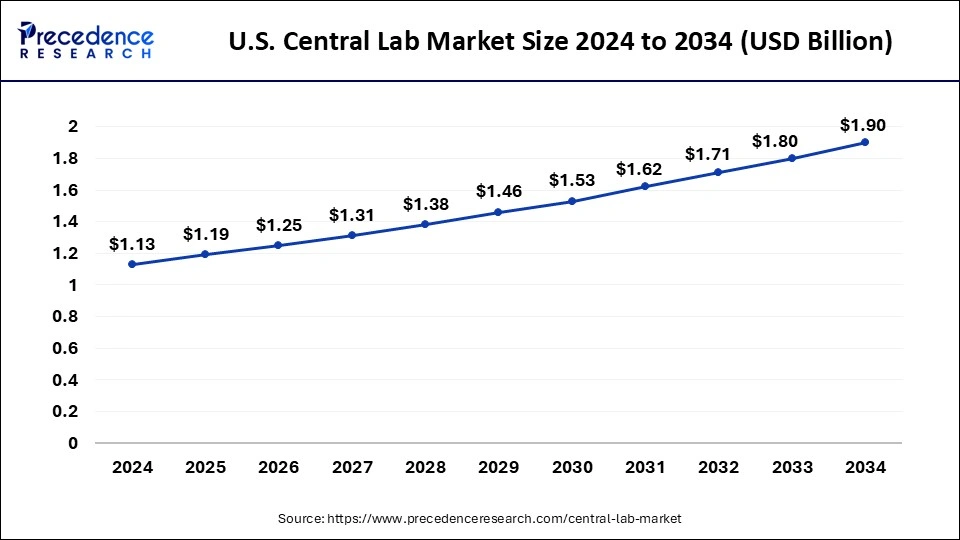
The U.S. central lab market size accounted for USD 2.37 billion in 2025 and is predicted to increase from USD 2.58 billion in 2026 to approximately USD 5.19 billion by 2035, expanding at a CAGR of 8.15% from 2026 to 2035. The market is experiencing strong growth driven by rising investments in biopharmaceutical R&D, increasingly complex clinical trial pipelines, and growing demand for standardized, high-quality biomarker testing. This expansion is further supported by the rapid adoption of advanced technologies such as artificial intelligence, laboratory automation, and decentralized clinical trial models, which are improving operational efficiency, data accuracy, and trial turnaround times.
Key Takeaways
- By product type, the biomarker services segment contributed the highest market share in 2025.
- By product type, the genetic services segment is expected to grow at a strong CAGR between 2026 and 2035.
- By end user, the pharmaceutical companies segment held a major market share in 2025.
- By end user, the biotechnology companies segment is expected to expand at a significant CAGR from 2026 to 2035.
Market Overview
The U.S. central lab market consists of specialized, centralized facilities that provide standardized testing, biomarker analysis, and specimen management for clinical trials and drug development. These labs ensure consistency, regulatory compliance, and accuracy in data across multiple clinical trial sites. The increasing adoption of personalized medicine and targeted therapies has boosted the demand for complex biomarker and genetic testing services. Several pharmaceutical companies are heavily investing in AI-based data analytics and advanced automation to expedite testing times and streamline operations, ensuring compliance with strict FDA regulations.
How is AI Transforming the U.S. Central Lab Market?
Artificial intelligence (AI) is transforming the market by optimizing workflows and accelerating patient diagnostics, serving as a vital tool for modern biopharmaceuticals. AI acts as a catalyst for faster drug development, enhanced data accuracy, and management of complex multi-site clinical trials. It changes clinical data management from a retroactive, batch-cleaning process to a proactive, real-time function, reducing resolution times. AI helps accelerate experimental cycles by predicting the efficacy and toxicity of potential drug candidates before physical testing.
- For instance, in January 2026, Elucidata launched an AI Lab aimed at advancing Artificial General Intelligence in biomedical development. This lab addresses out-of-distribution problems to capture essential edge-case signals, delivering real-world AI solutions across human, plant, and animal health.
Market Scope
| Report Coverage | Details |
| Market Size in 2025 | USD 2.37 Billion |
| Market Size in 2026 | USD 2.58 Billion |
| Market Size by 2035 | USD 5.19 Billion |
| Growth Rate from 2025 to 2034 | CAGR of 8.15% |
| Base Year | 2025 |
| Forecast Period | 2026 to 2035 |
| Segments Covered | Product Type, and End User |
Market Dynamics
Drivers
Demand for Decentralized Biomarker Testing
The shift toward precision medicine is increasing demand for biomarker-driven clinical trials, which in turn is driving the need for specialized central laboratory services. Modern central labs enable standardized, real-time data collection across multiple trial sites, ensuring data consistency in complex oncology and neurological studies. This improves data quality, reduces variability, accelerates drug development timelines, and ensures regulatory compliance, making central laboratories a critical component of pharmaceutical research.
Restraint
Regulatory Stringency and Specialized Staffing Shortages
The market faces challenges due to high operational costs linked to evolving FDA regulations and global compliance requirements. Laboratories also face complexities in validating and standardizing diverse testing platforms across multiple trial sites. In addition, a shortage of skilled medical technologists and data scientists is increasing labor costs and delaying the implementation of newly validated diagnostic assays, further constraining market efficiency and scalability.
Opportunity
Automation and AI-Driven Data Integration
The integration of artificial intelligence and robotic automation into central laboratory operations offers significant opportunities to reduce human error and improve processing throughput. Automation of tasks such as sample handling, accessioning, and multi-omics data analysis enables faster and more accurate insights into drug efficacy and patient stratification. These scalable digital ecosystems also allow central laboratories to expand specialized service offerings, creating new revenue streams and enhancing value for pharmaceutical sponsors.
How are Regulatory Mandates Shaping the U.S. Central Lab Market?
Regulatory mandates are standardizing operations within central labs through strict federal frameworks such as the FDA Medical Devices Overview and the CMS CLIA Program. These regulations require laboratories handling human specimens for clinical trials or diagnostics to obtain the appropriate certifications and rigorously validate their testing procedures. Moreover, updated FDA rules mandating that laboratory-developed tests undergo authorization necessitate robust compliance and data management protocols across all central labs.
- For instance, the FDA has proposed a rule to end enforcement discretion for laboratory-developed tests by classifying them as medical devices, impacting all existing LDTs.
Segment Insights
Product Type Insights
The biomarker services segment dominated the U.S. central lab market with the largest share in 2025. This is mainly due to the rapid shift toward personalized medicine, increasing complexity of targeted therapies, and the growing outsourcing of clinical trial data validation. The rising adoption of targeted therapies has also boosted demand for companion diagnostics, strengthening the role of biomarker testing in clinical development.
Central laboratories are increasingly providing advanced biomarker services to support patient stratification, enable genetically tailored treatments, and improve early disease detection. These capabilities also enhance the accuracy of treatment monitoring and clinical outcome assessment, further reinforcing the segment's dominant market position.
The genetic services segment held a significant share of the market in 2025 and is expected to grow at a strong CAGR in the coming years. This is mainly due to the rising adoption of precision medicine and the increasing use of genomic data in clinical trials and drug development. Expanding applications of genetic testing for patient stratification, disease risk assessment, and treatment selection are further driving demand for these services. In addition, advancements in next-generation sequencing (NGS) technologies and declining sequencing costs are making genetic analysis more accessible and widely adopted across pharmaceutical and clinical research settings.
End User Insights
The pharmaceutical companies segment led the U.S. central lab market in 2025. This is mainly due to their high R&D spending and strong need for standardized, high-quality data across large, multi-site global clinical trials. These companies conduct extensive studies that generate large volumes of patient samples, requiring central laboratories to ensure consistent testing protocols and reliable results across all sites. The growing focus on targeted oncology therapies, biosimilars, and rare disease treatments has further increased demand for centralized testing, helping reduce regulatory risks and improve approval success rates.
The biotechnology companies segment is anticipated to grow at the fastest rate during the forecast period, driven by the rapid expansion of targeted biologics, cell therapies, and gene therapies. Emerging biotech firms rely heavily on central labs for specialized services such as biomarker validation, genomic profiling, and secure sample management to support complex clinical pipelines. Increasing FDA approvals for advanced therapies are further accelerating the need for sophisticated analytical testing, strengthening the segment's growth momentum.
U.S. Central Lab Market: Country-Level Analysis
- Massachusetts: Biotech clusters in Cambridge and Boston are attracting significant venture capital and early-stage biopharma funding. As a result, central labs in this state are expanding their biorepositories and advanced genetic testing capabilities.
- California: With a dense concentration of innovative life science startups in the San Francisco Bay Area and San Diego, the demand for centralized oncology testing and biomarker analysis is at an all-time high.
- New Jersey: A traditional powerhouse for major pharmaceutical headquarters, New Jersey is investing heavily in laboratory automation and anatomic pathology networks to seamlessly process thousands of multisite clinical trial samples.
- Texas: Major medical and biotechnology hubs in Houston and Dallas are increasingly utilizing microbiology and specialized chemistry services to address the growing burden of chronic diseases.
- Maryland: Proximate to federal health agencies (e.g., FDA, NIH), Maryland's central labs are leading efforts in regulatory compliance and clinical data standardization, ensuring rapid and secure clinical validation for new therapeutics.
Competitive Landscape
The U.S. central lab market is moderately consolidated, with a few large players dominating alongside several specialized and niche service providers. Key companies compete by offering end-to-end laboratory solutions, expanding global and domestic trial support capabilities, and investing heavily in advanced technologies such as automation, AI-driven analytics, and multi-omics testing platforms. Strategic partnerships with pharmaceutical and biotechnology firms, acquisitions of specialized diagnostic labs, and expansion of biomarker and genetic testing portfolios are common strategies used to strengthen market position and secure long-term clinical trial contracts.
To remain competitive, key players must focus on expanding high-value specialty services such as biomarker discovery, genomic sequencing, and companion diagnostics, which are increasingly critical for precision medicine trials. In addition, expanding integrated service offerings for emerging biotech companies and supporting decentralized and hybrid clinical trial models is expected to help players maintain a stronghold in the market.
U.S. Central Lab Market Companies
- IQVIA
- Labcorp
- Quest Diagnostics
- Thermo Fisher Scientific
- ICON plc
- Charles River Laboratories
- Medpace
- Eurofins Scientific
- Frontage Labs
- ACM Global Laboratories
Recent Developments
- In June 2026, Altamonte Springs partnered with TSG Transportation Advisors to establish a Center of Excellence (COE) at the Altamonte Global Innovation Lab (AGÄ«L). This initiative guides international businesses through complex federal regulations and the Build America, Buy America Act, helping them access lucrative U.S. infrastructure and tech contracts.(Source: https://www.mysanfordherald.com)
- In April 2026, ARUP Laboratories launched an Innovation Central Laboratory to enhance collaboration in developing next-generation diagnostic technologies. This facility aims to accelerate the validation of innovative diagnostics, ensuring they are ready for real-world application to improve global patient care, advancing genomic sequencing, and integrating AI into laboratory workflows.(Source: https://clpmag.com)
Segments Covered in the Report
By Product Type
- Genetic Services
- Biomarker Services
- Microbiology Services
- Special Chemistry Services
- Clinical Research and Trial Services
- Others
By End User
- Pharmaceutical Companies
- Biotechnology Companies
- Academic and Research Institutes
- Others
For inquiries regarding discounts, bulk purchases, or customization requests, please contact us at sales@precedenceresearch.com
Frequently Asked Questions
Tags





Ask For Sample
No cookie-cutter, only authentic analysis – take the 1st step to become a Precedence Research client
 Get a Sample




 sales@precedenceresearch.com
 Schedule a Meeting
