



U.S. Insulin Pump Market Size, Companies, Share, Patient Volume, Treatment Adoption Rates, Pricing Analysis, Regulatory Landscape, Competitive Positioning, and Demand Forecast
Deepa Pandey, a Healthcare Industry Expert, highlights that the U.S. insulin pump market has reached USD 2.48 billion in 2026 and is on track to reach USD 5.13 billion by 2035, advancing at a CAGR of 8.40%. Key U.S. insulin pump market companies shaping the market include Medzer, Cequr SA, Medtronic, while major growth segments span By Pump Type, By Product, By Application, By Disease Indication, By End User.
Source: https://www.precedenceresearch.com/us-insulin-pump-market
 Get a Sample
 Table Of Content


What is the U.S. Insulin Pump Market Size in 2026?
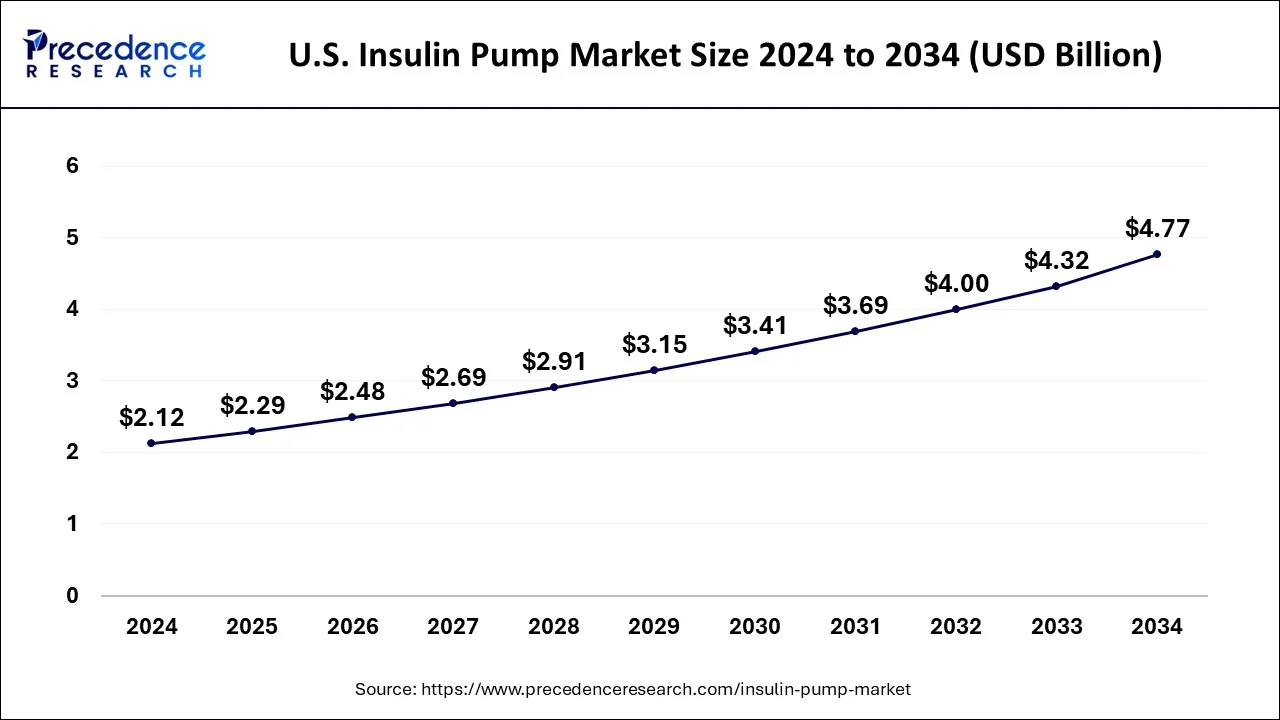
The U.S. insulin pump market size was calculated at USD 2.29 billion in 2025 and is predicted to increase from USD 2.48 billion in 2026 to approximately USD 5.13 billion by 2035, expanding at a CAGR of 8.40% from 2026 to 2035. The market is driven by the integration of artificial intelligence in hybrid closed-loop systems and the growing burden of diabetes.
Key Takeaways
- By pump type, the tethered pump segment held the largest market share in 2025.
- By pump type, the patch pump segment is expected to expand at the highest CAGR during the forecast period.
- By product, the MiniMed segment held the largest market share in 2025.
- By product, the tandem segment is expected to expand at the fastest rate during the forecast period.
- By accessories, the insulin set insertion devices segment held the highest share of the market in 2025.
- By accessories, the insulin reservoir segment is expected to grow with the highest CAGR during the forecast period.
- By disease indication, the type 1 diabetes segment held the highest share of the market in 2025.
- By disease indication, the type 2 diabetes segment is expected to grow with the highest CAGR during the forecast period.
- By end-user, the hospitals segment held the highest share of the market in 2025.
- By end-user, the homecare segment is expected to grow at the highest CAGR during the forecast period.
Market Overview
The U.S. insulin pump industry encompasses the manufacturers, distributors, and healthcare networks responsible for producing and supplying automated, wearable devices utilized to manage diabetes. The major driving force of the U.S. insulin pump market is the rising adoption of continuous glucose monitors and automated insulin delivery systems. Ongoing technological advancements in medical devices, growing diabetic population, and favorable healthcare reimbursement policies in some regions are likely to support market growth in upcoming period.
How is AI Revolutionizing the U.S. Insulin Pump Market?
In the U.S. insulin pump industry, AI acts as the "brain" of Automated Insulin Delivery (AID) systems. Machine learning algorithms continuously determine real-time glucose readings from continuous glucose monitors (CGMs). This enables pumps to automatically predict blood sugar trends and then adjust or suspend insulin delivery to prevent dangerous highs and lows. By automating micro-adjustments and overnight corrections, AI systems decrease the need for constant manual monitoring and daily math.
Market Scope
| Report Coverage | Details |
| Market Size in 2025 | USD 2.29 Billion |
| Market Size in 2026 | USD 2.48 Billion |
| Market Size by 2035 | USD 5.13 Billion |
| Market Growth Rate from 2026 to 2035 | CAGR of 8.40% |
| Base Year | 2025 |
| Forecast Period | 2026 to 2035 |
| Segments Covered | Pump Type, Accessories, and End User |
Market Dynamics
Drivers
Robust Healthcare Infrastructure
A robust healthcare infrastructure in developed countries drives the U.S. insulin pump market by seamlessly integrating advanced, AI-based medical devices into daily clinical practice. It fuels adoption via strong insurance coverage, comprehensive patient education, along with a competitive ecosystem of major manufacturers, which consistently push technological boundaries. Initiatives by organizations such as the CDC and dedicated pump-care programs educate patients and clinicians, which encourages early adoption and long-term compliance.
Restraint
Reimbursement Hurdles
Reimbursement hurdles act as a primary restraint for the U.S. insulin pump market. High costs of insulin pumps and even the administrative complexities required to obtain insurance coverage. These financial and procedural barriers deter patients from adopting advanced diabetes management solutions.
Opportunity
Shift Toward Tech-Integrated Diabetes Care
By combining hardware with software, the healthcare industry is shifting from basic insulin delivery to fully automated, personalized management systems. Moreover, the integration of insulin pumps with continuous glucose monitors, along with advanced algorithms, has created "hybrid closed loop" or artificial pancreas systems. These technologies automatically adjust insulin based on real-time glucose readings, remarkably reducing the risk of hypoglycemia and hyperglycemia.
Segment Insights
Pump Type Insights
The tethered pump segment dominated the U.S. insulin pump market with the largest share in 2025. This is because of its clinical reliability, precise insulin delivery, and seamless integration with advanced continuous glucose monitoring systems. Tethered pumps generally hold larger volumes of insulin, thus making them highly convenient and limiting the frequency of site changes for individuals demanding higher daily doses.
The patch pump segment is expected to grow at the highest CAGR during the forecast period, owing to its compact, tubeless design, high convenience, and seamless integration with continuous glucose monitors. Modern patch pumps feature sophisticated algorithms, such as those in the Insulet Omnipods 5 System, which communicate directly with CGMs to automatically adjust or pause insulin delivery.
Product Insights
The MiniMed segment dominated the market in 2025 due to its advanced closed-loop automation systems, which enabled highly effective and reliable diabetes management solutions. Its ability to integrate seamlessly with proprietary and partner CGM sensors created a comprehensive, connected ecosystem that improved glucose control and strengthened its competitive position in the market.
The tandem segment is expected to grow at the highest CAGR during the forecast period. Tandem transformed the market by enabling users to update their pump software at home. Instead of buying a completely new apparatus, users can upgrade their pumps to feature newly approved algorithms without needing fresh hardware. Tandem pumps feature color touchscreen displays, easy-to-read, rechargeable batteries, and even remote mobile bolusing capabilities via their Tandem Diabetes Care app.
Accessories Insights
The insulin set insertion devices segment held a major share of the U.S. insulin pump market in 2025. This is due to the high recurring replacement rates, improved patient comfort, and user-friendly designs. Modern insertion devices feature spring-loaded mechanisms that ensure consistent, painless, and rapid needle insertion. Reduced pain along with localized trauma strongly encourages individuals to stick to pump therapy, driving the demand for these devices.
The insulin reservoir segment is expected to grow at the fastest CAGR during the forecast period. This is mainly due to the shift toward smart, hybrid closed-loop systems, such as those from Tandem and Insulet, which have increased the usage of rapid-acting insulin. This has driven the need for specialized, compatible reservoirs that integrate seamlessly with continuous glucose monitors.
Disease Indication Insights
The type 1 diabetes segment dominated the market with a major share in 2025 due to the absolute insulin dependency of patients, as their bodies produce little to no insulin and require continuous, precise insulin administration. Insulin pumps are essential for patients with type 1 diabetes, significantly reducing the need for multiple daily injections, which improves glycemic control, enhances clinical outcomes, and substantially improves the quality of life for patients.
The type 2 diabetes segment is expected to grow at the highest CAGR during the forecast period due to its large and expanding patient population, along with an industry-wide shift toward more automated and user-friendly insulin pump technologies. Additionally, a growing number of insulin-dependent type 2 diabetes patients are transitioning from multiple daily injections (MDIs) and insulin pens to insulin pumps to achieve better glycemic control and reduce long-term disease complications.
End User Insights
The hospitals segment dominated the U.S. insulin pump market with a major share in 2025. This is due to their role as the initial point of care for diagnosis, their high volume of diabetes-related visits, and their ability to execute complex therapy training successfully. Hospitals are the primary setting for the complex initiation of insulin pump therapy. Clinicians calibrate initial basal rates, and even hospital educators provide patients with vital training on device operations, site insertion, and emergency protocols.
The homecare segment is expected to grow at the highest CAGR during the forecast period, driven by the increasing shift toward self-managed diabetes care, enabling individuals with type 1 and type 2 diabetes to monitor and control glycemic levels independently at home. The availability of wearable and user-friendly insulin delivery systems, including tethered pumps, patch pumps such as Omnipods, and hybrid closed-loop technologies, supports continuous, discreet, and highly accurate insulin administration.
U.S. Market Trends: Country-Level Analysis
- Shift Toward Advanced Devices: There is a rapid shift from simple delivery tools to automated artificial pancreas systems. This shift expands the target patient base, improves treatment compliance, and drives wider market adoption. Pumps with smartphone connectivity and data-sharing features enable patients to manage their condition discreetly and share real-time data with caregivers and endocrinologists.
- Investments: Investments drive R&D for technological breakthroughs, expand access to telehealth, and scale manufacturing of advanced AI-based closed-loop systems. Venture capital and corporate investments are focused on tubeless patch pumps, offering patients a more discreet and minimally invasive alternative to traditional tethered pumps.
- Regulatory Approvals: They unlock insurance coverage, expand the addressable patient base, including type 2 diabetes patients, and validate the safety and interoperability of AI-based closed-loop algorithms. In the U.S., insurers and Medicare typically cover only pumps and consumables that have received formal FDA clearance.
Competitive Landscape
The U.S. insulin pump market is highly competitive, driven by strategic partnerships, technological innovation, and expanding diabetes management needs. Major players such as Medtronic, Tandem Diabetes Care, Insulet Corporation, and Beta Bionics compete through advanced automated insulin delivery systems, user-friendly designs, and continuous glucose monitoring integration. Firms focus on FDA approvals, software enhancements, product innovation, and digital health connectivity to strengthen market position. Market participants also pursue collaborations, acquisitions, and geographic expansion to improve their customer base and product portfolios.
Top Companies Operating in the U.S. Insulin Pump Market
Recent Developments
- In May 2026, Insulet Corporation enrolled the first participant in a pivotal study for its fully closed-loop (FCL) automated insulin delivery (AID) system for type 2 diabetes (T2D). Moreover, FCL for T2D is a breakthrough innovation intended to further enhance glycemic outcomes with less burden for users across diverse care settings.(Source: https://investor.insulet.com)
- In February 2026, Medtronic declared three significant U.S. milestones that expand access, choice, and even flexibility for people living with type 1 and insulin‑requiring type 2 diabetes. These milestones involve Medicare access for the MiniMed 780G system paired with the Instinct sensor, made by Abbott, and thus, FDA clearance of the MiniMed 780G system for use with the Instinct sensor for insulin-requiring type 2 diabetes. (Source: https://news.medtronic.com)
Segments Covered in the Report
By Pump Type
- Tethered Pump
- Patch Pump
- Implanted Insulin Pump
- Closed Loop Insulin Pump
By Product
- MiniMed (630G, 670G, and VEO)
- Accu-Chek (Combo, Insight, and Solo)
- Tandem (T: slim X2, G4, T: flex Delivery System)
- Omnipod
- My life omnipod
- Others
By Accessories
- Battery
- Insulin Set Insertion Devices
- Insulin Reservoir
By Disease Indication
- Type 1 Diabetes
- Type 2 Diabetes
By End User
- Hospitals
- Clinics
- Homecare
- Laboratories
For inquiries regarding discounts, bulk purchases, or customization requests, please contact us at sales@precedenceresearch.com
Frequently Asked Questions





Ask For Sample
No cookie-cutter, only authentic analysis – take the 1st step to become a Precedence Research client
 Get a Sample




 sales@precedenceresearch.com
 Schedule a Meeting
