



AI in CGT Manufacturing Market Trends, Companies, Revenue / Sales Performance, Subscriber Growth, Pricing Strategies, Cloud Adoption, Infrastructure Expansion, Competitive Landscape, and Industry Outlook
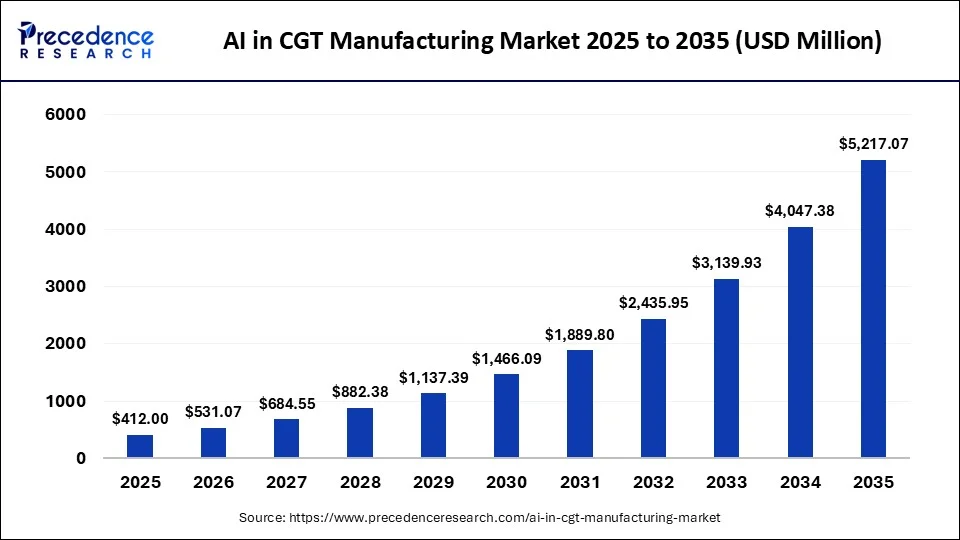
ICT industry specialist Shivani Zoting estimates the AI in CGT manufacturing market at USD 531.07 million in 2026, with continued technology adoption expected to take the market to USD 5,217.07 million by 2035 at a CAGR of 28.90%. Leading AI in CGT manufacturing market providers such as Bluebird Bio Inc., Boehringer Ingelheim, Catalent Inc are expanding their capabilities across segments including component, deployment mode, technology, manufacturing stage, therapy type, application, end user, organization size, region.
Source: https://www.precedenceresearch.com/ai-in-cgt-manufacturing-market
 Get a Sample
 Table Of Content


AI in CGT Manufacturing Market Size and Forecast 2026 to 2035
The global AI in CGT manufacturing market size accounted for USD 412.00 million in 2025 and is predicted to increase from USD 531.07 million in 2026 to approximately USD 5,217.07 million by 2035, expanding at a CAGR of 28.90% from 2026 to 2035. Market growth is attributed to the increasing commercialization of cell and gene therapies and growing investments in AI-driven process optimization across advanced therapy production facilities.
Key Takeaways
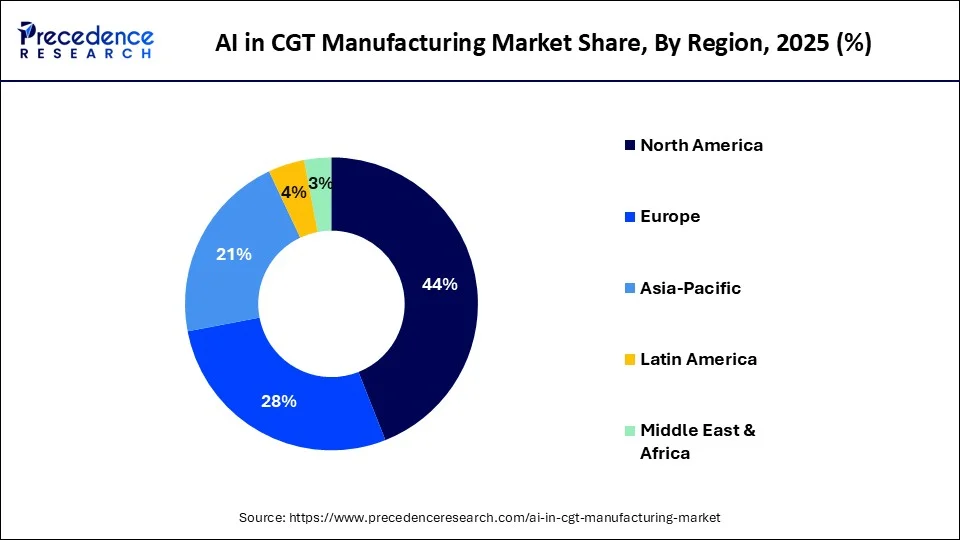
- North America dominated the AI in CGT manufacturing market with 44% of the market share in 2025.
- Asia-Pacific is expected to register the fastest growth of 34.6% CAGR during 2026 and 2035.
- By component, the software segment contributed the highest market share of 72% in 2025.
- By component, the service segment is expected to grow at a rapid CAGR of 30.8% between 2026 and 2035.
- By deployment mode, the cloud-based segment held a major market share of 51% in 2025 and is expected to register the fastest growth of 31.8% CAGR during 2026 and 2035.
- By deployment mode, the on-premises segment held the second-largest market share with a 34% share in 2025.
- By technology, the machine learning (ML) segment contributed the highest AI in CGT manufacturing market share of 34% in 2025.
- By technology, the generative AI segment is estimated to grow at a strong CAGR of 35.8% over the projected period.
- By manufacturing stage, the cell expansion segment contributed the highest market share of 21% in 2025.
- By manufacturing stage, the gene editing and vector production segment is expected to grow at the fastest CAGR of 31.5% between 2026 and 2035.
- By therapy type, the cell therapy segment contributed the highest market share of 62% in 2025.
- By therapy type, the gene therapy segment is expected to grow at the fastest CAGR of 30.1% between 2026 and 2035.
- By end user, the biopharmaceutical companies segment held a major market share of 46% in 2025.
- By end user, the contract development and manufacturing organizations (CDMOs) segment is expected to register the fastest growth of 32.4% CAGR during 2026 and 2035.
Market Overview
Advanced manufacturing is gaining traction, with government support further driving a faster growth rate in the market. Artificial intelligence (AI) enhances cell and gene therapy production. They optimize production and monitor production in real-time. This integrates machine learning, computer vision, predictive analytics, robotics, and digital twins.
These technologies help achieve batch success and enable high productivity of complex products. The U.S. Food and Drug Administration (FDA) has taken action to approve nearly 50 cell and gene therapies at CBER. Furthermore, this growing pipeline is driving a need for intelligent manufacturing platforms that meet the needs of commercial-scale production in the coming years.
AI in CGT Manufacturing Market Growth Factors
- Growing Adoption of Digital Twin Manufacturing: The increasing use of Digital Twin Manufacturing is enhancing process simulation and manufacturing planning in CGT facilities through the use of AI.
- Driving Expansion of AI-Enabled Manufacturing Software Platforms: AI-powered manufacturing execution and quality management (MAQ) software is being deployed in greater numbers, and regulatory preparedness of manufacturing software.
AI in CGT Manufacturing Market Trends
- Autonomous AI Agents Becoming the Next Manufacturing Standard: Manufacturers increasingly replace isolated AI tools with autonomous AI agents that coordinate production scheduling and equipment utilization across connected manufacturing facilities. These engineered systems augment decisions made by humans without needing to be used on an ongoing basis. They enable the continuous manufacturing of advanced therapies.
- Physical AI Reshaping Robotic Cell and Gene Therapy Manufacturing: Robotics, computer vision, and intelligent simulation, physical AI is becoming a trend in advanced biomanufacturing facilities. Manufacturers are moving toward more complex laboratory automation and increasing manufacturing consistency. In 2026, Multiply Labs added NVIDIA Isaac technologies to build biomanufacturing robotic systems that can help in the evolution of cell and gene therapies.
Market Report Coverage and Key Metrics
| Report Coverage | Details |
| Market Size in 2025 | USD 412.00 Million |
| Market Size in 2026 | USD 531.07 Million |
| Market Size by 2035 | USD 5,217.07 Million |
| Market Growth Rate from 2026 to 2035 | CAGR of 28.90% |
| Dominating Region | North America |
| Fastest Growing Region | Asia Paicfic |
| Base Year | 2025 |
| Forecast Period | 2026 to 2035 |
| Segments Covered | Component, Deployment Mode, Technology, Manufacturing Stage, Therapy Type, Application, End User, Organization Size, and Region |
| Regions Covered | North America, Europe, Asia-Pacific, Latin America, and Middle East & Africa |
Market Dynamics
Drivers
Increasing Commercialization of Cell and Gene Therapies
Increasing commercialization of cell and gene therapies is expected to drive market growth. Commercial pipelines for biopharmaceutical developers have been growing in recent times. They still need manufacturing processes that are data-driven and highly consistent to ensure product quality and compliance.
- According to the Waters Corporation 2024 report, there is an acute capacity shortage for cell and gene therapies, with a current manufacturing capacity shortfall estimated at 500%.
AI-driven analytics have the ability to streamline key processing parameters and maintain batch uniformity. It also minimizes manual interventions by facilitating real-time quality monitoring throughout production processes. Furthermore, the increasing number of therapies getting into late-stage clinical products is further cementing investments in AI-powered manufacturing infrastructure.
Restraint
High Implementation Costs and Complex Infrastructure Requirements
High implementation costs and complex infrastructure requirements are expected to hamper market growth in the coming years. The adoption of machine learning models in manufacturing execution systems (MES) and laboratory information management systems (LIMS) adds to the complexity of deployment. Furthermore, technology uptake is still stalling in several of the new manufacturing sites due to these investment and infrastructure issues.
Opportunity
Growing Manufacturing Complexity of Personalized Therapies
The growing manufacturing complexity of personalized cell and gene therapies, facilitating AI integration, is expected to create immense opportunities for the market. AI algorithms help to detect process variations. They also enhance the consistency of operations while maintaining seamless workflow continuity.
Computer vision technologies facilitate automated cell characterization. Predictive models boost equipment performance and minimize manufacturing deviations. Furthermore, the AI-based analytical platforms provide continuous monitoring, enhancing production control measures and minimizing variations in biologics facilities.
Market Segmentation Analysis
Deployment Mode Insights
The Cloud-based Segment Dominated the Market with 51% of Market Share in 2025
The cloud-based segment dominated the AI in CGT manufacturing market with a share of 51% in 2025, due to the growing implementation of scalable digital infrastructure for growing cell and gene therapy operations. Organizations considered cloud environments to integrate manufacturing plants and quality staff.
They are aimed at facilitating access to manufacturing information. Further allowing for the quick sharing of information between geographically dispersed manufacturing premises. On the other hand, Manufacturing execution systems (MES) further integration with advanced analytics platforms served as another boost to cloud adoption.
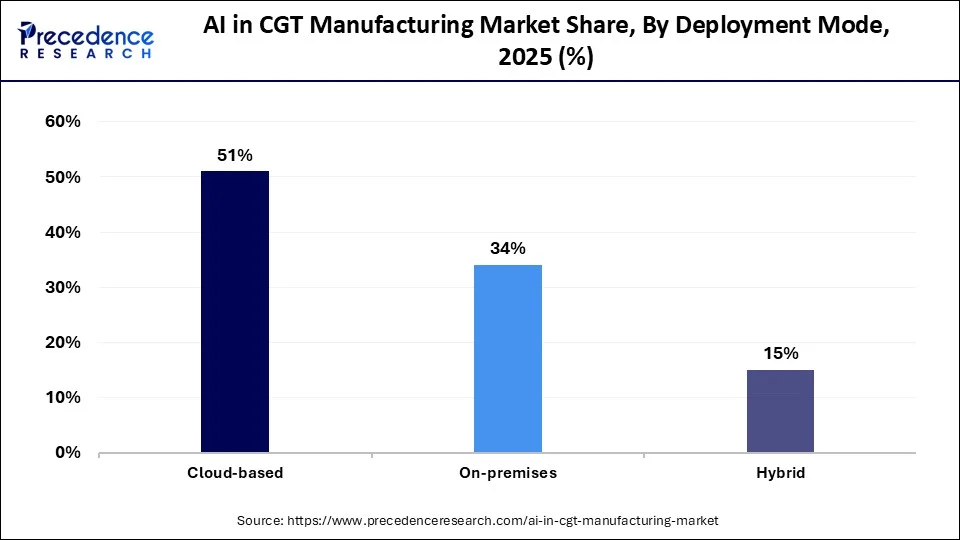
The on-premises segment held a 34% share of the market in 2025 and is expected to grow at a significant CAGR of 22.4% between 2026 and 2035, as a large number of commercial manufacturing facilities demand control of critical production systems in the field. Cell and gene therapy manufacturing processes are highly regulated.
They involve complex data and validation workflows that require robust monitoring and control measures. AI is often embedded in current automation systems and processes without moving necessary production data elsewhere, thus boosting the segment growth.
The hybrid segment held a 15% share in 2025 and is expected to register a significant growth of 28.7% CAGR during 2026 and 2035, due to a balance of both flexibility and regulatory compliance needs of manufacturers. Hybrid AI platforms support co-operation between development and commercial production laboratories. This design is compatible with processing secure critical manufacturing processes and with enterprise visibility of data.
Technology Insights
The Machine Learning (ML) Segment Dominated the Market with 34% of Market Share in 2025
The machine learning segment dominated the AI in CGT manufacturing market with a share of 34% in 2025, as manufacturers turned to predictive intelligence in therapy production processes. The manufacturing data was continuously analysed using advanced algorithms. They helped to optimise process parameters and ensure consistency of the products.
During 2025, the global development pipeline has grown to over 4000 gene, cell and RNA therapies, prompting increased demand for advanced digital manufacturing technologies including ML.
AI in CGT Manufacturing Market Share, By Technology, 2025 (%)
| Technology | 2025 | 2035 | CAGR (%) |
| Machine Learning (ML) | 34 | 30 | 26.50% |
| Deep Learning | 20 | 23 | 31.60% |
| Computer Vision | 15 | 17 | 30.90% |
| Natural Language Processing (NLP) | 10 | 9 | 25.80% |
| Reinforcement Learning | 8 | 9 | 32.40% |
| Generative AI | 13 | 12 | 35.80% |
The generative AI segment held a 13% share of the market in 2025 and is expected to grow at a rapid CAGR of 35.8% between 2026 and 2035, due to its increasing adoption for process optimization, automated quality control, and accelerated drug development workflows.
The deep learning segment held a 20% share in 2025 and is expected to register a significant growth of 31.6% CAGR during 2026 and 2035, due to growing investments in computational biology. Manufacturers deal with highly complex three-dimensional images of biology or high-intensity manufacturing data. Incorporation of deep learning has been demonstrated to recognize finer cellular changes. They are often not recognized by analytical models. These features enhance the reproducibility of manufacturing in advanced therapy manufacturing labs.
Manufacturing Stage Insights
The Cell Expansion Segment Held the Largest Market Share of 21% in 2025
The cell expansion segment held the largest revenue share of 21% in the AI in CGT manufacturing market in 2025, due to increasing commercialization of advanced therapies. Predictive analytics was also used in production teams to ensure cell viability. They also help to minimize process variability during scale-up production.
The gene editing and vector production segment held an 18% share of the market in 2025 and is expected to grow at the fastest CAGR of 31.5% between 2026 and 2035, as researchers continue to push forward next-generation genetic therapies that are now in clinical and commercial production trials. In 2025, CRISPR Therapeutics continued to use gene-edited therapy in clinical development, thus facilitating the segment's growth in the coming years.
AI in CGT Manufacturing Market Share, By Manufacturing Stage, 2025 (%)
| Manufacturing Stage | 2025 | 2035 | CAGR (%) |
| Upstream Processing | 17 | 15 | 26.20% |
| Cell Expansion | 21 | 23 | 30.80% |
| Gene Editing & Vector Production | 18 | 20 | 31.50% |
| Downstream Processing | 15 | 14 | 27.10% |
| Fill & Finish | 9 | 8 | 25.40% |
| Quality Control & Release Testing | 20 | 20 | 29.80% |
The quality control and release testing segment held a 20% share in 2025 and is expected to register growth of 29.8% CAGR during 2026 and 2035, owing to the increasing regulatory emphasis on manufacturing consistency. Developers added intelligent quality systems to release testing activities in commercial facilities.
Manufacturers are increasingly looking to link the digital quality platform with laboratory systems to enhance both analytical efficiency and compliance management. Furthermore, the areas of modern CGT manufacturing facilities were reinforced with a suite of innovations that enabled intelligent quality control.
Therapy Type Insights
The Cell Therapy Segment Dominated the Market with 62% of Market Share in 2025
The cell therapy segment dominated the AI in CGT manufacturing market with a share of 62% in 2025, due to the growing number of approved and late-stage cell therapies. Investors moved to improve intelligent automation in HTP environments with the growth of the clinical and commercial manufacturing base.
AI in CGT Manufacturing Market Share, By Therapy Type, 2025 (%)
| Therapy Type | 2025 | 2035 | CAGR (%) |
| Cell Therapy | 62 | 60 | 28.20% |
| Gene Therapy | 38 | 40 | 30.10% |
The Alliance for Regenerative Medicine (ARM) reported that developers secured over USD 15 billion in global financing during 2024, thus boosting the demand for AI-based CGT manufacturing for cell therapy in the coming years.
The gene therapy segment held a 38% share of the market in 2025 and is expected to grow at the fastest CAGR of 30.10% between 2026 and 2035, driven by the increasing complexity of gene therapy manufacturing. AI tools boost vector design, process optimization, analytical interpretation, and production planning in gene-specialized manufacturing processes.
End User Insights
The Biopharmaceutical Companies Segment Dominated the Market with 46% of Market Share in 2025
The biopharmaceutical companies segment dominated the AI in CGT manufacturing market with a share of 46% in 2025, as they persisted in increasing commercial manufacturing capacities of advanced cell and gene therapies (aCGT). Commercial biopharmaceutical teams were adding intelligent analytics to production. They are facilitating enhanced batch consistency and speeding up activities involved in the launch of new products and services.
In 2026, Novartis continued to develop digital manufacturing capabilities for advanced therapies and their production, thereby enhancing intelligent process management at biologics manufacturing facilities.
AI in CGT Manufacturing Market Share, By End User, 2025 (%)
| End User | 2025 | 2035 | CAGR (%) |
| Biopharmaceutical Companies | 46 | 43 | 27.80% |
| Contract Development & Manufacturing Organizations (CDMOs) | 27 | 31 | 32.40% |
| Research Institutes | 12 | 11 | 26.50% |
| Academic Institutions | 7 | 6 | 25.70% |
| Hospitals & Cell Therapy Centers | 8 | 9 | 30.60% |
The contract development and manufacturing organizations (CDMOs) segment held a 27% share of the market in 2025 and is expected to grow at the highest CAGR of 32.4% between 2026 and 2035, due to complex manufacturing processes increasingly being outsourced to specialty manufacturing partners. AI has the ability to boost manufacturing scheduling, technology transfer, quality control, and site utilisation in multi-client manufacturing settings.
The research institutes segment held a 12% share in 2025 and is expected to register a significant growth of 26.5% CAGR during 2026 and 2035, supported by expanding collaboration between academia and industry. Researchers continued to incorporate intelligent computational solutions into the experimental techniques. They are used to better replicate the experiments, scale up manufacturing, and enhance analysis for better accuracy in the course of therapy development programs.
Market Regional Analysis: North America, Europe, Asia-Pacific
Which Factors Drive the AI in CGT Manufacturing Market in North America?
North America held a major market share of 44% in 2025 due to the number of advanced therapy commercializations and robust digital manufacturing capabilities in the region. According to the Alliance for Regenerative Medicine (ARM) and the American Society of Gene & Cell Therapy (ASGCT), there are 387 active clinical trials in the region.
This has the largest clinical trial pipeline worldwide for the first half of 2025, showcasing quick advancement in state-of-the-art manufacturing technologies. The investments remain a testament to North America's position as the biggest innovation hotspot for AI-powered cell and gene therapy production.
U.S. AI in CGT Manufacturing Market Size and Growth 2026 to 2035
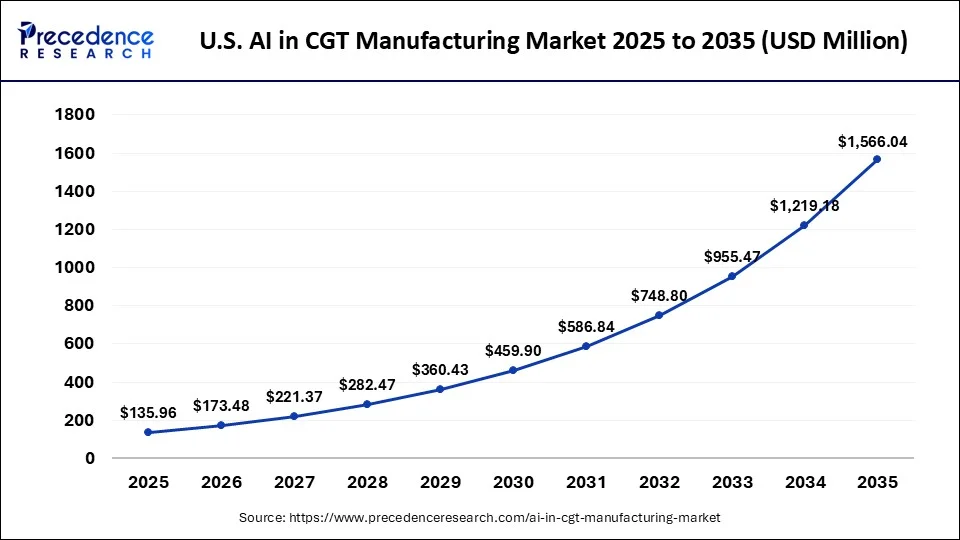
The U.S. AI in CGT manufacturing market size was evaluated at USD 135.96 million in 2025 and is projected to reach around USD 1,566.04 million by 2035, growing at a CAGR of 27.68% from 2026 to 2035
U.S. Driving North America's AI in CGT Manufacturing Leadership in 2025
U.S. leads the market due to its level of regulation and technology in commercial manufacturing. The national leadership in intelligent CGT manufacturing is further strengthened by the continuous expansion of commercial manufacturing facilities.
Asia-Pacific: The Fastest-Growing Region
Asia-Pacific held 21% of the AI in CGT manufacturing market share in 2025 and is expected to grow at a strong CAGR of 34.6% over the projected period, supported by a continued increase in advanced biomanufacturing infrastructure and digital transformation projects. The national Biotechnology Strategies (NBTSs) of China, Japan, South Korea, Singapore, and Australia have enhanced cell and gene manufacturing capabilities. These trends are driving up the demand for intelligent manufacturing platforms for rapidly growing commercial production facilities.
Japan Leading Europe's AI in CGT Manufacturing Expansion
Japan is a major contributor to the market, due to the growth in commercialization of regenerative medicine with pro-innovation regulations and production advancements. AI is being more heavily used by Japanese manufacturers in production optimization and automated production processes.
Europe: The Second-Largest Region
Europe held a 28% share of the market in 2025 and is expected to grow at a 27.9% CAGR between 2026 and 2035, driven by regulators and manufacturers in Europe continuing to fuel the rapid innovation of manufacturing cells and genes. Manufacturers began incorporating AI into the digital quality management and optimization of their processes and manufacturing workflows in this region.
United Kingdom Powering Asia Pacific's Rapid AI in CGT Manufacturing Growth
In the United Kingdom, the market, as it continues to be a huge investment player in advanced therapy manufacturing innovation and industrial automation. Researchers at these organizations are working on products to enhance the United Kingdom's position in digital CGT production, such as Ori Biotech's Cell Factories and Cellular Origins' Smart-Matrices.
Latin America Holding Notable Market Share with 4% in 2025
Latin America held 4% of the market share in 2025 and is expected to grow at a notable CAGR of 28.1% between 2026 and 2035, due to greater investment in biotechnology and importing collaborations with international research institutions. Regulatory authorities throughout the region helped develop policies to further support the use of internationally accepted AI CGT manufacturing specifications.
Brazil Expanding AI in CGT Manufacturing Opportunities Across Latin America
Brazil is a major player in the market, fuelled by the largest biotechnology ecosystem and advanced healthcare research infrastructure of the Latin American region. Research, pharmaceutical advances, and digital manufacturing in Brazil continue to attract investment and establish the country as the leading player for future AI-powered CGT manufacturing in the region.
Will the Middle East and Africa Grow in the AI in CGT Manufacturing Market?
The Middle East and Africa region held 3% of the market share in 2025 and is expected to grow at a strong CAGR of 26.7% between 2026 and 2035, fuelled by continuous momentum in digital readiness for future AI-integrated CGT manufacturers within the region. Furthermore, regional governments amplified investments in biotechnology Innovation Centres to promote greater commercial CGT manufacturing technologies.
UAE Accelerating AI in CGT Manufacturing Production in the Middle East & Africa
In the UAE, the market is boosted by the government's ongoing efforts to strengthen biotechnology's capabilities. The popular use of DHTP and continued investments in advanced manufacturing facilities continue to make Saudi Arabia the most promising digital healthcare market for future AI-powered CGT manufacturing.
Market Competitive Landscape: Leading Companies and Strategies
The AI in CGT manufacturing market remains moderately consolidated, with established technology providers competing alongside specialized AI manufacturing innovators. Integrated manufacturing portfolios give Thermo Fisher Scientific, Cytiva, Sartorius, Danaher, and Lonza good strengths. Specialized solutions in digital manufacturing are helping companies such as Cellares, Ori Biotech, Autolomous, TrakCel, and Tulip Interfaces to increase competition. Microsoft, Amazon Web Services (AWS), Google Cloud, and other cloud giants are rolling out more regulated AI infrastructure for advanced biomanufacturing environments.
Strategic partnerships continue reshaping competition across intelligent manufacturing and advanced therapy production. In 2026, Cellares continued its business cooperation with automated commercial-scale cell therapy manufacturing. Ori Biotech also progressed in the development of next-generation manufacturing technologies via other industry relationships and platform development. Growing adoption of autonomous manufacturing platforms continues to strengthen technology leaders across the global competitive landscape.
AI in CGT Manufacturing Market Companies
- Bluebird Bio Inc.
- Boehringer Ingelheim
- Catalent Inc.
- Cellular Therapeutics
- F. Hoffmann-La Roche Ltd
- Hitachi Chemical Co., Ltd.
- Lonza
- Merck KGaA
- Miltenyi Biotec
- Novartis AG
- Samsung Biologics
- Takara Bio Inc.
- Thermo Fisher Scientific
- Wuxi Advanced Therapies
Recent Developments AI in CGT Manufacturing Market (2025-2026)
- In June 2026, Merck (MSD outside the U.S. and Canada) entered a collaboration with Protillion Biosciences to utilize Protillion's Prot-MaP technology for AI-driven drug design. This partnership combines Protillion's ability to generate vast training datasets with Merck's expertise in discovering new therapeutic candidates. Protillion's approach allows for high-throughput protein library analysis, leading to optimized biologics with enhanced therapeutic profiles. Protillion will receive an upfront payment and potential milestone payments totaling up to $510 million.(Source: https://www.contractpharma.com)
- In June 2026, Catalent Inc. launched Qai, an enterprise AI tool aimed at improving quality management systems across its network. Qai uses Catalent's enterprise data to enhance quality processes, accelerate insights, and support better decision-making. This launch marks Catalent's first enterprise AI solution, showcasing the company's commitment to integrating advanced technologies to improve operations and patient support. (Source: https://www.contractpharma.com)
Segments Covered in the Report
By Component
- Software
- Machine Learning Platforms
- Predictive Analytics Software
- Digital Twin Software
- Process Control & Optimization Software
- Computer Vision Software
- Services
- Consulting Services
- Implementation & Integration Services
- Support & Maintenance Services
By Deployment Mode
- Cloud-based
- On-premises
- Hybrid
By Technology
- Machine Learning (ML)
- Deep Learning
- Computer Vision
- Natural Language Processing (NLP)
- Reinforcement Learning
- Generative AI
By Manufacturing Stage
- Upstream Processing
- Cell Expansion
- Gene Editing and Vector Production
- Downstream Processing
- Fill and Finish
- Quality Control and Release Testing
By Therapy Type
- Cell Therapy
- CAR-T Cell Therapy
- Stem Cell Therapy
- TCR-T Cell Therapy
- NK Cell Therapy
- Gene Therapy
- In Vivo Gene Therapy
- Ex Vivo Gene Therapy
By Application
- Process Optimization
- Predictive Maintenance
- Quality Assurance and Quality Control
- Process Monitoring
- Batch Release Optimization
- Supply Chain and Inventory Management
- Regulatory Compliance
- Digital Twin Simulation
By End User
- Biopharmaceutical Companies
- Contract Development and Manufacturing Organizations (CDMOs)
- Research Institutes
- Academic Institutions
- Hospitals and Cell Therapy Centers
By Organization Size
- Large Enterprises
- Small and Medium-sized Enterprises (SMEs)
By Region
- North America
- Latin America
- Europe
- Asia-pacific
- Middle and East Africa
For inquiries regarding discounts, bulk purchases, or customization requests, please contact us at sales@precedenceresearch.com
Frequently Asked Questions





Ask For Sample
No cookie-cutter, only authentic analysis – take the 1st step to become a Precedence Research client
 Get a Sample




 sales@precedenceresearch.com
 Schedule a Meeting
