



Battery Plate Market Trends, Companies, Contract Wins / Project Pipeline, Installed Capacity, Power Generation, Government Investment, Technology Adoption, Competitive Positioning, and Growth Forecast
Battery Plate Market (By Battery Type: Lead-acid (Flooded, VRLA), Lithium-ion, Nickel-based, Others (Zn-Air, Na-Ion, etc.); By Plate Material: Lead-Antimony Alloy, Lead-Calcium Alloy, Lead-Tin Alloy, Advanced Composites (Graphite-coated, Carbon Foam); By Manufacturing Technology: Gravity Casting, Continuous Pasting, Expanded Metal, Bipolar/3-D Printing; By End-User: Automotive (SLI, Start-Stop), Industrial (Forklifts, Telecom, UPS), Energy Storage Systems, Consumer Electronics, Aerospace and Defense) - Global Industry Analysis, Size, Trends, Leading Companies, Regional Outlook, and Forecast 2026 to 2035
Source: https://www.precedenceresearch.com/battery-plate-market
 Get a Sample
 Table Of Content


What is the Battery Plate Market Size in 2026?
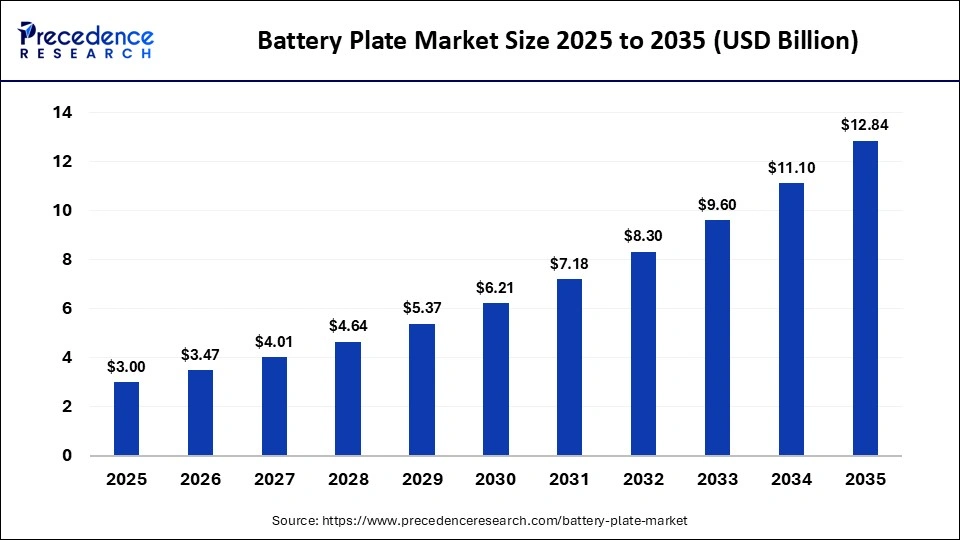
The global battery plate market size accounted for USD 3.00 billion in 2025 and is predicted to increase from USD 3.47 billion in 2026 to approximately USD 12.84 billion by 2035, expanding at a CAGR of 15.65% from 2026 to 2035. The rapid growth is due to rising electric vehicle adoption, expanding renewable energy storage, and manufacturing innovations with lower costs while improving electrochemical efficiency.
Key Takeaways
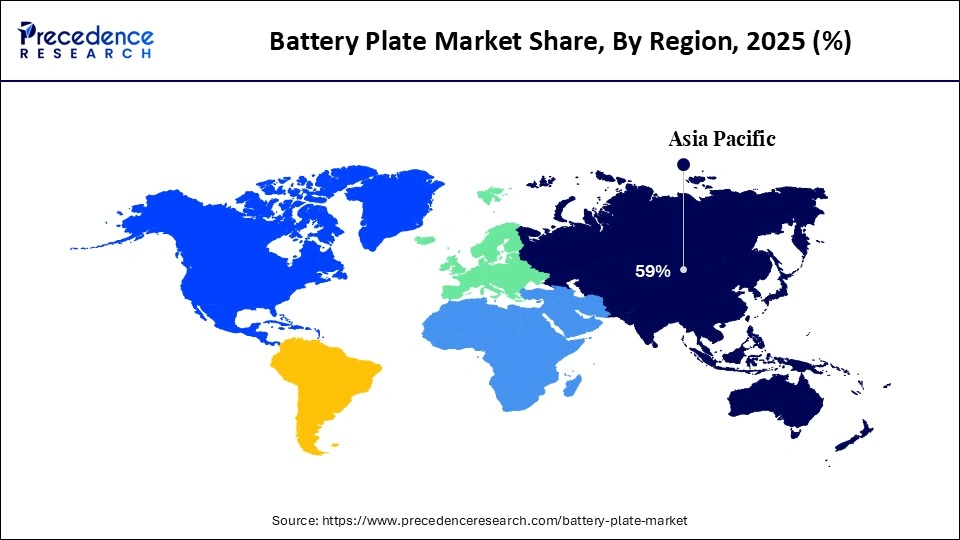
- Asia Pacific dominated the battery plate market with 59% in 2025.
- North America is expected to grow at the fastest CAGR in the market during the forecast period.
- By battery type, the lead-acid segment held a dominant position in the market of 57% in 2025.
- By battery type, the lithium-ion segment is expected to grow at the fastest CAGR in the market during the forecast period.
- By plate material, the lead-calcium alloys segment held a dominant position in the market with 47% in 2025.
- By plate material, the advanced composites segment is expected to grow at the fastest CAGR in the market during the forecast period.
- By manufacturing technology, the continuous pasting segment held a dominant position in the market with 43% in 2025.
- By manufacturing technology, the bipolar/3D printing segment is expected to grow at the fastest CAGR in the market during the forecast period.
- By end-user, the automotive segment held a dominant position in the battery plate market with 52% in 2025.
- By end-user, the energy storage systems segment is expected to grow at the fastest CAGR in the market during the forecast period.
Market Overview
Battery plates are built in a lattice grid, assisting the energetic flow and behavior of the electricity. The battery plate is an authoritative part of the battery's inner shape that can store and discharge energy and provide power to numerous devices. The battery plate market is witnessing global growth, driven by the rapid expansion of electric vehicles, renewable energy storage systems, and increasing demand for efficient energy solutions. Battery plates are becoming a crucial component in reliable energy storage and distribution for countries seeking decarbonization and modernizing energy infrastructure. The market is further strengthened by technological advancements in battery design, materials, and manufacturing processes, which improve electrochemical performance while reducing production costs.
How AI is Impacting the Battery Plate Market?
AI is significantly transforming the market. The overall performance optimization is achieved by enhancing material innovation and manufacturing efficiency with AI-assistance. AI-driven data analytics enable manufacturers to identify advanced materials and coatings that improve energy density, charging speed, and durability of battery plates. AI-powered systems monitor production in real time, an automation and machine vision system detects defects in real time, reducing material waste, and helps lower costs. Machine learning algorithms predict the performance of a battery under various operating conditions, which enables the design of a battery that maintains a longer lifecycle management. Accurate demand forecasting and inventory optimization are carried out using AI by strengthening supply chain planning.
Battery Plate Market Trends
- Rising EV Adoption: High demand for high-performance, durable, and energy-dense battery plates with rapid adoption of electric vehicles.
- Expansion of Renewable Storage Systems: With increased adoption of renewable energy sources such as solar and wind energy, demand for efficient battery plates in energy storage systems (ESS) is increasing.
- Sustainability Initiatives: To reduce environmental impact and promote decarbonization, manufacturers are focusing on eco-friendly materials, recycling initiatives, and low-emission production processes.
- Technological Advancements: Improved energy density, charging speed, and overall efficiency with innovations in battery chemistry and design.
- Strategic Partnerships and R and D Investments: To accelerate product development and strengthen competitive positioning, companies are forming collaborations and increasing R and D investments.
Market Scope
| Report Coverage | Details |
| Market Size in 2025 | USD 3.00 Billion |
| Market Size in 2026 | USD 3.47 Billion |
| Market Size by 2035 | USD 12.84 Billion |
| Market Growth Rate from 2026 to 2035 | CAGR of 15.65% |
| Dominating Region | Asia Pacific |
| Fastest Growing Region | North America |
| Base Year | 2025 |
| Forecast Period | 2026 to 2035 |
| Segments Covered | Battery Type, Plate Material, Manufacturing Technology, End-user, and Region |
| Regions Covered | North America, Europe, Asia-Pacific, Latin America, and Middle East & Africa |
Segment Insights
Battery Type Insights
How Did the Lead-Acid Segment Lead the Battery Plates Market?
The lead-acid segment led the battery plate market in 2025, due to its long-term industrial use, low cost, and high recycling rate. They account for a large market share as one of the rechargeable battery technologies, widely adopted in automotive starting, lighting, and ignition applications. They are known for their reliability and ability to deliver high surge currents, making them ideal for automotive applications. They are highly accessible across the automotive industry and other industrial sectors due to their affordability and abundant raw materials. With high recycling rates of lead-acid batteries, it ensures sustainable material reuse and stable supply chains.
The lithium ion segment is expected to grow at the fastest CAGR over the forecast period. These are widely used in portable electronics and electric vehicles. They offer high performance, efficiency, and flexibility. Their high energy density allows more power to be stored in a smaller and lighter form. Rapid technological advancements have improved charging speed, lifespan, and safety while reducing costs, accelerating adoption across industries. The push towards carbon emission reduction and the shift toward clean energy are driving demand for electrification and reliable storage solutions.
Plate Material Insights
How did the Lead-Calcium Alloys Segment Dominate the Battery Plate Market?
The lead-calcium alloy segment dominated the market in 2025. It offers high performance and operational advantages. The calcium in the lead grid reduces water loss, corrosion, and self-discharge, resulting in longer battery life and minimal maintenance. These batteries are more reliable for automotive and industrial applications due to their durability, charge retention, and efficiency. Large-scale adoption is further supported by its lower gassing and maintenance-free operation for safe and convenient for sealed battery designs.
The advanced composites segment is expected to grow at a faster CAGR between 2026 and 2035. Compared to conventional materials, advanced composites enhance performance, durability, and efficiency. They offer high strength-to-weight ratios, improved corrosion resistance, and better electrical conductivity. They support lightweight battery designs, essential for electric vehicles and portable energy systems. They enable improved thermal stability and faster charge-discharge cycles. Advanced composites are gaining adoption across automotive, renewable energy, and industrial applications, with growing demand for high performance and a shift toward next-generation battery technologies.
Manufacturing Technology Insights
How did the Continuous Pasting Segment Dominate the Battery Plate Market?
The continuous pasting segment dominated the market in 2025. Compared to traditional batch pasting methods, the continuous pasting method improves manufacturing efficiency, product quality, and cost control. With a fully automated production line, it integrates multiple steps such as grid feeding, paste application, drying, and stacking, enabling high-volume and consistent output. The electrochemical reliability and battery lifespan are improved by the continuous pasting process since it offers plate uniformity. The process requires less labor, reduced waste material generation, and environmental impact through cleaner, controlled operations, making production cost-effective and scalable.
The bipolar/3D printing segment is expected to grow at a faster CAGR between 2026 and 2035. It enables next-generation battery designs with high performance and manufacturing flexibility. Bipolar conformations offer reduced internal resistance and improved energy density by assembling cells more efficiently, resulting in lighter, more compact batteries with better power output. Precise control over plate architecture, material distribution, and complex geometries can be achieved through 3D printing, which improves conductivity, thermal management, and durability, further supporting the rapid adoption of the technology in the market.
End-User Insights
What made the Automotive Segment Dominate the Battery Plate Market?
The automotive segment dominated the battery plate market in 2025. The increasing demand for electric vehicles and hybrid models is contributing to the segment dominance in the market. The automotive industry requires high-performance batteries for starting, lighting, ignition, and propulsion, creating demand for battery plates. Government initiatives promoting the shift toward electrification and consumer interest in lower operating costs are further boosting the dominance. Major automakers are rapidly expanding their electric and hybrid vehicle portfolios, increasing battery production volumes.
The energy storage systems segment is expected to grow at a higher CAGR during the forecast period due to the rapid global expansion of renewable energy. There is a need for reliable storage solutions that can balance supply and demand with intermittent solar and wind power. Battery-based energy storage helps stabilize grids, store excess electricity, and ensure an uninterrupted power supply. To support decarbonization goals and modernize aging power infrastructure, governments are investing in large-scale storage.
Regional Insights
What is the Asia Pacific Battery Plate Market Size?
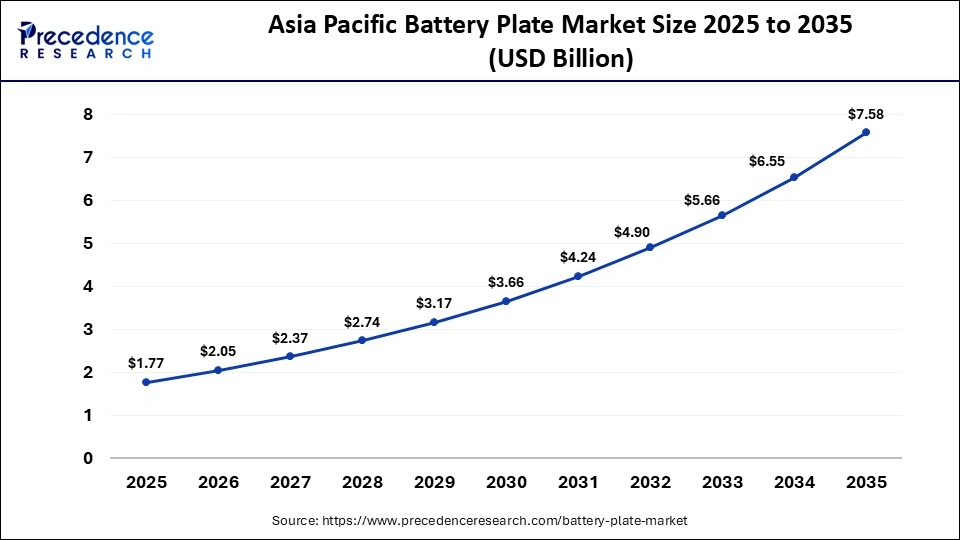
The Asia Pacific battery plate market size is expected to be worth USD 1.77 billion by 2035, increasing from USD 7.58 billion by 2025, growing at a CAGR of 15.66% from 2026 to 2035.
What Factors Have Driven the Dominance of Asia Pacific in the Battery Plate Market?
Asia Pacific dominated the global battery plate market in 2025, driven by increasing industrialization, urbanization, and rising demand for electric vehicles. Through government policies, EV incentives, and large-scale renewable energy investments, countries like China and India are leading the adoption. The region has cost-efficient labor, well-established manufacturing infrastructure, and integrated supply chains for battery production. As the demand for energy storage systems continues to rise, the region has become a major manufacturing hub for battery plates. The government is heavily investing in recycling infrastructure. The region is recognized for its technology leadership and rapid adoption innovation technologies. The region is a hub for all heavy battery users, reinforcing consistent base demand.
Battery Plate Market of China
China is the leading country in battery manufacturing hubs, which directly creates demand for the battery plate. The country leads global EV manufacturing and drives demand for battery plates. EV production expands the market of batteries, thereby increasing demand for battery plates. China has a strong raw material market required for the production of batteries, which further reduces manufacturing costs and supports large-scale production. Government policies encourage local production of battery components. China is heavily investing in renewable energy, thereby creating a need for energy storage systems. The country is involved largely in export activities, exporting batteries and battery components worldwide, expanding international demand for battery plates.
What makes North America the Fastest Growing Region in the Battery Plate Market?
The North American battery plate market is expected to grow at a significant CAGR from 2026 to 2035. The growth is driven by strong electrification trends and advanced manufacturing capabilities. Rapid adoption of electric vehicles and renewable energy storage solutions are major demand driver. Federal incentives, clean-energy targets, and infrastructure investments are accelerating battery production and usage. The competitive landscape in the region is dominated by key players that are investing heavily in research and development to enhance battery performance and sustainability. The presence of strong manufacturing facilities and supply chains, expanding energy storage installations, and technological innovation is driving rapid regional market growth.
The U.S. Battery Plate Market Trends Analysis
The U.S. battery plate market is rising steadily with the rising adoption of electric vehicles, grid-scale energy storage systems, and domestic battery manufacturing investments. Large-scale energy storage deployment to stabilize renewable energy is one of the key factors in driving the market. The country has a well-established supply chain network to meet the increasing demand for battery plates for export. Major manufacturers continue to invest in advanced battery technologies and domestic production. The U.S. is becoming a key growth hub for battery plate manufacturing with the support of government policies, industrial expansion, and federal incentives under clean energy.
How is Europe Growing in the Battery Plate Market?
Europe is expected to grow at a considerable CAGR in the upcoming period, due to the increased demand for electric vehicles, energy-efficient automotive technology development, and renewable energy sources' integration into the vehicle value chain. The region has also invested significantly in domestic battery production to reduce dependence on imported batteries and improve industrial competitiveness. At the same time, demand for sustainable battery technologies and their associated recycling systems continues to grow, which will further enhance battery plate production levels.
Germany Market Trends
Germany is the dominant player in the European market due to having the largest automotive manufacturing base in Europe and high volumes of capital invested in developing EV battery manufacturing facilities. The country is also enticing foreign battery manufacturers to set up advanced production facilities that will supply batteries to Europe's auto companies. Increased focus on battery recycling, along with energy transition strategies, is driving demand for more efficient, durable battery plate technologies in Germany.
Will Latin America Grow in the Battery Plate Market?
Latin America is considered to be a significantly growing area, due to increased automotive demand, improved industrial infrastructure, and greater levels of backup power use. Also, increasing levels of renewable energy and energy storage projects are prompting investments in battery manufacturing in Latin America. Governments support battery supply chains through mining and processing activities, which finds itself being one of the biggest contributors to supporting battery raw materials to support the development of local supply chains. The acceleration of demand for affordable and long-lasting solutions for energy storage has opened up new opportunities for companies involved in the manufacture and supply of battery plates.
Brazil Market Trends
Brazil is currently the leader within the region with respect to battery plate production, driven largely by its substantial automotive industry and increasing adoption of industrial energy storage. Brazil is currently investing heavily in the development of renewable energy projects while also working on augmenting existing processes for battery recycling programs. Increasing demand for backup power solutions and the electrification of transportation further benefit the production of battery plates and the advancement of existing production technologies.
Why Did Middle East & Africa Dominate the Battery Plate Market?
Europe region is expected to grow at a significant rate of market share between 2026 and 2035, as the dependency on ICE vehicles was high, strong replacement demand, and stress factors in the Gulf and Africa Regions. Several nations in Sub-Saharan Africa have widespread use of backup power systems, indirectly contributing to the demand for stationary lead-acid plate batteries for telecom towers and off-grid installations.
Saudi Arabia Emerging as a Key Growth Hub in the Middle East Battery Plate Market
The market growth is driven by its high dependence on battery-powered backups in telecom, infrastructure, and diversifying industries, with the automotive sector playing a pivotal role in this growth. The Saudi automotive "Vision 2030" industrial localization policies demand for SLI batteries used in passenger and commercial vehicles remains strong. The excessive heat in the desert often surpasses 45°C, which can lead to earlier battery degradation, boosting demand for replacement batteries from the aftermarket and driving the use of new lead-acid battery plates.
Battery Plate Market Value Chain Analysis
- Resource Extraction: Mining and processing of raw materials such as lithium, nickel, cobalt and lead through mining operations, refining, and chemical processing to produce battery-grade materials.
Key Companies: BHP, Rio Tinto, Glencore, Albemarle Corporation, and SQM. - Power Generation: Electricity production from renewable and conventional sources, utilities generate power through solar, wind, hydro, nuclear, and thermal plants integrated into national grids.
Key Companies: NextEra Energy, EDF, Enel, Duke Energy, Iberdrola - Distribution Network Management: Through smart grids, substations, automation systems, and digital energy management platforms; transmission and distribution infrastructure that delivers electricity and integrates battery storage into power networks.
Key Companies: National Grid plc, State Grid Corporation of China, Siemens, Schneider Electric, and ABB - Energy Storage Systems: Through advanced battery chemistry development, automated production lines, and system integration technologies, manufacturing of battery cells, modules, and plates used in EVs, grid storage, and industrial systems.
Key Companies: Tesla, CATL, LG Energy Solution, Panasonic, BYD - Grid Maintenance and Monitoring: Ongoing monitoring, diagnostics, and maintenance of power grids and storage infrastructure using sensors, predictive analytics, automation software, and remote monitoring technologies.
Key Companies: GE Vernova, Hitachi Energy, Honeywell, Eaton, Emerson Electric - Regulatory Compliance and Energy Trading: Policy regulation, market governance, and electricity trading through emissions policies, market pricing mechanisms, energy exchanges, and grid regulations.
Key Companies: Intercontinental Exchange, European Energy Exchange, PJM Interconnection, Federal Energy Regulatory Commission
Battery Plate Market Companies
- Clarios, LLC
- GS Yuasa Corporation
- Exide Industries Ltd.
- East Penn Manufacturing
- Enersys
- Toshiba Corporation
- Amara Raja Batteries Limited
- Kijo Battery Group
- Microvast Holding Inc.
- Crown Battery
- CSB Energy Technology Co. Ltd.
- Fiamm Energy Storage Solutions SpA
Recent Developments
- In May 2026, Titan Batteries opened its European drone battery plant in Tilburg, Netherlands, marking its first full-scale production facility outside the United States. The Idaho-based UAV power supplier announced the launch on International Drone Day, strengthening its global manufacturing footprint. The facility is located at the Energy Conversion Campus within Bosch premises, supporting advanced battery production. This expansion positions Titan Batteries as the first major UAV battery manufacturer with multi-continent production capability. (Source: https://dronelife.com)
- In May 2026, Basquevolt launched its lithium-metal battery cell, BQV400L, developed with a polymer electrolyte and NMC cathode system. The company stated that the cell delivers high-performance output and targets next-generation European battery applications. The technology is based on a proprietary hybrid electrolyte structure rather than a fully solid-state design. Basquevolt has now commercialized the BQV400L for immediate availability in advanced energy applications. (Source: https://www.electrive.com)
- In May 2026, SoftBank Group expanded into non-lithium battery manufacturing and Battery Energy Storage Systems (BESS). The initiative focuses on end-to-end production of alternative energy storage technologies. It includes collaboration with South Korean startups Cosmos Lab and DeltaX. The project will establish large-scale cell manufacturing in Osaka, Japan, supporting AI-driven energy infrastructure demand. (Source: https://itbusinesstoday.com)
- In April 2025, Lyten announced the U.S. first domestic production of battery-grade lithium metal foil with U.S. made lithium alloys and U.S.-sourced lithium metal. This achievement marks a pivotal step in bolstering the U.S. battery supply chain, aiming to reduce dependence on overseas sources for essential battery materials.(Source: https://lyten.com)
- In February 2025, Luminous Power Technologies launched lead production at its new industrial battery plant in northern India, boosting a revolutionary green positive plate manufacturing system that uses 100% grey oxide through a wet paste filling process.(Source: https://www.batteriesinternational.com)
Segments Covered in the Report
By Battery Type
- Lead-acid (Flooded, VRLA)
- Lithium-ion
- Nickel-based
- Others (Zn-Air, Na-Ion, etc.)
By Plate Material
- Lead-Antimony Alloy
- Lead-Calcium Alloy
- Lead-Tin Alloy
- Advanced Composites (Graphite-coated, Carbon Foam)
By Manufacturing Technology
- Gravity Casting
- Continuous Pasting
- Expanded Metal
- Bipolar/3-D Printing
By End-User
- Automotive (SLI, Start-Stop)
- Industrial (Forklifts, Telecom, UPS)
- Energy Storage Systems
- Consumer Electronics
- Aerospace and Defense
By Region
- North America
- Europe
- Asia-Pacific
- Latin America
- Middle East & Africa
For inquiries regarding discounts, bulk purchases, or customization requests, please contact us at sales@precedenceresearch.com
Frequently Asked Questions
Tags





Ask For Sample
No cookie-cutter, only authentic analysis – take the 1st step to become a Precedence Research client
 Get a Sample




 sales@precedenceresearch.com
 Schedule a Meeting
