



Chromatography Media Market Size, Companies, Share, Patient Volume, Treatment Adoption Rates, Pricing Analysis, Regulatory Landscape, Competitive Positioning, and Demand Forecast
Chromatography Media Market (By Media Type: Resins (Beaded Media), Inorganic Media, Membranes, Monoliths, Other Formats; By Separation Mechanism: Affinity Chromatography, Ion Exchange (IEX) Chromatography, Size Exclusion (SEC)/Gel Filtration, Hydrophobic Interaction, Mixed-Mode/Multimodal (Combination of IEX, HIC, and Hydrogen Bonding), Reversed-Phase Chromatography, Partition & Adsorption Chromatography; By Physical Format and Packaging: Pre-packed Columns, Bulk Media, Cassettes & Modules; By Application: Pharmaceutical & Biopharmaceutical Production, Academic & Basic Research, Food & Beverage Testing, Environmental & Forensic Testing; By Scale of Operation: Analytical Scale Preparative Scale, Process Scale/Industrial) - Global Industry Analysis, Size, Trends, Leading Companies, Regional Outlook, and Forecast 2026 to 2035
Source: https://www.precedenceresearch.com/chromatography-media-market
 Get a Sample
 Table Of Content


What is the Chromatography Media Market Size in 2026?
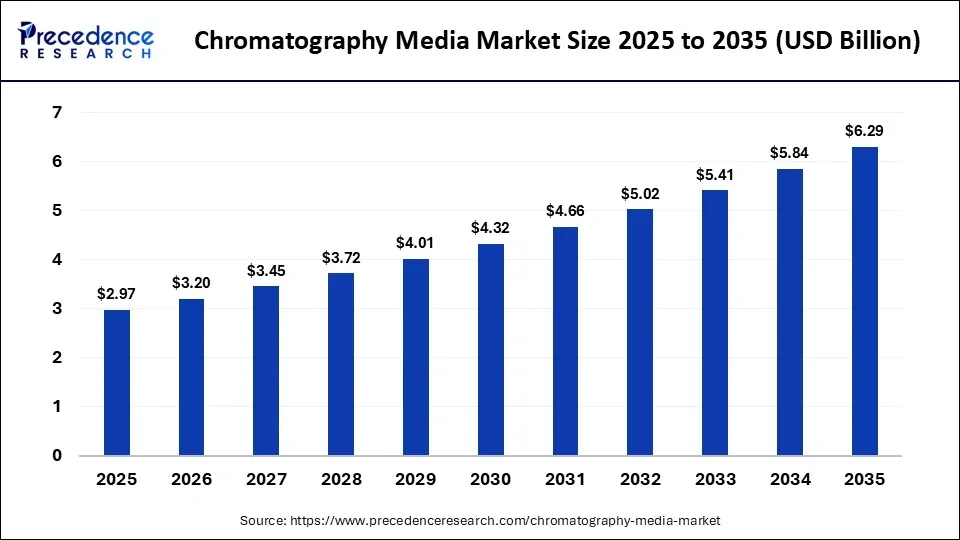
The global chromatography media market size accounted for USD 2.97 billion in 2025 and is predicted to increase from USD 3.20 billion in 2026 to approximately USD 6.29 billion by 2035, expanding at a CAGR of 7.79% from 2026 to 2035.
Key Takeaways
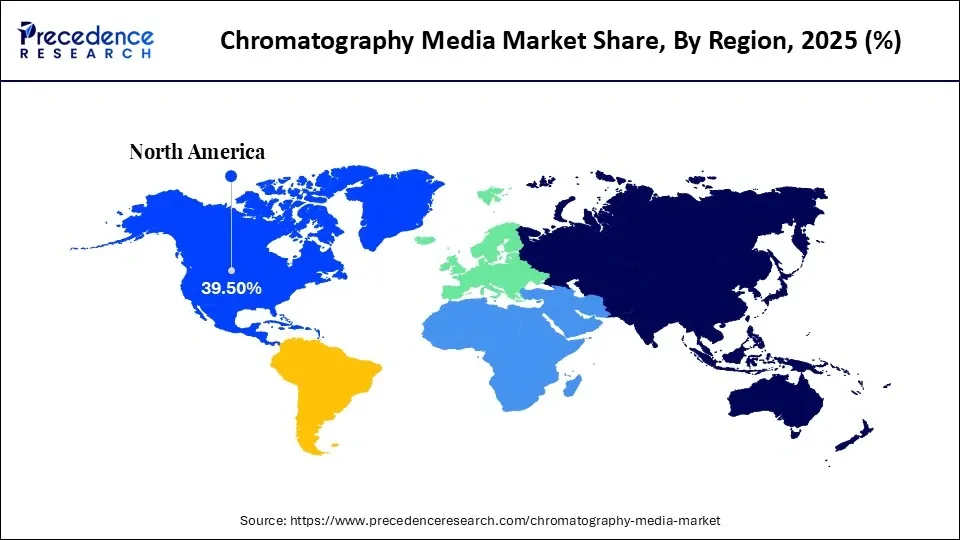
- North America dominated the market with 39.50% market share in 2025
- Asia Pacific is expected to grow at the fastest rate during the forecast period.
- By media type, the resins (beaded media) segment led the chromatography media market with 88.50% market share in 2025.
- By media type, the membranes segment is seen to grow at the fastest rate at the CAGR of 7.20% during the forecast period.
- By separation mechanism, the affinity chromatography segment led the market in 2025 with 42% market share.
- By separation mechanism, the mixed-mode segment is seen to grow at the CAGR of 6.50% during the forecast period.
- By physical format and packaging, the bulk media segment led the market with 62% in 2025.
- By physical format and packaging, the cassettes and modules segment is seen to grow at 8.50% CAGR during the forecast period.
- By application, the pharmaceutical and biopharmaceutical production segment dominated the market with 71.50% in 2025, the segment is expected to sustain the dominance during the forecast period.
- By scale of operation, the process scale/industrial segment dominated the market in 2025 with 69.40%.
- By scale of operation, the preparative scale segment is expected to grow at the fastest rate during the forecast period.
Market Overview
The chromatography media market refers to the global industry involved in the development, production, and sale of materials used as the stationary phase in chromatography processes. Chromatography media are substances designed to separate, purify, and analyze components within complex mixtures based on differences in chemical or physical properties such as size, charge, hydrophobicity, or biological affinity.
These media are typically composed of materials such as silica, agarose, synthetic polymers, resins, and other functionalized supports. They are used across various chromatography techniques including ion exchange chromatography, affinity chromatography, size exclusion chromatography, hydrophobic interaction chromatography, and reversed phase chromatography.
Positive Impact of Artificial Intelligence on the Chromatography Media Market
Artificial Intelligence is positively transforming the chromatography media market by improving process optimization, method development, and operational efficiency in purification workflows. AI driven algorithms help analyze complex chromatographic data, predict separation behavior, and optimize parameters such as flow rates, pH levels, and binding conditions, significantly reducing trial and error experimentation.
This accelerates drug development timelines and lowers production costs for biopharmaceutical manufacturers. Additionally, AI enabled predictive maintenance and real time monitoring enhance media utilization, extend product lifecycle, and minimize downtime, ultimately increasing productivity and profitability across research and large-scale manufacturing environments.
Latest Trends in Chromatography Media Market
- Increasing demand from biologics and biosimilars manufacturing
- Rising production of monoclonal antibodies, vaccines, and advanced therapies is driving higher consumption of purification media.
- Development of high binding capacity and high resolution media
- Manufacturers are designing media that improve separation efficiency and increase product yield.
- Growing adoption of affinity and ion exchange chromatography media
- These techniques are widely preferred for selective purification of proteins and biomolecules.
- Rising use of single use and pre packed chromatography systems
- Single use formats reduce contamination risks and eliminate cleaning validation requirements.
- Expansion of continuous chromatography processes
- Continuous processing enhances productivity and reduces buffer consumption compared to batch systems.
Market Scope
| Report Coverage | Details |
| Market Size in 2025 | USD 2.97 Billion |
| Market Size in 2026 | USD 3.20 Billion |
| Market Size by 2035 | USD 6.29 Billion |
| Market Growth Rate from 2026 to 2035 | CAGR of 7.79% |
| Dominating Region | North America |
| Fastest Growing Region | Asia Pacific |
| Base Year | 2025 |
| Forecast Period | 2026 to 2035 |
| Segments Covered | Media Type, Separation Mechanism, Physical Format and Packaging, Application, Scale of Operation, and Region |
| Regions Covered | North America, Europe, Asia-Pacific, Latin America, and Middle East & Africa |
Market Dynamics
Drivers
Rising Biologics Production and Regulatory Emphasis on Purity
The strongest growth driver in the Chromatography Media Market is the accelerating production of biologics such as monoclonal antibodies, recombinant proteins, vaccines, plasma derived products, and advanced therapies including cell and gene therapies. These complex molecules require multiple purification steps to achieve extremely high purity levels, making chromatography media indispensable in downstream processing.
In addition, increasingly stringent regulatory requirements for drug safety, impurity profiling, and batch consistency are pushing manufacturers to adopt high performance chromatography media with greater selectivity, binding capacity, and reproducibility. The expansion of biosimilars and contract manufacturing organizations further strengthens demand across global markets.
Restraint
High Capital Costs and Operational Complexity
Despite strong demand, the market faces challenges related to the high cost of chromatography media and purification infrastructure. Large scale bioprocessing requires significant investment in columns, resins, buffers, validation procedures, and skilled technical personnel. Media replacement costs and limited lifecycle in certain applications can further increase operational expenses.
In addition, process development and scale up can be technically complex, requiring optimization of flow rates, pressure limits, and chemical compatibility. These factors can limit adoption among small biotechnology firms and manufacturers operating in cost sensitive markets.
Opportunity
Technological Innovation and Emerging Market Expansion
Significant opportunities exist through the development of advanced chromatography media tailored for high throughput, continuous processing, and single use systems. Innovations such as improved resin stability, enhanced binding efficiency, and media designed for viral vector and gene therapy purification are opening new revenue streams. The shift toward continuous bioprocessing is also creating demand for media that can withstand prolonged operational cycles with consistent performance.
Furthermore, expanding pharmaceutical manufacturing capacity in emerging economies across Asia Pacific, Latin America, and the Middle East is generating new growth avenues as governments and private investors increase spending on healthcare infrastructure and domestic drug production.
Segmental Insights
Media Type Insights
The resins (beaded media) segment dominated the chromatography media market in 2025 with 88.50% market share. This dominance is attributed to the wide application of beaded resins in protein purification, monoclonal antibody production, and large-scale bioprocessing due to their high binding capacity, mechanical stability, and compatibility with multiple chromatography techniques such as ion exchange, affinity, and hydrophobic interaction. Their versatility and proven performance make them the preferred choice in both pharmaceutical and biopharmaceutical manufacturing.
The membranes segment is seen to grow at the fastest rate with a CAGR of 7.20% during the forecast period. The rapid growth is driven by the increasing adoption of membrane chromatography in single-use and continuous bioprocessing systems. Membranes offer advantages such as shorter processing times, reduced buffer consumption, and simplified scalability, making them highly attractive for emerging biopharmaceutical applications and small-scale purification workflows.
Separation Mechanism Insights
The affinity chromatography segment led the market in 2025 with 42% market share. Affinity chromatography's dominance stems from its exceptional selectivity and efficiency in purifying specific biomolecules such as antibodies, enzymes, and viral vectors. Its ability to isolate target molecules with high purity in fewer steps makes it essential in downstream bioprocessing and analytical workflows.
The mixed-mode chromatography segment is seen to grow at a CAGR of 6.50% during the forecast period. Mixed-mode systems, which combine ion exchange, hydrophobic interaction, and hydrogen bonding, are gaining traction because they allow more complex separations in a single step. Their adaptability and efficiency in handling challenging biomolecules are driving adoption in both research and industrial production settings.
Physical Format and Packaging Insights
The bulk media segment led the market with 62% in 2025. Bulk media remains the preferred choice for large-scale manufacturing processes due to its cost-effectiveness, flexibility in column packing, and ability to accommodate high-volume bioprocessing requirements. It is widely used in industrial purification of monoclonal antibodies, recombinant proteins, and vaccines where large quantities of chromatography media are required.
The cassettes and modules segment is seen to grow at 8.50% CAGR during the forecast period. This growth is driven by the increasing adoption of pre-packed, single-use modules in membrane chromatography systems. These cassettes simplify setup, reduce cleaning validation, and are compatible with continuous and disposable bioprocessing formats, making them ideal for small- to medium-scale production and fast turnaround operations.
Application Insights
The pharmaceutical and biopharmaceutical production segment dominated the market with 71.50% in 2025, and it is expected to sustain its dominance during the forecast period. This is due to the high reliance of the biopharma industry on chromatography media for purification of monoclonal antibodies, recombinant proteins, vaccines, and cell and gene therapy products. The need for high-purity end products and compliance with strict regulatory standards continues to drive strong demand from this segment.
Scale of Operation Insights
The process scale/industrial segment dominated the market in 2025 with 69.40%. Industrial-scale chromatography is the backbone of large-volume biopharmaceutical manufacturing. The dominance is supported by the need for large capacity purification systems, high-efficiency media, and robust process controls that ensure consistent product quality and yield at commercial scale.
The preparative scale segment is expected to grow at the fastest rate during the forecast period. Preparative chromatography is increasingly used in medium-scale production and laboratory-to-pilot scale operations. Its growth is fueled by expanding R&D activities, development of biosimilars, and adoption of flexible purification systems that can scale up efficiently from laboratory experiments to industrial production.
Regional Insights
North America Chromatography Media Market Size and Growth 2026 to 2035
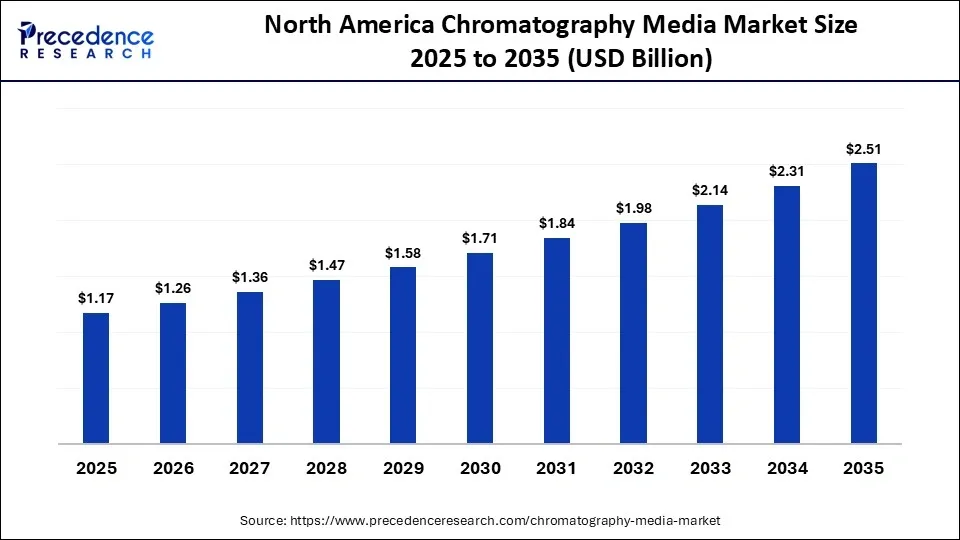
The North America chromatography media market size is estimated at USD 1.17 billion in 2025 and is projected to reach approximately USD 2.51 billion by 2035, with a 7.90% CAGR from 2026 to 2035.
North America Chromatography Media Market
North America dominated the chromatography media market due to its well established biopharmaceutical industry, advanced research infrastructure, and strong presence of leading biotechnology and pharmaceutical companies. The region benefits from high investment in drug development, widespread adoption of advanced purification technologies, and strict regulatory standards that require high quality analytical and purification processes. The presence of major contract research and manufacturing organizations further supports sustained demand for chromatography media across both commercial manufacturing and research applications.
U.S. Chromatography Media Market Size and Growth 2026 to 2035
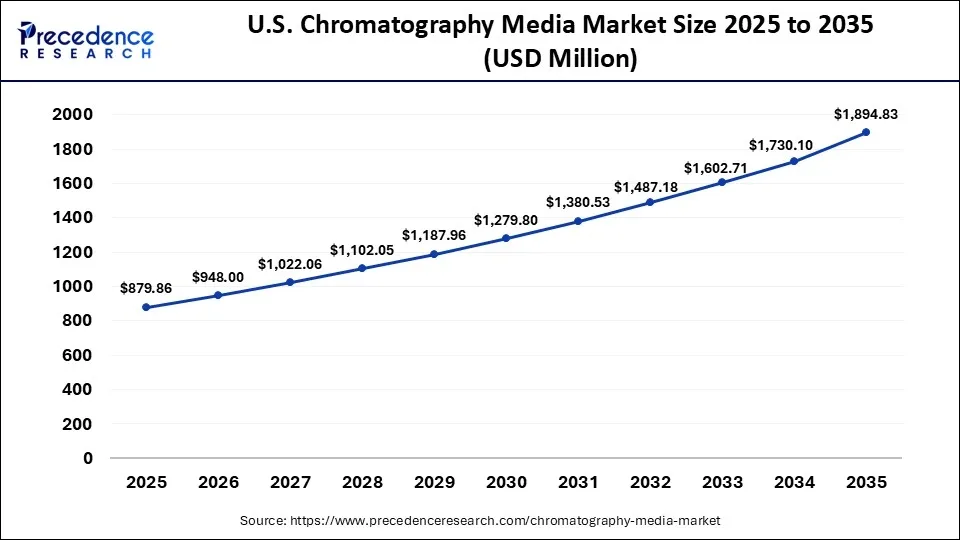
The U.S. chromatography media market size is calculated at USD 879.86 million in 2025 and is expected to reach nearly USD 1,894.83 million in 2035, accelerating at a strong CAGR of 7.97% between 2026 and 2035.
United States Chromatography Media Market Trends
In the United States, demand for chromatography media is closely linked to innovation in biologics, cell and gene therapies, and personalized medicine. There is a growing shift toward continuous bioprocessing and single use systems to improve manufacturing efficiency and reduce costs. Additionally, increased funding for biomedical research and strong collaboration between academic institutions and biopharmaceutical companies are driving consistent adoption of high performance chromatography solutions.
Asia Pacific Chromatography Media Market
Asia Pacific is expected to be the fastest growing region in the chromatography media market, driven by expanding pharmaceutical manufacturing capacity, increasing investments in biotechnology, and supportive government initiatives to strengthen domestic drug production. Rapid growth in biosimilars, vaccines, and generic biologics manufacturing, particularly in emerging economies, is accelerating demand for purification technologies. Lower production costs and rising foreign direct investment in life sciences are also contributing to the region's strong growth trajectory.
India Chromatography Media Market Trends
In India, the chromatography media market is expanding due to the country's strong position in generic pharmaceuticals and increasing focus on biosimilars and vaccine production. Government initiatives aimed at boosting domestic manufacturing and reducing reliance on imports are supporting growth in local bioprocessing capabilities. Rising investments in biotechnology startups and contract manufacturing services are also increasing the need for cost effective and scalable chromatography purification technologies.
Chromatography Media Market Companies
- Merck KGaA
- Thermo Fisher Scientific
- GE Healthcare
- Repligen Corporation
- Danaher Corporation
- Repligen Corporation
- Lonza Group
- SGE Analytical Science
Recent Developments
- In September 2025, Cytiva launched two new Protein A resins, MabSelect SuRe 70 and MabSelect PrismA X, to enhance monoclonal antibody purification. These products aim to increase productivity and reduce cost per gram for bioprocessing manufacturers
- In May 2025, Waters Corporation introduced the BioResolve Protein A Affinity Columns designed for rapid, precise antibody titer measurement during bioprocessing. Featuring MaxPeak Premier Technology, these columns reduce non-specific binding to provide up to 7x higher sensitivity than existing methods. This launch accelerates drug development by enabling real-time data for optimizing bioreactor harvests and enhancing batch quality.
- In May 2025, DuPont launched the AmberChrom TQ1 resin, an agarose-based anion exchange product for high-resolution purification of oligonucleotides and peptides. This new product expands the company's bioprocessing portfolio specifically for biopharmaceutical applications. The launch addresses the demand for advanced, robust media purification in therapeutic manufacturing.
Segments Covered in the Report
By Media Type
- Resins (Beaded Media)
- Natural Polymer Based
- Synthetic Polymer Based
- Inorganic Media
- Membranes
- Ion Exchange Membranes (Anion and Cation)
- Affinity Based Membranes
- Hydrophobic Interaction Membranes
- Monoliths
- Polymer Based Monoliths
- Silica Based Monoliths
- Other Formats
- Filter Papers
- TLC Plates
- Sorbents
By Separation Mechanism
- Affinity Chromatography
- Protein A, G, and L (Antibody capture)
- Immobilized Metal Ion Affinity (IMAC)
- Lectin and Heparin Affinity
- Custom Ligand Affinity
- Ion Exchange (IEX) Chromatography
- Anion Exchange (Strong/Weak)
- Cation Exchange (Strong/Weak)
- Size Exclusion (SEC)/Gel Filtration
- Hydrophobic Interaction (HIC)
- Mixed-Mode/Multimodal (Combination of IEX, HIC, and Hydrogen Bonding)
- Reversed-Phase Chromatography (RPC)
- Partition & Adsorption Chromatography
By Physical Format & Packaging
- Pre-packed Columns
- Analytical Columns (HPLC/UHPLC)
- Single-Use/Disposable Columns (Bioprocessing)
- Preparative Scale Columns
- Bulk Media (Loose Resins)
- Lab-Scale Bottles
- Industrial Process Containers
- Cassettes & Modules (Primarily for Membrane Chromatography)
By Application
- Pharmaceutical & Biopharmaceutical Production
- Monoclonal Antibodies (mAbs)
- Recombinant Proteins & Peptides
- Vaccines (mRNA, Viral Vectors)
- Cell & Gene Therapy
- Academic & Basic Research
- Proteomics & Metabolomics
- Genomic Analysis
- Food & Beverage Testing
- Nutrient Profiling
- Contaminant & Pesticide Screening
- Environmental & Forensic Testing
- Water Quality (PFAS Testing)
- Toxicology & Drug Testing
By Scale of Operation
- Analytical Scale (Microgram to Milligram)
- Preparative Scale (Gram to Kilogram)
- Process Scale/Industrial (Large-scale Manufacturing)
By Region
- North America
- Asia Pacific
- Europe
- Latin America
- Middle East and Africa
For inquiries regarding discounts, bulk purchases, or customization requests, please contact us at sales@precedenceresearch.com
Frequently Asked Questions





Ask For Sample
No cookie-cutter, only authentic analysis – take the 1st step to become a Precedence Research client
 Get a Sample




 sales@precedenceresearch.com
 Schedule a Meeting
