



Generative AI in Material Science Market Trends, Companies, Revenue / Sales Performance, Subscriber Growth, Pricing Strategies, Cloud Adoption, Infrastructure Expansion, Competitive Landscape, and Industry Outlook
Generative AI in Material Science Market (By Type: Materials Discovery and Design, Predictive Modeling and Simulation, Process Optimization; By Deployment: Cloud-Based, On-Premises, Hybrid; By Application: Pharmaceuticals and Chemicals, Electronics and Semiconductors, Energy Storage and Conversion, Automotive and Aerospace, Construction and Infrastructure, Consumer Goods and Others) - Global Industry Analysis, Size, Trends, Leading Companies, Regional Outlook, and Forecast 2026 to 2035
Source: https://www.precedenceresearch.com/generative-ai-in-material-science-market
 Get a Sample
 Table Of Content


What is the Generative AI in Material Science Market Size?
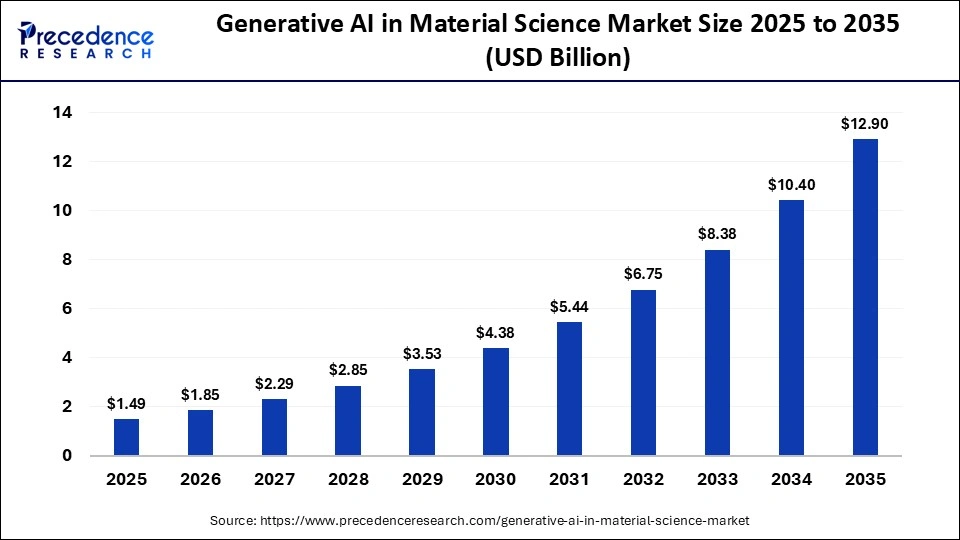
The global generative AI in material science market size accounted for USD 1.49 billion in 2025 and is predicted to increase from USD 1.85 billion in 2026 to approximately USD 12.90 billion by 2035, expanding at a CAGR of 24.10% from 2026 to 2035. Generative AI assists chemists through all phases of the chemical discovery process, including design, making, and testing, which are reshaping material science.
Market Highlights
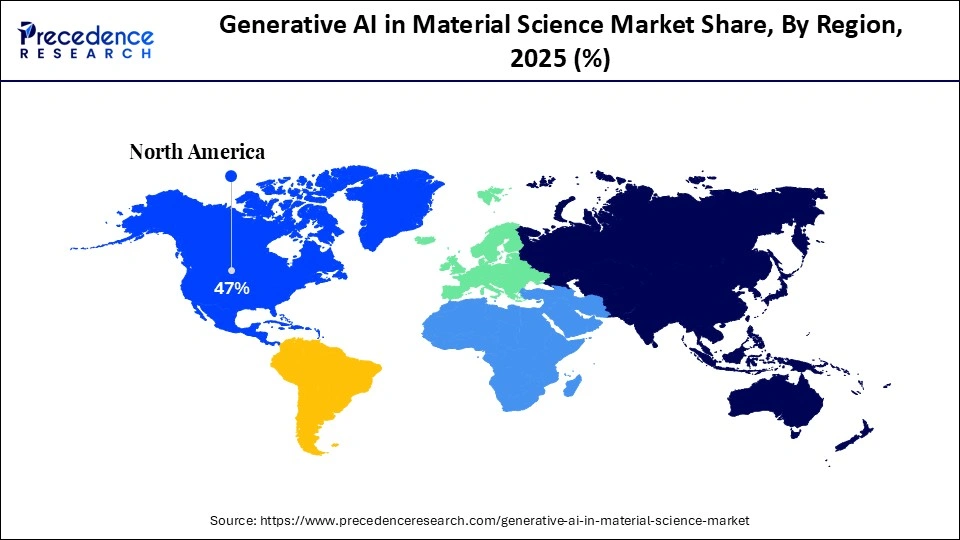
- North America dominated the market in 2025, with a revenue share of approximately 47%.
- Asia Pacific is expected to grow at the fastest CAGR in the market during the forecast period.
- By type, the materials discovery and design segment dominated the market in 2025, with a revenue share of approximately 42%.
- By type, the predictive modeling and simulation segment in the market is expected to grow at the fastest CAGR in the market during the forecast period.
- By deployment, the cloud-based segment dominated the generative AI in material science market in 2025, with a revenue share of approximately 47%.
- By deployment, the on-premises segment is expected to grow at the fastest rate in the market in 2025.
- By application, the pharmaceuticals and chemicals segment dominated the market in 2025, with a revenue share of approximately 26%.
- By application, the electronics and semiconductors segment is expected to grow at the fastest CAGR in the market during the forecast period.
Generative AI in Material Science: Driving Sustainability
The AI platform generative AI in material science market refers to cloud-based and on-premise AI systems that use generative artificial intelligence to accelerate discovery, design, simulation, and optimization of new materials. These platforms apply machine learning, neural networks, and predictive algorithms to model atomic/molecular structures, predict material properties, and guide experimental development. They significantly reduce research time and cost in sectors like aerospace, automotive, energy, pharmaceuticals, and electronics by enabling virtual testing and rapid material innovation.
However, material science remains the backbone of manufacturing innovation. Chemists focus on combining machine learning with computer simulations to analyze massive datasets and help predict material properties. The AI-driven solar revolution introduces smart materials for renewable energy production. AI algorithms are more advanced in discovering optimal materials to resolve challenges of photovoltaic efficiency and energy storage.
Generative AI in Material Science Market Trends
- Enhanced Sustainability and Supply Chain Resilience: Generative AI is heavily used to discover biodegradable plastics, rare-earth-free magnets, and more efficient battery chemistries. There is a growing focus on reducing dependency on volatile or environmentally damaging materials.
- Manufacturing Optimization: The new generative AI workflows improve synthesis, performance, and cost of materials. This ensures the reliability of AI-generated materials for large-scale industrial manufacturing across the expanding generative AI in material science market.
Market Scope
| Report Coverage | Details |
| Market Size in 2025 | USD 1.49 Billion |
| Market Size in 2026 | USD 1.85 Billion |
| Market Size by 2035 | USD 12.90 Billion |
| Market Growth Rate from 2026 to 2035 | CAGR of 24.10% |
| Dominating Region | North America |
| Fastest Growing Region | Asia Pacific |
| Base Year | 2025 |
| Forecast Period | 2026 to 2035 |
| Segments Covered | Type, Deployment, Application, and Region |
| Regions Covered | North America, Europe, Asia-Pacific, Latin America, and Middle East & Africa |
Segmental Insights
Type Insights
How does the Materials Discovery and Design Segment Dominate the Market in 2025?
The materials discovery and design segment dominated the market in 2025 with a revenue share of approximately 42%, owing to AI-accelerated materials discovery, which is reshaping the approaches of the research team to materials innovation. Moreover, generative AI models, autonomous laboratories, and graph neural networks are transforming RandD. The leading companies in materials discovery are Johns Hopkins APL, Arizona State University, and Google DeepMind, which prioritize AI-driven materials discovery for national security applications and material optimization.
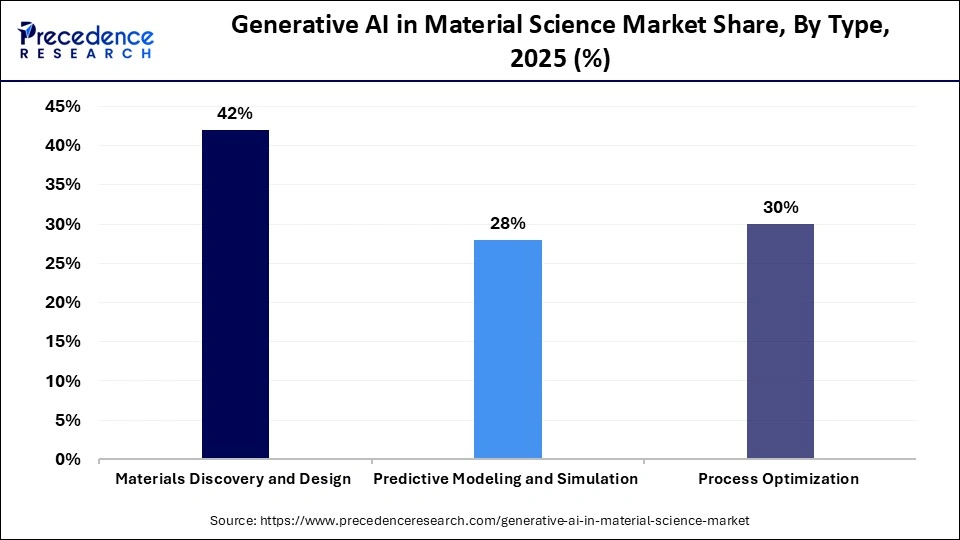
The predictive modeling and simulation segment is expected to grow at the fastest CAGR in the generative AI in material science market during the forecast period due to the growing importance of accelerated virtual screening, high-fidelity virtual testing, and closed-loop discovery. The leading companies use AI-driven simulations to test the thermal, mechanical, and electrical behavior of materials under extreme conditions. AI models are used in cloud environments for material research, including software like simulation and predictive tools.
Deployment Insights
What made the Cloud-Based Dominant Segment in the Market in 2025?
The cloud-based segment dominated the market in 2025 with a revenue share of approximately 47%, owing to sustainability and cloud-based AI, which are heavily used to design high-capacity battery electrolytes, rare-earth-free magnets, and carbon capture sorbents. Moreover, closed-loop autonomous laboratories introduce autonomously direct robotic synthesis, new materials, and more. The cloud infrastructure enables the integration of generative AI with self-driving laboratories.
The on-premises segment is estimated to grow at the fastest rate in the generative AI in material science market during the predicted timeframe due to the critical role of on-premise setups in IP and data protection, long-term cost predictability, and integration with laboratory automation. There is a growing integration of robotic platforms and self-driving laboratories into the on-premise systems. Enterprises are focusing on infrastructure optimization and the deployment of specialized hardware.
Application Insights
How did the Pharmaceuticals and Chemicals Segment Dominate the Market in 2025?
The pharmaceuticals and chemicals segment dominated the market in 2025 with a revenue share of approximately 26%, owing to the core role of generative AI in material discovery, molecular design, pharmaceutical formulation, and clinical applications. It also helps in chemical manufacturing and sustainability through process optimization and autonomous laboratories. The leading platforms, like Microsoft Azure AI and NVIDIA NIM, are offering scalable and cloud-native tools for researchers.
The electronics and semiconductors segment is anticipated to grow at a notable rate in the generative AI in material science market during the upcoming period due to the importance of AI in exploring materials, such as next-generation semiconductor alternatives. In manufacturing, AI optimizes processes and yields, and reduces manual inspection efforts through automated defect detection. Generative AI models are used to create millions of new crystalline structures, including stable materials for energy storage and next-generation microchips.
Regional Insights
How Big is the North America Generative AI in Material Science Market Size?
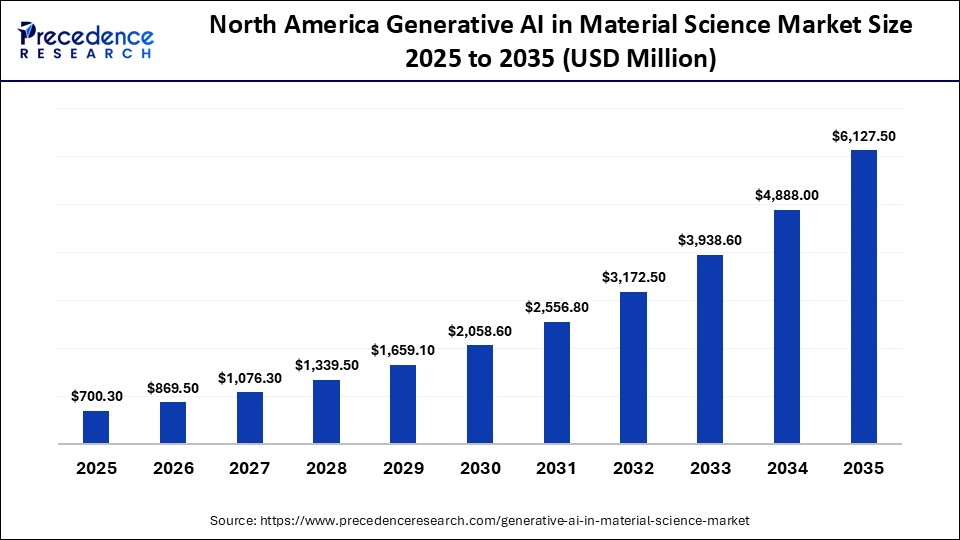
The North America generative AI in material science market size is estimated at USD 700.30 million in 2025 and is projected to reach approximately USD 6,127.50 million by 2035, with a 24.22% CAGR from 2026 to 2035.
How does North America dominate the Generative AI in Material Science Market in 2025?
North America dominated the market in 2025 with a revenue share of approximately 47%, owing to advanced computing, cloud accessibility, global mandates for sustainability, and robust technological infrastructure. The strategic partnerships between the leading companies focus on building a fully autonomous and AI-driven laboratory for sustainable polymers. Microsoft has updated its Azure platform with advanced generative AI tools designed for material science research. The large acquisitions between the major players, like Dassault Systèmes and Phaseshift Inc., are planned to integrate their rapid alloy design platform into their materials portfolio.
What is the Size of the U.S. Generative AI in Material Science Market?
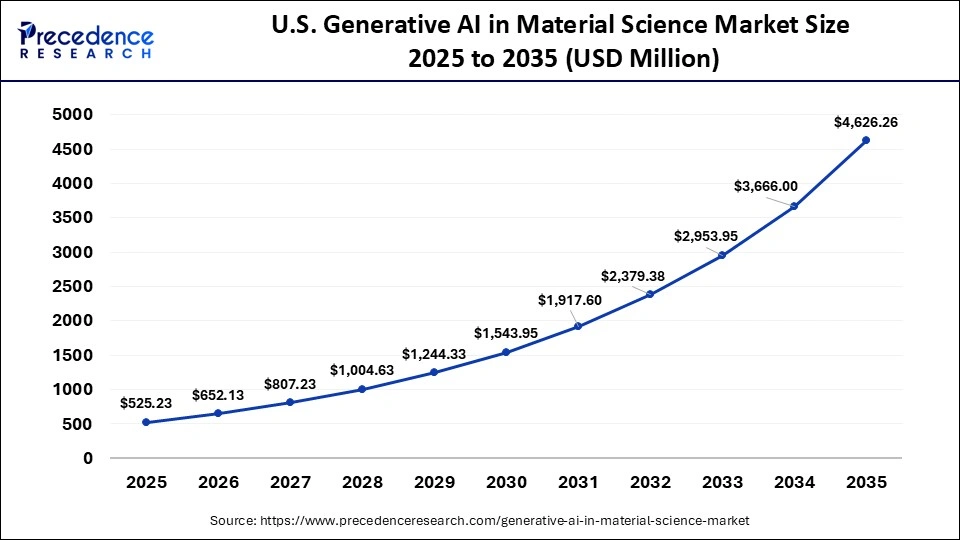
The U.S. generative AI in material science market size is calculated at USD 525.23 million in 2025 and is expected to reach nearly USD 4,626.26 billion in 2035, accelerating at a strong CAGR of 24.30% between 2026 and 2035.
U.S. Generative AI in Material Science Market Analysis
The U.S. experiences a massive industrial demand for next-generation materials across aerospace and defense. Moreover, there is a growing focus on sustainability, rising demand for clean energy, and semiconductor shortages. According to the U.S. National Science Foundation (NSF), the National Artificial Intelligence Research Resource (NAIRR) pilot will provide a national research infrastructure. It will accelerate innovation and reshape the modern workforce revolving around the generative AI in material science market.
Why is Asia Pacific the Fastest-Growing Region in the Generative AI in Material Science Market?
Asia Pacific is expected to grow at the fastest CAGR in the market during the forecast period, driven by strong government support for AI RandD and materials science in India, China, and Japan. The other major drivers of regional growth in the generative AI in material science market are rising demand in manufacturing, sustainability mandates, a skilled talent pool, and access to high-performance computing. In December 2025, ChemLex raised $45 million and launched its autonomous self-driving chemistry laboratory in Singapore to boost AI-driven chemical discovery.
India Generative AI in Material Science Market Trends
India advances through scientific breakthroughs, research excellence, and strategic government missions. In October 2024, India launched a government-led generative AI project, which focuses on foundational models in speech, language, and computer vision. The major programs focus on high-performance computing, indigenous model development, and advanced materials research.
What is the Major Footprint of Europe in the Generative AI in Material Science Market?
Europe is expected to grow at a notable rate in the market, owing to circular economy mandates, increased efforts on green transition, decarbonization, and sustainability, and accelerated RandD discovery across the generative AI in material science market. In November 2025, the European Commission launched ‘Resource for AI Science in Europe', which will bring essential resources to develop AI and apply it to drive revolutionary innovations. The European Commission and EU Member States have launched a strategic initiative named the European Union (EU) Coordinated Plan on Artificial Intelligence (AI). This plan is designed to promote investment, co-operation, and AI development.
Germany Generative AI in Material Science Market Analysis
The leading sectors in Germany, like aerospace and automotive, are heavily adopting generative AI to develop high-performance materials. German firms are investing in AI, while startups are equipped with high-performance computing resources. In January 2026, Germany invested €32 million to integrate AI across the nation's academic and research frameworks.
What Opportunities Exist in the Generative AI in Material Science Market in Latin America?
Latin America is expected to grow at a significant rate in the market due to national AI initiatives, a rapid shift towards cloud-hosted AI architectures, and cloud adoption that expands the generative AI in material science market. The major government programs like the Brazilian AI plan, regional collaboration, and the updated national AI policy of Chile result in the expansion of the market across this region. Latin America entered a new phase of generative AI adoption with cloud-based services such as Amazon Bedrock.
Brazil Generative AI in Material Science Market Trends
The infrastructure and corporate investments, the Brazilian AI plan, and accelerated materials discovery advance the market in Brazil. Brazil launched a USD 4 billion plan for AI and is preparing public policies on AI. Brazil stands as one of the main pillars of AI hubs globally, while the major pillars are AI research, tax incentives, training, and AI in public services.
What is the Potential of the Generative AI in Material Science Market in the MEA?
The Middle East and Africa are expected to grow at a lucrative rate in the market, owing to massive infrastructure, the expansion of data centers, sustainability, and green goals to drive the generative AI in material science market. This region focuses on foundational digital training and development. The major government programs and initiatives include AI for development, AI and Materials for Sustainability, and the Industrial AI academy. UNESCO collaborated with the Moroccan-based AI Movement to strengthen AI governance across the continent.
Saudi Arabia Generative AI in Material Science Market Analysis
Saudi Arabia experiences major initiatives in material science, international collaborations, smart manufacturing, and Giga-projects. In January 2026, Saudi Humain secured $1.2 billion to expand AI and digital infrastructure. Saudi Arabia launched the first-of-its-kind AI venture fund to cultivate AI champions.
Who are the Major Players in the Global Generative AI in Material Science Market?
The major players in the generative AI in material science market include Microsoft Corporation, IBM Corporation, NVIDIA Corporation, Google LLC (incl. DeepMind), Siemens AG, ANSYS Inc., Hexagon AB, OpenAI, Schrodinger Inc., Citrine Informatics Inc., XtalPi, QuesTek Innovations LLC, Materials Zone Ltd., Kebotix Inc., and Altair Engineering Inc.
Recent Developments
- In September 2025, CuspAI, an AI company, raised $100 million to establish an AI search engine to transform materials science. CuspAI's platform stands as a materials-agnostic technology that allows numerous industries to benefit from its capabilities. (Source: https://siliconangle.com)
- In February 2026, OpenAI launched GPT 5.3 Codex Spark, which is the company's first model designed for real-time coding. This model delivers more than 1000 tokens per second while holding immense potential for real-world coding tasks. (Source: https://openai.com)
Segments Covered in the Report
By Type
- Materials Discovery and Design
- Predictive Modeling and Simulation
- Process Optimization
By Deployment
- Cloud-Based
- On-Premises
- Hybrid
By Application
- Pharmaceuticals and Chemicals
- Electronics and Semiconductors
- Energy Storage and Conversion
- Automotive and Aerospace
- Construction and Infrastructure
- Consumer Goods and Others
By Region
- North America
- Europe
- Asia-Pacific
- Latin America
- Middle East & Africa
For inquiries regarding discounts, bulk purchases, or customization requests, please contact us at sales@precedenceresearch.com
Frequently Asked Questions





Ask For Sample
No cookie-cutter, only authentic analysis – take the 1st step to become a Precedence Research client
 Get a Sample




 sales@precedenceresearch.com
 Schedule a Meeting
